This is an invitation to submit questions to author Joshua Free in our facebook group. You must join the group in order to post questions.
This is an invitation to submit questions to author Joshua Free in our facebook group. You must join the group in order to post questions.
India has officially recognized dolphins as non-human persons, whose rights to life and liberty must be respected. Dolphin parks that were being built across the country will instead be shut down.
India’s Ministry of Environment and Forests has advised state governments to ban dolphinariums and other commercial entertainment that involves the capture and confinement of cetacean species such as orcas and bottlenose dolphins. In a statement, the government said research had clearly established cetaceans are highly intelligent and sensitive, and that dolphins “should be seen as ‘non-human persons’ and as such should have their own specific rights.”
The move comes after weeks of protest against a dolphin park in the state of Kerala and several other marine mammal entertainment facilities which were to be built this year. Animal welfare advocates welcomed the decision.
“This opens up a whole new discourse of ethics in the animal protection movement in India,” said Puja Mitra from the Federation of Indian Animal Protection Organizations (FIAPO). Mitra is a leading voice in the Indian movement to end dolphin captivity.
 Indian officials say it is morally unacceptable to exploit cetaceans in commercial entertainment
“The scientific evidence we provided during the campaign talked about cetacean intelligence and introduced the concept of non-human persons,” she said in an interview with DW.
Indiais the fourth country in the world to ban the capture and import of cetaceans for the purpose of commercial entertainment – along with Costa Rica, Hungary, and Chile.
Dolphins are persons, not performers
The movement to recognize whale and dolphins as individuals with self-awareness and a set of rights gained momentum three years ago in Helsinki, Finland when scientists and ethicists drafted a Declaration of Rights for Cetaceans. “We affirm that all cetaceans as persons have the right to life, liberty and well-being,” they wrote.
 Dolphins are naturally playful and curious, which has made them popular with aqurium visitors
The signatories included leading marine scientist Lori Marino who produced evidence that cetaceans have large, complex brains especially in areas involved in communication and cognition. Her work has shown that dolphins have a level of self-awareness similar to that of human beings. Dolphins can recognize their own reflection, use tools and understand abstract concepts. They develop unique signature whistles allowing friends and family members to recognize them, similar to the way human beings use names.
“They share intimate, close bonds with their family groups. They have their own culture, their own hunting practices – even variations in the way they communicate,” said FIAPO’s Puja Mitra.
But it is precisely this ability to learn tricks and charm audiences that have made whales and dolphins a favorite in aquatic entertainment programs around the world.
Seaworld slaughter
Disposable personal income has increased in India and there is a growing market for entertainment. Dolphin park proposals were being considered in Delhi, Kochi and Mumbai.
 India’s growing middle class is hungry for entertainment
“There’s nothing like having a few animals on display, particularly ones that are so sensitive and intelligent as these dolphins,” said Belinda Wright from the Wildlife Protection Society of India in an interview with DW. “It’s a good money making proposition.”
But audiences are usually oblivious to the documented suffering of these marine performers.
“The majority of dolphins and whales in captivity have been sourced through wild captures in Japan, in Taiji, in the Caribbean, in the Solomon Islands and parts of Russia. These captures are very violent,” Mitra explained.
“They drive groups of dolphins into shallow bay areas where young females whose bodies are unmarked and are thought to be suitable for display are removed. The rest are often slaughtered.”
Mitra argued that the experience of captivity is tantamount to torture. She explained that orcas and other dolphins navigate by using sonar signals, but in tanks, the reverberations bounce off the walls, causing them “immense distress”. She described dolphins banging their heads on the walls and orcas wearing away their teeth as they pull at bars and bite walls.
Tanks terminated
In response to the new ban, the Greater Cochin Development Authority (CGDA) told DW that it has withdrawn licenses for a dolphin park in the city of Kochi, where there have been massive animal rights demonstrations in recent months.
 Will the ban on captive dolphin exploitation lead to more protection for other highly intelligent non-humans?
“It is illegal now,” said N. Venugopal, who heads the CGDA. “It is over. We will not allow it anymore.”
He said the government hadn’t lost money on the development but declined to comment on how much the dolphin park was worth.
Boost for Ganges River dolphin
It’s possible that India’s new ban on cetacean captivity will lead to renewed interest in protecting the country’s own Ganges River dolphin.
“I hope this will put some energy into India’s Action Plan for the Gangetic Dolphin, which is supposed to run until 2020,” said Belinda Wright from the Wildlife Protection Society of India. “But there’s been very little action.
She said the ban was a good first stop, but warned against excessive optimism. “I’m very proud that India has done this,” she said. “I’m not trying to be cynical but I have been a conservationist in India for four decades. One gets thrilled with the wording, but I don’t think it’s going to turn to the tables.”
“But dolphins for now are safe from dolphinariums, and that’s a good thing,” she added.
The Seven Levels of the Human Energy Field and Corresponding Chakras
Each level of the Human Energy Field has a corresponding chakra, a spinning vortex receiving and exchanging energy from the Universal Energy Field. Each chakra has its own unique frequency.
1.Etheric Level and Base
The Etheric Level is a structured level, the matrix upon which the physical body is formed and appears as lines of blue and grey light. Through the base chakra we are connected to the earth’s core energy and when it is functioning well we feel grounded and safe. This chakra develops during our early years from birth to 5 years and it is here that much healing can take place by revisiting early life experiences.
2.Emotional Level and Sacral
The Emotional Level is a fluid level with multi-coloured clouds of light and is responsible for emotions about the self and self image. This chakra too develops during our early years when we start to take notice of the people and environment surrounding us and our belief patterns begin to emerge. We begin to feel pleasure and our sense of sexuality begins to develop. A nurturing environment is needed for healthy development of this chakra. Lack of these basic needs can lead to wounding on this level resulting in the inability to express ourselves fully.
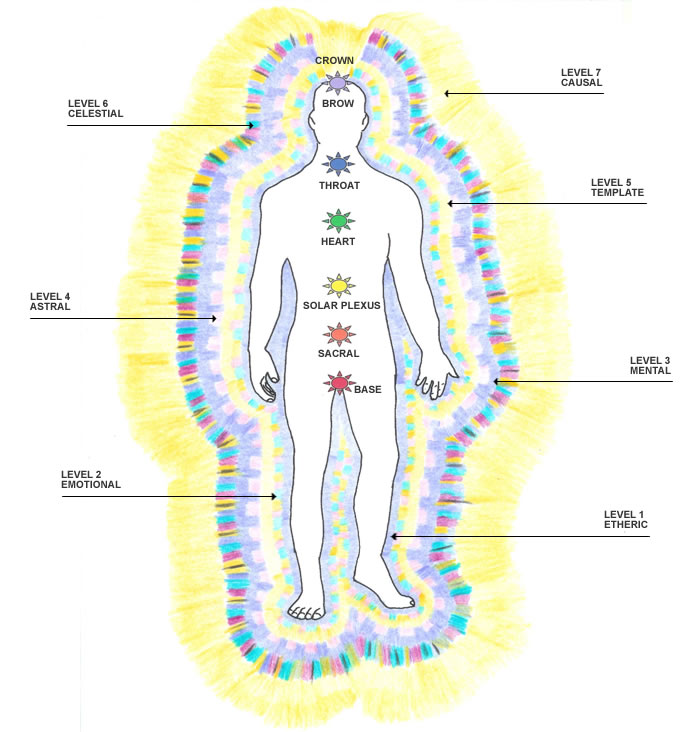
3.Mental Level and Solar Plexus
A structured and ordered level appearing as lines of yellow light. This level contains the blueprint of the logical mind, containing our thoughts and beliefs including those that no longer serve us well. Healing on this level can help us release old thought patterns, clearing the way for new experiences, allowing us to fully realise our potential in this lifetime.
4.Astral Level and Heart
The Astral Body, a multi-coloured fluid level. All our past experiences are held here including past lives and relationships. Blockages on this level can result from the absence of love and we can become stuck, unable to express unconditional love and relate in a healthy way to others. Much healing takes place on this level, clearing the debris of both past and present experiences. Healing on this level helps develop love and compassion for the self which is then mirrored in the way we relate to others.
5.Template Level and Throat
The Template Level, blue in appearance and is the gateway between mind and body. Here is the expression of self, our truth, where we hold the blueprint for our creative contribution throughout life.
Blockages form on this level as energy makes its way up through the body and past experiences and events start to form in our consciousness. We may “swallow them down” as a way of avoiding feeling them. Sound healing is regularly used to help release blockages on this level.
6.Celestial and Brow
The Celestial Level appearing as multi-coloured particles The task of this chakra is to assemble information from the other chakras into a meaningful pattern. Here we develop our consciousness and when this chakra is open and flowing we attain self-knowledge and wholeness. Connection to the Angelic Realm and Divine Love occurs on this level.
7.Causal and Crown
The Causal Level, a level of golden light which encompasses all the other layers of the Human Energy Field and where we feel our connection with The Divine. On this level we feel the perfection of what is, and know that all is as it should be.
Source: Positive Light
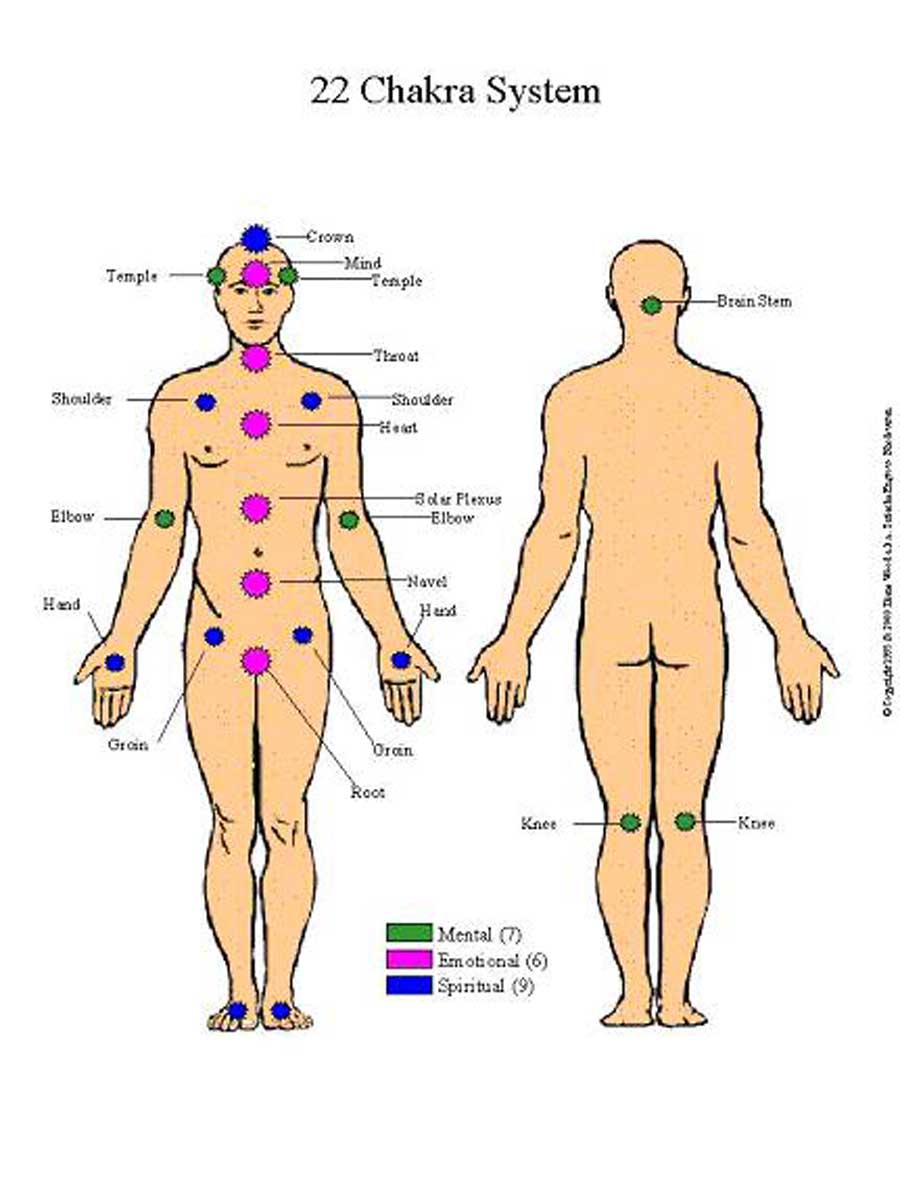
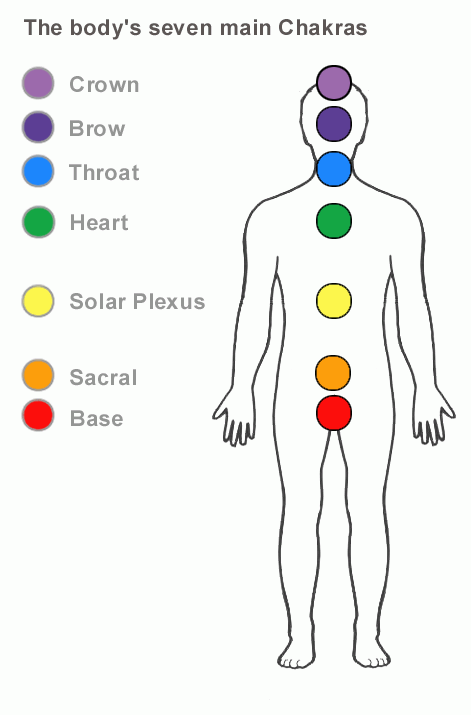
Head Centre. . . Pineal Gland
Centre between eyebrows. . . Pituitary Body
Throat Centre. . . Thyroid Gland
Heart Centre. . . Thymus Gland
Solar Plexus Centre. . . Pancreas
Sacral Centre. . . The Gonads
Centre at the base of the spine. . . Adrenal Glands

Two new milk advertisements by the dairy industry have been making their rounds on American television. Both ads suggest that drinking a glass of milk before bed will prevent awakenings in sleep and give you better dreams. Unfortunately, the evidence for a good night’s sleep thanks to a glass of milk is a little thin.
Or should I say skim?
Here’s one of the ads:
To do so, the properties of milk would have to have an effect on the structure of sleep, by increasing the length of REM sleep (dreaming sleep), for example, or delaying a shift into wakefulness. There’s no clinical study that’s ever looked at this correlation directly.
However, several studies have looked into the effects of a key ingredient found in milk: melatonin, an amino acid that regulates the sleep-wake cycle. A 2000 study published in the journal Sleep and Hypnosis found that taking 6mg of melatonin at night for two weeks significantly increased bizarre dreams for college students.
The second milk ad really seems to key into the bizarreness of dreams. Check it out.
By the way, in dream research lingo, bizarreness is often another way of saying creepy and nightmarish. Bizarre dreams are not necessarily populated by milk goddesses.
There’s also some clinical studies on larger doses of melatonin (over 5mg), which have been linked with increasing REM sleep in general, at least in some people, such as patients who are suffering from REM sleep deprivation.
On a purely anecdotal level, I know of many dreamers who have reported vivid, nightmarish and lucid dreams after taking very high doses of supplemental melatonin (over 10mg. It’s not safe, don’t do this).
So, at first blush, it seems there may be something to the dreamy effect of milk.
Tryptophan and Melatonin

Click the picture for more about the tryptophan effect
Besides melatonin, milk contains trace amounts of tryptophan, which is another amino acid that’s found in a lot of foods, including most meats as well as scores of seeds and nuts.
Tryptophan is synthesized in the brain as serotonin, and finally melatonin.
Because of this relationship, tryptophan can also have a drowsiness effect when a lot is consumed at the right time.
But here’s the rub:
Compared to other foods, milk doesn’t really contain much tryptophan. Half a glass of milk (4 oz) contains about .08grams of tryptophan, compared with the same or equivalent amount of soybeans (.59 gram), spirulina (.9 gram) and dried white egg (1gram).
you’d need to drink a gallon of milk for the tryptophan effect.
According to sleep doctor Michael Breus, you’d need to drink a gallon of milk for the tryptophan effect. So you’ll be interrupting your dreams by going to the bathroom every 20 minutes.
Milk doesn’t have much melatonin either; certainly much less than those 5mg mega-doses you can get from over-the-counter supplements.
Creepily enough, there is a new kind of milk currently being tested called night milk, which is taken from cows at night that are fed a lot of tryptophan in their diets. It’s patented and supposedly contains over 25 times the melatonin of ordinary milk. It’s pretty controversial. Still, even “sleepytime milk” has a hundredth of a typical dose you’d get from a typical melatonin supplement.

Drinking milk alone is sad.
In any case, the amount of sleep-inducing amino acids that you consume before bed is not the only issue here.
To affect sleep, tryptophan needs to be absorbed more readily than other amino acids, and the best way to do this is to eat foods with complex carbohydrates, which cause an insulin spike to clear out the sugars and those competing amino acids.
Guess what?
Milk by itself doesn’t have many complex carbs; it’s mostly simple sugars. So, to get the (ridiculously small) tryptophan effect from milk, you’d need to take it with a bowl of cereal or with some toast.
This is a good idea anyways, as eating a small, healthy snack an hour before bed can help you lose weight.
Milk’s secret weapon?
There’s one more potential for milk to help with falling asleep.
Milk contains some casein proteins, which may have a slight relaxation effect. Four of the six proteins in milk are casein proteins; the others are whey.
Athletes and bodybuilders swear by protein shakes high in casein to help with slowing muscle atrophy during sleep, although I don’t know if this use has been clinically demonstrated.
casein proteins may lower cortisol levels and blood pressure
According to some recent European research, casein proteins may lower cortisol levels and blood pressure, both of which are helpful for drifting off to sleep more quickly.
Still, there’s a lot of other dairy products that have more caseins proteins than milk –most hard cheeses and cottage cheese for example.
Got Curds?
Speaking of curds, there’s actually some evidence for the effect of fermented milk on sleep health. In fermented milk, the bacteria Lactobacillus helveticus may help with falling asleep and also lower blood pressure.
Lactobacillus helveticus is the bacteria that is responsible for making cheese, and as a probiotic it’s also been linked to preventing infections and improving immune response. So that’s another reason to have cheese rather than milk before bed (because those bacteria are still in the cheese–it’s a live food).
Go for cheddar, mozzarella or Swiss cheese. Even better, make some cheese toast, and get your complex carbs too.
Seriously though, did I mention my new book yet?
 Drinking milk is probably not going to transform your dream life. But a glass of milk may be a healthy part of a bedtime snack that could make it easier to fall asleep. Make it a warm glass of milk if you want to add that special “just like Grandma did” effect.
Do you really want to remember more dreams and get better sleep?
Sign up for notifications about my new book: Dream Like a Boss (Book one): Sleep better, dream more and wake up to what matters most. It’s dropping next month, so stay in touch!
By Ryan Hurd
Dreamstudies.org
MessageToEagle.com – There are several underwater ruins in various places around the world and all of them could be part of Atlantis.
The most detailed analysis ever of the archaeological remains of the lost medieval town of Dunwich, dubbed ‘Britain’s Atlantis’ has been carried out by a University of Southampton professor David Sear of Geography and Environment in cooperation with the University’s GeoData Institute; the National Oceanography Centre, Southampton; Wessex Archaeology; and local divers from North Sea Recovery and Learn Scuba.
The most accurate map to date of the town’s streets, boundaries and major buildings, and revealed new ruins on the seabed, was created by using advanced underwater imaging techniques.

Click on image to enlarge3D visualisation showing the remains of St Katherine’s Church in the now submerged town of Dunwich. Credit: University of Southampton
“Visibility under the water at Dunwich is very poor due to the muddy water. This has limited the exploration of the site,
“We have now dived on the site using high resolution DIDSON ™ acoustic imaging to examine the ruins on the seabed – a first use of this technology for non-wreck marine archaeology.
 Bedrock structures spotted under the sea: The project to survey the underwater ruins of Dunwich, the world’s largest medieval underwater town site, began in 2008
“DIDSON technology is rather like shining a torch onto the seabed, only using sound instead of light. The data produced helps us to not only see the ruins, but also understand more about how they interact with the tidal currents and sea bed.”
| “The loss of most of the medieval town of Dunwich over the last few hundred years – one of the most important English ports in the Middle Ages – is part of a long process that is likely to result in more losses in the future.
Everyone was surprised, though, by how much of the eroded town still survives under the sea and is identifiable,” Peter Murphy, English Heritage’s coastal survey expert who is currently completing a national assessment of coastal heritage assets in England, says. “Whilst we cannot stop the forces of nature, we can ensure what is significant is recorded and our knowledge and memory of a place doesn’t get lost forever. Professor Sear and his team have developed techniques that will be valuable to understanding submerged and eroded terrestrial sites elsewhere.” |
Present day Dunwich is a village 14 miles south of Lowestoft in Suffolk, but it was once a thriving port – similar in size to 14th Century London. Extreme storms forced coastal erosion and flooding that have almost completely wiped out this once prosperous town over the past seven centuries.
This process began in 1286 when a huge storm swept much of the settlement into the sea and silted up the Dunwich River.
 Carved stonework Chapel of St Katherine was clearly visible in the scans. Credit: University of Southampton
This storm was followed by a succession of others that silted up the harbour and squeezed the economic life out of the town, leading to its eventual demise as a major international port in the 15th Century. It now lies collapsed and in ruins in a watery grave, three to 10 metres below the surface of the sea, just off the present coastline.
 A Debris Field near St Peters spotted 10M underwater by the researchers. Credit: University of Southampton
The project to survey the underwater ruins of Dunwich, the world’s largest medieval underwater town site, began in 2008. Six additional ruins on the seabed and 74 potential archaeological sites on the seafloor have since been found.
Combining all known archaeological data from the site, together with old charts and navigation guides to the coast, it has also led to the production of the most accurate and detailed map of the street layout and position of buildings, including the town’s eight churches.
Findings highlights are:
• Identification of the limits of the town, which reveal it was a substantial urban centre occupying approximately 1.8 km2 – almost as large as the City of London
• Confirmation the town had a central area enclosed by a defensive, possibly Saxon earthwork, about 1km2
• The documentation of ten buildings of medieval Dunwich, within this enclosed area, including the location and probable ruins of Blackfriars Friary, St Peter’s, All Saint’s and St Nicholas Churches, and the Chapel of St Katherine
• Additional ruins which initial interpretation suggests are part of a large house, possibly the town hall
• Further evidence that suggests the northern area of the town was largely commercial, with wooden structures associated with the port
• The use of shoreline change analysis to predict where the coastline was located at the height of the town’s prosperity
“Global climate change has made coastal erosion a topical issue in the 21st Century, but Dunwich demonstrates that it has happened before. The severe storms of the 13th and 14th Centuries coincided with a period of climate change, turning the warmer medieval climatic optimum into what we call the Little Ice Age.
“Our coastlines have always been changing, and communities have struggled to live with this change. Dunwich reminds us that it is not only the big storms and their frequency – coming one after another, that drives erosion and flooding, but also the social and economic decisions communities make at the coast.”
“In the end, with the harbour silting up, the town partly destroyed, and falling market incomes, many people simply gave up on Dunwich.”
MessageToEagle.com
My interest in the myths, symbols, and the unusual aspects of life often leads me into some fairly strange sub-adventures that underly my day-to-day life. There are even certain points where I begin to feel that there is something of a continuum between them, and that particular themes will begin to emerge over and over again, until they finally command my attention. And interestingly, these sorts of instances often will yield the most fruit in terms of insights I am able to come away with regarding odd bits of esoterica.
One such instance involves a rather strange series of events surrounding the historic figure known as John Dee, a scientist, advisor, and spy for Queen Elizabeth I, in addition to having undertaken a variety of magical workings in his day. Knowing my interest in (and aptitude for) matters involving symbology, a woman had contacted me a while ago to ask whether I might know the meaning behind a certain strange little symbol: it resembled a stick man, with what resembled horns protruding from the head. Indeed, I did recognize the symbol, and within a few minutes, after initially mistaking it for being associated with the magician Aleister Crowley, I managed to confirm that it was the Monas Hieroglyphica of John Dee. In doing so, I also managed to spark a strange debate about the origins of symbols and information that the human mind seems capable of accessing at times… a process which some feels has ties to the otherworldly.

Once it was revealed that I had given the correct answer (which was posted on a Facebook group where others were attempting to solve the same riddle), I was subsequently contacted by a woman who wished to know how I had deciphered the symbol. She then told me she was a psychic, specializing in remote viewing, and wondered if I too, as she had done, managed to decipher the riddle “by consulting with the Akashic Record.” For the moment, I had somehow managed to give the impression that I was in touch with some kind of extra-bodily universal intelligence… but where, in fact, did my knowledge of the Hieroglyphica come from?
 I found this question rather strange, and while I had to admit that I had not knowingly been in direct contact with a nonphysical “library”, of sorts, which stored universal knowledge, I had been intrigued by symbols like Dee’s Monas (pictured right) for quite some time, and had merely stumbled across the image at some point. But the question of whether I had been able to consult with “Akashic Records” was somewhat synchronistic all the same, since I had only recently been contacted by a friend, who after reading my book The UFO Singularity, asked me whether I thought artificial intelligence in the future might be able to solve the UFO riddle by accessing the Akashic Records.
For those unfamiliar with the topic, the so-called “Akashic Records” refers to a concept found in the mythos surrounding many spiritualist and religious teachings, believed to contain “all knowledge of human experience and all experiences,” along with the complete history of the cosmos. This information is “written”, woven, or encoded into the very fabric reality, a state sometimes referred to as the ”aether.” The name itself is derived from the old Sanskrit “akasha,” a word used to express similar aether-like concepts of an all encompassing “substance” that permeates all creation.
Edgar Cayce, the great “sleeping prophet,” was actually said to have attained his knowledge of ancient lost civilizations by directly accessing the Akashic Records while in a trance state, though this was not asserted by Cayce himself, but revealed later in the first book in an odd series, called The Law of One, where it is stated that Cayce obtained the information (here again, this “answer” is channeled in similar fashion), revealing that humans occasionally access such realms of knowledge that exist beyond the mind alone. The relevant passage reads as follows:
“We have explained before that the intelligent infinity is brought into intelligent energy from eighth density or octave. The one sound vibratory complex called Edgar used this gateway to view the present, which is not the continuum you experience but the potential social memory complex of this planetary sphere. The term your peoples have used for this is the ‘Akashic Record’ or the ‘Hall of Records’.”

But the notion that humans may be capable of accessing information they would otherwise not be capable of attaining is mirrored in the study of psychology as well, particularly in the works of Carl Jung. In his essay, Confrontation with the Unconscious, he notes the appearance of an archetype he calls “Philemon,” which was an older male figure he refers to as a guide throughout his various imaginary visions. At one point, Jung begins to recognize the information imparted to him by Philemon as seeming to emanate from someplace other than his own mind:
Philemon and other figures of my fantasies brought home to me the crucial insight that there are things in the psyche which I do not produce, but which produce themselves and have their own life. Philemon represented a force which was not myself. In my fantasies I held conversations with him. and he said things which I had not consciously thought. For I observed clearly that it was he who spoke, not I. He said I treated thoughts as if I generated them myself, but in his view thoughts were like animals in the forest, or people in a room, or birds in the air, and added, “If you should see people in a room, you would not think that you had made those people, or that you were responsible for them.” It was he who taught me psychic objectivity, the reality of the psyche. Through him the distinction was clarified between myself and the object of my thought. He confronted me in an objective manner, and I understood that there is something in me which can say things that I do not know and do not intend, things which may even be directed against me.
It is a very strange notion indeed, that some aspects of human existence may be rooted within a complex collective unconsciousness, as Jung supposed; even more strange and perplexing is the idea that the human mind might even draw information from elsewhere… places or planes of thought and imagination that exist beyond the mind itself. I certainly don’t feel that I’ve done this myself, especially in my modest ability to reflect upon seeing, at one point, John Dee’s Monas Hieroglyphica; let alone do I acknowledge that there are components within the mind that, in scientific terms, might be capable of extending beyond the physical. But the prevalence of this concept in various cultures and traditions, along with allusions to similar processes expressed by Jung, do provide some compelling and challenging notions about the inner workings of the human mind.
Micah Hanks
Mysteriousuniverse.org
MessageToEagle.com – There is no doubt plants are special in a number of ways. We have previously seen plants that can make music and sing.
Plants are very much alive. Not only do they dislike human noise but they also posses the capacity to learn and communicate.
Researchers have also discovered that plants and humans have more in common than previously thought. Plants possess a number of amazing properties and they can “behave” similar to us.
Another astonishing property is that plants possess intelligence. They can sense danger and know exactly how to avoid predators.
Even more amazing is the fact that although plants are actually deaf, they can feel, see, smell and remember. Not to mention that they are also altruistic!
Recently researcher made another surprising discovery. A group of scientists from the John Innes Centre and University of East Anglia, UK asked themselves why rose petals have rounded ends while their leaves are more pointed and they noticed something unusual. Their study revealed that the shape of petals is controlled by a hidden map located within the plant’s growing buds.
| Leaves and petals perform different functions related to their shape.Leaves acquire sugars for a plant via photosynthesis, which can then be transported throughout the plant. Petals develop later in the life cycle and help attract pollinators.
In earlier work, this team had discovered that leaves in the plant Arabidopsis contain a hidden map that orients growth in a pattern that converges towards the tip of the bud, giving leaves their characteristic pointed tips. In the new study, the researchers discover that Arabidopsis petals contain a similar, hidden map that orients growth in the flower’s bud.
|
However, the pattern of growth is different to that in leaves — in the petal growth is oriented towards the edge giving a more rounded shape — accounting for the different shapes of leaves and petals. The researchers discovered that molecules called PIN proteins are involved in this oriented growth, which are located towards the ends of each cell.
“The discovery of these hidden polarity maps was a real surprise and provides a simple explanation for how different shapes can be generated,” said Professor Enrico Coen, senior author of the study.
 Can we imagine a world without flowers? Flowers are beautiful, offering us delight in their colour, fragrance and form, as well as their medicinal benefits. Flowers also speak to us in the language of the plant form itself, as cultural symbols in different societies, and at the highest levels of inspiration.
In this beautiful and original book, renowned thinker and geometrist Keith Critchlow has chosen to focus on an aspect of flowers that has received perhaps the least attention. This is the flower as teacher of symmetry and geometry (the ‘eternal verities’, as Plato called them). In this sense, he says, flowers can be treated as sources of remembering — a way of recalling our own wholeness, as well as awakening our inner power of recognition and consciousness. What is evident in the geometry of the face of a flower can remind us of the geometry that underlies all existence. Working from his own flower photographs and with every geometric pattern hand-drawn, the author reviews the role of flowers within the perspective of our relationship with the natural world. His illuminating study is an attempt to re-engage the human spirit in its intimate relation with all nature. More here
The team of researchers confirmed their ideas by using computer simulations to test which maps could predict the correct petal shape.
They then confirmed experimentally that PIN proteins located to the right sites to be involved in oriented growth, and identified that another protein, called JAGGED, is involved in promoting growth towards the edge of petals and in establishing the hidden map that determines petal growth and shape.
 There is a hidden map inside flowers…
Unlike animal cells, plant cells are unable to move and migrate to form structures of a particular shape, and so these findings help to explain how plants create differently shaped organs — by controlling rates and orientations of cell growth.
From an evolutionary perspective, this system creates the flexibility needed for plant organs to adapt to their environment and to develop different functions.
Isn’t nature amazing?
MessageToEagle.com – Sleep paralysis is a strange condition when you feel you are awake but cannot move. It happens when you are between the between stages of wakefulness and sleep. It can take some seconds or even several minutes before you are able to speak.
One can say that you are actually awake in your nightmare. If you have ever experienced sleep paralysis, you will know how awkward this condition can be.
Myths and legends about sleep paralysis persist all over the globe. Over the centuries, symptoms of sleep paralysis have been described in many ways and often attributed to an “evil” presence: unseen night demons in ancient times, the old hag in Shakespeare’s Romeo and Juliet, and alien abductors.
Almost every culture throughout history has had stories of shadowy evil creatures that terrify helpless humans at night. People have long sought explanations for this mysterious sleep-time paralysis and the accompanying feelings of terror.
 People who experience sleep paralysis often encounter demons in the nightmares.
According to surveys, this strange phenomenon seems to happen to about half the population at least once during a lifetime.
Scientists are now suggesting that it is essential to examine the causes and interpretations of sleep paralysis from both a scientific and cultural perspective.
During a meeting organized earlier this year by the Sleep Paralysis Project Christopher French, Professor of Psychology at Goldsmiths, University of London’s Anomalistic Psychology Research Unit. discussed common symptoms of the experience itself.
“You’re in this state, you realise you can’t move, and you get a very strong sense of presence. You feel certain that there is someone, or something in the room with you and whatever that thing or person is they mean you no good at all. They’re evil, in some cases a pure evil…
Very often these episodes are associated with hallucinations. These might be visual (you might see lights moving around in the room, dark shadows, grotesque monstrous forms); they might be auditory (you might hear footsteps, or voices, or mechanical sounds); they might be tactile (you might feel as if you are being touched, or as if someone is holding you tightly, or as if someone is dragging you out of the bed. Sometimes these can turn into full blown out of body experience,” Professor French said.
| Filmmaker Carla MacKinnon became interested in the subject when she started waking up several times a week unable to move, with the sense that a disturbing presence was in the room with her.“I was getting quite a lot of sleep paralysis over the summer, quite frequently, and I became quite interested in what was happening, what medically or scientifically, it was all about,” MacKinnon said.
Her research is becoming a short film and multiplatform art project exploring the strange and spooky phenomenon of sleep paralysis. The film, supported by the Wellcome Trust and set to screen at the Royal College of Arts in London, will debut in May. |
MacKinnon has met several psychologists and other experts who offered their opinion on the subject and some have even shared some own personal experiences.
“I looked at my right arm and willed it to move. I commanded it to move. It stayed put. When I tried to sit up or roll over nothing happened. I panicked. On the inside I was a twisting fury, but the shell of my body remained motionless. I gave up the struggle, overwhelmed by an intuition that if I tried any harder I would break through the shell and float away…
I now recognise this as a lucid dream, an hallucinatory state in the hinterlands of slumber where the mind is alert, but the body remains bound by the paralysis of sleep – the intersection of dream life and reality,” said Dr Paul Broks, a neuropsychologist and writer.
 Would you tell people about your “demon dreams”?
As previously mentioned it is very common people who suffer from sleep paralysis encounter demons.
“It was like nothing I’d ever experienced before,” recalls Hannah Foster from Brighton, UK. “After a normal day at work, I went to bed around 11pm, as always, and the next thing I remember is waking up, basically paralysed.
It was terrifying. And the more I panicked, the more it felt like I couldn’t breathe properly.
The second time, I knew what was happening – but as well as the paralysis, I also saw a terrifying black figure.
It looked a bit like a demon – with a scrunched, ugly face, like a gargoyle. I tried to scream and move away from it.”
It is estimated that millions of people have experienced something similar, but many people refuse to talk about it.
“Sufferers may be reluctant to talk of their experiences, for fear of being shunned or ridiculed as “crazy”. This can lead to social isolation and even marital breakdown,” said Professor French.
Some scientists like for example David Morgan, a Psychoanalyst and Psychotherapist are focusing on interpretations of hallucinatory experiences. Dr. Morgan suggests that the content of hallucinations can offer symbolic insights into the patient’s feelings.
“People take symbols from wherever they can… the dwarf, the hag – probably from fairy stories – represent an oppressive force keeping you down. Something in your mind that prevents you from being free,” Dr. Morgan sai
The oldest ancient Maya ceremonial compound ever discovered in the Central American lowlands dates back 200 years before similar sites pop up elsewhere in the region, archaeologists announced today (April 25). The recently excavated plaza and pyramid would have likely served as a solar observatory for rituals.
The finding at a site called Ceibal suggests that the origins of the Maya civilization are more complex than first believed. Archaeologists hotly debate whether the Maya – famous for their complex calendar system that spurred apocalypse rumors last year – developed independently or whether they were largely inspired by an earlier culture known as the Olmec. The new research suggests the answer is neither.
“This major social change happened through interregional interactions,” said study researcher Takeshi Inomata, an anthropologist at the University of Arizona. But it doesn’t look like the Olmec inspired the Maya, Inomata told reporters. Rather, the entire region went through a cultural shift around 1000 B.C., with all nearby cultures adopting similar architectural and ceremonial styles. [See Images of the Ancient Maya Observatory]
“It’s signaling to us that the Maya were not receiving this sophisticated stuff 500 years later from somebody else, but much of the innovation we’re seeing out of the whole region may be coming out of Ceibal or a place like Ceibal,” said Walter Witschey, an anthropologist at Longwood University in Virginia, who was not involved in the study.
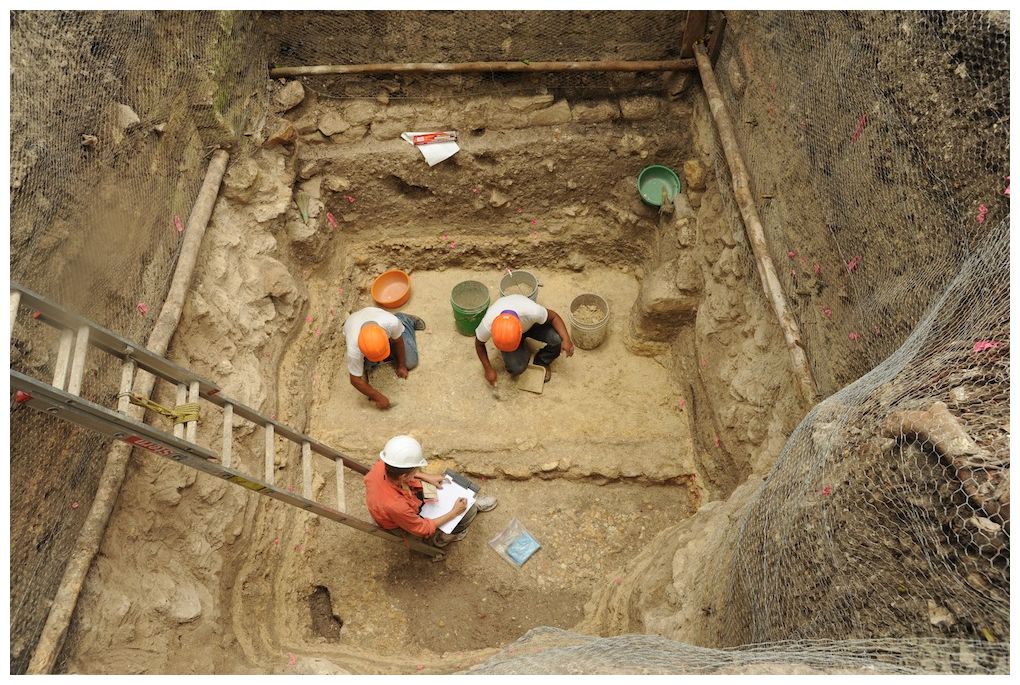
Oldest ritual compound
The finding comes from seven years of archaeological excavations at Ceibal, a site in central Guatemala that was occupied continuously for 2,000 years. Getting to Ceibal’s origins was no small feat: The earliest buildings were buried under 23 to 60 feet (7 to 18 meters) of sediment and later construction, said study co-researcher Daniela Triadan, also a University of Arizona anthropologist.
The earliest structures recently discovered include a plaza with a western building and an eastern platform, a pattern seen at later Maya sites and also at the Olmec center of La Venta on the Gulf Coast of what is now Mexico. The researchers used radiocarbon dating to peg the date of construction to about 1000 B.C. This technique analyzes organic materials for carbon-14, an isotope or variation of carbon that decays predictably. As such, carbon-14 acts as a chemical clock archaeologists can use to figure out how long something has been in the ground.
A construction date of 1000 B.C. makes the Ceibal structures about 200 years older than those at La Venta, meaning the Olmec’s construction practices couldn’t have inspired the Mayans, the researchers report Thursday (April 25) in the journal Science. Instead, it appears that the entire region underwent a shift around this time, with groups adopting each other’s architecture and rituals, modifying them and inventing new additions.
“We are saying there was this connection with various groups, but we are saying it was probably not one directional influence,” Inomata said.
There was an earlier Olmec center, San Lorenzo, which declined around 1150 B.C., but residents there did not build these distinctive ceremonial structures. By 850 B.C. or 800 B.C., the Maya at Ceibal had renovated their platform into a pyramid, which they continued refining until it reached a height of about 20 to 26 feet (6 to 8 m) by 700 B.C.
Starting a civilization
This early phase of Maya culture occurs before the group developed written language and before any record of their elaborate calendar system, so little is known about their beliefs, Inomata said. But the pyramid-and-plaza area was almost certainly a space for rituals. Among the artifacts found in the plaza are numerous greenstone axes, which seem to have been put there as offerings.
The architecture layout is what’s known as a “group-E assemblage,” said Witschey. These assemblages appear all over the Maya world and worked as solar observatories. From the western building, a view could stand and look at the eastern platform or pyramid, which would have posts at each end and at the center. On the summer solstice, the sunrise would occur over the northernmost marker; on the spring and fall equinoxes, it would be right over the center marker; and finally, on the winter solstice, the sun would rise over the southernmost marker, Witschey said.
“The first people who settled at Ceibal had, already, a well-developed idea about what a village would look like,” Triadan said. “The transition from a mobile hunter-gatherer and horticultural lifestyle to permanently settled agriculturalists was rapid.”
It’s not clear what might have prompted the lowland Maya to give up their semi-settled life for permanent villages and cities, Inomata said. One possibility is that maize production became more efficient around 1000 B.C. The coastal Olmec people had long been able to grow maize reasonably well, given fertile soil from rivers feeding into the Gulf of Mexico. But the Maya lowlands were less wet and less fertile, with fewer fish and fowl that the Olmec could have depended on to round out their diets. If maize farming became more productive around 1000 B.C., however, it may have prompted the Maya to start staying put.
“At that point, it probably made sense to cut down many forest trees in the Maya lowlands and then commit more strongly to an agricultural way of life,” Inomata said.
Members of the research team are currently working on environmental analysis to try to better understand the climate and weather of the area around the time of settlement. What does seem clear, Inomata said, is that Maya civilization didn’t have to arise from an earlier, failing civilization.
“This study is not just a study about this specific civilization,” he said. “We also want to think about how human society changed and how human society develops.”
What the Maya findings suggest is that a new civilization doesn’t have to arise from the dust of a previous one, but can happen through the interaction of multiple groups trading ideas, Inomata said.
“What they’re reminding us is how much the jungle still hides, how much more there is to learn and how complex a story of the evolution of this civilization we really have on our hands,” Witschey said.
Stephanie Pappas, Senior writer
Live Science


 anunnaki,alien gods and spirituality