Author Archive

Tomb of Mayan Queen Found

Posted: October 7, 2012 by phaedrap1 in News
Tags: , ,

K'abel_burial

Archaeologists in Guatemala say they have discovered the 7th-century tomb of Lady K’abel, one of the greatest queens of classic Maya civilization.

Unearthed during excavations of the royal Maya city of El Perú-Waka’ in northwestern Petén, Guatemala, the grave contained the skeletal remains of a mature individual buried with rich offerings such as dozens of ceramic vessels, numerous carved jade, shell artifacts and a small, carved alabaster jar.

According to the archaeologists, the white vessel strongly suggest the tomb belonged to the warrior Queen Lady K’abel.

Carved as a conch shell, with a head and arm of an aged woman emerging from the opening, the alabaster jar portrayed a woman, mature with a lined face and a strand of hair in front of her ear, while on the other side it featured a brief glyphic text consisting of four hieroglyphs.

The final two glyphs named the owner as “Lady Waterlily-Hand, Princess of Calakmul.”

“This is almost certainly an alternative spelling of the name of Lady K’abel, as both names consist of hands holding waterlilies and both are titled as princesses of Calakmul,” David Freidel, professor of archaeology at Washington University in St. Louis and co-director of the expedition, said.

The most powerful person in Waka’ during her lifetime, Lady K’abel is known in Maya archaeology because of a beautiful and detailed portrait of her in a stela dated to 692 A.D. The carved stone slab was looted from Waka’ in the 1960s and is now in the Cleveland Art Museum.

Lady K’abel ruled with her husband, K’inich Bahlam, for at least 20 years (672-692 A.D.). She was the military governor of the Wak kingdom for her family, the imperial house of the Snake King, and carried the title Kaloomte’, which translates to “Supreme Warrior.”

“The significance of this woman’s powerful role as a ‘Kaloomte,’ a title rarely associated with Maya women, provides tremendous insight on the nexus of gender and power in Classic Maya politics,” Olivia Navarro-Farr, assistant professor of sociology and anthropology at The College of Wooster and co-director of the expedition, said.

The discovery of the tomb of the seventh-century Maya queen occurred while Navarro-Farr investigated “ritually potent” features at El Perú-Waka’, such as shrines, altars, and dedicatory offerings.

Conch effigy

The tomb was found underneath various phases of a masonry shrine that had been placed on a staircase.

The shrine contained a monumental fire altar which had been dedicated by the sacrifice of a mature woman buried underneath it.

“Below that last shrine was a buried earlier version and it was below this earlier shrine that the royal tomb was found,” Freidel and Navarro-Farr said.

It soon became clear to the archaeologists why the structure received so much ritual attention throughout its final occupation.

“The golden age of the city, and the great queen and her husband who presided over it, were remembered and celebrated by ordinary people with their humble offerings,” the researchers said.

Inside the tomb the team led by Freidel and Navarro-Farr found the skeletal remains of an individual, whose skull was almost covered by ceramic vessels.

Deterioration of the bones did not permit a clear identification of the subject as male or female.

“If female, the interred individual had more robust than gracile features,” the researchers said. The traits would match the queen’s portrait on the stela on display at the Cleveland Art Museum.

One further clue favoring the identification of the skeleton as a queen was the presence of a large red spiny oyster shell on the lower torso.

“Late Classic queens at Waka’, including K’abel, regularly wore such a shell as a girdle ornament in their stela portraits while kings did not,” the researchers said.

According to Freidel, the newly uncovered tomb is a rare situation in which Maya archaeological and historical records meet.

“To put the discovery into perspective, there are five maya tombs in Classic Maya history that are indentifiable as to the person inside them — this is one of those five,” Freidel said.

Photos: Top: The burial chamber. Queen K’abel’s skull is above the plate fragments. Credit: El Peru Waka Regional Archaeological Project. Bottom: The carved alabaster vessel (shown from two sides). Credit: El Peru Waka Regional Archaeological Project.

The Roswell Incident

Posted: October 6, 2012 by phaedrap1 in Conspiracy
Tags: , ,

In July, 1947, something crashed at the Foster Ranch about 75 miles from Roswell, New Mexico.    What that something was exactly is still a mystery.  Was it a flying saucer or a weather balloon. Or was it a secret military project?

The incident begins with ranch manager, WW “Mac” Brazel finding metallic debris scattered over a large area.  He also found a shallow hole about 100 feet in length in the ground. Brazel took a large piece of debris to a shed and brought some smaller pieces to show to his neighbors, the Proctors.

The next day, Brazel told the Sheriff, George Wilcox, what he had found. Wilcox then reported it to the military, specifically to Major Jesse Marcel, the Intelligence Officer of the Roswell Army Air Field.  Marcel went to the sheriff’s office to see what had been found. Marcel reported to his commanding officer, Colonel William “Butch” Blanchard. Within days a large-scale search was launched well beyond the limits of the debris field. A few miles from the debris field, the main body of the flying saucer was allegedly found along with several bodies of small humanoid-type creatures.  Some of the remains of the craft and the alien bodies were taken to Fort Worth, TX.

Colonel Blanchard ordered Lieutenant Walter Haut, public relations officer at the base, to issue a press release telling the country that the Army had found the remains of a crashed flying disc.  Haut did as he was told.
General Clemence McMullen in Washington spoke by telephone with Colonel (later Brigadier General) Thomas DuBose in Fort Worth, chief of staff to the Eighth Air Force Commander General Roger Ramey. McMullen ordered DuBose to tell Ramey to quash the flying saucer story by creating a cover story and to send some of the crash material immediately to Washington.
General Roger Ramey held a press conference in Fort Worth in which he recanted the earlier press release and said  that what had crashed at was not a flying disk but a weather balloon. To make this story convincing, he showed the press the remains of a damaged weather balloon that he claimed was the actual wreckage from the crash site.
The military took Mr. Brazel into custody for about a week, during which time he was seen on the streets of Roswell with a military escort. His behavior at that time aroused the curiosity of friends when he passed them without any sign of recognition. Following this period of detention, Brazel repudiated his initial story.

The weather balloon story was published and accepted by the media.  The press coverage of the incident stopped and it was generally forgotten except as folklore.  However, in 1979 the story was revived and more witnesses came forward.
The military, for its part, has changed its story several times, from weather balloon to a secret project called “MOGUL” with anthropomorphic dummies, to plane crashes.
After the death of Walter Haut in 2006, a sworn affidavit signed by Haut was released in which he says what was found back in 1947 was not a weather balloon at all but was indeed a UFO.  Why he waited until after his death to tell his story is unclear, perhaps it was loyalty to the military or fear but now a new piece of the puzzle has been added and still the story is as muddled as ever.
What the truth is may one day come out with complete clarity but until then it is up to all of us to look at the information and decide for ourselves.

Earth is undergoing true polar wander, scientists say

Posted: October 2, 2012 by phaedrap1 in Science
Tags: ,
earth_nasa_300
Scientists developed a computer model to identify four possible instances of true polar wander in the past. And, they say, true polar wander is happening now.

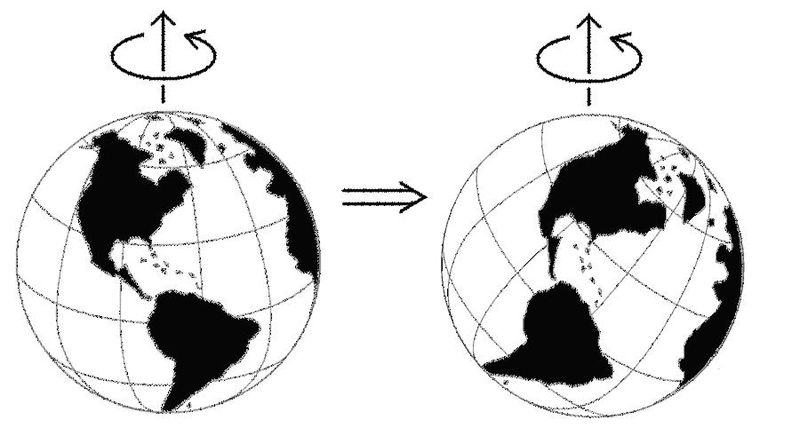
Scientists based in Germany and Norway today published new results about a geophysical theory known as true polar wander. That is a drifting of Earth’s solid exterior – an actual change in latitude for some land masses – relative to our planet’s rotation axis. These scientists used hotspots in Earth’s mantle as part of a computer model, which they say is accurate for the past 120 million years, to identify four possible instances of true polar wander in the past. And, they say, true polar wander is happening now. These scientists published their results in the Journal for Geophysical Research today (October 1, 2012).

The scientists – including Pavel V. Doubrovine and Trond H. Torsvik of the University of Oslo, and Bernhard Steinberger of the Helmholtz Center in Potsdam, Germany – established what they believe is a stable reference frame for tracking true polar wander. Based on this reference frame, they say that twice – from 90 to 40 million years ago – the solid Earth traveled back and forth by nearly 9 degrees with respect to our planet’s axis of rotation. What’s more, for the past 40 million years, the Earth’s solid outer layers have been slowly rotating at a rate of 0.2 degrees every million years, according to these scientists.

Diagram showing solid-body rotation of the Earth with respect to a stationary spin axis due to true polar wander. This diagram is greatly exaggerated. According to Doubrovine and his team, Earth’s solid outer layers have been slowly rotating at a rate of 0.2 degrees every million years. Diagram via Wikimedia Commons.

True polar wander is not:

  • A geomagnetic reversal, or reversal of Earth’s magnetic field, known to have happened before in Earth history.
  • Plate tectonics, which describes the large-scale motions of great land plates on Earth and is thought to be driven by the circulation of Earth’s mantle.
  • Precession of the Earth, whereby our world’s axis of rotation slowly moves, tracing out a circle among the stars, causing the identity of our North Star changes over time.

True polar wander is a geophysical theory, a way of thinking about Earth processes that might happen and that these scientists believe do happen. The theory suggests that if an object of sufficient weight on Earth – for example, a supersized volcano or other weighty land mass – formed far from Earth’s equator, the force of Earth’s rotation would gradually pull the object away from the axis around which Earth spins. A supersized volcano far from Earth’s equator would create an imbalance, in other words. As explained at Princeton.edu:

If the volcanoes, land and other masses that exist within the spinning Earth ever became sufficiently imbalanced, the planet would tilt and rotate itself until this extra weight was relocated to a point along the equator.

That’s the theory of true polar wander. It would cause a movement of Earth’s land masses, but for a different reason than the reason the continents drift in the theory of plate tectonics (formerly called “continental drift”). In the theory of plate tectonics, the continents drift because Earth’s the layer of Earth underlying our planet’s crust, called the mantle, is convective. That is, it circulates, slowly – like water about to boil. In true polar wander, on the other hand, a similar-seeming movement of land masses on Earth’s crust happens in order to correct an imbalance of weight with respect to Earth’s spin.

Scientists’ understanding of true polar wander overlaps with their understanding of plate tectonics in various ways. That’s understandable, since it’s all the same Earth.

Scientists delving into true polar wander want to know when, in which direction, and at what rate the Earth’s solid exterior might be rotating due to true polar wander. To sort it out, they say, you would need a stable frame of reference to which observations of relative motion might be compared. Doubrovine and his team say they found one: volcanic hotspots.

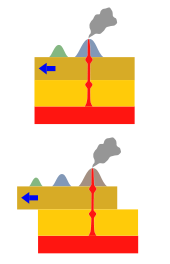
Hotspot forming an island chain. As land plates drift, a successive of volcanoes form over the hotspot. Image via Wikimedia Commons.

In geology, hotspots are volcanic regions fed by Earth’s underlying mantle. For example, the Hawaiian islands are believed to have formed over a hotspot in the mantle. The hotspot created a volcano, but then – as that land plate drifted over time, as described by the theory of plate tectonics – the volcano drifted, too, and was eventually cut off from the hotspot. Gradually, another volcano begins to form over the hotspot, right next to the first one. And then it moves on … and another one forms … and so on … and so on. Earth’s crust produces first one, then another volcano over the hotspot until a long chain of volcanoes forms, such as in Hawaii. Hotspots have long been used to understand the motion of tectonic plates.

Doubrovine and colleagues went a step further in order to understand true polar wander. Instead of treating the hot spots as static – frozen in place at one spot above Earth’s mantle – their computer model let the hotspots’ positions drift slowly. According to these scientists, this drifting is what produced a model of a stable reference frame, which in turn let them draw conclusions about true polar wander.

They say their model does a good job of matching observations of real hotspot tracks on Earth – the path drawn by each hotspot’s island chain – which gives them confidence their results about true polar wander are accurate.

The Hawaiian islands are believed to have formed over a hotspot – a particularly hot place in Earth’s underlying mantle. Scientists expanded on previous thinking about hotspots to suggest that Earth’s solid surface is drifting, minutely, with respect to our planet’s rotation axis.

Bottom line: German and Norwegian scientists have incorporated hotspots in Earth’s mantle into a computer model being used to study true polar wander. They say their work established a stable reference frame for this study that lets them conclude Earth is undergoing true polar wander today.

Read the original paper: Absolute plate motions in a reference frame defined by moving hot spots in the Pacific, Atlantic and Indian oceans

Deborah Byrd/EarthSky

Gematria

Posted: October 1, 2012 by phaedrap1 in Occult

A system by which hidden truths and meanings are discovered within words. Each letter of an alphabet corresponds to a number. Numerical values of words are totaled up and then these words are said to correspond with other words sharing the same numerical value.
History:
The Babylonian king Sargon II, in 8th century BC, is believed to have been the first to use gematria when building the wall of Khorsabad exactly 16,283 cubits long, because that was the numerical value of his name.
In Jewish mysticism this is a traditional system of associating numbers with Hebrew letters for the purpose of discovering hidden meanings in words. This is accomplished by systematically associating letters with numbers and then finding other words with similar numbers. These latter words are regarded as comments on the original words. Systems related to the Hebrew implementation of gematria are still used.
The Hebrews also used gematria for divination.
The ancient Greeks used gematria in dream interpretation. It also appears in the literature of the magi, and has been used in connection with the Greek alphabet.
The Gnostics applied gematria to names of deities such as Abraxas and Mithras, equating them because both of their names equaled 365, the number of days in a year.
Gematria carried over into early Christianity which helped make the dove a representation of Jesus; the Greek word for dove, peristera, equals 801 as do the Greek letters in alpha and omega, which represent the Beginning and the End.
It was the Kabbalists, however, who seriously studied gematria and developed it into an art form. The Kabbalists of the 13th century seriously believed that the Old Testament was written in a hidden code inspired by God. They used gematria as one of the chief means by which to decipher this code. An example of this is shown in their interpretation of Jeremiah 9:9, “From the fowl of the heavens until the beasts are fled and gone”. This was interpreted as meaning, that no traveler passed through Judea for 52 years, because the Hebrew word for beast, behemah, has the numerical value of 52.
Entire verses were numerically added up and interpreted in such a fashion. The 13th century German Kabbalistic scholar, Eleazar of Worms, did extensive gematric commentaries on the Bible.
Present practices:
The Kabbalists also used gematria to search for the holy names of God thinking, as so many others have, that these names such as the Tetragrammaton possessed power. Such a procedure has been adopted by many present day magicians. However, it should be noted two schools of thought regarding gematria also were issued from the Kabbalists. One advocated it use while the other cautioned against its practice, recommending that it only be practiced to strengthen one’s own conclusions. Various methods of gematria have evolved; for example one Kabblistic tract lists 72 of them.
There are two other lesser known decoding systems which are related to gematria, and various methods of practice exist within each of these systems too. The first of these systems is known as notarikon, in which the first letter of words may be extracted and combined to form new words; or, another version is to take the first, last, and sometimes the middle letters to make new words or phrases.
The other system is called temurah. It is a more complicated system in which letters are organized in tables, or according to mathematical arrangements. By the procedure of substitution new words or anagrams are formed.
Some modern occultists apply gematria to Tarot cards, associating the twenty-two trumps with Hebrew letters. A.G.H.

What are earthquakes?

Posted: September 30, 2012 by phaedrap1 in Uncategorized

With the increase in earthquake frequency, many people have become interested in what causes quakes to happen and what the different categories of data mean.  Unfortunately, a lot of the information available does not provide the basic information in a way a layman or beginner can easily understand.  This article aims to do just that.  To begin here are some important terms:

Body waves – A seismic wave that travels through the Earth rather than across its surface.

Deep-focus – Earthquakes occurring within the subducting oceanic plates as they move beneath the continental plates. Appearing along fault lines, these are earthquakes with focus much deeper within the earth. A deep focus earthquake occurs when two tectonic plates slide towards one another followed by subduction.   Deep-focus earthquakes occur at greater focal depths of 300 – 700 km.

Epicenter – the point on the earths surface directly above the hypocenter

Fault – A break in the rocks that make up the Earth’s crust, along which rocks on either side have moved past each other.

Hypocenter – Also called the Focus.  The place in the earth where the earthquake rupture starts

Love waves – A Love wave is confined to the surface of the crust, Love waves produce entirely horizontal motion. It’s the fastest surface wave and moves the ground from side-to-side.  The Love wave was named after A.E.H. Love, a British mathematician.

Primary (P) Waves – Also called Compression waves. This is the fastest kind of seismic wave, and, consequently, the first to ‘arrive’ at a seismic station. The P wave can move through solid rock and fluids, like water or the liquid layers of the earth. It pushes and pulls the rock it moves through just like sound waves push and pull the air.

Rayleigh waves – A Rayleigh wave rolls along the ground just like a wave rolls across a lake or an ocean. Because it rolls, it moves the ground up and down, and side-to-side in the same direction that the wave is moving. Most of the shaking felt from an earthquake is due to the Rayleigh wave, which can be much larger than the other waves. The Rayleigh wave is named for John William Strutt, Lord Rayleigh.

Secondary (S) waves – The second type of body wave is the S wave or secondary wave, which is the second wave you feel in an earthquake. An S wave is slower than a P wave and can only move through solid rock, not through any liquid medium. It is this property of S waves that led seismologists to conclude that the Earth’s outer core is a liquid. S waves move rock particles up and down, or side-to-side–depending on the direction that the wave is traveling in.

Shallow-focus – Earthquakes are crustal earthquakes, caused by faults and movements of the continental plates. The focus of these are nearer the surface of the earth.  Shallow-focus earthquakes occur at depths less than 70 km.

Subduction – Happen at the place where two tectonic plates meet and one slides under the other.

Surface waves – Traveling only through the crust, surface waves are of a lower frequency than body waves, and are easily distinguished on a seismogram as a result. Though they arrive after body waves, it is surface waves that are almost enitrely responsible for the damage and destruction associated with earthquakes. This damage and the strength, of the surface waves are reduced in deeper earthquakes.

Tectonic Plates – Also called lithospheric plates are massive, irregularly shaped slab of solid rock, generally composed of both continental and oceanic lithosphere. Plate size can vary greatly, from a few hundred to thousands of kilometers across; the Pacific and Antarctic Plates are among the largest.

An earthquake is a shaking of the ground caused by the sudden breaking and moving of tectonic plates in the earth’s rocky outermost crust.  When an earthquake occurs, energy is released and radiates in waves along the fault.  All quakes are either shallow or deep-focus.   Shallow-focus earthquakes are usually larger and therefore more damaging than deep-focus earthquakes.  Earthquakes occur on both land and under the ocean.  These quakes under the ocean can cause tsunamis.

Faults are created when the earth’s crust becomes stressed and slips suddenly.   Movement of the tectonic plates is usually very slow, pressure within the earth’s crust builds up as they slip and collide with one another. One type of fault is called a normal fault, this happens when rock that is hanging over the slanted fault plane slips downwards, another fault is the reverse or thrust fault, this occurs when the rock pushes upward.  Vertical displacement happen when one side of the fault moves upward above the other side and can be created by both normal and reverse faults.  Finally, the strike-slip fault is a horizontal fault where the areas of rock slide past one another. These occur in areas where there is a transform plate boundary. The San Andreas fault in California is an example of a strike-slip fault.
When the rocks along a fault move suddenly, vibrations occur and waves send energy through the earth. The waves which create the most damage to the earth are called Sheering waves because they move the ground back and forth.
All of the rock in the path of a Primary (P) wave is compressed and expanded alternately.  P waves are also the fastest earthquake wave, in strong rocks, they can travel at speeds of up to four miles per secnd.  Once the P waves have begun radiating out from the focus of the rupturing fault, Secondary (S) waves follow. The S waves shear or twist the rocks by moving up and down or side to side, perpendicular to the direction the waves are traveling rather than compress it. S waves don’t travel as fast as P waves at their fastest only moving at about two miles per second.  The Love wave  is the fastest surface wave and moves the ground from side-to-side. Confined to the surface of the crust, Love waves produce entirely horizontal motion. A Rayleigh wave rolls along the ground just like a wave rolls across a lake or an ocean. Because it rolls, it moves the ground up and down, and side-to-side in the same direction that the wave is moving. Most of the shaking felt from an earthquake is due to the Rayleigh wave, which can be much larger than the other waves.
The magnitude or size, how long an earthquake lasts, and how much shaking actually occurs are factors that determine how much damage an earthquake causes.  Large quakes can easily crack the ground, cause buildings to collapse and create tsunamis that can cause devastating damage.  The Ritcher scale, developed by Charles Ritcher, an American seismologist in 1925, was the first seismic magnitude scale widely used.  The height or amplitude of the surface waves are measured  by the Ritcher scale, which is a logarithmic scale, every successive unit of magnitude represents ten times the amount of the previous number because earthquake waves can cause ground displacement between less than a millimeter and several meters.  This was addressed by the use of the logmaritic recorded wave heights, so that a quake of magnitude three on the Ritcher scale is ten times more than magnitude two and one hundred times more than magnitude one.
Although the Ritcher scale is still used, seismologists now prefer to use a new magnitude scale called the moment magnitude scale.  The moment magnitude is calculated by multiplying the area the quake occurred in and the amount of displacement that occurred in the slip.  Seismologists believe that the moment magnitude scale is more reliable for measuring earthquakes, especially those that above a seven on other scales  because other scales only take into account part of the seismic waves, and the moment magnitude measures the total size of the earthquake.

In the last few years we have seen earthquakes occur which have created very destructive tsunamis.  In 2004 there was a 9.1 earthquake in the Indian Ocean, the largest strike-slip quake ever recorded,  which spawned a tsunami that killed over 230,000 people and in 2011 there was a 9.0 that triggered a 7 metre high tsunami which has created the worse nuclear disaster in history. Just recently scientists have discovered that two earthquakes measuring  8.6 and 8.3 magnitude close to the Sumatran subduction zone have caused the earth’s crust to break up along a new plate boundary.  With all these events happening staying alert to what is going on is imperative.

These are only some of the basic concepts that apply to earthquakes.  There is much more information available.  If interested more can be found at the following sites:

http://www.earthquake.usgs.gov/earthquakes/
http://www.ceri.memphis.edu/
http://www.emsc-csem.org/Earthquake/

The point of no return: In astronomy, it’s known as a black hole—a region in space where the pull of gravity is so strong that nothing, not even light, can escape. Black holes that can be billions of times more massive than our sun may reside at the heart of most galaxies. Such supermassive black holes are so powerful that activity at their boundaries can ripple throughout their host galaxies. Now, an international team, led by researchers at MIT’s Haystack Observatory, has for the first time measured the radius of a black hole at the center of a distant galaxy—the closest distance at which matter can approach before being irretrievably pulled into the black hole. The scientists linked together radio dishes in Hawaii, Arizona and California to create a telescope array called the “Event Horizon Telescope” (EHT) that can see details 2,000 times finer than what’s visible to the Hubble Space Telescope. These radio dishes were trained on M87, a galaxy some 50 million light years from the Milky Way. M87 harbors a black hole 6 billion times more massive than our sun; using this array, the team observed the glow of matter near the edge of this black hole—a region known as the “event horizon.” “Once objects fall through the event horizon, they’re lost forever,” says Shep Doeleman, assistant director at the MIT Haystack Observatory and research associate at the Smithsonian Astrophysical Observatory. “It’s an exit door from our universe. You walk through that door, you’re not coming back.” Doeleman and his colleagues have published the results of their study this week in the journal Science.
Jets at the edge of a black hole
Supermassive black holes are the most extreme objects predicted by Albert Einstein’s theory of gravity—where, according to Doeleman, “gravity completely goes haywire and crushes an enormous mass into an incredibly close space.” At the edge of a black hole, the gravitational force is so strong that it pulls in everything from its surroundings. However, not everything can cross the event horizon to squeeze into a black hole. The result is a “cosmic traffic jam” in which gas and dust build up, creating a flat pancake of matter known as an accretion disk. This disk of matter orbits the black hole at nearly the speed of light, feeding the black hole a steady diet of superheated material. Over time, this disk can cause the black hole to spin in the same direction as the orbiting material.  Caught up in this spiraling flow are magnetic fields, which accelerate hot material along powerful beams above the accretion disk The resulting high-speed jet, launched by the black hole and the disk, shoots out across the galaxy, extending for hundreds of thousands of light-years. These jets can influence many galactic processes, including how fast stars form.
‘Is Einstein right?’
A jet’s trajectory may help scientists understand the dynamics of black holes in the region where their gravity is the dominant force. Doeleman says such an extreme environment is perfect for confirming Einstein’s theory of general relativity—today’s definitive description of gravitation. “Einstein’s theories have been verified in low-gravitational field cases, like on Earth or in the solar system,” Doeleman says. “But they have not been verified precisely in the only place in the universe where Einstein’s theories might break down—which is right at the edge of a black hole.” According to Einstein’s theory, a black hole’s mass and its spin determine how closely material can orbit before becoming unstable and falling in toward the event horizon. Because M87’s jet is magnetically launched from this smallest orbit, astronomers can estimate the black hole’s spin through careful measurement of the jet’s size as it leaves the black hole. Until now, no telescope has had the magnifying power required for this kind of observation. “We are now in a position to ask the question, ‘Is Einstein right?'” Doeleman says. “We can identify features and signatures predicted by his theories, in this very strong gravitational field.” The team used a technique called Very Long Baseline Interferometry, or VLBI, which links data from radio dishes located thousands of miles apart. Signals from the various dishes, taken together, create a “virtual telescope” with the resolving power of a single telescope as big as the space between the disparate dishes. The technique enables scientists to view extremely precise details in faraway galaxies. Using the technique, Doeleman and his team measured the innermost orbit of the accretion disk to be only 5.5 times the size of the black hole event horizon. According to the laws of physics, this size suggests that the accretion disk is spinning in the same direction as the black hole—the first direct observation to confirm theories of how black holes power jets from the centers of galaxies. The team plans to expand its telescope array, adding radio dishes in Chile, Europe, Mexico, Greenland and Antarctica, in order to obtain even more detailed pictures of black holes in the future.
By Jennifer Chu / Physorg.com
September 27, 2012
Ref. “Jet Launching Structure Resolved Near the Supermassive Black Hole in M87,” by S.S. Doeleman et al., Science, 2012.
Journal reference: Science
search and more info website Provided by Massachusetts Institute of Technology
The Watchers Tweet Tweet Herbs played a huge role in Egyptian medicine. Proof comes from burial sites, tombs and underground temples where archeologists have found extensive sets of medical documents and scrolls, including the Ebers Papyrus, the Edwin Smith Papyrus, the Hearst Papyrus, and the London Medical Papyrus, which contained the earliest documented awareness of tumors. The most famous plant – medicine “encyclopedia” is the Ebers Papyrus, a 110 page scroll which rolls out to be about 20 meters...

Herbs played a huge role in Egyptian medicine. Proof comes from burial sites, tombs and underground temples where archeologists have found extensive sets of medical documents and scrolls, including the Ebers Papyrus, the Edwin Smith Papyrus, the Hearst Papyrus, and the London Medical Papyrus, which contained the earliest documented awareness of tumors. The most famous plant – medicine “encyclopedia” is the Ebers Papyrus, a 110 page scroll which rolls out to be about 20 meters long.

Egyptians consumed raw garlic and onions for endurance and to heal asthma and bronchial-pulmonary issues. Many of their herbs were steeped in wine and used as oral medicine. These were natural herbs, untainted by pesticides, herbicides, insecticides, or fluoridated water. The Egyptians documented use of myrrh, frankincense, fennel, cassia, thyme, juniper, and even aloe. Fresh garlic cloves were peeled, mashed and macerated in a mixture of vinegar and water and used as a rinse for sore throats and toothaches.

The God of Sweetness

Egyptians knew about the healing powers of honey. In fact, the first official recognition of the importance of honey dates back to the first Egyptian Dynasty and the “Sealer of the Honey.” In Niuserre’s Sun temple, bee-keepers are shown in hieroglyphics blowing smoke into hives as they are removing honey-combs. The honey was immediately jarred and sealed and could therefore be kept for years, and it was used for the production of medicines and ointments. They even used it as a natural antibiotic.

The main land for bee-keeping was in Lower Egypt where there was extensive irrigation feeding thousands of flowering plants. The Bee was chosen as a symbol for the country and the gods were associated with the bee. One pharaoh’s title was Bee King and his Royal archers protected the bees like they were his holy temple. The temples were actually homes for the bees, in order to satisfy the desire of the gods. Canaan was called the “Land of Milk and Honey” in the Hebrew tradition.

Egyptian medicine is some of the oldest ever documented. From the 33rd century BC until the Persian invasion in 525 BC, Egyptian medical practice remained consistent in its highly advanced methods for the time. Homer even wrote in the Odyssey: “In Egypt, the men are more skilled in medicine than any of human kind,” and “The Egyptians were skilled in medicine more than any other art.”

The Edwin Smith papyrus is still benefiting modern medicine, and is viewed as a learning manual. Treatments consisted of ailments made from animal, vegetable, fruits and minerals. But the Ebers Papyrus is the most voluminous record of ancient Egyptian medicine known. The scroll contains some 700 remedies including empirical practice and observation. The papyrus actually contains a “treatise on the heart,” which recognizes the heart as the center of the blood supply, with vessels attached.

Even mental disorders, depression and dementia were detailed in one of the chapters. The Egyptians were treating intestinal disease and parasites, eye and skin problems, and even abscesses and tumors.

Remedies from the Ancient Ebers Papyrus Scrolls:

• Aloe vera was used to alleviate burns, ulcers, skin diseases and allergies

• Basil was written up as heart medicine

• Balsam Apple (Apple of Jerusalem) was used as a laxative and as a liver stimulant

• Bayberry was prescribed for diarrhea, ulcers and hemorrhoids

• Caraway soothed digestion and was a breath freshener

• Colchicum (citrullus colocynthus or meadow saffron) soothed rheumatism and reduced swelling

• Dill was recognized for laxative and diuretic properties

• Fenugreek was prescribed for respiratory disorders and to cleanse the stomach and calm the liver and pancreas

• Frankincense was used for throat and larynx infections, and to stop bleeding and vomiting

• Garlic was given to the Hebrew slaves daily to give them vitality and strength for building the pyramids

• Licorice was utilized as a mild laxative, to expel phlegm, and to alleviate chest and respiratory problems

• Onion was taken to prevent colds and to address cardiovascular problems (How did they know?)

• Parsley was prescribed as a diuretic

• Thyme was given as a pain reliever and Tumeric for open wounds

• Poppy was used to relieve insomnia, as an anesthetic, and to deaden pain

• Coriander was taken as a tea for urinary complaints, including cystitis

• Pomegranate root was strained with water and drunk to address “snakes of the belly” (tapeworms). The alkaloids contained in pomegranate paralyzed the worms’ nervous system and they relinquished their hold.

• Persian henna was used against hair loss

Disease and Natural Cures in Ancient Egypt

Disease was not uncommon in Ancient Egypt. There were many skin afflictions and parasites from the Nile river waters. Worms and tuberculosis were common, sometimes transmitted from cattle. Pneumonia struck people who breathed in too much sand into the lungs during sand storms. But the Egyptian physicians took full advantage of the natural resources all around them in order to treat common ailments. Many of their methods are still very viable today and are considered part of the homeopathic world of medicine.

Thanks to diligent record keeping, scholars have been able to translate the scrolls and appreciate what the Egyptians knew back then about anatomy, hygiene, and healing. Those scrolls, without question, paved the way for modern medicine.

NaturalNews
By S. D. Wells

Arctic sea ice melt ‘may bring harsh winter to Europe’

Posted: September 16, 2012 by phaedrap1 in News

The unprecedented loss of polar sea ice may lead to ‘wild extremes’ in the UK and northern Europe, say researchers

Arctic sea ice : Winter weather : Roads around Newcastle were blocked by deep snow

Unprecedented sea ice loss may bring a cold winter to the UK, say researchers. Photograph: John Giles/PA

The record loss of Arctic sea ice this summer may mean a cold winter for the UK and northern Europe. The region has been prone to bad wintersafter summers with very low sea ice, such as 2011 and 2007, said Jennifer Francis, a researcher at Rutgers University.


“We can’t make predictions yet … [but] I wouldn’t be surprised to see wild extremes this winter,” Francis told the Guardian.


This year’s ice melt has broken the 2007 record by an an area larger than the state of Texas.


Polar ice experts “thought that it would be many years until we again saw anything like we saw in 2007″, said Mark Serreze, director of the National Snow and Ice Data Centre in Colorado.


The unprecedented expanse of ice-free Arctic Ocean has been absorbing the 24-hour sun over the short polar summer. The heat in the water must be released into the atmosphere if the ice is to re-form this autumn. “This is like a new energy source for the atmosphere,” said Francis.


This heat and water vapour will affect the all-important jet stream – the west-to-east winds that are the boundary between cold Arctic and the warm mid-latitudes. Others researchers have already shown that the jet stream has been shifting northwards in recent years. Francis and colleagues have recently documented that the jet stream is also slowing down.


“The jet stream is clearly weaker,” said Francis. That means weather systems, be it rain or dry conditions, are slow to move on and last longer. Ultimately this can result in “blocking” events, such as the conditions that produced the terrible heatwave in western Russia during the summer of 2010, she said.


This summer, Greenland experienced a similar blocking anti-cyclone, resulting in a record surface melting of its ice sheet. It is not possible to directly connect that block to the prolonged US heatwave and drought this summer, Francis said. However “blocks act like a traffic jam, slowing down weather patterns elsewhere”.


These changes are happening much earlier than scientists thought, said James Overland, an oceanographer and researcher at the University of Washington.


“We’ve only had a little bit of global warming so far,” Overland said.


As the sea ice continues to decline, the jet stream will likely continue to slow more, and shift further north “bringing wild temperature swings and greater numbers of extreme events” in the future he said. “We’re in uncharted territory.”

Mithras = Christianity

Posted: September 14, 2012 by phaedrap1 in Spirituality

This religion, cloaked in mystery and secrecy, has captivated the imaginations of scholars for generations.  Many facts discovered sheds vital light on the cultural dynamics that led to the rise of Christianity.  The National Geographic Society’s book “Great Religions of the World,” page 309 writes; “By Jesus’ time, East and West had mingled here for three centuries.  Down columns of boulevards walked Roman soldiers loyal to the Persian god Mithras.” Mithras was a Persian deity.  He was also the most widely venerated god in the Roman Empire at the time of Jesus.  The Catholic Encyclopedia as well as the early Church Fathers found this religion of Mithras very disturbing, as there are so many similarities between the two religions, as follows:

 1)  Hundreds of years before Jesus, according to the Mithraic religion, three Wise Men of Persia came to visit the baby savior-god Mithra, bring him gifts of gold, myrrh and frankincense.

2)  Mithra was born on December 25 as told in the “Great Religions of the World”, page 330; “…it was the winter solstice celebrated by ancients as the birthday of Mithraism’s sun god”.

3)  According to Mithraism, before Mithra died on a cross, he celebrated a “Last Supper with his twelve disciples, who represented the twelve signs of the zodiac.

4)  After the death of Mithra, his body was laid to rest in a rock tomb.

5)  Mithra had a celibate priesthood.

6)  Mithra ascended into heaven during the spring (Passover) equinox (the time when the sun crosses the equator making night and day of equal length).

As you can now see, Christianity derived many of its essential elements from the ancient religion of Mithraism.   Mithraism became intertwined with the cult of Jesus to form what is known today as “Christianity.” Although literary sources on this religion are sparse, an abundance of material evidence exists in the many Mithraic temples and artifacts that archaeologists have found scattered throughout the Roman Empire, from England in the north and west to Palestine in the south and east.  The temples were usually built underground in caves, which are filled with an extremely elaborate iconography (illustrating by pictures, figures and images).  There were many hundreds of Mithraic temples in the Roman Empire, the greatest concentrations have been found in the city of Rome itself.

We often hear about how many of the traditions, rites and symbols of modern day “Christian” holidays have their roots in paganism. Have you ever wondered why December 25th was chosen to celebrate the birth of Jesus? Could it only be a consequence that ancient paganism and the story of Mithras’ birth coincides with the Yule/Christmas season? If the accounts in the Bible are correct, the time of Jesus birth would have been closer to mid-summer, for this is when shepherds would have been “tending their flocks in the field ” and the new lambs were born. Strange enough, the ancient pagan religion, Mithraism, which dates back over 4,000 years, also celebrated the birth of their “saviour” on December 25th. Franz Cumont, who is consider by many to be the leading research authority on Roman Paganism, explained the ancient religion called Mithraism.

Then Mithras returned to the earth to teach humanity His commandments and begin Mysteries and Rites which would help humans remember His acts on our behalf. Because of His actions, we can choose good without the overwhelming power of evil, even though evil’s influence can still seem powerful because our minds believe it is. Because of His teachings, we know that the purpose of our lives is to serve others in the name of Mithras. The followers refer to Him as the “Light of the World” a phrase often used also in Christian faith when referring to Jesus.

This son of a god born of a virgin, was so commonly spread in those days that Philo of Alexandria (30 BCE – 45 CE), warned against this widespread superstitious belief in unions between male gods and human females. The offspring’s are known as demigods.

Tammuz, who was incorporated also into Attis and Mithras, and they stood model for the story in the NT, because they were deities who all are supposed to have died and resurrected. Tammuz was always called Adon, meaning Lord. (the Greek Adonis, was based on him). Actually all these deities were based on the first deity to have died and resurrected, the Egyptian deity Osiris. So there is absolutely nothing unique about Jesus. In fact he is copyright due to Osiris.

Of the following (semi) deities, legends went around that they were born of a virgin:
Augustus (his father was the god Apollo)
Adonis                       Agdistis                        Attis
Korybas                     Krishna                        Dionysus
Osirus                        Perseus                         Mithras
Tammuz                    Zoroaster                     Jesus
So basically, all the pagan religions were alike, including Christianity. It just happens that one of them got the ascendancy, and became the most powerful, and did its best to wipe out all the others. In addition to a lack of historical support, many characteristics of Jesus, which Christians today believe in, are undeniably similar or identical to religious trends and beliefs that preceded Christianity. There are tens of accounts of pagan gods of many different cultures who were said to have the same attributes as those that Christians claim Jesus had. A brief review of some of these may lead to some interesting questions concerning the originality of the Christian claim:

ATTIS – Phrygia: Born of the virgin Nana on December 25. He was both the Father and the Divine Son. He was a savior crucified on a tree for the salvation of mankind. He was buried but on the third day the priests found the tomb empty — He had arisen from the dead (on March 25th). He followers were baptized in blood, thereby washing away their sins — after which they declared themselves “born again.” His followers ate a sacred meal of bread, which they believed became the body of the savoir.

DIONYSUS – GREECE: Born of a Virgin on December 25th, placed in a manger. He was a traveling teacher who performed many miracles. Turned water into wine. Followers ate sacred meal that became the body of the god. He rose from the dead March 25th. Identified with the ram and lamb’s and was called “King of Kings,” “Only Begotten Son,” “Savior,” “Redeemer,” “Sin bearer,” “Anointed One,” the “Alpha and Omega.”

HERACLES – GREECE: Born at the winter equinox of a virgin who refrained from sex with her until her god-begotten child was born and was sacrificed at the spring equinox. He too, was called “Savior,” “Only begotten,” “Prince of Peace,” “Son of Righteousness.”

KRISHNA – INDIA: Krishna was born while his foster-father Nanda was in the city to pay his tax to the king. His nativity heralded by a star, Krishna was born of the virgin Devaki in a cave, which at the time of his birth was miraculously illuminated. The cow-herds adored his birth. King Kansa sought the life of the Indian Christ by ordering the massacre of all male children born during the same night at He. Krishna traveled widely, performing miracles — raising the dead, healing lepers, the deaf and the blind. The crucified Krishna is pictured on the cross with arms extended. Pierced by an arrow while hanging on the cross, Krishna died, but descended into Hell from which He rose again on the third day and ascended into Heaven. (The Gospel of Nicodemus tell of Jesus’ descent into Hell.) He will return on the last day to judge the quick and the dead. Krishna is the second person of the Hindu trinity.

OSIRIS – EGYPT: He came to fulfill the law. Called “KRST,” the “Anointed One.” Born of the virgin Isis-Meri on December 25th in a cave / manger, with his birth announced by a star and attended by three wise men. Earthly father named “Seb” (translates to “Joseph.”) At age 12 he was a child teacher in the Temple and at 30 he was baptized, having disappeared for 18 years. Osiris was baptized in the river Iarutana — the river Jordan — by “Anup the Baptizer,” who was beheaded. (Anup translates to John.) He performed miracles, exorcised demons, raised El-Osiris from the dead. Walked on water and was betrayed by Typhon, crucified between two thieves on the 17th day of the month of Athyr. Buried in a tomb from which he arose on the third day (19th Athyr) and was resurrected. His suffering, death, and resurrection celebrated each year by His disciples on the Vernal Equinox — Easter. Called “The Way, the Truth, the Light,” “Messiah,” “god’s Anointed Son,’ the “Son of Man,” the “Word made Flesh,” the “word of truth.”  Expected to reign a thousand years.
NOTE 1: Persian legends of Mithras says that He was born of the Sun God and a virgin mother, called “the Mother of God”, on December 25th. They saw him as a symbol of justice, truth, and loyalty. He was considered the saviour of humankind, and stories abound of His healing the sick, raising the dead, and performing miracles (making the blind see and the lame walk). Throughout His lifetime, He was seen as a protector of human souls, a mediator between “heaven” and “earth” and was even associated with a “holy trinity”. He remained celibate, until the ripe old age of 64, throughout his life and preached the virtues of ethics, moral behavior, and good will. Does this sound familiar? Sure sounds like Jesus.

NOTE 2: Ancient Persians believed in a “celestial heaven” and hell. They believed that they would be judged by their god and granted justice of” eternal salvation. On judgement day, the faithful dead would be resurrected and light would triumph over darkness.

NOTE 3: They took part in ritual purification or baptism, held Sundays sacred, drank wine and ate bread as a symbol of the body and blood and even took part in ritualistic purging (purification rites such as flagellation).

NOTE 4: In their legends, Mithras had an “earthly mission’ to accomplish. He then was put to death on a cross and buried in a cave (some legends have Him held in a cave to be reborn once a year).

NOTE 5: He then “rose from the dead” and took part in a last supper with his 12 disciples (often associated with the 12 signs of the zodiac) and then ascended to the heavens to watch over His “flock” from above.

As a footnote to all this: The World Book Encyclopedia tells that Mithras was an angel of light who fought on the side against the forces of evil.  In the Zoroastrian religion of ancient Persia Mithras was called “the Heavenly Light.” This belief carried to Assyria and Asia Minor where many people identified him with the sun.  Mithraism came into the ancient Roman world about 75 BCE., and ranked as a principal competitor of Christianity for 200 years. In addition to a lack of historical support, many characteristics of Jesus, which Christians today believe in, are undeniably similar or identical to religious trends and beliefs that preceded Christianity. There are tens of accounts of pagan gods of many different cultures who were said to have the same attributes as those that Christians claim Jesus had.

Trinity―Trinities were popular in pagan sects before Christianity was introduced to the world. Some of the more well known trinity gods included Mithra-Vohu Mana-Rashnu, Amen-Mut-Khonsu, and Osiris-Isis-Horus.

Virgin Birth―Among the pagan cultures that preceded Christianity, virgin birth stories abounded. The long list of pagan gods born of virgins includes: Romulus and Remus, Zoroaster, Buddha, Mithras, Krishna, Osiris-Aion, Agdistis, Attis, Tammuz, Adonis, Korybas, Perseus, and Dionysus.

Disciples―In the following ‘saviors’ cases, a grouping of disciples was present, just as they were present in Jesus’ story: Horus, Buddha, Krishna, Dionysus, Mithra. Interestingly enough, in the case of Dionysus, his disciple Acoetes was a boatman, just as Jesus’ disciple Peter. And just as Peter was freed from jail when the doors miraculously flew open, so was Dionysus’ disciple Acoetes. In Buddha’s case, he, like Jesus, demanded that his disciples renounce all worldly possessions. Yet another instance of similarity is that the disciples of both Jesus and Buddha were said to have been arrested for preaching, as well as witnessed to have “walked on water.”

Miracles―Among those ‘saviors’ who, like Jesus, performed countless miracles include: Horus, Krishna, Buddha, Dionysus, Mithra, Osiris, and Adonis. Horus was said to have walked on water, just as Jesus did. In addition, Horus raised one man, El-Azarus, from the dead in front of countless witnesses. In the case of Buddha, it was told that he fed five hundred men with one loaf of bread, that he cured lepers, and that he caused the blind to see.  Dionysus  rescued a person from dying when the person was utterly desolate and placed them among the stars. And he gave food and drink, herbs and berries, to the starving people — not to mention turning water into wine.

The Sun―Here is another common theory, quoted from S. Acharya’s “The Origins of Christianity and the Quest for the Historical Jesus:” “The reason why all these pagan narratives are so similar to a “god-man” is that these stories were based on the movements of the sun through the heavens, an astrotheological development that can be found throughout the planet because the sun and the 12 zodiac signs can be observed around the globe.

Paul was supposedly born and raised in the city of Tarsus, a region in SE Asia-Minor (now called Turkey) where Mithras was well known.  Biblical scholars are now saying that Paul, the alleged author of 13 out of the 27 (maybe more) books of the New Testament, may have been influenced in his writings by this strong religion of Mithraism.  We can see a profound kinship between Mithraism and Christianity.

In-as-much as Mithraism was so popular in Rome, it is no wonder why the pagan Emperor Constantine, who believed in the sun god, Mithras, designated a certain day of the week to him, Sunday, which means, “the day of the sun.”

The original “Christian” faith became a mix of pagan, Mithramic, Judeo/Christian teaching. This lead to the confusing mix of theology that we have today within the “Christian” community. This apostasy from the original simple and plain teachings of Christ was accelerated by the persecutions and killings of any who tried to support the “old” ways. Maybe this solves the mystery of the “ungodly” marriage between Mithraism and the cult of Jesus. As it turns out, it was all for political convenience! But, Christians think they are better than that today. In short: The “Christianity” they have today has almost no relationship, in doctrine or in way of life, to the “the original teachings of Jesus.”

In my mind, there are two Jesus’ teachings. Jesus the Jew and Jesus the Gentile, which by the way is really Paul’s Jesus.  And guess which one Christians follow? The ex-pagan Constantine liked Paul’s Jesus over Jesus the Jew. Jesus and all the others upon whom this character is predicated are personifications of the sun, and the Gospel fable is merely a rehash of a mythological formula revolving around the movements of the sun through the heavens.

For instance, many of the world’s crucified “god-men” have their traditional birthday on December 25. This is because the ancients recognized that (from an earth-centric perspective) the sun makes an annual descent southward until December 21 or 22, the winter solstice, when it stops moving southerly for three days and then starts to move northward again.

During this time, the ancients declared that “God’s sun” had “died” for three days and was “born again” on December 25. The ancients realized quite abundantly that they needed the sun to return every day and that they would be in big trouble if the sun continued to move southward and did not stop and reverse its direction. Thus, these many different cultures celebrated the “sun of God’s” birthday on December 25th. The following are the characteristics of the “sun” of God:


a.  The sun “dies” for three days on December 22, the winter solstice, when it stops in its movement south, to be born again or resurrected on December 25, it resumes its movement north.
b.  In some areas, the calendar originally began in the constellation of Virgo, and the sun would therefore be “born of a Virgin.”
c.  The sun is the “Light of the World.”
d.  The sun “cometh on clouds, and every eye shall see him.”
e.  The sun rising in the morning is the “Savior of mankind.”
f.   The sun wears a corona (“crown of thorns”) or a halo.
g.  The sun “walks on water.”
h.  The sun’s “followers” or “disciples” are the 12 months and the 12 signs of the Zodiac, through which the sun must pass.
i.  The sun is “crucified,” which represents it’s passing through the equinoxes, the vernal equinox being Easter, at which time it is then resurrected.
In addition, all over the world are sites where this “god” or that allegedly was born, walked, suffered, died, etc., a common occurrence that is not monopolized by, and did not originate with, Christianity. An early Christian Syrian writer (quoted in Credner’s “De Natalitorium Christi Origine”) wrote the following concerning the December 25 hoax: “The reason why the Church fathers transferred the celebration from January 6 to December 25, was that it was the custom of the pagans to celebrate on the same December 25 the birthday of the sun, at which time they lit lights in token of festivity, and in these rites and festivals the Christians also took part. Accordingly, when the doctors of the Church perceived that the Christians had a liking for this festival, they resolved that the true nativity should be commemorated on that day.

When the Christ myth was new Mithras and Mithraism were already ancient. Worshiped for centuries as God’s Messenger of Truth, Mithras was long revered by the Persians and the Indians (Zoroastrianism) before his faith found it’s way to Rome where His mysteries flourished in the second century AD. Every year in Rome, in the middle of winter, the Son of God was born one more, putting an end to darkness. Every year at first minute of December 25th the temple of Mithras was lit with candles, priests in in white garments celebrated the birth of the Son of God and boys burned incense. Mithras was born in a cave, on December 25th, of a virgin mother. He came from heaven to be born as a man, to redeem men from their sin. He was know as “Savior,” “Son of God,” “Redeemer,” and “Lamb of God.” With twelve disciples he traveled far and wide as a teacher and illuminator of men. He was buried in a tomb from which he rose again from the dead — an event celebrated yearly with much rejoicing. His followers kept the Sabbath holy, holding sacramental feasts in remembrance of Him. The sacred meal of bread and water, or bread and wine, was symbolic of the body and blood of the sacred bull.

Baptism in the blood of the bull (taurobolum) – early Baptism “washed in the blood of the Lamb” – late Baptism by water [recorded by the Christian author Tertullian Mithraic rituals brought about the transformation and Salvation of His adherents –an ascent of the soul of the adherent into the realm of the divine.

All over the world are sites where this “god” or that allegedly was born, walked, suffered, died, etc., a common occurrence that is not monopolized by, and did not originate with, Christianity. At the time of Jesus, as for centuries before, the Mediterranean world roiled with a wide diversity of mythical creeds and rituals. Details varied according to location and culture, but the general outlines of these faiths were astonishingly similar. Simply put, the ancients’ gods:

a.  Were born on or very near our Christmas Day

b.  Were born of a Virgin-Mother

c.  Were born in a Cave or Underground Chamber.

d.  Led a life of toil for Mankind.

e.  Were called by the names of Light-bringer, Healer, Mediator, Savior, Deliverer.

f.  Were however vanquished by the Powers of Darkness.

g.  And descended into Hell or the Underworld.

h.  Rose again from the dead, and became the pioneers of mankind to the Heavenly world.

i.  Founded Communions of Saints, and Churches into which disciples were received by Baptism.

j.  Were commemorated by Eucharistic meals.

Many professors of modern and past times cannot help but conclude that Jesus is based on mythical deities of old. Among these scholars number individuals such as Porphry (3rd Century), Max Muller, Ernest de Bunsen, Joseph Wheless, Albert Churchward (all of the 19th Century), and T.W. Doane (20th Century). Even Pope Leo X, privy to the truth because of his high rank, made this curious declaration, “It was well known how profitable this fable of Christ has been to us” (“The Diegesis” by Rev. Robert Taylor, footnote, p. 35).

To conclude, in light of the tremendous volume of evidence that is there for anyone interesting in taking the time to study, the underlying question of whether or not Christianity is simply the heir of mythical beliefs prevalent at the time of its development, is not a question that can simply be ignored by any Christian when pondering the origins of his/her faith.


References were taken from:

The World Book Encyclopedia; Library of the World’s Myths and Legends (Persian Mythology); Stories of the Bible on TV – Historians; J.M.Robertson, T.W.Doane, F.Cument, J.G.Frazer; The Origins of the Mithraic Mysteries by David Ulansey


 Christianity-Revealed.com.

A new theory emerges about the mysterious death of Tutankhamen

Posted: September 12, 2012 by phaedrap1 in News
By Jessica Hamzelou and New Scientist, Published: September 10
Tutankhamen’s mysterious death as a teenager may finally have been explained. The condition that cut short the Egyptian ruler’s life may also have triggered the earliest monotheistic religion, suggests a new review of his family history.Since his lavishly furnished, nearly intact tomb was discovered in 1922, the cause of Tutankhamen’s death more than 3,000 years ago has been at the center of intense debate. There have been theories of murder, leprosy, tuberculosis, malaria, sickle-cell anemia, a snake bite — even the suggestion that the young king died after a fall from his chariot.

(Andrew Holt/ALAMY) – A srugeon in Britain argues that features of Tutankhamen’s body may help explain why the boy king died while still a teenager.

 But all of these theories have missed one vital point, says Hutan Ashrafian, a surgeon with an interest in medical history at Imperial College London. Tutankhamen died young with a feminized physique, and so did his immediate predecessors.

Paintings and sculptures show that Smenkhkare, a pharaoh who may have been Tutankhamun’s uncle or older brother, and Akhenaten, thought to have been the boy king’s father, both had feminized figures, with unusually large breasts and wide hips. Two pharaohs who came before Akhenaten — Amenhotep III and Tuthmosis IV — seem to have had similar physiques. All of these kings died young and mysteriously, says Ashrafian. “There are so many theories, but they’ve focused on each pharaoh individually.”

Ashrafian found that each pharaoh died at a slightly younger age than his predecessor, which suggests an inherited disorder, he says. Historical accounts associated with the individuals hint at what that disorder may have been.

“It’s significant that two [of the five related pharaohs] had stories of religious visions associated with them,” says Ashrafian. People with a form of epilepsy in which seizures begin in the brain’s temporal lobe are known to experience hallucinations and religious visions, particularly after exposure to sunlight. It’s likely that the family of pharaohs had a heritable form of temporal lobe epilepsy, he says.

This diagnosis would also account for the feminine features. The temporal lobe is connected to parts of the brain involved in the release of hormones, and epileptic seizures are known to alter the levels of hormones involved in sexual development. This might explain the development of the pharaohs’ large breasts. A seizure might also be to blame for Tutankhamen’s fractured leg, says Ashrafian.

Tuthmosis IV had a religious experience in the middle of a sunny day, recorded in the Dream Stele, an inscription near the Great Sphinx in Giza. But his visions were nothing compared with those experienced by Akhenaten. They encouraged Akhenaten to raise the status of a minor deity called the “sun-disk,” or Aten, into a supreme god — abandoning the ancient Egyptian polytheistic traditions to start what is thought to be the earliest recorded monotheistic religion. If Ashrafian’s theory is correct, Akhenaten’s religious experiment and Tutankhamen’s premature death may both have been a consequence of a medical condition.

“People with temporal lobe epilepsy who are exposed to sunlight get the same sort of stimulation to the mind and religious zeal,” says Ashrafian.

“It’s a fascinating and plausible explanation,” says Howard Markel, a medical historian at the University of Michigan in Ann Arbor. However, the theory is almost impossible to prove, he adds, given that there is no definitive genetic test for epilepsy.

Orrin Devinsky, a neurologist at New York University’s Langone Medical Center, says the theory must remain speculative.

“The exact timing of Akhenaten’s religious conviction is not so clearly documented, and most cases of sudden religious conversion are not due to epilepsy,” he says. “Monotheism could be related to epilepsy, or bipolar disorder, or schizophrenia, or drug intoxication from a fungus — but this paper does not sway me to any of these options.”

Markel agrees: “Do we know that a seizure led to monotheism? It’s a nice idea, but we don’t know,” he says. “It’s a very interesting hypothesis, but it’s just that — there’s no definite proof.”