Author Archive

When filmmaker Carla MacKinnon started waking up several times a week unable to move, with the sense that a disturbing presence was in the room with her, she didn’t call up her local ghost hunter. She got researching.

Now, that research is becoming a short film and multiplatform art project exploring the strange and spooky phenomenon of sleep paralysis. The film, supported by the Wellcome Trust and set to screen at the Royal College of Arts in London, will debut in May.

Sleep paralysis happens when people become conscious while their muscles remain in the ultra-relaxed state that prevents them from acting out their dreams. The experience can be quite terrifying, with many people hallucinating a malevolent presence nearby, or even an attacker suffocating them. Surveys put the number of sleep paralysis sufferers between about 5 percent and 60 percent of the population.

“I was getting quite a lot of sleep paralysis over the summer, quite frequently, and I became quite interested in what was happening, what medically or scientifically, it was all about,” MacKinnon said.

Her questions led her to talk with psychologists and scientists, as well as to people who experience the phenomenon. Myths and legends about sleep paralysis persist all over the globe, from the incubus and succubus (male and female demons, respectively) of European tales to a pink dolphin-turned-nighttime seducer in Brazil. Some of the stories MacKinnon uncovered reveal why these myths are so chilling.

Sleep stories

One man told her about his frequent sleep paralysis episodes, during which he’d experience extremely realistic hallucinations of a young child, skipping around the bed and singing nursery rhymes. Sometimes, the child would sit on his pillow and talk to him. One night, the tot asked the man a personal question. When he refused to answer, the child transformed into a “horrendous demon,” MacKinnon said.

For another man, who had the sleep disorder narcolepsy (which can make sleep paralysis more common), his dream world clashed with the real world in a horrifying way. His sleep paralysis episodes typically included hallucinations that someone else was in his house or his room — he’d hear voices or banging around. One night, he awoke in a paralyzed state and saw a figure in his room as usual.

“He suddenly realizes something is different,” MacKinnon said. “He suddenly realizes that he is in sleep paralysis, and his eyes are open, but the person who is in the room is in his room in real life.”

The figure was no dream demon, but an actual burglar.

Myths and science of sleep paralysis

Sleep paralysis experiences are almost certainly behind the myths of the incubus and succubus, demons thought have sex with unsuspecting humans in their sleep. In many cases, MacKinnon said, the science of sleep paralysis explains these myths. The feeling of suffocating or someone pushing down on the chest that often occurs during sleep paralysis may be a result of the automatic breathing pattern people fall into during sleep. When they become conscious while still in this breathing pattern, people may try to bring their breathing under voluntary control, leading to the feeling of suffocating.

Add to that the hallucinations that seem to seep in from the dream world, and it’s no surprise that interpretations lend themselves to demons, ghosts or even alien abduction, MacKinnon said.

What’s more, MacKinnon said, sleep paralysis is more likely when your sleep is disrupted in some way — perhaps because you’ve been traveling, you’re too hot or too cold, or you’re sleeping in an unfamiliar or spooky place. Those tendencies may make it more likely that a person will experience sleep paralysis when already vulnerable to thoughts of ghosts and ghouls.

“It’s interesting seeing how these scientific narratives and the more psychoanalytical or psychological narratives can support each other rather than conflict,” MacKinnon said.

Since working on the project, MacKinnon has been able to bring her own sleep paralysis episodes under control — or at least learned to calm herself during them. The trick, she said, is to use episodes like a form of research, by paying attention to details like how her hands feel and what position she’s in. This sort of mindfulness tends to make scary hallucinations blink away, she said.

“Rationalizing it is incredibly counterintuitive,” she said. “It took me a really long time to stop believing that it was real, because it feels so incredibly real.”

By Stephanie Pappas, LiveScience Senior Writer | LiveScience.com

MessageToEagle.com – Are you ready to go on a fascinating journey and explore the matrix?

We will once again discuss the idea that we might live in a computer simulation created by an unknown highly advanced civilization.

This time we will examine the possibility that there could be a number of “faked” universes and if we live in a simulated reality we should expect to see occasional sudden glitches, small drifts in the supposed constants and laws of Nature over time.

As previously stated it is quite possible that our Universe is a gigantic and wonderfully detailed holographic illusion.

Our life, and everything around us might be part of a vast, living and 3D holographic simulation conducted by “someone” invisible and superior to everything known in the universe! Is it the ultimate computer game of the superior ones?

Obviously we have no idea who created this complex simulation, but we can always speculate. Rich Terrell, from the NASA Jet Propulsion Laboratory, California Institute of Technology who has helped to design missions to Mars, discovered four new moons around Saturn, Neptune and Uranus and taken pictures of the distant solar system has his opinion about our creator.

Terrell believes our creator is a cosmic computer programmer.

“One has to think what are the requirements for God? God is an inter-dimensional being connected with everything in the Universe, a creator that is responsible for the Universe and in some way can change the laws of physics, if he wanted to. I think those are good requirements for what God ought to be,” Terrell says.

Using a supercomputer and other calculations, researchers have also discovered that there are striking similarities between the unknown laws that govern the Universe and human brain.

The scientists who conducted the study are not saying we are living in a holographic world, but according to the study, the results are not a coincidence.

“By no means do we claim that the universe is a global brain or a computer,” said study co-author Dmitri Krioukov at the University of California-San Diego.

“But the discovered equivalence between the growth of the universe and complex networks strongly suggests that unexpectedly similar laws govern the dynamics of these very different complex systems.”

According to John D. Barrow, Centre for Mathematical Sciences, Cambridge University we should seriously consider the possibility that our superior programmers could have created several faked universes and these computer simulations can contain errors. In his science paper, Living in a Simulated Universe, John D. Barrow writes ”

Once you take seriously that all possible universes can (or do) exist then a slippery slope opens up before you. It has long been recognised that technical civilisations, only a little more advanced than ourselves, will have the capability to simulate universes in which self-conscious entities can emerge and communicate with one another.

It is probable there are glitches in a simulated realtiy.
They would have computer power that differed from ours by a vast factor. Instead of merely simulating their weather or the formation of galaxies, like we do, they would be able to go further and watch the appearance of stars and planetary systems.

Then, having coupled the rules of biochemistry into their astronomical simulations they would be able to watch the evolution of life and consciousness (all speeded up to occur on whatever timescale was convenient for them). Just as we watch the life cycles of fruit flies they would be able to follow the evolution of life, watch civilisations grow and communicate with each other, argue about whether there existed a Great Programmer in the Sky who created their Universe and who could intervene at will in defiance of the laws of Nature they habitually observed.

Once this capability to simulate universe is achieved, fake universes will proliferate and will soon greatly outnumber the real ones.”

Scientists have announced that they found what can be considered the first evidence of parallel universes.The idea that our Universe could be a small component within a vast assemblage of other universes that together make up a “multiverse” has been treated by physicists as intriguing, but so far it has remained in the realm of theory without any experimental tests that could support it.

That might change now when a team of scientists has found evidence that other universes, as well as our own actually lie within “bubbles” of space and time.

“The multiverse scenario was suggested by some cosmologists as a way to avoid the conclusion that the Universe was specially designed for life by a Grand Designer.

Others saw it as a way to avoid having to say anything more about the problem of fine tuning at all.

We see that once conscious observers are allowed to intervene in the universe, rather than being merely lumped into the category of ‘observers’ who do nothing, that we end up with a scenario in which the gods reappear in unlimited numbers in the guise of the simulators who have power of life and death over the simulated realities that they bring into being. The simulators determine the laws, and can change the laws, that govern their worlds. They can engineer anthropic fine-tunings

Our lives and destiny can be decided by our creators. Image: Prometheus movie
They can pull the plug on the simulation at any moment, intervene or distance themselves from their simulation; watch as the simulated creatures argue about whether there is a god who controls of intervenes; work miracles or impose their ethical principles upon the simulated reality. All the time they can avoid having even a twinge of conscience about hurting anyone because their toy reality isn’t real, is it? They can even watch their simulated realities grow to a level of sophistication that allows them to simulate higher-order realities of their own.

Faced with these perplexities do we have any chance of winnowing fake realities from true?

What we might expect to see if we made scientific observations from within a simulated reality?

Firstly, the simulators will have been tempted to avoid the complexity of using a consistent set of laws of Nature in their worlds when they can simply patch in “realistic” effects, “John D. Barrow explains.

John D. Barrow points out that even the most intelligent programmers would create programs with errors and it is a matter of time before we detect what he calls “glitches”.

“Even if the simulators were scrupulous about simulating the laws of Nature, there would be limits to what they could do.

Assuming the simulators, or at least the early generations of them, have a very advanced knowledge of the laws of Nature, it’s likely they would still have incomplete knowledge of them (some philosophers of science would argue this must always be the case). They may know a lot about the physics and programming needed to simulate a universe but there will be gaps or, worse still, errors in their knowledge of the laws of Nature.

They would of course be subtle and far from obvious, otherwise our “advanced” civilisation wouldn’t be advanced. These lacunae do not prevent simulations being created and running smoothly for long periods of time. But gradually the little flaws will begin to build up.

Eventually, their effects would snowball and these realities would cease to compute. The only escape is if their creators intervene to patch up the problems one by one as they arise. This is a solution that will be very familiar to the owner of any home computer who receives regular updates in order to protect it against new forms of invasion or repair gaps that its original creators had not foreseen.

The creators of a simulation could offer this type of temporary protection, updating the working laws of Nature to include extra things they had learnt since the simulation was initiated.

In this kind of situation, logical contradictions will inevitably arise and the laws in the simulations will appear to break down now and again. The inhabitants of the simulation – especially the simulated scientists – will occasionally be puzzled by the experimental results they obtain. The simulated astronomers might, for instance, make observations that show that their so-called constants of Nature are very slowly changing7.

Can strange stories of people vanishing into thin air be explained as glitches in the simulation?
It’s likely there could even be sudden glitches in the laws that govern these simulated realities. This is because the simulators would most likely use a technique that has been found effective in all other simulations of complex systems: the use of error-correcting codes to put things back on track.

Take our genetic code, for example. If it were left to its own devices we would not last very long. Errors would accumulate and death and mutation would quickly follow. We are protected from this by the existence of a mechanism for error correction that identifies and corrects mistakes in genetic coding. Many of our complex computer systems possess the same type of internal ‘spell-checker’ to guard against error accumulation.

If the simulators used error-correcting computer codes to guard against the fallibility of their simulations as a whole (as well as simulating them on a smaller scale in our genetic code) then every so often a correction would take place to the state or the laws governing the simulation.

Are we just participating in a simulated game?
Mysterious sudden changes would occur that would appear to contravene the very laws of Nature that the simulated scientists were in the habit of observing and predicting.

So we conclude that if we live in a simulated reality we should expect occasional sudden glitches, small drifts in the supposed constants and laws of Nature over time, and a dawning realisation that the flaws of Nature are as important as the laws of Nature for our understanding of true reality,” John D. Barrow says.

The holographic universe theory remains fascinating, not only to the public, but also to physicists and other scientists. That is why a team of physicists at the University of Washington has come up with a potential test to see if we truly live in a matrix.

Are you ready to find out the truth?

© MessageToEagle.com

The discovery in Chattisgarh is being billed as India’s biggest archaeological find in at least half a century
New Delhi: Explorers claim they have evidence of a 2,500-year-old planned city—complete with water reservoirs, roads, seals and coins—buried in Chhattisgarh, a discovery that is being billed as the nation’s biggest archaeological find in at least half a century.
The discoveries were made from Tarighat in Durg district and spanned five acres of a sparsely inhabited region beside a river, according to archaeologists from the state’s department of culture and archaeology.
“As of now, we have four 15ft high mounds around which we have evidence of pottery, coins and some terracotta figures,” said J.R. Bhagat, deputy director in the department. “Once we begin, the entire digging could take at least 5-10 years.”
The 5th and 3rd century BC—to which the Tarighat finds date—points to a period when the region was ruled by the Kushan and Satavahana dynasties in central India. While there have been extensive, previous evidence of urban growth after the first century, such finds are extremely rare for preceding periods.
“These were among the most interesting times in early India,” said Abhijit Dandekar, an archaeologist at the Deccan College, Pune. “It was the end of the period of the 16 mahajanapadas (loosely translated to great kingdoms) when the Mahabharata was supposedly set, and the beginning of the Maurya empire. There’s very little known about urban structures in this period, in regions spanning modern-day Madhya Pradesh and Chhattisgarh.”
Dandekar, who is not involved in these finds, added that evidence of towns and urbanization spanning five acres was quite significant in an Indian context, though only excavations and peer review would throw true light on the import of these findings.
He added that the excavations at Ahichhatra, near Bareilly in Uttar Pradesh, that began in 1960s were the most recent evidence of large-scale town planning in India for a comparable period and, if the Chattisgarh findings were as extensive, then it would be a significant find.
“In an Indian context, an excavation has rarely been disappointing,” said Dandekar. “If you believed there’s a city, it usually turns out to be one and bigger than what you first expected.”
To be sure, Bhagat clarified that the finds still haven’t been dated using methods such as radiocarbon or thermoluminescence dating—modern, established techniques that measure the amount of carbon or the relative proportions of other elements from which exact ages of materials are deduced—but he added that the texture of the pots, the typical pattern of raised mounds etc all pointed to evidence of an urban agglomeration.
“The kind of pottery called the Red and Black Northern Pottery, the coins, etc., at the surface of the site itself show very visible signs of complex urbanization.”
Arun Raj, a Chhattisgarh-based archaeologist with the Archaeological Survey of India, characterized Chhattisgarh as being an untapped “gold mine” for archaeology.
“We’ve just given them permission for this dig, and I think it will be some time before we understand how important this is,” Raj said. “But this region, which has been relatively unexplored due to Naxalite conflict, could throw up several such finds.”
He added that one strand of Indian archaeological research sought to find common threads urban lifestyle patterns of the Indus Valley civilization that declined around 1300 BC, to urban formations in central India. “This may possibly falsify or add more credibility to such theories,” he said.
Jacob P. Koshy
Livemint.com

HIGASHI-MATSUSHIMA, Japan (Reuters) – The tsunami that engulfed northeastern Japan two years ago has left some survivors believing they are seeing ghosts.

In a society wary of admitting to mental problems, many are turning to exorcists for help.

Tales of spectral figures lined up at shops where now there is only rubble are what psychiatrists say is a reaction to fear after the March 11, 2011, disaster in which nearly 19,000 people were killed.

“The places where people say they see ghosts are largely those areas completely swept away by the tsunami,” said Keizo Hara, a psychiatrist in the city of Ishinomaki, one of the areas worst-hit by the waves touched off by an offshore earthquake.

“We think phenomena like ghost sightings are perhaps a mental projection of the terror and worries associated with those places.”

Hara said post-traumatic stress disorder (PTSD) might only now be emerging in many people, and the country could be facing a wave of stress-related problems.

“It will take time for PTSD to emerge for many people in temporary housing for whom nothing has changed since the quake,” he said.

Shinichi Yamada escaped the waves that destroyed his home and later salvaged two Buddhist statues from the wreckage. But when he brought them back to the temporary housing where he lived, he said strange things began to happen.

His two children suddenly got sick and an inexplicable chill seemed to follow the family through the house, he said.

“A couple of times when I was lying in bed, I felt something walking across me, stepping across my chest,” Yamada told Reuters.

Many people in Japan hold on to ancient superstitions despite its ultra-modern image.

Yamada, like many other people in the area, turned to exorcist Kansho Aizawa for help.

Aizawa, 56, dressed in a black sweater and trousers and with dangling pearl earrings, said in an interview in her home that she had seen numerous ghosts.

“There are headless ghosts, and some missing hands or legs. Others are completely cut in half,” she said. “People were killed in so many different ways during the disaster and they were left like that in limbo. So it takes a heavy toll on us, we see them as they were when they died.”

In some places destroyed by the tsunami, people have reported seeing ghostly apparitions queuing outside supermarkets which are now only rubble. Taxi drivers said they avoided the worst-hit districts for fear of picking up phantom passengers.

“At first, people came here wanting to find the bodies of their family members. Then they wanted to find out exactly how that person died, and if their spirit was at peace,” Aizawa said.

As time passed, people’s requests changed.

“They’ve started wanting to transmit their own messages to the dead,” Aizawa said.

Shinichi Yamada said life had improved since he put the two Buddhist statues in a shrine and prayed. He still believes the statues are haunted, but now thinks their spirits are at peace.

By Ruairidh Villar and Sophie Knight | Reuters

Alister Doyle / Reuters

Marianne Vedeler of Norway’s Museum of Cultural History shows off a 1,700-year-old tunic in the mountains of southern Norway.

Reuters

OSLO — A pre-Viking woolen tunic found beside a thawing glacier in south Norway shows how global warming is proving something of a boon for archaeology, scientists said on Thursday.

The greenish-brown, loose-fitting outer clothing — suitable for a person up to about 5 feet, 9 inches tall (176 centimeters) — was found 6,560 feet (2,000 meters) above sea level on what may have been a Roman-era trade route in south Norway. Carbon dating showed it was made around the year 300.

“It’s worrying that glaciers are melting, but it’s exciting for us archaeologists,” Lars Piloe, a Danish archaeologist who works on Norway’s glaciers, said at the first public showing of the tunic, which has been studied since it was found in 2011.

A Viking mitten dating from the year 800 and an ornate walking stick, a Bronze Age leather shoe, ancient bows, and arrowheads used to hunt reindeer are also among 1,600 artifacts found in Norway’s southern mountains since thawing accelerated in 2006.
“This is only the start,” Piloe said, predicting many more finds.One ancient wooden arrow had a tiny shard from a seashell as a sharp tip, revealing intricate craftsmanship.

Receding glaciers
The 1991 discovery of Otzi, a prehistoric man who roamed the Alps 5,300 years ago between Austria and Italy, is the best-known glacier find. In recent years, other finds have been made from Alaska to the Andes, many because glaciers are receding.

The shrinkage is blamed on climate change, stoked by human-caused emissions of greenhouse gases from burning fossil fuels.

The archaeologists said the tunic showed that Norway’s Lendbreen glacier, where it was found, had not been so small since 300. When exposed to air, untreated ancient fabrics can disintegrate in weeks because of insect and bacteria attacks.

Oppland County Council via Reuters

A view over a valley in the mountains of south Norway where a 1,700-year-old loose-fitting tunic was found.

“The tunic was well-used — it was repaired several times,” said Marianne Vedeler, a conservation expert at Norway’s Museum of Cultural History.

The tunic is made of lamb’s wool with a diamond pattern that had darkened with time. Only a handful of similar tunics have survived so long in Europe.

Climate’s impact
The warming climate is having an impact elsewhere.

Patrick Hunt, a Stanford University expert who is trying to find the forgotten route that Hannibal took over the Alps with elephants in a failed invasion of Italy in 218 B.C., said the Alps were unusually clear of snow at the level of 2,500 meters last summer.

Receding snows are making searching easier.

“I favour the Clapier-Savine Coche route (over the Alps) after having been on foot over at least 25 passes including all the other major candidates,” he told Reuters by e-mail.

The experts in Oslo said one puzzle was why anyone would take off a warm tunic by a glacier.

One possibility was that the owner was suffering from cold in a snowstorm and grew confused with hypothermia, which sometimes makes suffers take off clothing because they wrongly feel hot.

More about climate change and history:

Copyright 2013 Thomson Reuters.

– Scientists are making a lot of progress in the area of artificial intelligence.

We have previously seen examples of robots like Nico that can learn how to become self-ware.

Researchers are also working on the first ever Super-Turing computer based on Analog Recurrent Neural Networks. A Super-Turing machine should be as adaptable and intelligent as the human brain.

Now, a group of researchers just announced they have successfully developed Zoe, a digital talking head which can express human emotions on demand with “unprecedented realism” and could herald a new era of human-computer interaction.

According to the developers, this virtual “talking head” can express a full range of human emotions and could be used as a digital personal assistant, or to replace texting with “face messaging”.

The lifelike face can display emotions such as happiness, anger, and fear, and changes its voice to suit any feeling the user wants it to simulate. Users can type in any message, specifying the requisite emotion as well, and the face recites the text. According to its designers, it is the most expressive controllable avatar ever created, replicating human emotions with unprecedented realism.


Meet Zoe, digital talking head and interface of the future. The virtual talking head, “Zoe”, uses a basic set of six simulated emotions which can then be adjusted and combined. (Credit: Toshiba Cambridge Research Lab / Department of Engineering, University of Cambridge)

The system, called “Zoe,” is the result of a collaboration between researchers at Toshiba’s Cambridge Research Lab and the University of Cambridge’s Department of Engineering. Students have already spotted a striking resemblance between the disembodied head and Holly, the ship’s computer in the British sci-fi comedy, Red Dwarf.

Appropriately enough, the face is actually that of Zoe Lister, an actress perhaps best-known as Zoe Carpenter in the Channel 4 series, Hollyoaks. To recreate her face and voice, researchers spent several days recording Zoe’s speech and facial expressions. The result is a system that is light enough to work in mobile technology, and could be used as a personal assistant in smartphones, or to “face message” friends.


The framework behind “Zoe” is also a template that, before long, could enable people to upload their own faces and voices, but in a matter of seconds, rather than days.That means that in the future, users will be able to customise and personalise their own, emotionally realistic, digital assistants.

If this can be developed, then a user could, for example, text the message “I’m going to be late” and ask it to set the emotion to “frustrated.”

Their friend would then receive a “face message” that looked like the sender, repeating the message in a frustrated way.

“This technology could be the start of a whole new generation of interfaces which make interacting with a computer much more like talking to another human being,” Professor Roberto Cipolla, from the Department of Engineering, University of Cambridge, said.

“It took us days to create Zoe, because we had to start from scratch and teach the system to understand language and expression. Now that it already understands those things, it shouldn’t be too hard to transfer the same blueprint to a different voice and face.”


Holly, in the British sci-fi comedy, Red Dwarf is an “intelligent” computer. Holly’s user interface appears on ship screens as a disembodied human head on a black background, and can also be downloaded into a watch worn.

As well as being more expressive than any previous system, Zoe is also remarkably data-light. The program used to run her is just tens of megabytes in size, which means that it can be easily incorporated into even the smallest computer devices, including tablets and smartphones.

It works by using a set of fundamental, “primary colour” emotions. Zoe’s voice, for example, has six basic settings — Happy, Sad, Tender, Angry, Afraid and Neutral. The user can adjust these settings to different levels, as well as altering the pitch, speed and depth of the voice itself.

By combining these levels, it becomes possible to pre-set or create almost infinite emotional combinations. For instance, combining happiness with tenderness and slightly increasing the speed and depth of the voice makes it sound friendly and welcoming. A combination of speed, anger and fear makes Zoe sound as if she is panicking. This allows for a level of emotional subtlety which, the designers say, has not been possible in other avatars like Zoe until now.

“Present day human-computer interaction still revolves around typing at a keyboard or moving and pointing with a mouse.” Cipolla added.

“For a lot of people, that makes computers difficult and frustrating to use.

In the future, we will be able to open up computing to far more people if they can speak and gesture to machines in a more natural way. That is why we created Zoe — a more expressive, emotionally responsive face that human beings can actually have a conversation with.”

© MessageToEagle.com


The stuff of nightmares: paranormal entities or alien invasion.

Welcome to the world of extraterrestrial medicine animals and the Trickster who can shape-shift while being pursued. It is more than mythology. A shape-shifter thought to be an adept shaman who has the ability to change form is more likely to be an extraterrestrial entity able to masquerade as a human being. Are there also animals visiting us from other dimensions who can appear to be creatures of Earth? Can they live in two worlds?

There have been sightings of big cats out of their habitats in North America, France, Germany, and in England. Christian Macé wrote about the tigers being seen in Amiens, France. One witness reported seeing “tigers, panthers, and cougars” in the Amiens area. Macé quoted Fabrica Kircher`s theory that the big cats arrived here from another dimension as through a vortex. His accounts of the inter-dimensional train stations at and near Turns, France are proof that tears in our dimension exist in Europe as they do in Uinta, Utah at Skinwalker Ranch.

It is interesting to note that historically in rural France, the cat was associated with the corn harvest. A pet cat would be regaled in ribbons and flowers during the harvest. In Amiens specifically, one of these cats would be sacrificed at that time (“Man, Myth, and Majic” – Cats). Is there an association between the big cats sighted at Amiens and the history of their involvement with house cats in this way?

In Britain, big cats have been reportedly spotted since the 1950s. From the 1970s onward fifty to one hundred more have been seen. A black puma appeared in 2006 and was witnessed by some members of the Northumbria University staff. In Lincolnshire, leaping black felines as large as Labrador Retrievers have startled travelers in the woods. There have been 102 sightings with remaining kills, paw prints, and videos as evidence of their existence. In 2005 near Hartlepool, England, two brothers observed a gorilla-shaped animal in a clearing where tawny cougars had been spotted. Hartlepool is halfway up the east coast of Britain close to the Scottish border. When large pumas are seen in a forest which is not part of their normal habitat and there is also a sighting of a gorilla-like (Bigfoot?) creature, it could be a clue that these are materialized tulpoidal forms, that is paranormal UFO related entities similar to the M.I.Bs., the Men in Black.

There is a debate over the nature of Bigfoot, whether he is a biological animal belonging only to this earth, or whether he is an inter-dimensional being. One witness was held captive by a family of Bigfoots which is evidence that they do reproduce in nature. Another sighting by a wilderness housewife was of a “Bigfoot running…he was wearing a glowing blue belt and was carrying a sheep.” That experience is testimony that Bigfoot is of the latter classification, an inter-dimensional entity. There have also been reports of “self-luminous Swamp Apes” which add validity to this theory.

The historic paranormal black dogs of England (“Black Shuck”) usually had supernatural characteristics and death often followed a sighting. It is the opinion of John Burton, Chief Executive Officer of the World Land Trust, that the spectral hounds “simply metamorphosed into the large Labrador-sized black cats.” The black dogs were known to appear along the Ley-lines and at hedgerows. The famed “Lindsey Leopard” of 2004 has still not been explained.

“Black panthers” are actually melanistic (black melanin pigment) African leopards or South American black melanistic jaguars. The cougar/puma/panther does not have a black melanistic form. Nature books about the world`s big cats mention sightings of “black panthers” in North America, but none have ever been captured. Wildlife biologists assert that the pumas ranging on this continent have been tagged, collared, and tracked by satellite. Rangers in both America and Europe find it strange that hunters do not spot the black cats during hunting season.

Panthera Atrox

In the Pleistocene era 10,000 years ago, there were lions in America. These were maned lions who were larger and darker than their African cousins. The females were black. Fossils of these lions have been discovered from Alaska to Peru, and from Nebraska to Florida. As with other anomalous animals such as Bigfoot and Lake Monsters, the large black mystery cats were thought to be extinct. These creatures exist in the fossil record. The power animal of shamanic author Carlos Casteneda was a fossil cat. Carlos was in Los Angeles and his ally was a black Saber-Tooth Tiger. If a black panther is reported, it is probably the female of the species, the male would have a rough or mane. The jury is still out concerning the black panthers of North America and of Europe. They remain classified as “melanistic felid cryptids”- black mystery cats. Could it be that the paranormal European black dogs have shape-shifted into the black mystery cats?

On Uinta`s Skinwalker Ranch, the paranormal animals are bullet proof. Bigfoots have been reported to whine when shot, but they recover. For generations Native American hunters have said that their arrows go right through these types of creatures and that they are not subject to shamantic control as a normal animal ally would be.

Vision Questers

The late great John Mack wrote that the “ET aliens are consummate shape-shifters” who appear to seekers on vision quests and to contactees as large-eyed animals. Many times under hypnosis a witness will recall their UFO “screen-memory” of a deer, panther, eagle or an owl during an encounter. “The horse with the big dark eyes” was the memory of one contactee. These power animals have one thing in common, their eyes are recalled as being abnormally large and black.

Mack revealed a black panther memory during the regression of one of his male abductees. The subject related that he was a Native American of the Susquehannock tribe before the time of the white man. His name was “Panther-by-the-Creek”, named for the black panther who was seen at the time of his birth. The brave thought it significant that he saw the black panther again after being returned from an alien encounter. This account presents the paranormal black panther in a UFO context, known to the tribe as an auspicious animal.

Spectral Cats

Cryptozoologists who search for rare animals debate whether their field should include these out-of-place animals, feral, as well as animal ghosts and apparitions. As Fabrica Kircher of France has written of the panthers seen near Amiens, “They travel in other dimensions and are invisible to us.” These animals can vanish into thin air just as the Uinta entities do.

The following is a personal experience of a “sensitive” Arizona woman who has the ability to sometimes see the spirits of human beings, she never knows when they might show up. One night she entered her Phoenix apartment kitchen and was confronted by a 4 foot tall white translucent entity with a cat-like hollow-eyed face. It had long clawed fingers and powerful back legs like a kangaroo. It crouched as if to spring at her, at which point she shut herself into her bedroom with her children. She spent the entire night there in her room with the lights on, praying. In the morning, the creature was gone. The ghastly ghost-faced runners of New Mexico who keep pace with speeding patrol cars have the same pale hollow-eyed look. To run as fast as they do, they must have powerful back legs.

Could the ghost cat be the invisible being that scratches the victims of hauntings with parallel marks that resemble cat scratches? The residents of haunted houses may be dealing with animal rather than human ghosts or beings. There are many types of alien and ghost animals in the other dimension.

Synchronicity

During the writing of this article, a cougar was seen at Tucson`s Steele school down the road. This was a rare sighting and the first one to be spotted so close to town. Yesterday my sister wrote that her Durango, Colorado neighbor had observed a large wild black feline on her property. Wildlife experts told her that it is called a “Jaguarundi” and was thought to be extinct in that area. It may have come down from the mountains because of the forest fires.


UFODIGEST.COM All rights reserved.

FAIR USE NOTICE: This page contains copyrighted material the use of which has not been specifically authorized by the copyright owner. This website distributes this material without profit to those who have expressed a prior interest in receiving the included information for research and educational purposes. We believe this constitutes a fair use of any such copyrighted material as provided for in 17 U.S.C § 107.


Did Jesus have descendants?

Posted: March 15, 2013 by phaedrap1 in Occult, Spirituality
Tags: ,

The success of The Da Vinci Code has transformed the question whether or not Jesus had descendents. My own quest for understanding has been a strange journey. It led me to uncover new aspects of Mary Magdalene, the name that is normally given to a person that the Jews call Myriam Migdal and others Mary of Magdala.

Painting of Mary Magdalene with the apostles

A lot has been written about Jesus the Nazarean. The New Testament collects the most important moments of the life of Jesus, placed into four gospels. But these merely attest to Jesus’ public life, to show that he was the promised Messiah for Israel. His private life is thus of only secondary importance. Extra knowledge about Jesus is found in documents that did not make it into the New Testament – the apocrypha. Such documents continue to be found on occasion, such as at Nag Hammadi in Egypt in 1945.
In the Gnostic gospels (part of the material that was “surplus” to the requirements of the New Testament), we find references to a special – intimate – relationship between Jesus and Mary Magdalene. They underline that Peter had a certain aversion and jealousy towards this woman; he refuses to accept that after Jesus’ resurrection, it is to her that He has confided his secret teachings and has made her the leader of the community he has left behind.
Some of these documents, such as the Gospel of Philip, state that Mary Magdalene is the companion of Jesus and there are even references to a descendent: “there exists the mystery of the Son of Man and the mystery of the son of the Son of Man.” This gospel continues, to state that Jesus was able to create and “procreate”, suggesting that his marriage with Mary Magdalene was a “sacred marriage” – which suggests that it was type of a ritual marriage. This could be interpreted in several ways, but one could be that the “sacred marriage” was there to create divine offspring, as in the myth of Osiris and Isis.

These are the type of documents that were hunted down and destroyed by the Church after the Council of Nicea, in the 4th century. This meant that by the Middle Ages, nothing but rumours and legends remained about Mary Magdalene. This begs the question how far one can go to verify any of this information and test it to reality.

Monastery of Sainte Marie de Oia Pontevedra

My first discoveries were made on the “Road of Santiago de Compostella” with Prisciliano, better known as the “Heretic Bishop”, born in Galicia in 340. Prisciliano preached a Gnostic doctrine, which was very popular in the North of Spain and Southern Gaul. It should therefore not come as a surprise that we find repeated references to Mary Magdalene in this part of the world, which also includes Rennes-le-Château, which is largely the town where the debate about the relationship of Mary Magdalene with Jesus would give birth to The Da Vinci Code.

The first discovery was made in the Monastery of Sainte Marie de Oia, in the Cistercian church that dates from the 7th century. The church has a painting that shows the descent of the Holy Spirit. On the one hand, my attention was drawn to its resemblance to the seal of the Knights Templar of the abbey of Notre Dame de Mont Sion. On the other hand, the central character represented Mary Magdalene, surrounded by the apostles, while the Holy Spirit, in the form of the traditional dove, descended to them.

Templar seal of the Abbey of Mont de Sion

Close to where I live, I found another important element. This is the Royal Monastery of the Holy Cross, in Aiguamurcia, in the province of Tarragona. This Cistercian monastery has a number of important artistic works, but what drew my attention was one in one of the two chapels situated at the lower slopes of the Temple, near the entrance gate. This chapel was consecrated to St John the Evangelist and contained a painting of this saint, which nevertheless shows “him” with very distinct feminine traits: long red hair and wearing clothing that we would more expect on a woman than on a man.

Observe the red colour of the hair, as well as dress

When I studied this painting closely, I not only realised it was painted on wood and was an oil painting, I specifically discovered seven icons that were added to the bottom part of the scene. Carefully studying these, I noticed that they depicted various biblical passages concerning Jesus and Mary Magdalene.
Even though the central figure on the painting seems to be John the Evangelist, there are numerous details that contradict this. Traditionally, John the Evangelist is depicted much more masculine, with a beard and of a ripe age, carrying a book. We just need to refer to paintings by El Greco, Titian or Velasquez. But the person on this painting is very feminine. And I identify it as Mary Magdalene specifically through the presence of red hair, the type of clothes “she” is wearing, as well as other details that have all been painted red on the painting. But also because in her left hand, she is carrying some of the oils that she is known to have used on Jesus. John the Evangelist has no connection with any anointments.

As we mentioned, underneath the central image are seven, small icons, four of which present Mary Magdalene and the three central and larger icons represent episodes of the life of Jesus: birth, crucifixion and the descent from the cross. To give a detailed description of each individual one would take too long and we will only concentrate on what is central to the current debate. In the central image, the scene of the crucifixion of Jesus, we find a depiction of Mary Magdalene, showing her… pregnant!
I studied this scene from all possible angles to make sure that I was not looking at an optical illusion. But there is no doubt about it… the Magdalene at the foot of the Cross, at the feet of Jesus, with her red hair and a handkerchief, this Mary Magdalene is pregnant: her breasts are enlarged, her belly is in the typical shape of pregnant women. Next to her is a skull, which is typically associated with this saint in iconography, confirming it is she. On the painting appear only the two women that are traditionally identified as the Virgin Mary and Mary Magdalene, which clarifies any remaining doubt about the person who is represented. The third person is the apostle John.
This is the ultimate proof that I needed. Is it possible that I was the first person to notice this? For how long would this hidden message therefore have been on this painting? How many eyes looked at it? And could anyone fail to notice it? All the pieces of the puzzle fell into place. And I felt it was vital to look at all other details of this painting.

Mary Magdalene, clearly pregnant, at the foot of the Cross

In the next scene, we can see the descent of Christ from the cross. He is surrounded by several people. From left to right appear May, the wife of Cleophas and the cousin of the mother of Jesus; Joseph of Arimathea with the beard and the typical turban that certain Pharisians wore; Jeanne, sister of the Virgin Mary and aunt of Jesus, who appears to sit on her knees at the foot of the Cross; finally, standing on the ladder that rests against the Cross is a man who could very well Nicodemus.

The descent from the Cross

In the iconography of the descent of the Cross, the author gives us another intriguing reference: everyone who is depicted on this painting seems to be immediate family of Jesus. According to the Law of Moses, it was forbidden to touch the dead, unless if you were very close family, as is confirmed in Numbers 19:11: “He that touches the dead body of any man shall be unclean for seven days.” The same can be read in Numbers 19:14-16, which is corroborated in Ezechiel 44:25: “And they shall come near no dead person, lest they be defiled, only their father and mother, and son and daughter, and brother and sister, that hath not had another husband: for whom they may become unclean.” This therefore confirms the “law”, which states that only the closest family is allowed to touch the dead. This means that the painter underlines the close affinity that Mary Magdalene has to Jesus.

The rest of the iconography also appears to underscore the relationship between Jesus and the Magdalene. But nowhere is the evidence of descendants of them more apparent than in another painting where we see the Magdalene depicted in the presence of two twin daughters!

A pregnant Mary Magdalene at the foot of the Cross

Mary Magdalene, with two, twin children

She is carrying one child, holding the other one’s hand. It is a clear sign that someone believed this couple had offspring. And it underlines the notion that such a tradition – that Jesus and Mary Magdalene had a relationship and that she had children – existed in the past, and was passed on as legend into the Middle Ages.

It is impossible to convey in one single article everything that I conveyed from the painting of this artist. It is something I have set out in my book, but I only need to underline that this Monastery of the Holy Cross belonged to the Cistercian Order, founded by St Bernard of Clairvaux, who was also the man behind the Knights Templar.
These came to the Monastery of the Holy Cross through the military order of the Holy Mary of Montesa, founded in 1319 by King James II of Aragon, to accommodate the Knights of the Order of the Temple that succeeded in fleeing the persecution of King Philip IV of France, with the approval of Pope Clement V. The Knights who managed to flee France took refuge in other orders, such as that of Montesa or Calatrava. They carried amongst them a secret knowledge that the order had acquired from their exposure to various heretical Christian groups. Amongst these secrets was the existence of the “Holy Blood”, which asserted that there was a “royal” descendant from Jesus and Mary Magdalene.
Saint Bernard de Clairvaux

The above painting was done in 1603 and shows to us that this tradition was transmitted in Western Europe. It is also a fact that the Cathars in this region had a specific fascination with Mary Magdalene, which other Cathars elsewhere in Europe did not possess, showing that there was a local tradition present in the region – a local tradition that was also adopted by the Cathars, another heretical form of Christianity that had a different interpretation of the Gospels than those found in the New Testament.
I believe that the painting speaks for itself. But we should note that even though the painting takes us back to 1603, there are other and older paintings that show this painting is not unique. Still, this painting had four centuries in which people should have noticed this anomaly, but perhaps we should indeed agree with Hermes who stated that everything arrives in its own and proper time.

Extract from the book « El legado de María Magdalena – The Heritage of Mary Magdalene» by José Luis Giménez

Early Birds Sported 4 Wings

Posted: March 14, 2013 by phaedrap1 in News
Tags: ,
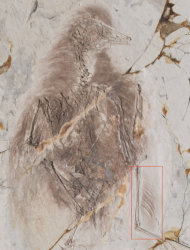
  • Chinese fossils reveal that ancient birds had feathers on their legs.View PhotoChinese fossils reveal that ancient …

More than 100 million years ago, birds living in what is now China sported wings on their legs, a new study of fossils suggests.

Researchers found evidence of large leg feathers in 11 bird specimens from China’s Shandong Tianyu Museum of Nature. The feathers suggest that early birds had four wings, which may have played a role in the evolution of flight, scientists report in a study published today (March 14) in the journal Science.

Most scientists believe that birds evolved from other feathered dinosaurs; this belief is supported by discoveries of fossils of feathery birdlike creatures. In 2000, scientists discovered a nonavian dinosaur with feathers on its arms and legs, called Microraptor, which could probably fly. In addition, specimens of Archaeopteryx, a transitional fossil between modern birds and feathered dinosaurs, show faint featherlike structures on their legs, but the signs are poorly preserved.

Now, leg feathers have been spotted in the 11 museum fossils that had been collected from the Lower Cretaceous Jehol formation in Liaoning, China, from a period about 150 million to 100 million years ago. The feathers are stiff and stick straight out from the birds’ legs, and have a large enough surface area to be aerodynamic, the researchers say.

The fossils belong to at least four different groups, including the genera Sapeornis, Yanornis and Confuciusornis, as well as the Enantiornithes group. The findings suggest that leg feathers weren’t just an evolutionary rarity.

The researchers also analyzed feathers of other birds and nonbird dinosaurs. Feathers covering the entire leg and feet first developed in dinosaurs, continued in early birds and later disappeared, the results imply. Birds gradually lost feathers on their feet and then their legs, and today, modern birds have wings on their arms only.[Avian Ancestors: Dinosaurs That Learned to Fly]

Whether these early birds used their leg feathers to fly, and how they may have done so, is up for debate. According to the study researchers, the flat surface formed by the stiff perpendicular feathers could have provided lift and maneuverability.

“These new fossils ?ll in many gaps in our view of the early evolution of birds,” animal flight expert David Alexander of the University of Kansas, Lawrence, who was not involved in the study, told Science magazine. Alexander agrees that the feathers probably had some aerodynamic function, “although whether as stabilizers, steering vanes, or full-blown wings remains to be seen.”

Other scientists aren’t convinced. Paleontologist Kevin Padian of the University of California, Berkeley, told Science magazine that the authors don’t provide evidence that the feathers contributed to any sort of flight. In fact, the feathers would create drag that would hinder flight, Padian said. The birds may have used their plumes for courtship instead, another scientist suggested.

More studies are needed to nail down the feathers’ function. Examining more fossils from the thousands in the museum collection will help, the study’s authors say.

Tanya Lewis LiveScience Staff Writer

Cyrus the Great Cylinder – Legacy Of The Ancients

Posted: March 13, 2013 by phaedrap1 in News
Tags:

The Cyrus Cylinder, sometimes referred to as the first “bill of human rights,” traces its origins to the Persian king Cyrus the Great’s conquest of Babylon in the sixth century B.C.

Almost 2,600 years later, its remarkable legacy continues to shape contemporary political debates, cultural rhetoric and philosophy.

One of the most celebrated objects in world history makes its U.S. debut March 9 when “The Cyrus Cylinder and Ancient Persia” opens at the Arthur M. Sackler Gallery.


On loan from the British Museum, the Cylinder will be on view at the Sackler through April 28, travelling afterwards to Houston, New York, San Francisco and Los Angeles.


Click on image to enlargePersian Empire Map During King Cyrus The Great

“You could almost say that the Cyrus Cylinder is a history of the Middle East in one object, creating a link to a past that we all share and to a key moment in history that has shaped the world around us,” said Neil MacGregor, director of the British Museum.

“Objects are uniquely able to speak across time and space, and this object must be shared as widely as possible.”


In this text, a clay cylinder now in the British Museum, Cyrus describes how he conquers the old city. Nabonidus is considered a tyrant with strange religious ideas, which causes the god Marduk to intervene. That Cyrus thought of himself as chosen by a supreme god, is confirmed by Second Isaiah; h is claim that he entered the city without struggle corroborates the same statement in the Chronicle of Nabonidus.

The Cylinder—a football-sized, barrel-shaped clay object covered in Babylonian cuneiform, one of the earliest written languages—announced Cyrus’ victory and his intention to allow freedom of worship to communities displaced by the defeated ruler Nabonidus. At the time, such declarations were not uncommon, but Cyrus’ was unique in its nature and scope.


When contextualized with other contemporary sources, such as the Bible’s Book of Ezra, it becomes evident that Cyrus allowed displaced Jews to return to Jerusalem.

“One of the goals of this exhibition is to encourage us to reflect that relations between Persians and Jews have not always been marked by the discord that disfigures the political map of the Near East today,” said Julian Raby, The Dame Jillian Sackler Director of the Arthur M. Sackler Gallery and the Freer Gallery of Art.

“Cyrus was the very image of a virtuous rule¬—inspiring leaders from Alexander the Great to Thomas Jefferson—so it is apt that the first time it will be seen in the West is in Washington, D.C.”


Under Cyrus (ca. 580–530 B.C.), the Persian Empire became the largest and most diverse the world had known to that point. Subsequent generations of rulers considered it to be the ideal example of unified governance across multiple cultures, languages and vast distances.


Cyrus – The Great Of Persia

Cyrus’ declarations of tolerance, justice and religious freedom provided inspiration for generations of philosophers and policymakers, from Ancient Greece to the Renaissance, and from the Founding Fathers to modern-day Iran, so much so that a copy now resides in the United Nations’ headquarters in New York.

The message of the Cylinder and the larger legacy of Cyrus’ leadership have been appropriated and reinterpreted over millenia, beginning with its creators. The Babylonian scribe who engraved the Cylinder attributed Cyrus’ victory to the Babylonian god Marduk, a stroke of what could be considered royal and religious propaganda.

In the fourth century B.C., the Greek historian Xenophon wrote Cyropaedia, a text that romanticizes the philosophies and education of Cyrus as the ideal ruler, which greatly influenced both Alexander the Great and, much later, Thomas Jefferson in his creation of the Declaration of Independence.

When the Cylinder was rediscovered in 1879, it immediately entered the fray of public debate as invaluable proof of the historical veracity of events described in biblical scripture. In the early 20th century, supporters of the creation of the state of Israel compared the actions of British King George V to those of Cyrus, allowing Jews to return to Jerusalem. When the Cylinder was loaned to Iran in 2010, it was viewed by more than 1 million people, one of the most visited exhibitions in the country’s history.

“The Cyrus Cylinder and Ancient Persia” includes related objects that highlight some of the artistic, cultural and historical achievements of the Achaemenid Empire (550–330 B.C.) of Iran, such as architectural fragments, finely carved seals and luxury objects from the Oxus Treasure.

© MessageToEagle.com