Archive for the ‘Science’ Category

The oldest ancient Maya ceremonial compound ever discovered in the Central American lowlands dates back 200 years before similar sites pop up elsewhere in the region, archaeologists announced today (April 25). The recently excavated plaza and pyramid would have likely served as a solar observatory for rituals.

The finding at a site called Ceibal suggests that the origins of the Maya civilization are more complex than first believed. Archaeologists hotly debate whether the Maya – famous for their complex calendar system that spurred apocalypse rumors last year – developed independently or whether they were largely inspired by an earlier culture known as the Olmec. The new research suggests the answer is neither.

“This major social change happened through interregional interactions,” said study researcher Takeshi Inomata, an anthropologist at the University of Arizona. But it doesn’t look like the Olmec inspired the Maya, Inomata told reporters. Rather, the entire region went through a cultural shift around 1000 B.C., with all nearby cultures adopting similar architectural and ceremonial styles. [See Images of the Ancient Maya Observatory]

“It’s signaling to us that the Maya were not receiving this sophisticated stuff 500 years later from somebody else, but much of the innovation we’re seeing out of the whole region may be coming out of Ceibal or a place like Ceibal,” said Walter Witschey, an anthropologist at Longwood University in Virginia, who was not involved in the study.
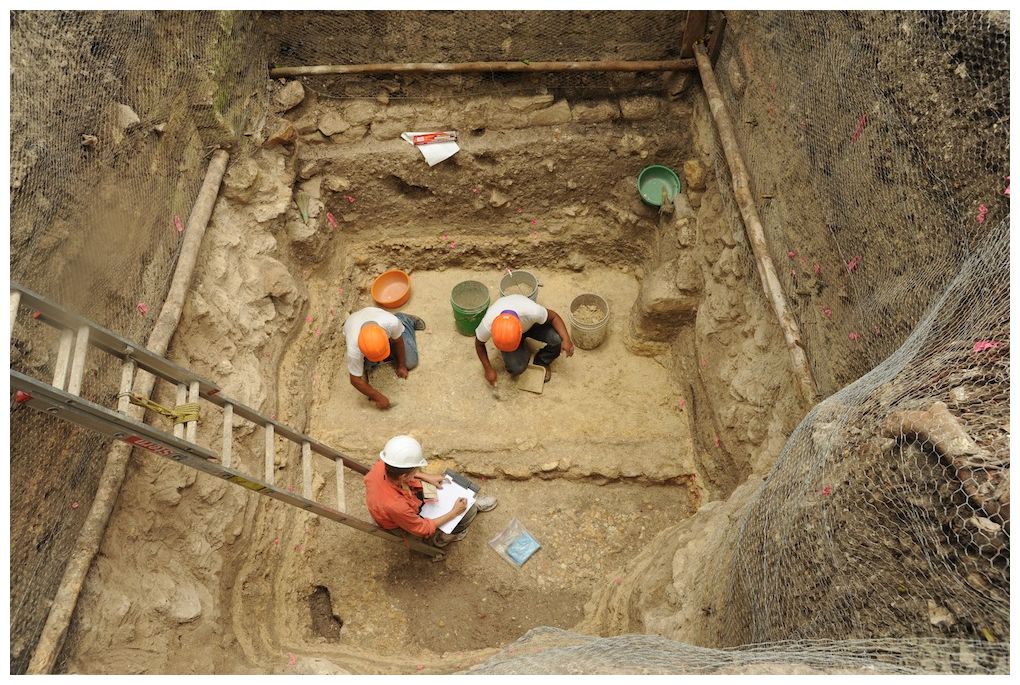
Residential Structures

© Takeshi Inomata
Archaeologists uncover some of the earliest residences in Ceibal. The oldest layers of the city were buried under 23 to 60 feet (7 to 18 meters) of dirt and later construction.

Oldest ritual compound

The finding comes from seven years of archaeological excavations at Ceibal, a site in central Guatemala that was occupied continuously for 2,000 years. Getting to Ceibal’s origins was no small feat: The earliest buildings were buried under 23 to 60 feet (7 to 18 meters) of sediment and later construction, said study co-researcher Daniela Triadan, also a University of Arizona anthropologist.

The earliest structures recently discovered include a plaza with a western building and an eastern platform, a pattern seen at later Maya sites and also at the Olmec center of La Venta on the Gulf Coast of what is now Mexico. The researchers used radiocarbon dating to peg the date of construction to about 1000 B.C. This technique analyzes organic materials for carbon-14, an isotope or variation of carbon that decays predictably. As such, carbon-14 acts as a chemical clock archaeologists can use to figure out how long something has been in the ground.

A construction date of 1000 B.C. makes the Ceibal structures about 200 years older than those at La Venta, meaning the Olmec’s construction practices couldn’t have inspired the Mayans, the researchers report Thursday (April 25) in the journal Science. Instead, it appears that the entire region underwent a shift around this time, with groups adopting each other’s architecture and rituals, modifying them and inventing new additions.

“We are saying there was this connection with various groups, but we are saying it was probably not one directional influence,” Inomata said.

There was an earlier Olmec center, San Lorenzo, which declined around 1150 B.C., but residents there did not build these distinctive ceremonial structures. By 850 B.C. or 800 B.C., the Maya at Ceibal had renovated their platform into a pyramid, which they continued refining until it reached a height of about 20 to 26 feet (6 to 8 m) by 700 B.C.

Starting a civilization

This early phase of Maya culture occurs before the group developed written language and before any record of their elaborate calendar system, so little is known about their beliefs, Inomata said. But the pyramid-and-plaza area was almost certainly a space for rituals. Among the artifacts found in the plaza are numerous greenstone axes, which seem to have been put there as offerings.

The architecture layout is what’s known as a “group-E assemblage,” said Witschey. These assemblages appear all over the Maya world and worked as solar observatories. From the western building, a view could stand and look at the eastern platform or pyramid, which would have posts at each end and at the center. On the summer solstice, the sunrise would occur over the northernmost marker; on the spring and fall equinoxes, it would be right over the center marker; and finally, on the winter solstice, the sun would rise over the southernmost marker, Witschey said.

“The first people who settled at Ceibal had, already, a well-developed idea about what a village would look like,” Triadan said. “The transition from a mobile hunter-gatherer and horticultural lifestyle to permanently settled agriculturalists was rapid.”

It’s not clear what might have prompted the lowland Maya to give up their semi-settled life for permanent villages and cities, Inomata said. One possibility is that maize production became more efficient around 1000 B.C. The coastal Olmec people had long been able to grow maize reasonably well, given fertile soil from rivers feeding into the Gulf of Mexico. But the Maya lowlands were less wet and less fertile, with fewer fish and fowl that the Olmec could have depended on to round out their diets. If maize farming became more productive around 1000 B.C., however, it may have prompted the Maya to start staying put.

“At that point, it probably made sense to cut down many forest trees in the Maya lowlands and then commit more strongly to an agricultural way of life,” Inomata said.

Members of the research team are currently working on environmental analysis to try to better understand the climate and weather of the area around the time of settlement. What does seem clear, Inomata said, is that Maya civilization didn’t have to arise from an earlier, failing civilization.

“This study is not just a study about this specific civilization,” he said. “We also want to think about how human society changed and how human society develops.”

What the Maya findings suggest is that a new civilization doesn’t have to arise from the dust of a previous one, but can happen through the interaction of multiple groups trading ideas, Inomata said.

“What they’re reminding us is how much the jungle still hides, how much more there is to learn and how complex a story of the evolution of this civilization we really have on our hands,” Witschey said.

Stephanie Pappas, Senior writer

Live Science

MessageToEagle.com – Four mysterious disk-shaped copper plates were discovered by archaeologists conducting excavations close to a necropolis of the ancient archaeological site just east of the Sea of Galilee, Israel.

Recently, from the fascinating region of the Sea of Galilee (also known as Lake of Tiberias), near the Golan Heights, in the Jordan Rift Valley, northeast Israel, archaeologists reported the discovery of a submerged cone-shaped structure.

Now, the four copper plates – first unearthed during a survey two years ago at Hippos-Sussita – baffle archaeologists working in the area.


Click on image to enlargeThe excavated remains of Hippos, an aerial view. Credits: Michael Eisenberg/Hippos Excavation Project

What was the plates’ true purpose? How old the artifacts are?

Dr. Michael Eisenberg of the Zinman Institute of Archaeology at the University of Haifa, Israel along with other reseachers of the Hippos Excavation Project asks for help:


The four plates, showing the “inner” sides with decorative incisions and apparent nail marks. Courtesy Michael Eisenberg and the Hippos Excavation Project

“Has anyone encountered such plates and if so, do you know if they were set on wooden coffins?”

“They were found in the Hippos necropolis during several surveys”, says Israeli archaeologist Dr. Michael Eisenberg.

He directs the Hippos Excavation Project, which has uncovered remarkably well-preserved monumental remains and artifacts at this ancient mountaintop Greco-Roman city, a site that overlooks the Sea of Galilee.


“None were found during excavation, but all were found very near to robbed and open graves.

It was Dr. Alexander Iermolin, conservator from the institute of Haifa, who first found the pieces during a metal detector survey. They were totally ignored even by us as at first glance they look rather modern.”

The disk-shaped plates, approximately 20 cm in diameter, were found at the necropolis hill located 300 m south of Hippos, feature what appear to be incisions in a decorative pattern on what has been interpreted as their inner sides, with clear marks of nails and a hole in the middle of each.


As the necropolis has not yet been systematically excavated, the age and specific context of the plates could not be determined.


Click on image to enlargeHippos, the main excavation areas. Above and below, aerial views. Credits: Michael Eisenberg/Hippos Excavation Project


Hippos – The temenos south wall. Credits: Michael Eisenberg/Hippos Excavation Project


Credits: Michael Eisenberg/Hippos Excavation Project

According to Dr. Eisenberg, the necropolis is probably dated to the broad Hellenistic-Byzantine time range, as does the nearby Hippos-Sussita polis, which has been extensively excavated.
However, the plates were found outside of graves, not inside, so it is difficult to determine the provenance as they could not be associated with surrounding artifacts and human remains within the internments.

“The plates seemed to have been thrown out of the graves by ancient robbers,” says Dr. Eisenberg, who suspects that the relics were first exposed as a result of looting.

They may not be the only extant examples. “One similar plate was located recently in the Israeli treasury department, but without any context”, says Eisenberg.

The mystery surrounding the relics still remains.

Rosemary Aroma May Help You Remember to Do Things

Posted: April 16, 2013 by phaedrap1 in Science
Tags:
The aroma of rosemary essential oil may improve prospective memory in healthy adults.

This is the finding of a study conducted by Jemma McCready and Dr Mark Moss from the University of Northumbria. The findings presented today, Tuesday 9 April, at the Annual Conference of the British Psychological Society in Harrogate, suggest that this essential oil may enhance the ability to remember events and to remember to complete tasks at particular times in the future.

Dr Mark Moss said: “We wanted to build on our previous research that indicated rosemary aroma improved long-term memory and mental arithmetic. In this study we focused on prospective memory, which involves the ability to remember events that will occur in the future and to remember to complete tasks at particular times this is critical for everyday functioning. For example when someone needs to remember to post a birthday card or to take medication at a particular time.”

Rosemary essential oil was diffused in to a testing room by placing four drops on an aroma stream fan diffuser and switching this on five minutes before the participants entered the room. Sixty-six people took part in the study and were randomly allocated to either the rosemary-scented room or another room with no scent.

In each room participants completed a test designed to assess their prospective memory functions. This included tasks such as hiding objects and asking participants to find them at the end of the test and instructing them to pass a specified object to the researcher at a particular time. All the tasks had to be done with no prompting. If the task was not performed then different degrees of prompting were used. The more prompting that was used the lower the score. Participants also completed questionnaires assessing their mood.

Participants’ blood was also analysed to see if performance levels and changes in mood following exposure to the rosemary aroma were related to concentrations of a compound (1,8-cineole) present in the blood. The compound is also found in the essential oil of rosemary and has previously been shown to act on the biochemical systems that underpin memory.

The results showed that participants in the rosemary-scented room performed better on the prospective memory tasks than the participants in the room with no scent. This was the case for remembering events and remembering to complete tasks at particular times.

Jemma McCready explained: “There was no link between the participants’ mood and memory. This suggests performance is not influenced as a consequence of changes in alertness or arousal.”

The results from the blood analysis found that significantly greater amounts of 1,8-cineole were present in the plasma of those in the rosemary scented room, suggesting that the influence of aroma was mediated pharmacologically.

Jemma McCready said: “These findings may have implications for treating individuals with memory impairments. It supports our previous research indicating that the aroma of rosemary essential oil can enhance cognitive functioning in healthy adults, here extending to the ability to remember events and to complete tasks in the future. Remembering when and where to go and for what reasons underpins everything we do, and we all suffer minor failings that can be frustrating and sometimes dangerous. Further research is needed to investigate if this treatment is useful for older adults who have experienced memory decline.”

Science Daily

Single tree on hillside, late afternoon.

When drought hits, trees can suffer—a process that makes sounds. Now, scientists may have found the key to understanding these cries for help.

In the lab, a team of French scientists has captured the ultrasonic noise made by bubbles forming inside water-stressed trees. Because trees also make noises that aren’t related to drought impacts, scientists hadn’t before been able to discern which sounds are most worrisome. (Watch a video: Drought 101.)

“With this experiment we start to understand the origin of acoustic events in trees,” said Alexandre Ponomarenko, a physicist at Grenoble University in France, whose team conducted the research.

This discovery could help scientists figure out when trees are parched and need emergency watering, added Ponomarenko, who presented his team’s results last month at an American Physical Society meeting in Baltimore, Maryland.

Listening to Trees

To figure out how to listen to trees, the French scientists drew on their knowledge of how trees take in water—essentially by drinking from a really long “straw.”

Inside tree trunks are bundles of specialized tubes called xylem, which rely on the attractive forces between water molecules as well as those between water and plant cells to lift liquid to the highest leaves and branches. (See National Geographic’s tree pictures.)

Because trees are so tall, the liquid in the xylem can be under intense pressure—many times that of the atmosphere around us—but the attractive forces between neighboring water molecules keep the water column intact.

Imagine using a straw to slurp the last few drops from the bottom of your glass: You have to increase the pressure even more. In drought-stricken trees, this increased pressure can cause the water column to break, allowing dissolved air to form bubbles that block water flow.

These events are called cavitations, and while trees can withstand some, too many can be deadly.

Since cavitations can kill trees, scientists and forest managers want to know when they are increasing. (Also see “Pictures: Saving and Studying Tasmania’s Giant Trees.”)

Scientists have known for decades that microphones can pick up the noises that cavitations make. But because they couldn’t see inside the tree, they weren’t certain of the origins of these sounds, which could have resulted from wood creaking or breaking or xylem cells collapsing.

To answer the question, the team put a thin slice of pine wood into a liquid-filled gel capsule to mimic conditions inside a living tree.

The scientists then evaporated water from the gel, simulating a drought. As the wood began cavitating, the scientists filmed bubbles forming while recording with a microphone.

The scientists found that around half the sounds they picked up were associated with cavitations. The rest were from other processes, such as bubbles invading neighboring cells. Most important, the sound waves from each type of event made a distinct pattern. All of them are above the range of human hearing.

The researchers think they can compare sounds from living trees with these patterns, and determine which processes are creating the sounds.

Helping Thirsty Trees

According to Ponomarenko, the findings could lead to the design of a handheld device that allows people to diagnose stressed trees using only microphones.

Such a device may be particularly important if droughts become more common and more severe, as many global warming models predict they will. (Read “The New Dust Bowl” in National Geographic magazine.)

In fact, a study published in Nature last fall suggested that trees in many places—from tropical rain forests in South America to arid woodlands in the U.S. West—already “live on the edge,” meaning their cavitation rate is almost as high as they can sustain.

Ponomarenko’s method could provide an early warning that cavitations are increasing.

For instance, he envisions a device that would attach to a tree and constantly listen for sounds of thirst. If needed, the device could then trigger an emergency-watering system.

Ponomarenko’s research is promising, added Cornell University’s Abe Stroock, whose lab designed the gel capsule the French team used. He said the result “opens a new mode of observation” into cavitation. (See pictures of the 2012 drought that parched much of the United States.)

But he also noted that the wood samples used in the team’s study had to be “excised and abused,” so they don’t necessarily behave exactly like wood in a living tree.

“Translating [these findings] to a living plant and into different species is a lot of work, potentially,” he said.

National Geographic


World`s oldest harbour, hieroglyphic papyri found Cairo: A team of archaeologists in Egypt has unearthed what are believed to be the world’s most ancient harbour and a set of hieroglyphic papyri dating to the third millennium B.C..

“The port of Wadi el-Jarf located on the Red Sea, 180 km south of Suez, dates to around 2,600 B.C. and the reign of King Khufu,” Minister for Antiquities Mohammed Ibrahim said.

It is considered one of the most important ancient Egyptian ports because it was used to transport copper and other minerals from the Sinai Peninsula, Ibrahim said.

“The papyri, which provide detailed accounts of daily life and traditions at the time of the Old Kindgom, are considered the oldest ever found,” he said.

The papyri are currently being studied by experts at the Suez Museum.

The team of French and Egyptian archaeologists also discovered stone anchors at Wadi el-Jarf that were marked with ropes used to tie the ships inside the port.

A collection of stone tools used for cutting ropes, some wooden remains and ropes as well as remains of ancient houses for port workers and 30 caves whose entrances were closed with stone blocks bearing inscriptions of King Khufu were also discovered at the site.

The pharoah King Khufu is credited with building the Great Pyramid of Giza, one of the Seven Wonders of the ancient world.

IANS

Music Activates Same Pleasure Center In The Brain As Sex

Posted: April 14, 2013 by phaedrap1 in Science
Tags:
Image Credit: Accord / Shutterstock

redOrbit Staff & Wire Reports – Your Universe Online

Listening to good music can trigger the same reaction in our brains as eating a good meal, taking a psychoactive drug or enjoying an evening of passion, researchers from McGill University in Montreal claim in a new study.

The research, which was published in the journal Science, reported the nucleus accumbens is the part of the brain that is most closely associated with the enjoyment a person experiences when listening to a pleasant song for the first time.

The nucleus accumbens, which is described by The Telegraph as “the rewards region” of the brain, is located near the center of the organ and is operated by the chemical dopamine. Furthermore, the more the listener enjoyed what he or she was hearing, the stronger the connections in this region of the brain became.

Lead researcher Valorie Salimpoor recruited 126 volunteers, polling each about their musical preferences, and then compiling a list of 60 songs that were unfamiliar to the test subjects. Each participant listened to the first 30 seconds of each song while Salimpoor and her colleagues measured their brain activity using functional magnetic resonance imaging (fMRI), explained National Geographic’s Virginia Hughes.

“To specifically look into brain activity exhibited while people listened to new music they liked, though – rather than any new music at all – the researchers introduced a twist: Each of the 19 study participants were able to buy any of the songs afterward, with real money,” Joseph Stromberg of Smithsonian.com said. “By including this step, the scientists had an objective measure of which songs each of the participants truly enjoyed and deemed worth purchasing.”

The purchase program was set-up like an auction in that study participants were allowed to place “bids” as to how much they would be willing to pay for each tune – essentially linking a dollar value to how much pleasure they derived from each piece of music. The more a person was willing to spend to buy a song, the greater the level of activity in the nucleus accumbens when it was first played, Stromberg said, suggesting this particular region of the brain was vital for the pleasure a person experiences when hearing good music for the first time.

“When people listen to a piece of music they have never heard before, activity in one brain region can reliably and consistently predict whether they will like or buy it, this is the nucleus accumbens which is involved in forming expectations that may be rewarding,” Salimpoor told The Telegraph. “What makes music so emotionally powerful is the creation of expectations. Activity in the nucleus accumbens is an indicator that expectations were met or surpassed, and in our study we found the more activity we see in this brain area while people are listening to music, the more money they are willing to spend.”

The inspiration for the study, Salimpoor told Hughes, was an experience she had while driving a vehicle and listening to the radio. The researcher said she was feeling uncertain about her future, particularly the type of career she wanted or how she would use her undergraduate training in neuroscience, when she heard Johannes Brahms’s Hungarian Dance No. 5 for the very first time.

“This piece of music came on, and something just happened. I just felt this rush of emotion come through me. It was so intense,” Salimpoor told National Geographic. She said she pulled over and listened to the song, and once it was over, she then began to wonder about the impact that listening to the song had on her mood. “I was thinking, wow, what just happened? A few minutes ago I was so depressed, and now I’m euphoric. I decided that I had to figure out how this happened – that that’s what I’m going to do with the rest of my life.”

MessageToEagle.com – The g-tummo meditative practice controls “inner energy” and is considered by Tibetan practitioners as one of the most sacred spiritual practices in the region.

Monasteries maintaining g-tummo traditions are very rare and are mostly located in the remote areas of eastern Tibet. Now, a group of researchers can show for the first time that it is possible for core body temperature to be controlled by the brain.

The scientists, led by Associate Professor Maria Kozhevnikov from the Department of Psychology at the National University of Singapore (NUS) Faculty of Arts and Social Sciences found that core body temperature increases can be achieved using certain meditation techniques (g-tummo) which could help in boosting immunity to fight infectious diseases or immunodeficiency.

Published in science journal PLOS ONE in March 2013, the study documented reliable core body temperature increases for the first time in Tibetan nuns practising g-tummo meditation. Previous studies on g-tummo meditators showed only increases in peripheral body temperature in the fingers and toes.

The researchers collected data during the unique ceremony in Tibet, where nuns were able to raise their core body temperature and dry up wet sheets wrapped around their bodies in the cold Himalayan weather (-25 degree Celsius) while meditating.Using electroencephalography (EEG) recordings and temperature measures, the team observed increases in core body temperature up to 38.3 degree Celsius. A second study was conducted with Western participants who used a breathing technique of the g-tummo meditative practice and they were also able to increase their core body temperature, within limits.

Applications of the research findings

The findings from the study showed that specific aspects of the meditation techniques can be used by non-meditators to regulate their body temperature through breathing and mental imagery.

The techniques could potentially allow practitioners to adapt to and function in cold environments, improve resistance to infections, boost cognitive performance by speeding up response time and reduce performance problems associated with decreased body temperature.


The two aspects of g-tummo meditation that lead to temperature increases are “vase breath” and concentrative visualisation.

“Vase breath” is a specific breathing technique which causes thermogenesis, which is a process of heat production. The other technique, concentrative visualisation, involves focusing on a mental imagery of flames along the spinal cord in order to prevent heat losses.

Both techniques work in conjunction leading to elevated temperatures up to the moderate fever zone.

Assoc Prof Kozhevnikov explained, “Practicing vase breathing alone is a safe technique to regulate core body temperature in a normal range. The participants whom I taught this technique to were able to elevate their body temperature, within limits, and reported feeling more energised and focused. With further research, non-Tibetan meditators could use vase breathing to improve their health and regulate cognitive performance.”

MessageToEagle.com

When filmmaker Carla MacKinnon started waking up several times a week unable to move, with the sense that a disturbing presence was in the room with her, she didn’t call up her local ghost hunter. She got researching.

Now, that research is becoming a short film and multiplatform art project exploring the strange and spooky phenomenon of sleep paralysis. The film, supported by the Wellcome Trust and set to screen at the Royal College of Arts in London, will debut in May.

Sleep paralysis happens when people become conscious while their muscles remain in the ultra-relaxed state that prevents them from acting out their dreams. The experience can be quite terrifying, with many people hallucinating a malevolent presence nearby, or even an attacker suffocating them. Surveys put the number of sleep paralysis sufferers between about 5 percent and 60 percent of the population.

“I was getting quite a lot of sleep paralysis over the summer, quite frequently, and I became quite interested in what was happening, what medically or scientifically, it was all about,” MacKinnon said.

Her questions led her to talk with psychologists and scientists, as well as to people who experience the phenomenon. Myths and legends about sleep paralysis persist all over the globe, from the incubus and succubus (male and female demons, respectively) of European tales to a pink dolphin-turned-nighttime seducer in Brazil. Some of the stories MacKinnon uncovered reveal why these myths are so chilling.

Sleep stories

One man told her about his frequent sleep paralysis episodes, during which he’d experience extremely realistic hallucinations of a young child, skipping around the bed and singing nursery rhymes. Sometimes, the child would sit on his pillow and talk to him. One night, the tot asked the man a personal question. When he refused to answer, the child transformed into a “horrendous demon,” MacKinnon said.

For another man, who had the sleep disorder narcolepsy (which can make sleep paralysis more common), his dream world clashed with the real world in a horrifying way. His sleep paralysis episodes typically included hallucinations that someone else was in his house or his room — he’d hear voices or banging around. One night, he awoke in a paralyzed state and saw a figure in his room as usual.

“He suddenly realizes something is different,” MacKinnon said. “He suddenly realizes that he is in sleep paralysis, and his eyes are open, but the person who is in the room is in his room in real life.”

The figure was no dream demon, but an actual burglar.

Myths and science of sleep paralysis

Sleep paralysis experiences are almost certainly behind the myths of the incubus and succubus, demons thought have sex with unsuspecting humans in their sleep. In many cases, MacKinnon said, the science of sleep paralysis explains these myths. The feeling of suffocating or someone pushing down on the chest that often occurs during sleep paralysis may be a result of the automatic breathing pattern people fall into during sleep. When they become conscious while still in this breathing pattern, people may try to bring their breathing under voluntary control, leading to the feeling of suffocating.

Add to that the hallucinations that seem to seep in from the dream world, and it’s no surprise that interpretations lend themselves to demons, ghosts or even alien abduction, MacKinnon said.

What’s more, MacKinnon said, sleep paralysis is more likely when your sleep is disrupted in some way — perhaps because you’ve been traveling, you’re too hot or too cold, or you’re sleeping in an unfamiliar or spooky place. Those tendencies may make it more likely that a person will experience sleep paralysis when already vulnerable to thoughts of ghosts and ghouls.

“It’s interesting seeing how these scientific narratives and the more psychoanalytical or psychological narratives can support each other rather than conflict,” MacKinnon said.

Since working on the project, MacKinnon has been able to bring her own sleep paralysis episodes under control — or at least learned to calm herself during them. The trick, she said, is to use episodes like a form of research, by paying attention to details like how her hands feel and what position she’s in. This sort of mindfulness tends to make scary hallucinations blink away, she said.

“Rationalizing it is incredibly counterintuitive,” she said. “It took me a really long time to stop believing that it was real, because it feels so incredibly real.”

By Stephanie Pappas, LiveScience Senior Writer | LiveScience.com

MessageToEagle.com – Are you ready to go on a fascinating journey and explore the matrix?

We will once again discuss the idea that we might live in a computer simulation created by an unknown highly advanced civilization.

This time we will examine the possibility that there could be a number of “faked” universes and if we live in a simulated reality we should expect to see occasional sudden glitches, small drifts in the supposed constants and laws of Nature over time.

As previously stated it is quite possible that our Universe is a gigantic and wonderfully detailed holographic illusion.

Our life, and everything around us might be part of a vast, living and 3D holographic simulation conducted by “someone” invisible and superior to everything known in the universe! Is it the ultimate computer game of the superior ones?

Obviously we have no idea who created this complex simulation, but we can always speculate. Rich Terrell, from the NASA Jet Propulsion Laboratory, California Institute of Technology who has helped to design missions to Mars, discovered four new moons around Saturn, Neptune and Uranus and taken pictures of the distant solar system has his opinion about our creator.

Terrell believes our creator is a cosmic computer programmer.

“One has to think what are the requirements for God? God is an inter-dimensional being connected with everything in the Universe, a creator that is responsible for the Universe and in some way can change the laws of physics, if he wanted to. I think those are good requirements for what God ought to be,” Terrell says.

Using a supercomputer and other calculations, researchers have also discovered that there are striking similarities between the unknown laws that govern the Universe and human brain.

The scientists who conducted the study are not saying we are living in a holographic world, but according to the study, the results are not a coincidence.

“By no means do we claim that the universe is a global brain or a computer,” said study co-author Dmitri Krioukov at the University of California-San Diego.

“But the discovered equivalence between the growth of the universe and complex networks strongly suggests that unexpectedly similar laws govern the dynamics of these very different complex systems.”

According to John D. Barrow, Centre for Mathematical Sciences, Cambridge University we should seriously consider the possibility that our superior programmers could have created several faked universes and these computer simulations can contain errors. In his science paper, Living in a Simulated Universe, John D. Barrow writes ”

Once you take seriously that all possible universes can (or do) exist then a slippery slope opens up before you. It has long been recognised that technical civilisations, only a little more advanced than ourselves, will have the capability to simulate universes in which self-conscious entities can emerge and communicate with one another.

It is probable there are glitches in a simulated realtiy.
They would have computer power that differed from ours by a vast factor. Instead of merely simulating their weather or the formation of galaxies, like we do, they would be able to go further and watch the appearance of stars and planetary systems.

Then, having coupled the rules of biochemistry into their astronomical simulations they would be able to watch the evolution of life and consciousness (all speeded up to occur on whatever timescale was convenient for them). Just as we watch the life cycles of fruit flies they would be able to follow the evolution of life, watch civilisations grow and communicate with each other, argue about whether there existed a Great Programmer in the Sky who created their Universe and who could intervene at will in defiance of the laws of Nature they habitually observed.

Once this capability to simulate universe is achieved, fake universes will proliferate and will soon greatly outnumber the real ones.”

Scientists have announced that they found what can be considered the first evidence of parallel universes.The idea that our Universe could be a small component within a vast assemblage of other universes that together make up a “multiverse” has been treated by physicists as intriguing, but so far it has remained in the realm of theory without any experimental tests that could support it.

That might change now when a team of scientists has found evidence that other universes, as well as our own actually lie within “bubbles” of space and time.

“The multiverse scenario was suggested by some cosmologists as a way to avoid the conclusion that the Universe was specially designed for life by a Grand Designer.

Others saw it as a way to avoid having to say anything more about the problem of fine tuning at all.

We see that once conscious observers are allowed to intervene in the universe, rather than being merely lumped into the category of ‘observers’ who do nothing, that we end up with a scenario in which the gods reappear in unlimited numbers in the guise of the simulators who have power of life and death over the simulated realities that they bring into being. The simulators determine the laws, and can change the laws, that govern their worlds. They can engineer anthropic fine-tunings

Our lives and destiny can be decided by our creators. Image: Prometheus movie
They can pull the plug on the simulation at any moment, intervene or distance themselves from their simulation; watch as the simulated creatures argue about whether there is a god who controls of intervenes; work miracles or impose their ethical principles upon the simulated reality. All the time they can avoid having even a twinge of conscience about hurting anyone because their toy reality isn’t real, is it? They can even watch their simulated realities grow to a level of sophistication that allows them to simulate higher-order realities of their own.

Faced with these perplexities do we have any chance of winnowing fake realities from true?

What we might expect to see if we made scientific observations from within a simulated reality?

Firstly, the simulators will have been tempted to avoid the complexity of using a consistent set of laws of Nature in their worlds when they can simply patch in “realistic” effects, “John D. Barrow explains.

John D. Barrow points out that even the most intelligent programmers would create programs with errors and it is a matter of time before we detect what he calls “glitches”.

“Even if the simulators were scrupulous about simulating the laws of Nature, there would be limits to what they could do.

Assuming the simulators, or at least the early generations of them, have a very advanced knowledge of the laws of Nature, it’s likely they would still have incomplete knowledge of them (some philosophers of science would argue this must always be the case). They may know a lot about the physics and programming needed to simulate a universe but there will be gaps or, worse still, errors in their knowledge of the laws of Nature.

They would of course be subtle and far from obvious, otherwise our “advanced” civilisation wouldn’t be advanced. These lacunae do not prevent simulations being created and running smoothly for long periods of time. But gradually the little flaws will begin to build up.

Eventually, their effects would snowball and these realities would cease to compute. The only escape is if their creators intervene to patch up the problems one by one as they arise. This is a solution that will be very familiar to the owner of any home computer who receives regular updates in order to protect it against new forms of invasion or repair gaps that its original creators had not foreseen.

The creators of a simulation could offer this type of temporary protection, updating the working laws of Nature to include extra things they had learnt since the simulation was initiated.

In this kind of situation, logical contradictions will inevitably arise and the laws in the simulations will appear to break down now and again. The inhabitants of the simulation – especially the simulated scientists – will occasionally be puzzled by the experimental results they obtain. The simulated astronomers might, for instance, make observations that show that their so-called constants of Nature are very slowly changing7.

Can strange stories of people vanishing into thin air be explained as glitches in the simulation?
It’s likely there could even be sudden glitches in the laws that govern these simulated realities. This is because the simulators would most likely use a technique that has been found effective in all other simulations of complex systems: the use of error-correcting codes to put things back on track.

Take our genetic code, for example. If it were left to its own devices we would not last very long. Errors would accumulate and death and mutation would quickly follow. We are protected from this by the existence of a mechanism for error correction that identifies and corrects mistakes in genetic coding. Many of our complex computer systems possess the same type of internal ‘spell-checker’ to guard against error accumulation.

If the simulators used error-correcting computer codes to guard against the fallibility of their simulations as a whole (as well as simulating them on a smaller scale in our genetic code) then every so often a correction would take place to the state or the laws governing the simulation.

Are we just participating in a simulated game?
Mysterious sudden changes would occur that would appear to contravene the very laws of Nature that the simulated scientists were in the habit of observing and predicting.

So we conclude that if we live in a simulated reality we should expect occasional sudden glitches, small drifts in the supposed constants and laws of Nature over time, and a dawning realisation that the flaws of Nature are as important as the laws of Nature for our understanding of true reality,” John D. Barrow says.

The holographic universe theory remains fascinating, not only to the public, but also to physicists and other scientists. That is why a team of physicists at the University of Washington has come up with a potential test to see if we truly live in a matrix.

Are you ready to find out the truth?

© MessageToEagle.com

The discovery in Chattisgarh is being billed as India’s biggest archaeological find in at least half a century
New Delhi: Explorers claim they have evidence of a 2,500-year-old planned city—complete with water reservoirs, roads, seals and coins—buried in Chhattisgarh, a discovery that is being billed as the nation’s biggest archaeological find in at least half a century.
The discoveries were made from Tarighat in Durg district and spanned five acres of a sparsely inhabited region beside a river, according to archaeologists from the state’s department of culture and archaeology.
“As of now, we have four 15ft high mounds around which we have evidence of pottery, coins and some terracotta figures,” said J.R. Bhagat, deputy director in the department. “Once we begin, the entire digging could take at least 5-10 years.”
The 5th and 3rd century BC—to which the Tarighat finds date—points to a period when the region was ruled by the Kushan and Satavahana dynasties in central India. While there have been extensive, previous evidence of urban growth after the first century, such finds are extremely rare for preceding periods.
“These were among the most interesting times in early India,” said Abhijit Dandekar, an archaeologist at the Deccan College, Pune. “It was the end of the period of the 16 mahajanapadas (loosely translated to great kingdoms) when the Mahabharata was supposedly set, and the beginning of the Maurya empire. There’s very little known about urban structures in this period, in regions spanning modern-day Madhya Pradesh and Chhattisgarh.”
Dandekar, who is not involved in these finds, added that evidence of towns and urbanization spanning five acres was quite significant in an Indian context, though only excavations and peer review would throw true light on the import of these findings.
He added that the excavations at Ahichhatra, near Bareilly in Uttar Pradesh, that began in 1960s were the most recent evidence of large-scale town planning in India for a comparable period and, if the Chattisgarh findings were as extensive, then it would be a significant find.
“In an Indian context, an excavation has rarely been disappointing,” said Dandekar. “If you believed there’s a city, it usually turns out to be one and bigger than what you first expected.”
To be sure, Bhagat clarified that the finds still haven’t been dated using methods such as radiocarbon or thermoluminescence dating—modern, established techniques that measure the amount of carbon or the relative proportions of other elements from which exact ages of materials are deduced—but he added that the texture of the pots, the typical pattern of raised mounds etc all pointed to evidence of an urban agglomeration.
“The kind of pottery called the Red and Black Northern Pottery, the coins, etc., at the surface of the site itself show very visible signs of complex urbanization.”
Arun Raj, a Chhattisgarh-based archaeologist with the Archaeological Survey of India, characterized Chhattisgarh as being an untapped “gold mine” for archaeology.
“We’ve just given them permission for this dig, and I think it will be some time before we understand how important this is,” Raj said. “But this region, which has been relatively unexplored due to Naxalite conflict, could throw up several such finds.”
He added that one strand of Indian archaeological research sought to find common threads urban lifestyle patterns of the Indus Valley civilization that declined around 1300 BC, to urban formations in central India. “This may possibly falsify or add more credibility to such theories,” he said.
Jacob P. Koshy
Livemint.com