Archive for the ‘Occult’ Category
Chaldean Astrology/Astronomy (The Great Chaldeans Invented Astronomy)
Posted: December 29, 2012 by phaedrap1 in Occult, videosTags: Astrology
The Seven Sermons to the Dead Septem Sermones ad Mortuos by Carl Gustav Jung, 1916 (Translation by H. G. Baynes)
Posted: December 28, 2012 by phaedrap1 in Occult, Spirituality, TextsTags: CG Jung
“The Seven Sermons to the Dead,” Septem Sermones ad Mortuos, might best be described as the “summary revelation of the Red Book.” It is the only portion of the imaginative material contained in the Red Book manuscripts that C.G. Jung shared more or less publicly during his lifetime. To comprehend the importance of the Septem Sermones, one must understand the events behind the writing of the Red Book itself — a task ultimately facilitated by the epochal publication of Jung’s Red Book in October of 2009 (C. G. Jung, The Red Book: Liber Novus, ed. Sonu Shamdasani, Norton, 2009). Dr. Shamdasani’s extensive introduction and notes on the text of the Red Book provide a wealth of previously unavailable primary documentation on this crucial period of Jung’s life.
In November of 1913 Carl Jung commenced an extraordinary exploration of the psyche, or “soul.” He called it his “confrontation with the unconscious.” During this period Jung willfully entered imaginative or “visionary” states of consciousness. The visions continued intensely from the end of 1913 until about 1917 and then abated by around 1923. Jung carefully recorded this imaginative journey in six black-covered personal journals (referred to as the “Black Books”); these notebooks provide a dated chronological ledger of his visions and dialogues with his Soul.

The Red Book – Liber Novus |
Beginning in late 1914, Jung began transcribing from the Black Book journals the draft manuscript of his legendary Red Book, the folio-sized leather bound illuminated volume he created to contain the formal record of his journey. Jung repeatedly stated that the visions and imaginative experiences recorded in the Red Book contained the nucleus of all his later works.
Jung kept the Red Book private during his lifetime, allowing only a few of his family and associates to read from it. The only part of this visionary material that Jung choose to release in limited circulation was the Septem Sermones, which he had privately printed in 1916. (Click to see a page from the original printing) Throughout his life Jung occasionally gave copies of this small book to friends and students, but it was available only as a gift from Jung himself and never offered for public sale or distribution. When Jung’s autobiographical memoir Memories, Dreams, Reflections was published in 1962, the Septem Sermones ad Mortuos was included as an appendix.
It remained unclear until very recently exactly how the Septem Sermones ad Mortuos related to the hidden Red Book materials. After Jung’s death in 1961, all access to the Red Book was denied by his heirs. Finally in October of 2009, nearly fifty years after Jung’s death, the family of C. G. Jung release the Red Book for publication in a beautiful facsimile edition, edited by Sonu Shamdasani. With this central work of Jung’s now in hand, we discover that the Seven Sermons to the Dead actually compose the closing pages of the Red Book draft manuscripts; the version transcribed for the Red Book varies only slightly from the text published in 1916, however the Red Book includes after each of the sermons an additional amplifying homily by Philemon (Jung’s spirit guide). [The Red Book, p346-54]
Base on their context, voice, content, and history, I suggest the Septem Sermones ad Mortuos might now properly be described as the “summary revelation of the Red Book.” Seen in this light, it becomes understandable why Jung chose this one section of his “revelations” for printing and distribution among his disciples.
Near the end of his life, Jung spoke to Aniela Jaffe about the Septem Sermones and explained “that the discussions with the dead [in the Seven Sermons] formed the prelude to what he would subsequently communicate to the world, and that their content anticipated his later books. ‘From that time on, the dead have become ever more distinct for me as the voices of the unanswered. unresolved and unredeemed.’ ” [The Red Book, p346 n78] Jung’s decision in 1916 to publish this single summary statement from the Red Book writings gives evidence of the importance he ascribed to the Seven Sermons. In this same context, Jung remarked to Aniela Jaffe:
The years … when I pursued the inner images were the most important time of my life. Everything else is to be derived from this. It began at that time, and the later details hardly matter anymore. My entire life consisted in elaborating what had burst forth from the unconscious and flooded me like an enigmatic stream and threatened to break me. That was the stuff and material for more than only one life.
Everything later was merely the outer classification, the scientific elaboration, and the integration into life. But the numinous beginning, which contained everything, was then.”
In Memories, Dreams, Reflections Jung gives one account of how the Septem Sermones came to be written (the Sunday referred to below is probably Sunday, 30 January 1916):
It began with a restlessness, but I did not know what it meant or what “they” wanted of me. There was an ominous atmosphere all around me. I had the strange feeling that the air was filled with ghostly entities. Then it was as if my house began to be haunted….
Around five o’clock in the afternoon on Sunday the front doorbell began ringing frantically…but there was no one in sight. I was sitting near the doorbell, and not only heard it but saw it moving. We all simply stared at one another. The atmosphere was thick, believe me! Then I knew that something had to happen. The whole house was filled as if there were a crowd present, crammed full of spirits. They were packed deep right up to the door, and the air was so thick it was scarcely possible to breathe. As for myself, I was all a-quiver with the question: “For God’s sake, what in the world is this?” Then they cried out in chorus, “We have come back from Jerusalem where we found not what we sought/’ That is the beginning of the Septem Sermones. (Memories, Dreams, Reflections, p190-1)
A careful reading of The Red Book (including the abundant notes provided by the editor, Sonu Shamdasani) provides further contextual information. Shamdasani includes in the appendix a crucial journal entry from Jung’s Black Book 5, dated 16 January 1916 [The Red Book, Appendix C, p370-1]. In this entry, Jung’s Soul reveals to him the cosmological vision that will be more fully developed two weeks later in the Seven Sermons to the Dead. During these weeks Jung sketched in his journal the outlines of his first “mandala”, the Systema Munditotius, which forms a schema to the vision conveyed in the Sermons [The Red Book, Appendix A, p363-4]. The Seven Sermons are recorded in journal entries in Black Book 6, dated 31 January to 8 February 1916.
In the original journal account of the revelation (Black Book 6) Jung himself is the voice speaking the Seven Sermons to the Dead. In the version transcribed into the Red Book manuscript, Jung gives Philemon as the voice speaking the Sermons. Interestingly, a few pages later, on the last page of the Red Book manuscript, Philemon is identified with the historical Gnostic prophet Simon Magus. When Jung subsequently transcribed the Sermons for printing as an independent text, the Sermons were attributed pseudepigraphically to yet another historical second century Gnostic teacher, Basilides of Alexandria. Thus Jung, Philemon, Simon Magus, and Basilides are all finally conflated together in the voice of the Gnostic prophet who speaks the Septem Sermones ad Mortuos.
Jung and Gnostic Tradition
For a further introduction to Jung and Gnostic tradition, read the introductory excerpt from The Gnostic Jung and the Seven Sermons to the Dead by Stephan A. Hoeller: The Gnosis of C. G. Jung.
Translations
Two English translations of the text are available in our library. The first translation (below) by H. G Baynes is the version published as an appendix in Memories, Dreams, Reflections. The second translation was made by Stephan A. Hoeller based on his transcription of a private copy of the Septem Sermones ad Mortuos which came to him in 1949. It is found in his book, The Gnostic Jung and the Seven Sermons to the Dead, and is included here by permission of the author.
The translation by Dr. Hoeller is recommended to readers — Click here for the Hoeller translation of The Seven Sermons to the Dead.
The most compete version of the material surrounding the Septem Sermones is found in C. G. Jung, The Red Book: Liber Novus. It should be remembered, however, that this primary version remained hidden and largely unknown until very recently. Students of Jung are encouraged to again consider the text of the Septem Sermones as published and shared by Jung — this is the signal revelation of Jung’s hidden vision.
– Lance S. Owens
VII Sermones ad Mortuos
(Seven Sermons to the Dead)
C.G. Jung, 1916
(Translation by H. G. Baynes)
THE SEVEN SERMONS TO THE DEAD
WRITTEN BY BASILIDES IN ALEXANDRIA,
THE CITY WHERE THE EAST
TOUCHETH THE WEST.Sermo I
The dead came back from Jerusalem, where they found not what they sought. They prayed me let them in and besought my word, and thus I began my teaching.
Harken: I begin with nothingness. Nothingness is the same as fullness. In infinity full is no better than empty. Nothingness is both empty and full. As well might ye say anything else of nothingness, as for instance, white is it, or black, or again, it is not, or it is. A thing that is infinite and eternal hath no qualities, since it hath all qualities.
This nothingness or fullness we name the PLEROMA. Therein both thinking and being cease, since the eternal and infinite possess no qualities. In it no being is, for he then would be distinct from the pleroma, and would possess qualities which would distinguish him as something distinct from the pleroma.
In the pleroma there is nothing and everything. It is quite fruitless to think about the pleroma, for this would mean self-dissolution.
CREATURA is not in the pleroma, but in itself. The pleroma is both beginning and end of created beings. It pervadeth them, as the light of the sun everywhere pervadeth the air. Although the pleroma pervadeth altogether, yet hath created being no share thereof, just as a wholly transparent body becometh neither light nor dark through the light which pervadeth it. We are, however, the pleroma itself, for we are a part of the eternal and infinite. But we have no share thereof, as we are from the pleroma infinitely removed; not spiritually or temporally, but essentially, since we are distinguished from the pleroma in our essence as creatura, which is confined within time and space.
Yet because we are parts of the pleroma, the pleroma is also in us. Even in the smallest point is the pleroma endless, eternal, and entire, since small and great are qualities which are contained in it. It is that nothingness which is everywhere whole and continuous. Only figuratively, therefore, do I speak of created being as a part of the pleroma. Because, actually, the pleroma is nowhere divided, since it is nothingness. We are also the whole pleroma, because, figuratively, the pleroma is the smallest point (assumed only, not existing) in us and the boundless firmament about us. But wherefore, then, do we speak of the pleroma at all, since it is thus everything and nothing?
I speak of it to make a beginning somewhere, and also to free you from the delusion that somewhere, either without or within, there standeth something fixed, or in some way established, from the beginning. Every so-called fixed and certain thing is only relative. That alone is fixed and certain which is subject to change.
What is changeable, however, is creatura. Therefore is it the one thing which is fixed and certain; because it hath qualities: it is even quality itself.
The question ariseth: How did creatura originate? Created beings came to pass, not creatura; since created being is the very quality of the pleroma, as much as non-creation which is the eternal death. In all times and places is creation, in all times and places is death. The pleroma hath all, distinctiveness and non-distinctiveness.
Distinctiveness is creatura. It is distinct. Distinctiveness is its essence, and therefore it distinguisheth. Therefore man discriminateth because his nature is distinctiveness. Wherefore also he distinguisheth qualities of the pleroma which are not. He distinguisheth them out of his own nature. Therefore must he speak of qualities of the pleroma which are not.
What use, say ye, to speak of it? Saidst thou not thyself, there is no profit in thinking upon the pleroma?
That said I unto you, to free you from the delusion that we are able to think about the pleroma. When we distinguish qualities of the pleroma, we are speaking from the ground of our own distinctiveness and concerning our own distinctiveness. But we have said nothing concerning the pleroma. Concerning our own distinctiveness, however, it is needful to speak, whereby we may distinguish ourselves enough. Our very nature is distinctiveness. If we are not true to this nature we do not distinguish ourselves enough. Therefore must we make distinctions of qualities.
What is the harm, ye ask, in not distinguishing oneself? If we do not distinguish, we get beyond our own nature, away from creatura. We fall into indistinctiveness, which is the other quality of the pleroma. We fall into the pleroma itself and cease to be creatures. We are given over to dissolution in the nothingness. This is the death of the creature. Therefore we die in such measure as we do not distinguish. Hence the natural striving of the creature goeth towards distinctiveness, fighteth against primeval, perilous sameness. This is called the principium individuationis. This principle is the essence of the creature. From this you can see why indistinctiveness and non-distinction are a great danger for the creature.
We must, therefore, distinguish the qualities of the pleroma. The qualities are pairs of opposites, such as—
- The Effective and the Ineffective.
- Fullness and Emptiness.
- Living and Dead.
- Difference and Sameness.
- Light and Darkness.
- The Hot and the Cold.
- Force and Matter.
- Time and Space.
- Good and Evil.
- Beauty and Ugliness.
- The One and the Many. etc.
The pairs of opposites are qualities of the pleroma which are not, because each balanceth each. As we are the pleroma itself, we also have all these qualities in us. Because the very ground of our nature is distinctiveness, therefore we have these qualities in the name and sign of distinctiveness, which meaneth—
When we strive after the good or the beautiful, we thereby forget our own nature, which is distinctiveness, and we are delivered over to the qualities of the pleroma, which are pairs of opposites. We labor to attain to the good and the beautiful, yet at the same time we also lay hold of the evil and the ugly, since in the pleroma these are one with the good and the beautiful. When, however, we remain true to our own nature, which is distinctiveness, we distinguish ourselves from the good and the beautiful, and, therefore, at the same time, from the evil and the ugly. And thus we fall not into the pleroma, namely, into nothingness and dissolution.
Thou sayest, ye object, that difference and sameness are also qualities of the pleroma. How would it be, then, if we strive after difference? Are we, in so doing, not true to our own nature? And must we none the less be given over to sameness when we strive after difference?
Ye must not forget that the pleroma hath no qualities. We create them through thinking. If, therefore, ye strive after difference or sameness, or any qualities whatsoever, ye pursue thoughts which flow to you out of the pleroma; thoughts, namely, concerning non-existing qualities of the pleroma. Inasmuch as ye run after these thoughts, ye fall again into the pleroma, and reach difference and sameness at the same time. Not your thinking, but your being, is distinctiveness. Therefore not after difference, as ye think it, must ye strive; but after your own being. At bottom, therefore, there is only one striving, namely, the striving after your own being. If ye had this striving ye would not need to know anything about the pleroma and its qualities, and yet would ye come to your right goal by virtue of your own being. Since, however, thought estrangeth from being, that knowledge must I teach you wherewith ye may be able to hold your thought in leash.
Sermo II
In the night the dead stood along the wall and cried:
We would have knowledge of god. Where is god? Is god dead?
God is not dead. Now, as ever, he liveth. God is creatura, for he is something definite, and therefore distinct from the pleroma. God is quality of the pleroma, and everything which I said of creatura also is true concerning him.
He is distinguished, however, from created beings through this, that he is more indefinite and indeterminable than they. He is less distinct than created beings, since the ground of his being is effective fullness. Only in so far as he is definite and distinct is he creatura, and in like measure is he the manifestation of the effective fullness of the pleroma.
Everything which we do not distinguish falleth into the pleroma and is made void by its opposite. If, therefore, we do not distinguish god, effective fullness is for us extinguished.
Moreover god is the pleroma itself, as likewise each smallest point in the created and uncreated is the pleroma itself.
Effective void is the nature of the devil. God and devil are the first manifestations of nothingness, which we call the pleroma. It is indifferent whether the pleroma is or is not, since in everything it is balanced and void. Not so creatura. In so far as god and devil are creatura they do not extinguish each other, but stand one against the other as effective opposites. We need no proof of their existence. It is enough that we must always be speaking of them. Even if both were not, creatura, of its own essential distinctiveness, would forever distinguish them anew out of the pleroma.
Everything that discrimination taketh out of the pleroma is a pair of opposites. To god, therefore, always belongeth the devil.
This inseparability is as close and, as your own life hath made you see, as indissoluble as the pleroma itself. Thus it is that both stand very close to the pleroma, in which all opposites are extinguished and joined.
God and devil are distinguished by the qualities fullness and emptiness, generation and destruction. Effectiveness is common to both. Effectiveness joineth them. Effectiveness, therefore, standeth above both; is a god above god, since in its effect it uniteth fullness and emptiness.
This is a god whom ye knew not, for mankind forgot it. We name it by its name Abraxas. It is more indefinite still than god and devil.
That god may be distinguished from it, we name god Helios or Sun. Abraxas is effect. Nothing standeth opposed to it but the ineffective; hence its effective nature freely unfoldeth itself. The ineffective is not, therefore resisteth not. Abraxas standeth above the sun and above the devil. It is improbable probability, unreal reality. Had the pleroma a being, Abraxas would be its manifestation. It is the effective itself, not any particular effect, but effect in general.
It is unreal reality, because it hath no definite effect.
It is also creatura, because it is distinct from the pleroma.
The sun hath a definite effect, and so hath the devil. Wherefore do they appear to us more effective than indefinite Abraxas.
It is force, duration, change.
The dead now raised a great tumult, for they were Christians.
Sermo III
Like mists arising from a marsh, the dead came near and cried: Speak further unto us concerning the supreme god.
Hard to know is the deity of Abraxas. Its power is the greatest, because man perceiveth it not. From the sun he draweth the summum bonum; from the devil the infimum malum; but from Abraxas life, altogether indefinite, the mother of good and evil.
Smaller and weaker life seemeth to be than the summum bonum; wherefore is it also hard to conceive that Abraxas transcendeth even the sun in power, who is himself the radiant source of all the force of life.
Abraxas is the sun, and at the same time the eternally sucking gorge of the void, the belittling and dismembering devil.
The power of Abraxas is twofold; but ye see it not, because for your eyes the warring opposites of this power are extinguished.
What the god-sun speaketh is life.
What the devil speaketh is death.
But Abraxas speaketh that hallowed and accursed word which is life and death at the same time.
Abraxas begetteth truth and lying, good and evil, light and darkness, in the same word and in the same act. Wherefore is Abraxas terrible.
It is splendid as the lion in the instant he striketh down his victim. It is beautiful as a day of spring. It is the great Pan himself and also the small one. It is Priapos.
It is the monster of the under-world, a thousand-armed polyp, coiled knot of winged serpents, frenzy.
It is the hermaphrodite of the earliest beginning.
It is the lord of the toads and frogs, which live in the water and go up on the land, whose chorus ascendeth at noon and at midnight.
It is abundance that seeketh union with emptiness.
It is holy begetting.
It is love and love’s murder.
It is the saint and his betrayer.
It is the brightest light of day and the darkest night of madness.
To look upon it, is blindness.
To know it, is sickness.
To worship it, is death.
To fear it, is wisdom.
To resist it not, is redemption.
God dwelleth behind the sun, the devil behind the night. What god bringeth forth out of the light the devil sucketh into the night. But Abraxas is the world, its becoming and its passing. Upon every gift that cometh from the god-sun the devil layeth his curse.
Everything that ye entreat from the god-sun begetteth a deed of the devil.
Everything that ye create with the god-sun giveth effective power to the devil.
That is terrible Abraxas.
It is the mightiest creature, and in it the creature is afraid of itself.
It is the manifest opposition of creatura to the pleroma and its nothingness.
It is the son’s horror of the mother.
It is the mother’s love for the son.
It is the delight of the earth and the cruelty of the heavens.
Before its countenance man becometh like stone.
Before it there is no question and no reply.
It is the life of creatura.
It is the operation of distinctiveness.
It is the love of man.
It is the speech of man.
It is the appearance and the shadow of man.
It is illusory reality.
Now the dead howled and raged, for they were unperfected.
Sermo IV
The dead filled the place murmuring and said:
Tell us of gods and devils, accursed one!
The god-sun is the highest good; the devil is the opposite. Thus have ye two gods. But there are many high and good things and many great evils. Among these are two god-devils; the one is the burning one, the other the growing one.
The burning one is eros, who hath the form of flame. Flame giveth light because it consumeth.
The growing one is the tree of life. It buddeth, as in growing it heapeth up living stuff.
Eros flameth up and dieth. But the tree of life groweth with slow and constant increase through unmeasured time.
Good and evil are united in the flame.
Good and evil are united in the increase of the tree. In their divinity stand life and love opposed.
Innumerable as the host of the stars is the number of gods and devils.
Each star is a god, and each space that a star filleth is a devil. But the empty-fullness of the whole is the pleroma.
The operation of the whole is Abraxas, to whom only the ineffective standeth opposed.
Four is the number of the principal gods, as four is the number of the world’s measurements.
One is the beginning, the god-sun.
Two is Eros; for he bindeth twain together and outspreadeth himself in brightness.
Three is the Tree of Life, for it filleth space with bodily forms.
Four is the devil, for he openeth all that is closed. All that is formed of bodily nature doth he dissolve; he is the destroyer in whom everything is brought to nothing.
For me, to whom knowledge hath been given of the multiplicity and diversity of the gods, it is well. But woe unto you, who replace these incompatible many by a single god. For in so doing ye beget the torment which is bred from not understanding, and ye mutilate the creature whose nature and aim is distinctiveness. How can ye be true to your own nature when ye try to change the many into one? What ye do unto the gods is done likewise unto you. Ye all become equal and thus is your nature maimed.
Equality shall prevail not for god, but only for the sake of man. For the gods are many, whilst men are few. The gods are mighty and can endure their manifoldness. For like the stars they abide in solitude, parted one from the other by immense distances. But men are weak and cannot endure their manifold nature. Therefore they dwell together and need communion, that they may bear their separateness. For redemption’s sake I teach you the rejected truth, for the sake of which I was rejected.
The multiplicity of the gods correspondeth to the multiplicity of man.
Numberless gods await the human state. Numberless gods have been men. Man shareth in the nature of the gods. He cometh from the gods and goeth unto god.
Thus, just as it serveth not to reflect upon the pleroma, it availeth not to worship the multiplicity of the gods. Least of all availeth it to worship the first god, the effective abundance and the summum bonum. By our prayer we can add to it nothing, and from it nothing take; because the effective void swalloweth all.
The bright gods form the celestial world. It is manifold and infinitely spreading and increasing. The god-sun is the supreme lord of that world.
The dark gods form the earth-world. They are simple and infinitely diminishing and declining. The devil is the earth-world’s lowest lord, the moon-spirit, satellite of the earth, smaller, colder, and more dead than the earth.
There is no difference between the might of the celestial gods and those of the earth. The celestial gods magnify, the earth-gods diminish. Measureless is the movement of both.
Sermo V
The dead mocked and cried: Teach us, fool, of the church and holy communion.
The world of the gods is made manifest in spirituality and in sexuality. The celestial ones appear in spirituality, the earthly in sexuality.
Spirituality conceiveth and embraceth. It is womanlike and therefore we call it mater coelestis, the celestial mother. Sexuality engendereth and createth. It is manlike, and therefore we call it phallos, the earthly father.
The sexuality of man is more of the earth, the sexuality of woman is more of the spirit.
The spirituality of man is more of heaven, it goeth to the greater.
The spirituality of woman is more of the earth, it goeth to the smaller.
Lying and devilish is the spirituality of the man which goeth to the smaller.
Lying and devilish is the spirituality of the woman which goeth to the greater.
Each must go to its own place.
Man and woman become devils one to the other when they divide not their spiritual ways, for the nature of creatura is distinctiveness.
The sexuality of man hath an earthward course, the sexuality of woman a spiritual. Man and woman become devils one to the other if they distinguish not their sexuality.
Man shall know of the smaller, woman the greater.
Man shall distinguish himself both from spirituality and from sexuality. He shall call spirituality Mother, and set her between heaven and earth. He shall call sexuality Phallos, and set him between himself and earth. For the Mother and the Phallos are super-human daemons which reveal the world of the gods. They are for us more effective than the gods, because they are closely akin to our own nature. Should ye not distinguish yourselves from sexuality and from spirituality, and not regard them as of a nature both above you and beyond, then are ye delivered over to them as qualities of the pleroma. Spirituality and sexuality are not your qualities, not things which ye possess and contain. But they possess and contain you; for they are powerful daemons, manifestations of the gods, and are, therefore, things which reach beyond you, existing in themselves. No man hath a spirituality unto himself, or a sexuality unto himself. But he standeth under the law of spirituality and of sexuality.
No man, therefore, escapeth these daemons. Ye shall look upon them as daemons, and as a common task and danger, a common burden which life hath laid upon you. Thus is life for you also a common task and danger, as are the gods, and first of all terrible Abraxas.
Man is weak, therefore is communion indispensable. If your communion be not under the sign of the Mother, then is it under the sign of the Phallos. No communion is suffering and sickness. Communion in everything is dismemberment and dissolution.
Distinctiveness leadeth to singleness. Singleness is opposed to communion. But because of man’s weakness over against the gods and daemons and their invincible law is communion needful. Therefore shall there be as much communion as is needful, not for man’s sake, but because of the gods. The gods force you to communion. As much as they force you, so much is communion needed, more is evil.
In communion let every man submit to others, that communion be maintained; for ye need it.
In singleness the one man shall be superior to the others, that every man may come to himself and avoid slavery.
In communion there shall be continence.
In singleness there shall be prodigality.
Communion is depth.
Singleness is height.
Right measure in communion purifieth and preserveth.
Right measure in singleness purifieth and increaseth.
Communion giveth us warmth, singleness giveth us light.
Sermo VI
The daemon of sexuality approacheth our soul as a serpent. It is half human and appeareth as thought-desire.
The daemon of spirituality descendeth into our soul as the white bird. It is half human and appeareth as desire-thought.
The serpent is an earthy soul, half daemonic, a spirit, and akin to the spirits of the dead. Thus too, like these, she swarmeth around in the things of earth, making us either to fear them or pricking us with intemperate desires. The serpent hath a nature like unto woman. She seeketh ever the company of the dead who are held by the spell of the earth, they who found not the way beyond that leadeth to singleness. The serpent is a whore. She wantoneth with the devil and with evil spirits; a mischievous tyrant and tormentor, ever seducing to evilest company. The white bird is a half-celestial soul of man. He bideth with the Mother, from time to time descending. The bird hath a nature like unto man, and is effective thought. He is chaste and solitary, a messenger of the Mother. He flieth high above earth. He commandeth singleness. He bringeth knowledge from the distant ones who went before and are perfected. He beareth our word above to the Mother. She intercedeth, she warneth, but against the gods she hath no power. She is a vessel of the sun. The serpent goeth below and with her cunning she lameth the phallic daemon, or else goadeth him on. She yieldeth up the too crafty thoughts of the earthy one, those thoughts which creep through every hole and cleave to all things with desirousness. The serpent, doubtless, willeth it not, yet she must be of use to us. She fleeth our grasp, thus showing us the way, which with our human wits we could not find.
With disdainful glance the dead spake: Cease this talk of gods and daemons and souls. At bottom this hath long been known to us.
Sermo VII
Yet when night was come the dead again approached with lamentable mien and said: There is yet one matter we forgot to mention. Teach us about man.
Man is a gateway, through which from the outer world of gods, daemons, and souls ye pass into the inner world; out of the greater into the smaller world. Small and transitory is man. Already is he behind you, and once again ye find yourselves in endless space, in the smaller or innermost infinity. At immeasurable distance standeth one single Star in the zenith.
This is the one god of this one man. This is his world, his pleroma, his divinity.
In this world is man Abraxas, the creator and the destroyer of his own world.
This Star is the god and the goal of man.
This is his one guiding god. In him goeth man to his rest. Toward him goeth the long journey of the soul after death. In him shineth forth as light all that man bringeth back from the greater world. To this one god man shall pray.
Prayer increaseth the light of the Star. It casteth a bridge over death. It prepareth life for the smaller world and assuageth the hopeless desires of the greater.
When the greater world waxeth cold, burneth the Star.
Between man and his one god there standeth nothing, so long as man can turn away his eyes from the flaming spectacle of Abraxas.
Man here, god there.
Weakness and nothingness here, there eternally creative power.
Here nothing but darkness and chilling moisture.
There wholly sun.
Whereupon the dead were silent and ascended like the smoke above the herdsman’s fire, who through the night kept watch over his flock.
ANAGRAMMA:
NAHTRIHECCUNDE
GAHINNEVERAHTUNIN
ZEHGESSURKLACH
ZUNNUS
Sensing Spiritual Energy- Ways to Feel or Sense Healing & Subtle Energy
Posted: December 27, 2012 by phaedrap1 in Occult, SpiritualityTags: energy, Subtle energy
What is Spiritual Energy?
First of all, we are not talking about “ghosts” here, but the spiritual (not religious) level vibrational radiance from all matter in all dimensions, including non-physical ones. This is the emanation of the clear, clean, loving, primordial energy that allows things to exist. One day soon this energy will be universally recognized as the basic organizational level of all things. It is Creational energy coming through as the signature vibrations of individuated forms. Science does not yet have a way to reliably detect or measure this energy nor do the inane “ghostbusters” on TV shows. Fortunately, we can use our own higher senses to perceive and evaluate these higher vibrational frequencies. We can also tap into and make use of them to expand our consciousness, heal ourselves, help others, communicate with higher dimensions, and move forward on our path.
There are also subtle energies that are not so spiritual in nature. These are the vibrations of unbalanced, unloving, or disorganized thoughts, emotions, actions, and intentions from human Souls here on Earth or on the Other Side. These energies surround us all of the time and can detrimentally affect us along with the subtle frequencies of electromagnetic devices like cellphones, high tension wires, computers, microwaves, etc. You may have sensed that you’ve been affected by some of them without being fully aware of it. Not to worry. As you learn to perceive subtle energies, you can also learn ways remediate the detrimental ones. Read on…
When and how do people notice or feel subtle or spiritual “energy”?
People sense subtle energy in different ways. Not everyone feels it bodily. Some people perceive it as colored light, “hear” it as a rising or falling sound or just “know” it. Some sense it in multiple ways at the same time or in succession. Some people can tell what consciousness, emotional, or situational “labels” are attached to subtle energy since energy can carry all possible outcomes at the same time. This is in fact what physicists have seen on the smallest level of matter, the Quantum level, where a particle can exist at many places at the same time yet still be only one “thing”.
To notice these subtle energies, you have to know that Spiritual energy exists. Understand that these Spiritual forces are not nearly as physically strong or readily noticeable to our five senses as the other kinds of energy (movement or Kinetic energy, heat, light, sound, electricity, gravity, etc.) that people interact with every day. If you’ve ever been “zapped” with electricity, you know what we’re talking about. Those energies we usually register only with our five senses of touch, taste, smell, feel, sight, or hearing. They are usually overtly apparent to us, even in relatively small amounts or strength as we have the ability to see in relatively dim light, sense minute temperature changes, or feel the brush of a hair against our skin. You’ve learned to hold your hand over a stove burner to feel if there is heat energy coming off of it before you touch it and can feel it quite far away if you tune in to the feeling of “heat”. If you pay attention, you may even be able to feel light falling upon your skin. What you notice, you are conscious of and what you are conscious of, you notice. So too with subtle energies:
Mesa Creative Arts Center Director, Brad Silberberg says this about sensing subtle energies: “When doing healing work or work with energy tools, I will often feel with my left hand by placing it on or near the source. I may feel a tingling or pushing sensation or feel a kind of heat coming from them, but not the kind of heat from a flame. This mostly tells me the strength and balance of the energy. I may feel other qualities contained by or attached to the energy somewhere inside of ‘me’ as well and use my practiced discernment to decode it. I sense energy with my whole physical body, my aura, chakras, and my expanded consciousness; what I call my ‘Felt Sense’. I believe I’m processing these sensations, in part, by using some of the 90% of my Human brain that Science says we ‘don’t use’ because they don’t understand subtle energy, how to detect, or measure it because it’s not electrical or chemical. It’s nonsense to me to think that so much of our brain is useless tissue. Nature and Creation would not have wasted that space.
I have always perceived other people’s emotions, state of mind, state of openness or closed-ness, denseness or lightness, high or low vibrational frequency, general health, and other information this way, often feeling it as if I am ‘having’ them myself. Over time I have learned how to interpret a great deal of what I pick up empathically with my Felt Sense and to widen my perception to other energies. I am still learning ways to sense, interpret, and work with inter-dimensional energies and the fundamental structural energies at the Spiritual/Creational level of matter that I ‘know’ are there all around us. Doing hands-on energy healing work with people, animals, and plants (e.g. Reiki, White Light, Sound Healing) interacting with crystals, and building and working with energy/healing tools have helped me to hone my perception and interpretation of subtle energies.”
Can just anyone feel these energies?
We are ALL sensitive to subtle energies, but as a species have largely forgotten how to notice and interpret them. You’ve probably had myriad energy-sensing experiences without recognizing them. One of the easiest energies to notice is “people energy”. (Why do you think shopping malls feel like they do?) Have you ever had the experience of pulling up at a traffic light and looking at the guy in the car next to you, only to have him turn and look back at you? Why did he do that? Because he FELT your attention energy and your consciousness focused at him and turned to see where it was coming from. His animal instincts told him to do so because some part of him was sensing that energy. Have you ever felt someone looking at you or felt someone silently enter a room behind your back?
Whether you realize it or not, you’ve likely already had experiences with feeling the Life Force or thought energies of people or places yourself. You’ve probably walked into a restaurant or motel room and just felt an uncomfortable “something” that made you decide to leave. If you thought about it at the time, you may have been able to describe it as a heaviness, staleness, sadness, or dullness. You may have even felt an uncomfortable humming or buzzing sensation somewhere in your body. You probably took your business to another establishment where you found the place feeling lighter, calmer, or happier somehow.
If you were to sit in a circle with a group of total strangers, besides what you see and hear you’d likely be noticing all kinds of things about them with your higher senses. If you turned your attention to each one in turn, you might find one person to seem happier and one sadder, one angrier or one more withdrawn. One person might feel “brighter” or “shinier” somehow while another might have a “dullness” about them. There might even be one person for whom you get a feeling that “the lights are on, but no one is home”. You may be picking up visual clues to give you this information, but you’d probably still be getting a lot of it even if they were each covered with a blanket. What you are doing is using your higher senses to feel their energy without thinking about it. It is part of the sensing system that our ancient ancestors evolved to survive in a dangerous world, but because our current times are relatively safe compared to dodging saber-toothed tigers, this system has fallen into background of Human awareness in “developed” cultures.
Brad Silberberg relates an experience he had with a woman who wanted to sense energy but wasn’t aware of it:
I met a woman who was working in a small health food store who wanted desperately to “feel” energy. I told her she already was, but that she simply wasn’t noticing it. Things were very quiet in the store, so her manager gave her permission to go into the little office room with me for a few minutes. I sat down next to her and asked her if she could feel her own presence. She looked quite puzzled and replied that she could not.
“Close your eyes,” I said, “Can you feel me sitting next to you without looking?”
“Yes,” she replied.
“OK then,” I said, “I’m going to move over here (crossing the room). Did you feel something change?”
“Why, yes, I did!” she answered excitedly.
I came back and sat next to her. “Can you feel me sitting next to you again?”, I said.
“Yes, I am,” she replied.
“What are you feeling that moved over there and back? You’re feeling my energy, my presence, my I-am-here-ness,” I explained.
“Now,” I said, “can you feel that same thing about yourself?”
A startled look came over her face. “Oh, my God!”, she exclaimed, “what IS that?!!”
“You’re feeling your own presence, your own I-am-sitting-right-here-ness,” I replied.
Her mouth fell open and then she started to cry. “I’ve never felt that before,” she wailed, “I’ve never felt that part of me.”
“That’s where our awareness needs to start,” I told her, “with noticing our own Spiritual nature.”
The thing that we notice most easily is CHANGE (like someone’s presence moving across the room), in part because we would just go nuts if we were constantly noticing every little static situation (like our OWN presence). When you put on a shirt, you feel it against your skin. You don’t spend all day noticing your “I-have-a shirt-on-ness.” We take notice when we feel a room turn from hot to cold when the air conditioning is turned on or feel a hand press on our skin when there was nothing there before. We notice change most easily when we are PAYING ATTENTION to what is changing. That’s the first part of the equation and the key to perception and eventual enlightenment. The second part is just a lot of practice feeling energies and noticing their subtle differences. Think of a professional wine taster; he takes a swig of wine (Blindfolded, of course!) and proceeds to tell you that it was bottled in 1968 in Bordeaux, France at 11am on a Sunday in October and that it had spent 11-1/4 months in an oak barrel. How does he know all that? He’s tasted a whole lot of wine and peeked at all of the labels to get to the point of acquiring great discernment, becoming a connoisseur in the process.
The third and maybe most important component for energy discernment is being mentally OPEN TO IT and allowing yourself to sense it. If we are not open to noticing it or even blocking the sensation by closing the safety shutters on our energy system, it’s like having our Geiger counter turned off when we are trying to measure nuclear radiation. Most people tend to shut down their own personal energy emanations (or aura) rather than allowing in “the other” and facing the emotional risks involved. This is a protective maneuver we do out of limiting beliefs, fear, lack of trust, and because most of those around us are also shut down, so we mirror it unconsciously. It is also a self preserving habit to keep out some of the ever growing energy bombardment from people, places, things, light pollution, cell phones, air and car traffic, microwaves, TV and radio broadcasts, power lines, computer screens, etc., that is stressing people out and making them sick. These energies can also clog up our Human energy system and keep us from perceiving movement and changes that we might otherwise notice.
Lastly, releasing disappointment from past experiences and holding the intention that you will eventually be able to feel these subtle/spiritual energies will magnetize you for actually achieving it. Remember that you cannot fail until you stop making attempts to succeed, so hold a lot of crystals, get involved in energy healing, engage in psychic practice exercises, and handle or work with energy devices like our Mesa Creative Arts Tools for Transformation and Healing. Not only will you hone your sensing abilities, but you will receive healing in the process that will open and enhance them.
Staying open to energy
Besides unbalanced Earth energies (geopathic stress) and electromagnetic smog, the negativity of Humanity’s mass consciousness is one of the greatest sources of unbalanced energy that we are exposed to every day. Other people’s fear, anger, pain, grief, etc, can drain us or induce resonance to those emotions in our own systems. It’s important to be aware of this process and find ways to keep from absorbing these energies. One way is to use our minds to make ourselves less like an absorbing sponge and more like a window screen, allowing things to simply flow through us instead of needing periodic “wringing out” to stay energetically healthy. Along with natural healing modalities that release energy, our Tools for Transformation and Healing may be just what’s needed to help release what might otherwise accumulate. It also helps to RADIATE.
Radiating
There are practical ways to stay open to what comes our way while remaining healthy and radiant. One way is by using our intention to be an receiver-transmitter for higher energies from Creation. We can use our awareness to take in those life-giving subtle energies from Nature, God/Source, and The Universe, and radiate them back out. The more we remember to radiate, the more we can take in and the more we take in, the more we can send out. The more we are able to radiate, the more relaxed we are. The more relaxed we are, the more we can feel and notice. Radiating also protects us through a process of giving away instead of fearful shielding and helps us to clear our own energy systems. Think about trying to push dirt and stones into the end of a garden hose with a forceful stream of water coming out of it. If the water is turned off, it’s far easier to do. The good news is that there is no shortage of “water” (spiritual or life-force energy) for you to draw from and radiate. Holding back (NOT radiating) is a stressed state that most people don’t even know they are in.
You see, each one of us is an antenna for Source/God Energy. We are here (in part) to receive it, slow down its very high frequency with our chakras (subtle energy centers in our bodies), and radiate it back out to the Earth, Nature, and Humanity through our aura. We have demonstrated the difference in how this feels to others by asking people to turn on their energy “radar” while we stand in front of them and consciously pulling in our aura as hard and as tight as we can. They will usually say they feel “quietness”, “coldness”, and/or a pulling or sucking sensation. As we release our aura (It’s very uncomfortable to hold in for long) people often say; “You came back!”
When people shut down and stop radiating their auric light they become like a Black Hole, sucking in energy from all around them and sending it off-planet to who knows where. (You’ve probably met someone who was in such a bad or sad mood that they seemed to suck the very oxygen out of the room.) Each one of us who is radiating counteracts the effects of many Black Holes. It can take some practice to let your Light shine and our Tools for Transformation and Healing can help you by unclogging your energy systems, healing your thoughts and emotions, and increasing your vibrational frequency directly or indirectly. It’s still up to you to choose to be a Shining Star or Black Hole. Remember that radiating your Light keeps the flowers opening, the birds singing, the rivers flowing, and the Earth turning. Do you really want to NOT radiate?
What might subtle and spiritual energies FEEL like?
One of the most common experiences people have had that’s like that of feeling energy move through them is BLUSHING. The sensation starts in your face, but then rapidly spreads through your whole body. That rush of adrenaline that causes the blood vessels in your face to dilate goes through your whole system in seconds and so does the emotional energy that set it off.
“OK,” you might say, “so you’ve told me all about these subtle energies, but how do I deal with or discuss them if I can’t describe them even to myself?” People are still finding language to talk about the complex nature of what they feel. You probably know what Love feels like to you, but can you really describe what it feels like inside of your body when you are feeling Love? Here’s a little meditation/exercise to help you do some sensing and practice discernment:
Close your eyes and just feel what your are feeling right now. (Noticing what you are noticing is called being CONSCIOUS.) Take a little tour of your body and awareness from your feet to your head, pausing first to sense how your feet feel. Are they tired, tingling, relaxed, aching? Next move up to your knees and tune in there. How do they feel? Now move up to your pelvis. Are you relaxed or tense there, hot or cold? Do you feel pressure anywhere? Is your chest tight or expanded and relaxed? Are your shoulders sore? Is your neck stiff? Turn your attention to your jaw. Are you gritting your teeth? Is your tongue pressed against the roof of your mouth? Are your eyes tired, burning, or cool? Can you feel wrinkles in your forehead or is it calm? Is the top of your head itching or tingling? Do you feel dense or loose, warm or cold, calm or nervous? Now you’ve gone completed that tour so you’ll more easily pick up on it if some sensation were to change. Now pick up a crystal, touch a plant, put your hand on someone’s heart, or hold a Tool for Transformation and Healing. Does something change in your awareness? Can you describe it? If you’re not noticing anything different you’re still OK, but you may be resisting the whole idea of this energy or your internal “meter” may be shut down– energetically in protective mode. Try this:
First, take a deep breath and let it out. Think about radiating light, sound, or heat out from your body in all directions. Close your eyes, put your hands on your heart, say “RADIATE” and move your hands out to the sides until your arms are straight out. Can you feel your energy system open up? Now pick up that crystal and see what changes you feel. You may still have to open the protective “doorway” in your wrist that keeps everything you touch from entering your energy system through your hand. Just envision a door (however you see it, as the door to your house, a garden gate, or a big iron prison door) at your wrist and envision that door opening. Can you trust enough to let the energy and consciousness of the crystal enter now? Can you even send your consciousness out to meet it? What do you feel now? Need some words/concepts to fill things out?
Here are some ways we use to describe how these energies feel to us that might help you increase your awareness of them. They may be sensed with the hand or all over the body:
- Buzzing or tingling, like when your leg is asleep.
- Prickly, like static electricity.
- A feeling of heat without a heat source. (Usually denotes a LOT of energy moving.)
- A feeling of cold without a physical source.
- A sense of a rising or falling pitch without any audible sound.
- A feeling of something flowing through you like wind or a stream or current of warm water.
- A feeling like a wave passing through you.
- A sense that some other Being, like an angel or ghost has stepped inside of you (“incorporation”)
- Pressure or a pushing sensation with nothing touching you.
- A pulsing sensation that is not in time with your heartbeat. (Usually a balancing “Healing Pulse”.)
- A sensation of bubbles rising like carbonated water or Alka-Seltzer.
- A “clanging” sensation like striking a piece of metal held in your hand with a hammer.
- A spinning or spiraling sensation.
- A fluttering or shimmering sensation.
- A sensation like a change in altitude or barometric pressure.
- A sense of lightness that wasn’t present before.
- A sense of expansion in some way.
- A shift in consciousness like meditation or falling asleep.
- A sudden sigh or yawn. (Denotes that you are getting relieved of something by what you came into contact with.)
Many people don’t recognize the signs of their energy system in movement or release. Here are some signs that built up energy is being released from a person’s system on the physical, mental, emotional, and/or spiritual level:
- Crying
- Laughing
- Muscle twitching/releasing
- Yelling
- Coughing
- Vomiting
- Burping
- Flatulence
- Shaking or trembling
- Sighing
- Yawning
- Vibrating or buzzing, especially in the feet, hands, head, or sex organs
Mesa Creative Arts
Third Eye – Pineal Gland — Crystalinks
Posted: December 22, 2012 by phaedrap1 in Occult, SpiritualityTags: chakra, pineal gland, third-eye


The pineal gland (also called the pineal body, epiphysis cerebri, epiphysis or the “third eye”) is a small endocrine gland. It produces melatonin, a hormone that affects the modulation of wake/sleep patterns and photoperiodic (seasonal) functions. It is located near to the center of the brain between the two hemispheres, tucked in a groove where the two rounded thalamic bodies join. Unlike much of the rest of the brain, the pineal gland is not isolated from the body by the blood-brain barrier system. It is reddish-gray and about the size of a pea (8 mm in humans).
The pineal gland is shaped like a tiny pine cone, hence its name. 
Pseudoscience Theories
While the physiological function of the pineal gland has been unknown until recent times, mystical traditions and esoteric schools have long known this area in the middle of the brain to be the connecting link between the physical and spiritual worlds. Considered the most powerful and highest source of ethereal energy available to humans, the pineal gland has always been important in initiating supernatural powers. Development of psychic talents has been closely associated with this organ of higher vision.
The third eye controls the various bio-rhythms of the body. It works in harmony with the hypothalamus gland which directs the body’s thirst, hunger, sexual desire and the biological clock that determines our aging process. When it “awakens”, one feels a pressure at the base of the brain.
The pineal gland’s location deep in the brain seems to intimate hidden importance. In the days before its function as a physical eye that could see beyond space-time was discovered, it was considered a mystery linked to superstition and mysticism. Today it is associated with the sixth chakra.

Chakras – Spiraling Wheels or Cones of Energy

12 Around Spiraling Cones of Creation
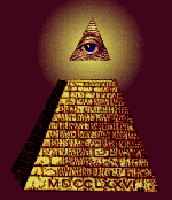
It’s about the Eye, Zero Point, focusing your consciousness and trusting what you see. You do it all the time and may not beware of the difference between your thoughts and those from higher frequency. I was told that the third eye has a lens that opens to see behind physical reality, so you might want to relate to that theory. When the third eye opens it can feels like a pressure at the base of the brain. We all want to be more psychic and increase the connection with the other side as our Consciousness Hologram closes and souls return to light. We want to empower and most of all to understand beyond the physical. Meditation, Visualization, Yoga, and all forms of Out of Body Experiences help.
Jesus & Mary Magdalene: The Sacred Marriage in Gnosticism
Posted: December 4, 2012 by phaedrap1 in Occult, SpiritualityTags: Gnosticism
The astonishing success of Dan Brown’s bestselling book, The Da Vinci Code, and the radical overreaction to it by orthodox and fundamental forms of Christianity is revealing; obviously its subject strikes a powerful chord in our psyche. Although Brown’s work is fictional, the subject of a sacred relationship between Jesus and Mary Magdalene, the inclusion of the Sacred Feminine, and the mystery of the Holy Grail all touch a deep part of us—a place that intuits a greater and archetypal truth. Whether knowingly or unknowingly, when Dan Brown writes about secret societies preserving the inner and mystical tradition of original Christianity, and of secret knowledge being passed down from one generation to another concerning mysteries of hieros gamos, or the “sacred marriage,” he points directly to living traditions of Gnostic Christianity. The mysteries are only partially spoken in his book, and the context in which they are put may differ from the teachings of actual gnostic traditions. However, the basic ideas presented accord very well with the Sophia Tradition of Gnostic Christianity. Some four years ago, as I was writing the sections of The Gnostic Gospel of St. Thomas that discuss the relationship between Jesus and Mary Magdalene, I had no idea the subject would become so popular. Today, of course, I’m constantly being asked what Sophian Gnosticism teaches about this sacred relationship. And though the subject is approached in my book, there is certainly more that can be shared.
First, it must be said that nowhere in the New Testament does it state that Jesus was celibate. As a matter of fact, in Judaism an unmarried man is considered incomplete. Typically, all Jewish holy men—teachers and prophets alike—were married. It would have been highly unusual for a recognized rabbi (teacher) to be single. Originally, Christianity was a Jewish spiritual movement, and Jesus taught Jewish individuals primarily. Bearing that in mind, it would have been easier for students to accept that Jesus was married than to accept a rabbi unwilling or unable to sustain a marriage. This is quite the opposite of the unnatural view we have been lead to believe—that the union of Jesus with a wife and consort would somehow diminish his spiritual status. The truth is that it would have exalted him all the more, and this is precisely the Sophian view.
Jesus’s interactions with various women as recorded in the gospels prove very interesting when one understands the plight of women in ancient Palestine. At that time, Jewish women had no legal standing, could not own property in their own name, could not bear witness in court, and could not speak in their own defense. They could, however, be divorced on a whim by a man. They had little part in Jewish spirituality at the time, and certainly did not hold spiritual authority or have the right to be taught directly by a holy man. Yet, Jesus teaches a Samaritan woman at a well, and she goes into her town and brings others to him, bearing witness of him. He praises a poor widow who gives all that she has into his circle’s treasury. He delivers a woman from a death sentence for adultery, and he heals a woman considered unclean from a twelve-year illness. He even raises a young girl, the daughter of Jairus, from the dead. Again and again he appears relating directly with women. When male disciples attempt to keep children away from him, as though they were an inconvenience, he insists on seeing them and blessing them, in accordance with the wishes of the mothers who brought their children to him. In other words, he had a radically different view of the feminine than others in the time and place in which he lived. It would seem that he intended to bring about a balance between the masculine and feminine in the spirituality he taught.
In the gospels when Jesus sends his disciples out to teach and initiate he sends them in pairs, telling them two must go out together. In a letter to the Corinthians, there is an interesting hint as to what the disciples going out to minister in pairs might have actually meant. We have been lead to believe that it was the twelve male disciples sent out in pairs, yet it is written: “Do we not have the right to be accompanied by a believing wife, as do other apostles and the brothers of the Lord and Cephas?” (I Corinthians 9:5) This seems to allude to a man and woman going out together to teach and initiate, not two men unaccompanied by women. Likewise, it reflects the idea that the balance between male and female was likely a strong part of the original Jesus movement.
Although the place of the Sacred Feminine and the sacred relationship between Jesus and Mary is never spoken outright in the canonical gospels, there certainly are some interesting hints.
For example: In addition to St. John, three women have the faith and courage to be present at the crucifixion. Meanwhile, all of the other men are in hiding, too afraid to show their faces. Interestingly enough, the image of three women brings to mind the three principles of the Sacred Feminine and the cycles of a woman’s life—the maid, mother, and crone.
Women accompany Mary Magdalene to the tomb of Jesus, as if they were serving as an escort to a widow in mourning. And it is to Mary Magdalene that the Risen Savior first appears, as though to his most dearly beloved. In the Sophian Tradition, the woman who anoints the body of Jesus with costly perfume before the crucifixion, though unnamed, is said to be Mary Magdalene. This alludes to a priestess-queen preparing a priest-king for a rite of sacred sacrifice—a mythical event commonly associated with the pre-Christian mystery traditions of ancient Egypt, Mesopotamia, and Greece. In other words, there are hints even in the canonized Scriptures of a deeper mystery transpiring in the Gospel—one that included the Sacred Feminine and the supreme mystery of hieros gamos.
Gnostic Scriptures are significantly more straightforward with regard to the sacred relationship between Jesus and Mary Magdalene; the inclusion of the Sacred Feminine; and the mystery of hieros gamos in the Christ revelation. In the Gospel of St. Thomas—albeit in a somewhat awkward fashion—the final saying clearly cites the equality of men and women by putting forth a statement of Jesus saying he will make Mary Magdalene “male” like the men who are his disciples. In saying this of Mary, he says this of all women—that in Spirit they are equal to men. The Gospel of St. Philip goes even further, clearly stating that Mary Magdalene was the wife and consort of Jesus, and that he taught her more than any of his male disciples. This gospel even alludes to her as Jesus’s equal and co-preacher of the Gospel. In the Gnostic Gospel entitled Pistis Sophia (“Faith-Wisdom”), Mary Magdalene is portrayed as his inmost disciple and serves in a capacity much like that of a divine muse; inspiring and facilitating the outpouring of secret knowledge from the Risen Savior.
The sacred texts of Gnosticism found in the Nag Hammadi library get even more explicit if one understands the language of initiates of ancient Mystery Schools. According to Gnostic Scriptures, there are five sacred rites: baptism, chrism, wedding feast, ransom, and the bridal chamber. The term “wedding feast” is what Christian Gnostics call the Eucharist of bread and wine, while the term “bridal chamber” connotes the mystery of hieros gamos (the sacred marriage). Although the exoteric idea of redemption from sin may play of role in the rite of the holy eucharist as performed in some traditions of Gnostic Christianity, the true nature of “salvation” is, in fact, quite different. The idea is not so much a salvation from “original sin,” but salvation by restoration to the original blessing, which occurs in the unification of male and female. Accordingly, the bread represents the Logos and the wine represents the Sophia, the male and female aspects of the Christos. Thus the Eucharist is a ceremony celebrating their mystical union or sacred marriage—the union of the Divine Masculine and Feminine through which all creation transpires, as well as redemption through divine illumination.
This original blessing is reflected in Genesis in the story of the creation of the First Adam (literally, the first human being). At the outset, Adam is both male and female and therefore in a state of hieros gamos. It is only when there is a division between male and female—Adam and Eve—that cosmic ignorance enters into play and the “fall” from a state of grace transpires. Thus, from a Sophian perspective, it is through the dynamic balance and unification of the masculine and feminine that “redemption” through divine illumination occurs. The male and female are actualized and made complete in one another. And, in their union, the great creative power of Divine Being flows through them. This state of restoration to unity of the male and female is called the Second Adam, the Great Seth, or the Image of the Bridal Chamber in Sophian Gnosticism.
This alludes to a very different meaning in the symbol of the cross as it is understood in some schools of Christian Gnosticism. Like the symbol of the lingam-yoni in Eastern Tantric Traditions, which represents the union of the Divine Male and Female energy, the holy cross bears the same meaning in Gnosticism: the vertical axis is the Divine Masculine, Christ the Logos, and the horizontal axis is the Divine Feminine, Christ the Sophia. These two cosmic principles are personified by Jesus and Mary Magdalene in the Gnostic Gospel as taught in the Sophian Tradition.
In Sophian teachings, first and foremost this union of masculine and feminine principles is understood inwardly, within oneself—a “sacred marriage” of the male and female aspects of ourselves on psychic and spiritual levels. On a psychic level (or mental-emotional level), this means the union of the male and female aspects of our psyche through which our personality and life-display are brought into a full and harmonious manifestation and our true intelligence and creativity becomes expressed. On a spiritual level, it is the union of the heavenly and earthly aspects of our soul of Light through which we experience various states of higher consciousness or divine illumination.
Yet, in the Sophian teachings, this union is not exclusive to the spiritual and psychic levels. It is also spoken of in terms of physical union—a sensual and sexual mysticism that views love-play as a holy sacrament that embodies the Light of the original blessing in which we were conceived, both above and below. In other words, the Sophian teachings propose a dynamic balance between heaven and earth in our lives. They consider our bodies and lives as sacred expressions of our souls of Light. The body and soul are equally holy from a Sophian point of view.
If the idea of Jesus as married seems strange or offensive, or the idea of the inclusion of our bodies and sexuality in our spirituality sounds outrageous, then there is certainly something within us in dire need of being acknowledged and healed. Quite frankly, the idea that our bodies and sexuality must be excluded from our spiritual life and practice, or are in some way opposed to enlightenment or God, is a strange and unnatural idea that makes very little sense (at least from a Sophian perspective). After all, our bodies and lives are part of God’s creation. So is the drive of creatures to the joy of procreation, and our own recreation in our human experience of love and sexuality. If this is true, then the whole of ourselves and our lives is inherently sacred and holy, assuming we open ourselves to embody something of the Divine within them. Isn’t this the true message of the myth of the Divine Incarnation central to the Gospel: that the human being is meant to embody something of Divine Being? Such embodiment of Divine Being implies a complete integration of the Divine into all aspects of ourselves and our lives. This must necessarily include our body and sexuality also; hence the celebration of hieros gamos on all levels.
To the Gnostic Christian, the belief that Mary Magdalene was the wife and divine consort of Jesus does not diminish him as the Christ-bearer. Rather, this Gnostic view includes her as Christ-bearer also, so that in the sacred marriage of Jesus and Magdalene we have an image of Christed manhood and Christed womanhood—supernal or Messianic consciousness embodied in male and female form. To speak of the enlightenment and liberation of all human beings, but to reject the idea of an enlightened woman does not seem to make much sense. How would Christ-consciousness be different whether embodied by a man or a woman? Why would women be isolated from it? These are certainly questions Sophians would ask, and questions that are integral to the Sophian view of the Gospel.
There is a plethora of myths and legends in the oral tradition of Sophian Gnosticism, including various myths concerning the Holy Grail. In the Sophian Gospel, this holy relic is not created by Joseph of Arimathea, but by St. Mary Magdalene. While some stories speak of the Grail as an actual cup in which Mary caught some of the blood and water flowing from the side of the Savior, others clearly speak of Mary herself as the Holy Grail. This idea plays out in a number of different ways.
There certainly are teachings that tell us Jesus and Mary conceived a child through their sacred marriage, and that tell us about the mystery of the Sangreal as the lineage of the royal blood-line that followed. One can only wonder at the kind of soul such parents might draw into incarnation while enacting the mystery of the hieros gamos. Truly, it would seem a soul of a very high grade would be drawn into such a sacred and holy union. Indeed! This is reflected by the name given to the child in Sophian legends, St. Michael, a name literally meaning “one who is like unto God.” Other legends speak of a daughter named Sarah, which is the name of the “Mother of the True Faith.”
The idea of Mary Magdalene as the Holy Grail goes beyond this, however. As the divine consort of Jesus, the Sophian teachings propose that the full Supernal Light of the Messiah pours into her. They speak of her as the inmost disciple of Jesus to whom he imparted all teachings; the outer, inner, and secret teachings, along with their corresponding initiations. Likewise, as the first to receive the gnosis of the Risen Savior, she is the First Apostle, and bearing the full teachings of the Gospel, she is the Apostle of the apostles—the foundation of the True Church, from a Sophian perspective. Essentially, all streams of the apostolic succession flow out through her, as though she is a Holy Grail overflowing with secret knowledge and wisdom that “feeds the hungry, gives drink to the thirsty, and heals the sick.” Thus, she is the embodiment of Christ the Sophia, just as Yeshua is the embodiment of Christ the Logos in the Sophian Gospel. Through their union the full Light of the Messiah shines forth; hence the metaphor of the Holy Child called “St. Michael.”
These ideas are not exclusive or necessarily original to Gnostic Christianity. But, as I mentioned above, they reflect the influence of the gnosis within the ancient pagan Mystery Schools of the Middle East, along with the influence of Jewish gnosis taught in Merkavah Mysticism and the Kabbalah. They have existed in human consciousness for a very long time, and no doubt will continue to echo and resurface in various forms. By nature, these ideas are archetypal and are innate to our human experience. They are integral to who and what we are as human beings. So it is not surprising that a fictional book based upon them will strike a very deep cord in us and attract a lot of attention, both positive and negative. Something in us feels there is some truth to what Dan Brown is writing about, and that part of us is correct—there is some truth to it, on some level. Indeed! There always have been individuals who believed Jesus was married to Mary Magdalene, from the very outset of Christianity, and who believed she played an essential role in the Christ revelation. Likewise, there have been and are now secret societies or esoteric orders that preserve oral traditions surrounding these beliefs, some of which, perhaps, are becoming a bit more open with their views and teachings in modern times and, thus, a bit less secretive.
There is certainly much more than can be said on these mysteries. Ihe oral tradition among Sophians, there is a wealth of myth and legend concerning Mary Magdalene and her flight to what has come to be known as Southern France. In The Gnostic Gospel of St. Thomas, as well as my forthcoming books, more of the oral tradition among Sophians about the Holy Bride, St. Mary Magdalene, will be disclosed, along with other Gnostic teachings.
If I were to share something practical here it would be this: If one simply opens one’s mind and heart to the idea of the sacred marriage of Jesus and Mary Magdalene—and specifically to St. Mary Magdalene herself—and one contemplates her and meditates upon her, one will find her presence quite healing and might experience an amazing transformation in one’s consciousness and life. She tends to have that effect on women and men alike! This is enough to invoke a spiritual or mystical experience of Mary Magdalene if one desires to know her. It is said that her presence is swift to come to those who believe in her and who seek her—she is always very near! Perhaps this is also part of the power of The Da Vinci Code and other books being published in which Mary Magdalene plays a part—they naturally invoke the presence of the Sacred Feminine, of which she is a powerful personification.
References: The verse quoted is from the NRSV of the Bible.
This article was written by Tau Malachi
The Llewellyn Journal
758″ />756″ />href=”https://anunnakialiengodsandspirituality.com/2012/12/03/freemasonry-apprentice/attachment/00700/” rel=”attachment wp-att-741″>

ENTERED APPRENTICE, OR FIRST DEGREE
Seven Freemasons, viz., six Entered Apprentices and one Master Mason, acting under a charter or dispensation from some Grand Lodge, is the requisite number to constitute a Lodge of Masons, and to initiate a candidate to the First Degree of Masonry.
They assemble in a room well guarded from all cowans and eaves-droppers, in the second or third story (as the case may be) of some building suitably prepared and furnished for Lodge purposes, which is, by Masons, termed “the Ground Floor of King Solomon’s Temple.”
The officers take their seats, as represented in the Plate. Lodge-meetings are arranged as follows, viz.: a “regular” is held but once a month (i.e. every month on, or preceding, the full of the moon in each month); special meetings are held as often as the exigency of the case may seem to demand, if every night in the week, Sunday excepted. If Tuesday should be Lodge night, by Masons it would be termed, “Tuesday evening on or before the full of the moon, a regular night =”LODGE OF ENTERED APPRENTICES, FELLOW CRAFTS, OR MASTER MASONS.” src=”tn/00800.jpg” /> Click to enlarge LODGE OF ENTERED APPRENTICES, FELLOW CRAFTS, OR MASTER MASONS.href=”https://anunnakialiengodsandspirituality.com/2012/12/03/freemasonry-apprentice/attachment/01000/” rel=”attachment wp-att-744″> <a
<a
1. Candidate prays. 2. First stop. 3. Second stop. 4. Third stop. 5. Room where candidates are prepared. 6. Ante-room where members enter the lodge. 7. Hall. 8. Doors. 9. Door through which candidates are admitted into the lodge. 10. Door through which members enter. 11. Altar. 12. Treasurer. 13. Secretary. 14. Senior Deacon. 15. Worshipful Master. 16. Junior Warden. 17 and 18. Stewards. 19. Senior Warden. 20. Junior Deacon. 21. Tyler.
All business relative to Masonry is done at a “regular,” and in the Third, or Master Mason Degree. None but Master Masons are allowed to be present at such meetings; balloting for candidates is generally done on a “regular,” also receiving petitions, committee reports, &c., &c.
A petition for the degrees of Masonry is generally received at a “regular” (though, as a common thing, Grand Lodges of each State make such arrangements as they may deem best for the regulation of their several subordinate Lodges).
At the time of receiving a petition for the degrees of Masonry, the Master appoints a committee of three, whose duty it is to make inquiry after the character of the applicant, and report good or bad, as the case may be, at the next regular meeting, when it is acted upon by the Lodge.
Upon reception of the committee’s report, a ballot is had: if no black balls appear, the candidate is declared duly elected; but if one black ball or more appear, he is declared rejected.
No business is done in a Lodge of Entered Apprentices, except to initiate a candidate to the First Degree in Masonry, nor is any business done in a Fellow Crafts’ Lodge, except to pass a Fellow Craft from the first to the second degree. To explain more thoroughly: when a candidate is initiated to the First Degree, he is styled as “entered;” when he has taken the Second Degree, “passed.” and when he has taken the Third, “raised” to the sublime Degree of a Master Mason. No one is allowed to be present, in any degree of Masonry, except he be one of that same degree or higher. The Master always wears his hat when presiding as such, but no other officer, in a “Blue Lodge” (a “Blue Lodge” is a Lodge of Master Masons, where only three degrees are conferred, viz.: Entered Apprentice, 1st; Fellow Craft, 2d; Master Mason, 3d. Country Lodges are mostly all “Blue Lodges“).
A Lodge of Fellow Craft Masons consists of five, viz.: Worshipful Master, Senior and Junior Wardens, Senior and Junior Dear hens; yet seven besides the Tyler generally assist, and take their seats as in the Entered Apprentice’s Degree. The Fellow Craft Lodge is styled by Masons “the Middle Chamber of King Solomon’s Temple.”
Three Master Masons is the requisite number to constitute a Masters’ Lodge, which is called by Masons “the Sanctum Sanctorum, or, Holy of Holies of King Solomon’s Temple.” Although three are all that is required by “Masonic Law” to open a Third Degree Lodge, there are generally seven besides the Tyler, as in the other degrees.
All the Lodges meet in one room, alike furnished, for the conferring
of the different degrees (E. A., F. C., and M. M.); but they are masonically styled by the Craft as the Ground Floor, Middle Chamber, and Sanctum Sanctorum.
A person being in the room, while open on the First Degree, would not see any difference in the appearance of the room from a Master Masons’ Lodge. It is the duty of the Tyler to inform all the brethren on what degree the Lodge is at work, especially those that arrive too late (i.e., after the Lodge has been opened). so that none will be liable to give the wrong sign to the Worshipful Master when he enters. If the Lodge is opened on the First Degree, there might he present those who had taken only one degree, and, if the brother arriving late should be ignorant of this fact, and make
 MOST WORSHIPFUL MASTER IN THE EASThref=”https://anunnakialiengodsandspirituality.com/2012/12/03/freemasonry-apprentice/attachment/00800/” rel=”attachment wp-att-743″> MOST WORSHIPFUL MASTER IN THE EASThref=”https://anunnakialiengodsandspirituality.com/2012/12/03/freemasonry-apprentice/attachment/00800/” rel=”attachment wp-att-743″> <a <a |
a Third Degree sign, they would see it; consequently, caution on this point should always be given to such brethren by the Tyler, before entering the Lodge.
Usual way: Brethren that arrive too late come up to the ante-room, which they find occupied by the Tyler, sword in hand; after inquiring of the Tyler on what degree the Lodge is at work (opened), they put on an apron, and request the Tyler to let them in; the Tyler steps to the door, gives one rap (•), i.e. if opened on the First Degree; two raps (• •), if Second Degree; three raps (• • •), if the Third Degree; which being heard by the Junior Deacon, on the inside, he reports to the Master the alarm, as follows, viz.:
J. D.–Worshipful Master, there is an alarm at the inner door of our Lodge.
W. M.–Attend to the alarm, Brother Junior, and ascertain the cause.
Junior Deacon opens the door and inquires of the Tyler the cause of the alarm; when the Tyler will report the brethren’s
names (which we will suppose to be Jones, Brown, and Smith).
J. D. (to the Master)–Brothers Jones, Brown, and Smith are without, and wish admission.
If they are known to the Master, he will say, “Admit them.”
Deacon opens the door, and says, in an under tone of voice, “Come in.” These brothers advance to the centre of the Lodge, at the altar make the duegard, and sign of the degree on which the Lodge is opened, which is responded to by the Master, and then take their seats among the brethren. No brother is allowed to take his seat until he has saluted the Worshipful Master on entering a Lodge; and if one omits his duty in this respect, he is immediately reminded of it by either the Master or some one of the brethren present. The Tyler generally cautions the brethren, before entering the Lodge, about giving the sign, before passing them through the door; the Junior Deacon the same, as soon as they are in. This officer’s station is at the inner door, and it is his duty to attend to all alarms from the outside, to report the same to the Master, and get his permission before admitting any one.
The author remembers seeing the duegard and sign of a Master Mason given, while yet an Entered Apprentice Mason: he was sitting one evening in the Lodge, when a brother of the Third Degree came in, and very carelessly saluted the Master with the Master’s duegard and sign, undoubtedly supposing the Lodge open on that degree–a very common error among Masons.
In large cities there are often more than one Lodge. Some cities have ten or twenty, and even more; in the cities of New York and Brooklyn there are one hundred and thirty-five Lodges, besides Chapters, Councils, Commanderies, &c., &c. Consequently, there are Lodge-meetings of some sort every night in the week, excepting Sunday, and of course much visiting is going on between the different Lodges. The visitors are not all known to the Masters personally; but the brethren are, generally, acquainted with each other, and of course have often to be vouched for in some of the Lodges, or pass an examination; and for the purpose of giving the reader an idea of the manner in which they are admitted, the author will suppose a case, in order to illustrate it. Jones, Smith, and Brown, belonging to Amity Lodge, No. 323, in Broadway, New York, wish to visit Hiram Lodge, No. 449, of Twenty-fifth Street, and for that purpose go on Lodge night to the hall of Hiram Lodge, No. 449, and ask the Tyler for admission. The Tyler, perhaps, will say–Brothers, are you acquainted with our Master, or any of the brethren in the Lodge? Smith, Jones, and Brown will say, perhaps, Yes; or, We can’t tell, but pass our names in, and if there are any acquainted with
us, they will vouch for our masonic standing. The Tyler does so, in the manner already described; and, if they are vouched for by either Master or any brother, they are admitted, the Tyler telling them on what degree the Lodge is opened, besides furnishing them with aprons.
On the evening of a Lodge-meeting, brethren generally get together at an early hour at the Lodge-room, which has been opened and cleaned out by the Tyler. On arrival of the Master, and the hour of meeting, the Master repairs to his seat in the east, puts on his hat, 1 sash, yoke, and apron, with gavel in hand, and says: “Brethren will he properly clothed and in order; officers repair to their stations for the purpose of opening.”
At this announcement the brethren put on their aprons, and seat themselves around the Lodge-room, while the officers invest themselves with their yokes and aprons, and take their stations as represented in Plate , viz.: Senior Warden in the west; Junior Warden in the south; Senior Deacon in front of the Worshipful Master in the east, and a little to his right hand, with a long rod in hand; Junior Deacon at the right hand of the Senior Warden in the west, guarding the inner door of the Lodge, with rod in hand; Secretary at the left of the Worshipful Master, and Treasurer at the right; and, generally, two Stewards on the right and left of the Junior Warden in the south, with rods in hand. After all are thus seated, the Worshipful Master says: “Is the Tyler present? If so, let him approach the east.”
At this command, the Tyler, who is all this time near the outer door of the Lodge, approaches the Worshipful Master’s seat in the east, with yoke and apron on.<img src="https://anunnakialiengodsandspirituality.com/wp-content/uploads/2012/12/01900.jpg" alt="01900" width="302" height="250" class="alignnone size-full wp-image-
W. M.–Brother Tyler, your place in the Lodge?
Tyler–Without the inner door.
W. M.–Your duty there?
Tyler–To keep off all cowans and eavesdroppers, and not to pass or repass any but such as are duly qualified and have the Worshipful Master’s permission.
W. M.–You will receive the implement of your office (handing him the sword). Repair to your post, and be in the active discharge of your duty.
The Tyler retires to the inside of the outer door of the ante-room, and all Lodge-doors are closed after him.
W. M. (gives one rap with his gavel, Junior Deacon rises up)–Brother
[paragraph continues] Junior Deacon, the first and constant care of Masons when convened?
Junior Deacon–To see that the Lodge is duly tyled.
W. M.–You will attend to that part of your duty, and inform the Tyler that we are about to open a Lodge of Entered Apprentice Masons (Fellow Crafts, or Master Masons, as the case may be), and direct him to tyle accordingly.
The Deacon opens the door, and says to the Tyler–Brother Tyler, it is the orders of the Worshipful Master that you tyle this Lodge as an Entered Apprentice (Fellow Crafts, or Master Mason, as the case may be); then closes the door, gives one rap (two, if a Fellow Crafts’, or three, if a Masters’ Lodge), which is responded to by the Tyler.
J. D.–Worshipful Master, the Lodge is tyled.
W. M.–How tyled?
J. D.–By a brother of this degree, without the inner door, invested with the proper implement of his office (the sword). W. M.–His duty there?
J. D.–To keep off all cowans 1 and eavesdroppers; suffer none to pass or repass, except such as are duly qualified, and have the Worshipful Master’s permission. (Sits down.)
W. M. (one rap, Warden rises to his feet.)–Brother Senior Warden, are you sure that all present are Entered Apprentice Masons (Fellow Crafts, or Master Masons? as the case may be).
S. W.–I am sure, Worshipful Master, that all present are Entered Apprentice Masons (or as the case may be).
W. M.–Are you an Entered Apprentice Mason?
S. W.–I am so taken and accepted among all brothers and fellows.
W. M.–Where were you first prepared to be made an Entered Apprentice Mason?
S. W.–In my heart.
W. M.–Where secondly?
S. W.–In a room adjacent to a legally constituted Lodge of such, duly assembled in a place representing the Ground Floor of King Solomon’s Temple.
W. M.–What makes you an Entered Apprentice Mason?
S. W.–My obligation.
W. M: How many constitute a Lodge of Entered Apprentice Masons?
S. W.–Seven or more, consisting of the Worshipful Master, Senior and Junior Wardens, Senior and Junior Deacons, Secretary, and Treasurer.
W. M.–The Junior Deacon’s place?
S. W.–At the right hand of the Senior Warden in the west.
W. M. (two raps with his gavel, when all the officers of the Lodge rise to their feet.)–Your duty there, brother Junior Deacon?
J. D. (makes the sign of an Entered Apprentice Mason, see Fig. 2, )–To carry orders from the Senior Warden in the west to the Junior Warden in the south, and elsewhere around the Lodge, as he may direct, and see that the Lodge is tyled.
W. M.–The Senior Deacon’s place in the Lodge?
J. D.–At the right hand of the Worshipful Master in the east.
W. M.–Your duty there, brother Senior?
S. D.–To carry orders from the Worshipful Master in the east to the Senior Warden in the west, and elsewhere around the Lodge, as he may direct; to introduce and clothe all visiting brethren; to receive and conduct candidates.
W. M.–The Secretary’s place in the Lodge?
S. D.–At the left hand of the Worshipful Master in the east.
W. M.–Your duty, brother Secretary?
Sec.–To observe the Worshipful Master’s will and pleasure, record the proceedings of the Lodge, transmit a copy of the same to the Grand Lodge, if required, receive all moneys paid into the Lodge by the hands of the brethren, pass the same over to the Treasurer, and take his receipt for the same.
W. M.–The Treasurer’s place in the Lodge?
Sec.–At the right hand of the Worshipful Master in the east.
W. M.–Your duty there, brother Treasurer?
Treas.–To receive all moneys paid into the Lodge from the hands of the Secretary, keep a regular and just account of the same, and pay it out by the order of the Worshipful Master and the consent of the Lodge.
W. M.–The Junior Warden’s station in the Lodge?
Treas.–In the south, Worshipful.
W. M.–Your duty there, brother Junior Warden?
J. W.–As the sun in the south, at high meridian, is the beauty and glory of the day, so stands the Junior Warden in the south, the better to observe the time, call the craft from labor to
refreshment, superintend them during the hours thereof, and see that the means of refreshment be not converted into intemperance or excess; and call them on to labor again, that they may have pleasure and profit thereby.
W. M.–The Senior Warden’s station in the Lodge?
J. W.–In the west, Worshipful.
W. M.–Why in the west, brother Senior, and your duty there?
S. W.–To assist the Worshipful Master in opening and closing his Lodge, pay the craft their wages, if any be due, and see that none go away dissatisfied, if in my power to prevent, harmony being the strength of all institutions, more especially of this of ours.
W. M.–The Worshipful Master’s station in the Lodge?
S. W.–In the east, Worshipful.
W. M.–Why in the east, and his duty there?
S. W.–As the sun rises in the east, to open and govern the day, so rises the Worshipful Master in the east (here he gives three raps with his gavel, when all the brethren of the Lodge rise, and himself), to open and govern his Lodge, set the craft to work, and give them proper instructions.
W. M.–Brother Senior Warden, it is my orders that this Lodge be opened on the First Degree of Masonry (or Second, or Third Degree, as the case may be). For the dispatch of business during which time, all private committees, and other improper, unmasonic conduct, tending to destroy the peace of the same while engaged in the lawful pursuits of Masonry, are strictly forbidden, under no less penalty than a majority of the brethren present, acting under the by-laws of this Lodge, may see fit to inflict: this you will communicate to the Junior Warden in the south, and he to the brethren around the Lodge, that they, having due and timely notice, may govern themselves accordingly. 1
S. W. (turning to the Junior Warden in the south.)–Brother Junior Warden, you have heard the orders of the Worshipful Master, as communicated to me from the Worshipful Master in the east. You will take notice, and govern yourself accordingly.)
J. W. (to the Lodge.)–Brethren, you have heard the orders of the Worshipful Master, as communicated to me through the Senior Warden in the west. You will please take notice, and govern yourselves accordingly.
W. M.–Brethren, together on the signs. (The signs of the three degrees are given, if opening on the Third Degree; but if only on the First Degree, Entered Apprentice, the Master would say, Together on the sign, and not signs. The Master always leads off in giving the sign or signs. The Master first makes the “duegard” of the First Degree, representing the position of the hands when taking the oath of an Entered Apprentice Mason, which is called the “duegard” of an Entered Apprentice, viz.: “My left hand supporting the Bible, and my right hand resting
 FIG. 1. DUEGARD OF AN ENTERED APPRENTICE. FIG. 1. DUEGARD OF AN ENTERED APPRENTICE. 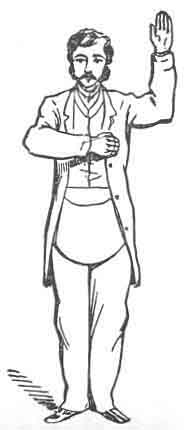   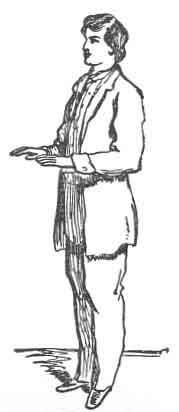 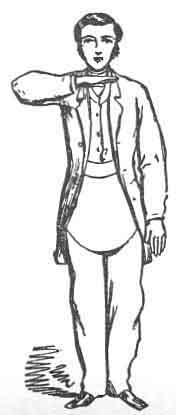 <a <a
|
thereon.”
After which the Master makes the sign of an Entered Apprentice Mason, which alludes to the penalty of the Entered Apprentice’s obligation, which is imitated by all the brethren present.
[Explanation of Fig. 2.–Draw the right hand rapidly across the neck, as represented in the cut, and drop the arm to the side.–Remember that the duegards and signs are all made with right angles, horizontals, and perpendiculars, with very slight, but marked pauses between each motion or part of the sign.]
The Master then makes the duegard of a Fellow Craft, which alludes to the position of the hands when taking the oath of a Fellow Craft Mason.
[Explanation of Fig. 3.–The left arm, as far as the elbow, should be held in a horizontal position, and the rest of the arm in a vertical position, forming a square. The right hand detached from the stomach, fingers extending outward.]
After which he gives the sign of a Fellow Craft. which alludes to the penalty of the Fellow Craft obligation.
[.–In making the duegard and sign of the Fellow Craft, or Second Degree, care must be taken to drop the left arm suddenly and with spirit, as soon as the two motions are accomplished.]
Next is the duegard of a Master Mason, which alludes to the position of the hands when taking the oath of a Master Mason, both hands resting on the Holy Bible, square, and compasses.


And then (Fig. 6) the sign of a Master Mason, which alludes to the penalty of the obligation of a Master Mason.
[Explanation of Fig. 6.–In making this sign, draw the right hand (thumb in) across the stomach as low down as the vest, then drop the hand suddenly.]
The last sign given (Fig. 7) is the “grand hailing sign of distress.”
[Explanation of Fig. 7.–Raise the hands as represented in the cut, and drop them with spirit. Repeat this three times.]
The words accompanying this sign in the night, or dark, when the sign cannot be seen, are, viz.: “O Lord my God! is there no help for the widow’s son?” This sign is given by the Master, at the grave of our “Grand Master Hiram Abiff.”
Master gives one rap with his gavel; Senior Warden, one;
[paragraph continues] Junior Warden, one. Master one the second time, which is responded to by the wardens a second time, in the west and south, when the master makes the third gavel sound, which is responded to by the Wardens. These three raps are made, when opening the Lodge on the Third Degree; if opening on the Second, two raps only are used; First Degree, one rap each, first given by the Master, then Senior Warden, lastly Junior Warden. After which the Master takes off his hat, and repeats the following passage of Scripture:–
“Behold, how good and how pleasant it is for brethren to dwell together in unity! It is like the precious ointment upon the head, that ran down upon the beard, even Aaron’s beard; that went down to the skirts of his garments; as the dew of Hermon, and as the dew that descended upon the mountains of Zion: for there the Lord commanded the blessing, even life forever more.” Amen!
Responded to by all the brethren present: “Amen! So mote it be!”
W. M.–I now declare this Lodge opened on the First (or, as the case may be) Degree of Masonry. Brother Junior Deacon, you will inform the Tyler. (Deacon opens the Lodge-door, and delivers his message to the Tyler.)
W. M.–Brother Senior Deacon, you will attend at the altar. (Here the Senior Deacon steps to the altar, places the square above the compasses, if opened
 COMPASSES, PLACED IN A LODGE OF ENTERED APPRENTICES, ”BOTH POINTS COVERED BY THE SQUARE” COMPASSES, PLACED IN A LODGE OF ENTERED APPRENTICES, ”BOTH POINTS COVERED BY THE SQUARE” |
on the First Degree, viz.:)
W. M. (gives one sound of the gavel.)–All are seated and ready for business.
If the Lodge is opened on the Third Degree, and at a regular meeting of the Lodge, the following would be the order of business; but as the reader may be a little anxious, besides curious, about the way and manner of raising the Lodge from the First to the Third Degree, the author will suppose the Lodge open on the First Degree, and, it being a regular Lodge-night, and business to transact, the Lodge must be raised to the Third or Masters’ Degree, as no business except that of initiation can be done on the
[paragraph continues] First Degree. The following manner is generally adopted among Masons at the present day, though there are two or three ways.
W. M. (gives one rap with his gavel.)–Brother Senior Warden, are you sure that all present are Master Masons? (or Fellow Crafts, as the case may be.)
S. W.–I am not sure that all present are Master Masons, but will ascertain through my proper officers, and report.
S. W.–Deacons will approach the west (Deacons, both Junior and Senior, repair to the Warden’s station in the west); first the Senior Deacon whispers the password of a Master Mason in the ear of the Junior Deacon (Tubal Cain), and the Senior Deacon whispers the same in the Senior Warden’s ear, when one Deacon passes up one side of the Lodge, and the other the other side, and, as they go, stop at each brother present for the pass-word, which each brother rises up and whispers in the ear of the Deacon (Tubal Cain); if there are any present that cannot give it, the Deacons pass them by, especially if they are lower degree members (Entered Apprentices or Fellow Crafts), and after the Deacons have gone through the entire Lodge, they meet before the Worshipful Master in the east; the Senior Deacon gets the pass again from the Junior Deacon, and passes it up to the Master, and then they return to the Senior Warden in the west, and pass the same up to him in the same way, and take their seats again, as in . The Warden then rises and says–All present are not Master Masons, Worshipful.
W. M.–All below the degree of Master Mason will please retire while we raise the Lodge. The Junior Deacon says to those below Master Mason, “Brothers, please retire,” and he sees that they do so. After they are out, and the door is closed by the Junior Deacon, the Senior Warden says: “All present are Master Masons, Worshipful, and makes the sign of a Master Mason.”
W. M.–If you are satisfied that all present are Master Masons, you will have them come to order as such, reserving yourself for the last.
S. W. (gives three raps with his gavel, when all in the Lodge rise to their feet.)–Brethren, you will come to order as Master Masons.
Brethren all place their hands in the form of a duegard of a Master Mason. (See Fig. 5, ~)
S. W.–In order, Worshipful.
W. M.–Together on the sign, brethren; and makes the sign of a Master Mason (see Fig. 6,), which is imitated by the officers and brethren, and lastly the Senior Warden. The Master gives one rap, Senior Warden one, Junior Warden one, and then
the Master again one rap, followed up by the Wardens, until they have rapped three times each.
W. M.–I now declare this Lodge open on the Third Degree of Masonry. Brother Junior Deacon, inform the Tyler. Brother Senior Deacon attend to the altar. (Raps once, and the officers and brethren take their seats.) (See Note D, Appendix.)
Order of business as follows, viz.:–
W. M.–Brother Secretary, you will please read the minutes of our last regular communication.
The Secretary reads as follows, viz.:–
MASONIC HALL, New YORK, December 8, A. L. 5860.
A regular communication of St. John’s Lodge, No. 222, of Free and Accepted Masons, was holden at New York, Wednesday, the 10th of November, A. L. 5860.
|
|
Present. |
|
Members. |
|
Brother |
A. B., Worshipful Master. |
Brother |
Luke Cozzans. |
|
“ |
B. C., Senior Warden. |
“ |
John Hart. |
|
“ |
C. D., Junior Warden. |
“ |
Peter Lewis. |
|
“ |
D. E., Treasurer. |
“ |
George Fox. |
|
“ |
E. F., Secretary. |
“ |
Robert Onion. |
|
“ |
F. G., Senior Deacon. |
“ |
Frank Luckey. |
|
“ |
G. H., Junior Deacon. |
“ |
Samuel Slick. |
|
“ |
H. I., Stewards. |
“ |
Solomon Wise. |
|
“ |
I. J., “ |
“ |
Henry Wisdom. |
|
“ |
K. L., Tyler. |
“ |
Truman Swift. |
VISITING BROTHERS.
Brother James B. Young, of Union Lodge, No. 16, Broadway, New York.
Brother George J. Jones, Rochester Lodge, No. 28, Rochester, New York.
Brother Benjamin Scribble, of Hiram Lodge, No. 37, New Orleans, Louisiana.
Brother Stephen Swift, of Cleveland Lodge, No. 99, Cleveland, Ohio.
Brother Robert Morris, of Lexington Lodge, No. 7, Lexington, Kentucky.
Lodge was opened in due form on the Third Degree of Masonry. The minutes of the last communication of St. John’s Lodge were read and confirmed.
The committee on the petition of John B. Crockerberry, a candidate for initiation, reported favorably, whereupon he was balloted for, and duly elected.
The committee on the application of D. C. Woolevert, a candidate for initiation, reported favorably; whereupon he was balloted for, and the box appearing foul, he was declared rejected.
The committee on the application of William S. Anderson, a candidate for initiation, having reported unfavorably, he was declared rejected, without a ballot.
A petition for initiation from Robert Chase, of Jersey City, accompanied by the usual fee of ten dollars ($10), and recommended by Brothers Hart, Lewis, and Onion, was referred to a committee of investigation, consisting of Brothers Slick, Wise, and Swift.
Brother Samuel Brevoort, an Entered Apprentice, having applied for advancement, was duly elected to the Second Degree; and Brother Thomas Jansen, a Fellow Craft, was, on his application for advancement, duly elected to the Third Degree in Masonry.
Lodge of Master Masons was then closed, and a Lodge of Entered Apprentices opened in due form.
Mr. Charles Fronde, a candidate for initiation, being in waiting, was duly prepared, brought forward, and initiated as an Entered Apprentice Mason in due and ancient form, he paying the further sum of five dollars ($5).
Lodge of Entered Apprentices closed, and a Lodge of Fellow Crafts opened in due form.
Brother Stephen Currie, an Entered Apprentice, being in waiting, was duly prepared, brought forward, and passed to the degree of a Fellow Craft, he paying the further sum of five dollars ($5).
Lodge of Fellow Crafts closed, and a Lodge of Master Masons opened in due form.
Brother John Smith, a Fellow Craft, being in waiting, was duly prepared, brought forward, and raised to the sublime degree of a Master Mason, he paying the further sum of five dollars ($5).
Amount received this evening, as follows:–
|
Petition of Robert Chase |
$10.00 |
|
Fellow Craft Charles Fronde |
5.00 |
|
Fellow Craft Stephen Currie |
5.00 |
|
Master Mason John Smith |
5.00 |
|
|
$25.00 |
All of which was paid over to the Treasurer.
There being no further business, the Lodge was closed in due form and harmony.
SAMUEL SLICK, Secretary.
Approved:
SOLOMON NORTHUS, W. M.
Such is the form which has been adopted as the most convenient mode of recording the transactions of a Lodge at the present day.
The minutes of a Lodge should be read at the close of each meeting, that the brethren may suggest any necessary alterations or additions, and then at the beginning of the next regular meeting, that they may be confirmed.
W. M.–Brother Senior Warden, have you any alterations to propose?
S. W. (makes the sign of a Master Mason, see Fig. 6, )–I have none, Worshipful.
W. M.–Have you any, Brother Junior Warden?
J. W. (sign, Fig. 6.)–None, Worshipful.
W. M.–Has any brother around the Lodge any alterations to propose? (None offering) W. M.–Then, brethren, the motion is on the confirmation of the minutes of our last communication; all that are in favor of their confirmation will make it known by the usual sign of a Mason (see Fig 6–raise the right hand); those opposed, by the same sign, which is called the usual sign of a Mason. The question of confirmation is simply a question whether the secretary has faithfully and correctly recorded the transactions of the Lodge.
If it can be satisfactorily shown by any brother that there are any omissions or misentries, this is the time to correct them.
SECOND ORDER OF BUSINESS
W. M. (reading and referring petitions.)–If the secretary has any petitions on his table, he will report to the Lodge, as follows: Worshipful Master, there are two petitions for membership, which are as follows, viz.:–
FORM OF PETITION.
To the Worshipful Master, Wardens, and Brethren of St. John’s Lodge, No. 222, of Free and Accepted Masons:
The petition of the subscriber respectfully showeth, that, entertaining a favorable opinion of your ancient institution, he is
desirous of being admitted a member thereof, if found worthy. His place of residence is New York City, his age thirty-eight years, his occupation a bookseller. (Signed) ABNER CRUFF.
Recommended by Brothers Jones, Carson, and Fox.
NEW YORK, December 1, 1860.
Sec.–The next petition is from Peter Locke, recommended by Brothers Derby and Jackson. Both these petitions are accompanied by the usual fee of ten dollars each.
W. NI.–Brethren, what is your pleasure respecting these petitions of Gruff and Locke?
Brother Hand–I would move that they be received, and a committee of investigation be appointed.
Brother Fast–I second that motion, Worshipful.
W. M.–Brethren, you have heard the motion. All those in favor of the motion, make it known by the usual sign; all to the contrary, the same.
W. M.–The petitions are received, and I would appoint, on the application of Mr. Cruff, Brothers Brevoort, Gore, and Acker-man; and, on the petition of Mr. Locke, Brothers Derby, Hart, and Barnes.
THIRD ORDER OF BUSINESS
W. M. (receiving reports of committees.)–Brother Secretary, are there any committee reports due on your desk?
Sec.–There are two reports, Worshipful. One on the application of Mr. Robert Granger, and one on the application of Mr. Brady.
W. AL–Are the chairmen of those committees present?
Brother Pepper–Worshipful, as chairman of the committee to whom was referred the application of Mr. Robert Granger, I would say to the Lodge that I have examined into his character and find it good, and, consequently, report on it favorably. I think he will make a good Mason. In his younger days, he was rather wild; but now he is considered very steady, and a good member of society. (Here, sometimes, great and lengthy discussion arises. Some very conscientious and discreet brother thinks more thorough inquiry should have been made respecting Mr. Robert Granger’s early history, the result of which is that he is not balloted for until the next regular meeting. This is no common thing, though.)
W. M.–Is the chairman of the committee to whom was referred the application of Peter Locke present?
Brother Melville–Worshipful, I am chairman of that committee,
and report favorably. He is recommended as one of the best of men.
W. M.–Brethren, what’s your pleasure with the petition of Mr. Locke?
Brother Jones–I move, Worshipful, that the report be received, committee discharged, and the candidate balloted for. Brother Jackson–I second that motion.
W. M.–Brethren, you have heard the motion. All in favor of it, make it known by the usual sign; the contrary, the same.
FOURTH ORDER OF BUSINESS
W. M. (balloting for candidates, or admission.)–Brother Secretary, are there any candidates to be balloted for?
Sec.–There are, Worshipful, two, viz.: Joseph Locker and Reuben Bruce.
W. M.–Brethren, we are about to ballot for two applicants for the First Degree in Masonry. The first is the petition of Mr. Joseph Locker. Any thing for or against this gentleman is now in order. (Here, if any brother has any thing against or for Mr. Locker, he is privileged to speak on the subject.) If nothing is offered, the Master says:
W. M.–If there is nothing to offer, we will proceed to ballot. Brother Senior Deacon, you will prepare the ballot-box.
Senior Deacon takes the ballot-box (which is a small box, five or six inches square, with two drawers in it, and a small hopper in the top, a hole from which passes down into the first drawer, which is empty and shoved in, while the lower one is drawn out and nearly full of both black and white balls), places the box on the altar in the middle of the Lodge, and takes his seat again.
W. M.–Brethren, you will proceed to ballot.
The balloting is done as follows, viz.: Master first; Secretary calls the names, commencing with the Senior Warden down to the Tyler, and, as their names are called, each Mason steps up to the box at the altar, makes the sign of Master Mason to the Master, and then takes from the lower drawer of the ballot-box a ball (white or black, as he sees fit), deposits it in the hopper above, and retires to his seat. So all vote.
W M.–Have all voted? If so, Brother Senior Deacon, you wild close the ballot.
Senior Deacon closes the drawer, and carries the box to the Junior Warden in the south He nulls out the top drawer, looks to see if the drawer is “clear” or not, and then closes it and
hands it to the Deacon, who carries it to the Senior Warden in the west for his examination. As the Deacon leaves the Junior Warden’s station, the Master says to him:
W. M.–Brother Junior Warden, how stands the ballot in the south?
J. W. (makes the sign of a Master Mason, see Fig. 6)–Clear in the south, Worshipful. (If not clear, and there should be a black ball or two, he would say–Not clear in the south, Worshipful.)
By this time the Senior Warden has examined, and the Master inquires of him:
W. M.–Brother Senior Warden, how stands the ballot in the west?
S. W.–Clear (or not) in the west, Worshipful. (Making the sign.)
By this time the Deacon has arrived at the Worshipful Master’s station in the east. He looks in the box, and says:
W. M.–And clear (or not clear) in the east. Brethren, you have elected (or not) Mr. Joseph Locker to the First Degree in Masonry.
The other candidate is balloted for in the same manner.
FIFTH ORDER OF BUSINESS
W. M. (conferring Degrees.)–Brother Junior Deacon, you will ascertain whether there are any candidates in waiting, and for what Degree, and report at once.
The Junior Deacon inquires of the Tyler and brethren generally, and reports some one will name a candidate who has been previously balloted for, who will probably be waiting in the ante-room.
J. D.–There is one, or two (as the ease may be) now in waiting for the First Degree, Mr. Peter Gabe and Mr. John Milke.
W. M.–Brethren, there seems to be a good deal of business on hand this evening; but my business engagements are such as to render it impossible for me to be present very late, consequently we will confer the Degree upon Mr. Gabe only, and will call a special communication next week to attend to Mr. Milke’s wants. You will inform Mr. Milke, Brother Junior Deacon, of our decision, and not keep him any longer in waiting. You will also say to Mr. Gabe, that as soon as we finish the regular business of the Lodge, he can have the First Degree conferred on him.
Junior Deacon does his duty.
SIXTH ORDER OF BUSINESS
W. M. (considering unfinished business.)–No unfinished business.
SEVENTH ORDER OF BUSINESS
W. M. (disposing of such other business as may lawfully come before the Lodge.)–Brethren, if there is no further business before this Lodge of Master Masons, we will proceed to close the same, and open an Entered Apprentices’ Lodge, for the purpose of initiation.
Here Lodges differ, in the mode of lowering from a Masters’ to an Entered Apprentices’ Lodge. Some close entirely, and open on the First; but we will adopt a short way, that Lodges have at the present day.
W. M.–Brother Senior Warden, are you sure all present are Entered Apprentice Masons?
S. W.–I am sure, Worshipful, all present are Entered Apprentice Masons.
W. M.–If you are sure all present are Entered Apprentice Masons, you will have them come to order as such, reserving yourself for the last.
S. W. (gives three raps with his gavel, all rise to their feet.)–Brethren, you will come to order as Entered Apprentice Masons.
The members place their hands in the position of a duegard of an Entered Apprentice. (See Plate1.) When the Master makes “the sign, by drawing his hand across his throat, all follow suit; Worshipful then makes one rap with the gavel, Senior Warden one, and the Junior Warden one.
W. M.–I now declare this Lodge of Master Masons closed, and an Entered Apprentice in its stead. Brother Junior Deacon, inform the Tyler; Brother Senior Deacon, attend at the altar (which is placing both points of the compasses under the square). (Worshipful Master gives one rap, which seats the whole Lodge.) Brother Junior Deacon, you will take with you the necessary assistants (the two Stewards), repair to the ante-room, where there is a candidate in waiting (Mr. Gabe, for the First Degree in Masonry), and, when duly prepared, you will make it known by the usual sign (one rap).
The Junior Deacon and his assistants retire to the ante-room, but before they leave the Lodge-room they step to the altar, and Blake the sign of the First Degree to the Master. It is the duty of the Secretary to go out into the ante-room with them, and
before the candidate is required to strip, the Secretary gets his assent to the following interrogations, viz. (Monitorial):–
Do you seriously declare, upon your honor, that, unbiassed by friends, and uninfluenced by mercenary motives, you freely and voluntarily offer yourself a candidate for the mysteries of Masonry?
Yes (or, I do).
Do you seriously declare, upon your honor, that you are prompted to solicit the privileges of Masonry by a favorable opinion of the institution, a desire for knowledge, and a sincere wish of being serviceable to your fellow-creatures?
Yes.
Do you seriously declare, upon your honor, that you will con-form to all the ancient established usages of the Order?
Yes.
The Secretary returns to the Lodge, and reports that the candidate has given his assent to the interrogations.
 |
The candidate is now requested to strip.
J. D.–Mr. Gabe, you will take oft your coat, shoes, and stockings, also your vest and cravat; and now your pantaloons; here is a pair of drawers for you. You will now slip your left arm out of your shirt-sleeve, and put it through the bosom of your shirt, that your arm and breast may be naked. The Deacon now ties a handkerchief or hoodwink over his eyes, places a slipper on his right foot, and after-wards puts a rope, called a cable-tow, once round his neck, letting it drag behind. 1
The figure is a representation of the candidate duly and truly prepared for the First Degree in Masonry.
The Junior Deacon now takes the candidate by the arm and leads him forward to the door of the Lodge, and gives three distinct knocks, when the Senior Deacon. on the inside, rises to his feet, makes the sign of an Entered Apprentice to the Master, and says:
S. D.–Worshipful Master, there is an alarm at the inner door of our Lodge. W. M.–You will attend to the alarm,
and ascertain the cause. (The Deacon repairs to the door, gives three distinct knocks, and then opens it.)
S. D.–Who comes here?
J. D. (who always responds for the candidate.)–Mr. Peter Gabe, who has long been in darkness, and now seeks to be brought to light, and to receive a part in the rights and benefits of this worshipful Lodge, erected to God, and dedicated to the holy Sts. John, as all brothers and fellows have clone before.
S. D.–Mr. Gabe, is it of your own free-will and accord?
Mr. G.–It is.
S. D.–Brother Junior Deacon, is he worthy, and well qualified?
J. D.–He is.
S. D.–Duly and truly prepared?
J. D.–He is.
S. D.–Of lawful age, and properly vouched for?
J. D.–He is.
S. D.–By what further right or benefit does he expect to gain admission?
J. D.–By being a man, free born, of good repute, and well recommended.
S. D.–Is he such?
J. D.–He is.
S. D.–Since he is in possession of all these necessary qualifications, you will wait with patience until the Worshipful Master is informed of his request, and his answer returned.
Deacon closes the door and repairs to the altar before the Worshipful Master, raps once on the floor with his rod, which is
responded to by the Master with his gavel, when the same thing is passed through with as at the door, and the Master says:
W. M.–Let him enter, and be received in due form.
The Senior Deacon takes the compasses from off the altar, re-pairs to the door, opens it, and says:
S. D.–Let him enter, and be received in due form.
Senior Deacon steps back, while the Junior Deacon, with candidate, enters the Lodge, followed by the two Stewards. As they advance they are stopped by the Senior Deacon, who presents one point of the compasses to the candidate’s naked left breast, and says:
S. D.–Mr. Gabe, on entering this Lodge for the first time, I receive you on the point of a sharp instrument pressing your naked left breast, which is to teach you, as it is a torture to your flesh, so should the recollection of it ever be to your mind and conscience, should you attempt to reveal the secrets of Masonry unlawfully.
The Junior Deacon now leaves the candidate in the hands of the Senior Deacon, and takes his seat at the right hand of the Senior Warden in the west; while the Senior Deacon, followed by the two Stewards, proceeds to travel once regularly around the Lodge-room, as follows, viz.: Senior Deacon takes the candidate by the right arm, advances a step or two, when the Master gives one rap with his gavel. (Deacon and candidate stop.)
W. M.–Let no one enter on so important a duty without first invoking the blessing of the Deity. Brother Senior Deacon, you will conduct the candidate to the centre of the Lodge, and cause him to kneel for the benefit of prayer.
S. D.–Mr. Gabe, you will kneel. (Candidate kneels.)
Worshipful Master now leaves his seat in the east, approaches candidate, kneels by his side, and repeats the following prayer, viz.:–
W. M.–Vouchsafe Thine aid, Almighty Father of the Universe, to this our present convention; and grant that this candidate for Masonry may dedicate and devote his life to Thy service, and become a true and faithful brother among us! Endue him with a competency of Thy divine wisdom, that, by the secrets of our art, he may be better enabled to display the beauties of brotherly love, relief, and truth, to the honor of Thy Holy Name. Amen.
Responded to by all, “So mote it be.”
W. M. (rising to his feet, taking candidate by the right hand, placing his left on his head.)–Mr. “Gabe” (sometimes Masters say, “Stranger!”), in whom do you put your trust?
Candidate (prompted.)–In God. 1
W. M.–Since in God you put your trust, your faith is well founded. Arise (assists candidate to rise), follow your conductor and fear no danger.
The Master retires to his seat in the east, and while the conductor (S. D.) is attending the candidate once around the Lodge-room, he repeats the following passage:–
“Behold, how good and how pleasant it is for brethren to dwell together in unity!” &c., &c. (See opening, or Monitor’s.) The reading is so timed as to be concluded when they have passed once around the Lodge-room to the Junior Warden’s station in the south; as they pass each 1
 S. D. CONDUCTING CANDIDATE ONCE AROUND THE LODGE–FIRST DEGREE (ENTERED APPRENTICE) S. D. CONDUCTING CANDIDATE ONCE AROUND THE LODGE–FIRST DEGREE (ENTERED APPRENTICE) |
officer’s station, east, south, and west, they give one sound with their gavels, viz.: first the Master, one (•): J. W., one (•); S. W., one (•); which has a good effect on the candidate, the sounds being near his ears as he passes by (his conductor generally passing close up). Having passed once around the Lodge, they halt at the Junior Warden’s station in the south.
J. W. (gives one rap; conductor one.)–Who comes here?
Conductor (S. D.)–Mr. Peter Gabe. who has long been in darkness, and now seeks to be brought to light, and to receive a part in the rights and benefits of this Worshipful Lodge, erected to God, and dedicated to the holy St. John, as all brothers and fellows have done before.
J. W.–Mr. Gabe, is it of your own free will and accord?
Mr. Gabe–It is.
J. W.–Brother Senior Deacon, is he worthy and well qualified? S. D.–He is.
J. Ws–Duly and truly prepared? S. D.–Re is.
J. W.–Of lawful age, and properly vouched for?
S. D.–He is.
J. W.–By what further right or benefit does he expect to gain admission?
S. D.–By being a man, free born, of good repute, and well recommended.
J. W.–Since he is in possession of all these necessary qualifications, I will suffer him to pass on to the Senior Warden’s station in the west.
Senior Warden, disposing of him in the same manner as the Junior Warden, suffers him to pass on to the Worshipful Master in the east, who makes the same inquiries as did the Wardens in the south and west, after which the Master says:
W. M.–From whence come you, and whither are you travelling?
S. D.–From the west, and travelling toward the east.
W. M.–Why leave you the west and travel toward the east?
S. D.–In search of light.
W. M.–Since light is the object of your search, you will reconduct the candidate, and place him in charge of the Senior Warden in the west, with my orders that he teach this candidate to approach the east, the place of light, by advancing with one upright, regular step to the first stop, the heel of his right placed in the hollow of his left foot, his body erect at the altar (see Fig. 14), before the Worshipful Master in the east.
Senior Deacon conducts candidate back to the Senior Warden in the west, and says:
S. D.–Brother Senior Warden, it is the orders of the Worshipful Master, that you teach this candidate to approach the east, the place of light, by advancing on one regular upright step to the first stop; the heel of his right foot in the hollow of his left (see Fig. 14, ), his body erect at the altar before the Worshipful Master in the east.
Senior Warden leaves his seat, comes down to the candidate, faces him towards the Worshipful Master, and requests him to step off with his left foot, bringing the heel of his right in the hollow of his left (see step 1, Fig. 14–before the candidate is requested to do this, he is led by the Warden within one pace of the altar). Senior Warden reports to the Worshipful Master.
S. W.–The candidate is in order, and awaits your further will and pleasure.
The Master now leaves his seat in the east, and, approaching (in front of the altar) the candidate, says:
W. M.–Mr. Gabe, before you can be permitted to advance any farther in Masonry, it becomes my duty to inform you, that you must take upon yourself a solemn oath or obligation, appertaining to this degree, which I, as Master of this Lodge, assure you will not materially interfere with the duty that you owe to your God, yourself, family, country, or neighbor. Are you willing to take such an oath?
Candidate–I am.
W. M.–Brother Senior Warden, you will place the candidate in due form, which is by kneeling on his naked left knee, his right forming the angle of a square, his left hand supporting the Holy Bible, square, and compasses, his right hand resting thereon.
The Warden now places, or causes the candidate to be placed, in the position commanded by the Worshipful Master, as shown in Figure 8.
W. M.–Mr. Gabe, you are now in position for taking upon
 FIG. 8. CANDIDATE TAKING THE OATH OF AN ENTERED APPRENTICE.
(left to right: Master. Altar. Candidate. Conductor.)
“Kneeling on my naked left knee, my right forming a square; my left supporting the Holy Bible, square, and compasses, my right resting thereon
yourself the solemn oath of an Entered Apprentice Mason, and, if you have no objections still, you will say I, and repeat your name after me.
Master gives one rap with his gavel which is the signal for all present to assemble around the altar.
OBLIGATION.
I, Peter Gabe, of my own free will and accord, in the presence of Almighty God, and this Worshipful Lodge, erected to Him, and dedicated to the holy Sts. John, 1 do hereby and hereon (Master presses his gavel on candidate’s knuckles) most solemnly and sincerely promise and swear, that I will always hail, 2 ever conceal, and never reveal, any of the arts, parts, or points of the hidden mysteries of Ancient Free Masonry, which may have been, or hereafter shall be, at this time, or any future period, communicated to me, as such, to any person or persons whomsoever, except it be to a true and lawful brother Mason, or in a regularly constituted Lodge of Masons; nor unto him or them until, by strict trial, due examination, or lawful information, I shall have found him, or them, as lawfully entitled to the same as I am myself. I furthermore promise and swear that I will not print, paint, stamp, stain, cut, carve, mark, or engrave them, or cause the same to be done, on any thing movable or immovable, capable of receiving the least impression of a word, syllable, letter, or character, whereby the same may become legible or intelligible to any person under the canopy of heaven, and the secrets of Masonry thereby unlawfully obtained through my unworthiness.
All this I most solemnly, sincerely promise and swear, with a firm and steadfast resolution to perform the same, without any mental reservation or secret evasion of mind whatever, binding
myself under no less penalty than that of having my throat cut across, 1 my tongue torn out by its roots, and my body buried in the rough sands of the sea, at low-water mark, 2 where the tide ebbs and flows twice in twenty-four hours, should I ever knowingly violate this my Entered Apprentice obligation. So help me God, and keep me steadfast in the due performance of the same.
W. M.–In token of your sincerity, you will now detach your hands, and kiss the book on which your hands rest, which is the Holy Bible.
After the candidate has kissed the Bible, he is asked by the Master:
W. M.–In your present condition, what do you most desire? Candidate (prompted.)–Light.
W. M.–Brethren, you will stretch forth your hands, and assist me in bringing our newly made brother to light.
Here the brethren surrounding the altar place their hands in form of duegard of an Entered Apprenticed Mason (see Fig. 1,).
W. M.–“In the beginning God created the heavens and the earth. And the earth was without form, and void; and darkness was upon the face of the waters. And God said, Let there be light, and there was light.” (In some Lodges, at the last word, “light,” the brethren stamp their feet and clap their hands once; but this is nearly done away with now-a-days. Too much “Morganry” about it, as it is styled by Masons.)
Worshipful Master now gives one rap which is the signal for all to be seated but himself, he remaining at the altar. I should remark here, that at the word “light,” the conductor
strips off the hoodwink from the candidate’s eyes, but keeps him yet kneeling at the altar.
W. M.–Brother Senior Deacon, I will now thank you to remove the cable-tow. (Rope is taken off candidate’s neck.)
Some Masters say–As we now hold the brother by a stronger tie.
W. M.–My brother, on being brought to light in this degree, you discover both points of the compasses hid by the square, which is to signify that you are yet in darkness as respects Masonry, you having only received the degree of an Entered Apprentice. You also discover the three great lights of Masonry, by the help of the three lesser. The three great lights in Masonry are the Holy Bible, square, and compasses, which are thus explained: the Holy Bible is the rule and guide of our faith and practice; the square, to square our actions; the compasses, to circumscribe and keep us within bounds with all mankind, but more especially with a brother Mason. The three lesser lights are the three burning tapers which you see placed in a triangular form about this altar. They represent the sun, moon, and Master of the Lodge; and as the sun rules the day, and the moon governs the night, so ought the Worshipful Master to endeavor to rule and govern his Lodge, with equal regularity.
W. M. (taking a step back from the altar.)–You next discover me as the Master of this Lodge, approaching you from the east, under the duegard, sign, and step of an Entered Apprentice Mason (Master making the duegard, sign, and step, as represented and explained in Figs. 1, 2, and 14, ), and, in

token of my brotherly love and favor, present you my right hand (takes the candidate by the right hand, who is yet kneeling at the altar), and with it the grip and word of an Entered Apprentice. (W. M. to candidate.) Grip me, brother, as I grip you. As you are yet uninformed, your conductor will answer for you. (Senior Deacon.)
W. M. (looking the Deacon in the eye, while holding candidate by the right hand.)–I hail.
S. D.–I conceal.
W. M.–What do you conceal?
S. D.–All the secrets of Masons, in Masons, to which this
[paragraph continues] (here presses his thumb-nail on the joint) token alludes.
W. M.–What is that?
S. D.–A grip.
W. M.–Of what?
S. D.–Of an Entered Apprentice Mason.
W. M.–Has it a name?
S. D.–It has.
W. M.–Will you give it me?
S. D.–I did not so receive it; neither can I so impart it.
W. M.–How will you dispose of it?
S. D.–I will letter it, or halve it.
W. M.–Letter it, and begin.
S. D.–No, you begin.
W. M.–Begin you.
S. D.–A.
W. M.–B.
S. D.–O.
W. M.–Z.
S. D.–Bo.
W. M.–Az.
S. D. (pronouncing)–Boaz. (The old way of spelling this word, as represented by Morgan, Craft, Allyn, Richardson, and Barnard, was by syllabling it. See those books.)
W. M. (helping candidate to rise from the altar, by the right hand.)–Rise, my brother, and salute the Junior and Senior Wardens as an obligated Entered Apprentice.
Here Lodges differ; some only pass candidate once around the room, and, as he passes the officers’ stations, he gives the duegard and sign of an Entered Apprentice; while other Lodges require him to halt at the Wardens’ stations, and pass through with the following ceremony, viz.: The Deacon takes candidate by the right arm, and passes around the altar to the Junior Warden’s station in the south, stops, gives one rap with his rod on the floor, which is responded to by the Junior Warden with his gavel, once.
J. W.–Who comes here?
S. D.–An obligated Entered Apprentice.
J. W.–How shall I know him to be such?
S. D.–By signs and tokens.
J. W–What are signs?
S. D.–Right angles, horizontals, and perpendiculars (  ,
,  ,
,  ).
).
J. W.–What are tokens?
S. D.–Certain friendly or brotherly grips, by which one Mason may know another, in the dark as well as in the light,
J. W.–Give me a sign.
Senior Deacon gives the duegard, and directs the candidate to do likewise. (See duegard, Fig. 1, .)
J. W.–What is that?
S. D.–A duegard.
J. W.–Has it an allusion?
S. D.–It has; it alludes to the manner in which my hands were placed when I took upon myself the obligation of an Entered Apprentice Mason.
J. W.–Have you any further sign?
S. D.–I have. (Makes the sign of an Entered Apprentice. See Fig. 2, p. 17.)
J W.–What is that?
S. D.–Sign of an Entered Apprentice Mason.
J. W.–Has it an allusion?
S. D.–It has, to the penalty of my obligation. 1
J. W.–Have you any further sign?
S. D.–I have not; but I have a token.
J. W.–Advance your token.
Senior Deacon makes candidate take the Junior Warden by the right hand.
J. W.–I hail.
S. D.–I conceal.
J. W.–What do you conceal?
S. D.–All the secrets of Masons, in Masons, to which this (here presses his thumb-nail on the joint) token alludes.
J. W.–What is that?
S. D.–A grip.
J. W–Of what?
S. D.- Of an Entered Apprentice Mason.
J. W.–Has it a name?
S. D.–It has.
J. W.–Will you give it me?
S. D.–I did not so receive it, neither will I so impart it.
J. W.–How will you dispose of it?
S. D.–I will letter it, or halve it,
J. W.–Letter it, and begin.
S. D.–No, you begin.
J. W.–Begin you.
S. D.–A.
J. W.–B.
S. D–O.
J. W.–Z.
S. D.–Bo.
J. W–Az.
S. D. (pronounces)–Boaz. In spelling this word–Boaz–always begin with the letter “A.” This is one way that Masons detect impostors, i.e., Morgan or book Masons.–See Note E, Appendix.)
J. W.–I am satisfied, and will suffer you to pass on to the Senior Warden in the west for his examination.
The conductor and candidate pass on to the Senior Warden’s station, where the same ceremony is gone through with, and suffers them to pass on to the Worshipful Master in the east. As they leave the west, and are nearly to the Master’s station in the east, he gives one rap with his gavel, when they halt. The Master takes a white linen apron (sometimes a lambskin, which is kept for such purposes), approaches the candidate, hands it to him rolled up, and says:
W. M.–Brother, I now present you with a lambskin or white
 ENTERED APPRENTICE’S APRON. ENTERED APPRENTICE’S APRON. |
apron, which is an emblem of innocence and the badge of a Mason, more ancient than the Golden Fleece or Roman Eagle, and, when worthily worn, more honorable than the Star and Garter, or any other order that can be conferred on you at this time, or any future period, by kings, princes, and potentates, or any other persons, except it be by Masons. I trust that you will wear it with equal pleasure to yourself and honor to the fraternity. You will carry it to the Senior Warden in the west, who will teach you how to wear it as an Entered Apprentice.
Deacon conducts candidate back to the west, and says:
S. D.–Brother Senior Warden, it is the order of the Worshipful Master, that you teach this new-made brother how to wear his apron as an Entered Apprentice.
The Senior Warden takes the apron and ties it on the candidate, with the flap turned up, remarking to the candidate as he does so: This is the way, Brother Gabe, that Entered Apprentices wore their aprons at the building of King Solomon’s Temple, and so you will wear yours until further advanced. Senior Deacon now reconducts the candidate to the Worshipful Master in the east.
W. M.–Brother Gabe, agreeably to an ancient custom, adopted among Masons, it is necessary that you should be requested to deposit something of a metallic kind or nature, not for its intrinsic valuation, but that it may be laid up among the relics in the archives of this Lodge, as a memento that you were herein made a Mason. Anything, brother that you may have about you, of a metallic nature, will be thankfully received–a button, pin, five or ten cent piece–anything, my brother.
Candidate feels for something–becomes quite confused. On examination, or reflection, finds himself very destitute, not being able to contribute one pin, his conductor having been careful to take every thing from him, in the ante-room, before he entered the Lodge;–finally stammers out that he has nothing of the kind with him, but if permitted to pass out into the ante-room, where his clothes are, he will contribute. This the Master refuses to do, of course, which only helps confuse the candidate more and more. After the Master has kept the candidate in this suspense some moments, he says:
W. M.–Brother Gabe, you are indeed an object of charity–almost naked, not one cent, no, not even a button or pin to bestow on this Lodge. Let this ever have, my brother, a lasting effect on your mind and conscience; and remember, should you ever see a friend, but more especially a brother, in a like destitute condition, you will contribute as liberally to his support and relief as his necessities may seem to demand and your ability permit, without any material injury to yourself or family. 1
W. M.–Brother Senior Deacon, you will now reconduct this candidate to the place from whence he came, and reinvest him with that which he has been divested of, and return him to the Lodge for further instruction.
Senior Deacon takes candidate by the arm, leads him to the centre of the Lodge, at the altar before the Worshipful Master in the east, makes duegard and sign of an Entered Apprentice, and then retires to the ante-room.
After candidate is clothed, the deacon ties on his apron, and, returning to the Lodge, conducts him to the Worshipful Master in the east, who orders the Deacon to place him in the northeast corner of the Lodge, which is at the Master’s right.
W. M.–Brother Gabe, you now stand in the northeast corner of this Lodge, as the youngest Entered Apprentice, an upright man and Mason, and I give it to you strictly in charge as such ever to walk and act. (Some Masters preach great sermons to candidate on this occasion.) Brother, as you are clothed as an
[paragraph continues] Entered Apprentice, it is necessary you should have the working-tools of an Entered Apprentice, which are the twenty-four-inch gauge and common gavel.
W. M.–The twenty-four-inch gauge is an instrument made use of by operative masons to measure and lay out their work; but we, as Free and Accepted Masons, are taught to make use of it for the more noble and glorious purpose of dividing our time. It being divided into twenty-four equal parts, is emblematical of the twenty-four hours of the day which we are taught to divide

into three parts, whereby we find a portion for the service of God and the relief of a distressed worthy brother, a portion for our usual avocations, and a portion for refreshment and sleep.
W. M.–The common gavel is an instrument made use of by operative masons to break off the superfluous corners of rough stones, the better to fit them
 |
for the builder’s use; but we, as Free and Accepted Masons, are taught to make use of it for the more noble and glorious purpose of divesting our minds and consciences of all the vices and superfluities of life, thereby fitting us, as living stones, for that spiritual building, that house not made with hands, eternal in the heavens.
W. M.–Brother Gabe, there is a lecture to this Degree, consisting of three sections, which you will at your earliest opportunity commit to memory. 1 The first section treats of the manner of your initiation; the second section, the reasons wily, &c.; the third section, the form, furniture, lights, &c., &c. This lecture commences as follows:
FIRST SECTION.
Q. From whence came you? (Some say, As an Entered Apprentice Mason.)
A. From a Lodge of the Sts. John of Jerusalem.
Q. What came you here to do?
A. To learn to subdue my passions and improve myself in Masonry.
Q. Then I presume you are a Mason?
A. I am so taken and accepted among all brothers and fellows. (See Note F, Appendix.)
Q. How do you know yourself to be a Mason?
A. By having been often tried, never denied, and willing to be tried again.
Q. How shall I know you to be a Mason?
A. By certain signs, a token, a word, and the perfect points of my entrance.
Q. What are signs?
A. Right angles, horizontals, and perpendiculars ( , , ).
Q. What are tokens?
A. Certain friendly or brotherly grips, by which one Mason may know another in the dark as well as in the light. Q. Give me a sign.
Here give sign of Entered Apprentice. (See Fig 2, .)
Q. Has that an allusion?
A. It has; to the penalty of my obligation.
Q. Give me a token.
Here give sign of Entered Apprentice. (See Fig. 2,.)
Q. I hail.
A. I conceal.
Q. What do you conceal?
A. All the secrets of Masons, in Masons, to which this (here press with thumb-nail the first joint hard) token alludes.
Q. What is that?
A. A grip.
Q. Of what?
A. Of an Entered Apprentice Mason.
Q. Has it a name?
A. It has.
Q. Will you give it me?
A. I did not so receive it, neither will I so impart it.
Q. How will you dispose of it?
A. I will letter it or halve it.
Q. Letter it, and begin.
A. No, you begin.
Q. Begin you. (Some say, No, you begin.)
A. A.
Q. B.
A. O.
Q. Z.
A. Bo.
Q. Az.
A. Boaz.
Q. Where were you first prepared to be made a Mason?
A. In my heart.
Q. Where were you next prepared?
A. In a room adjacent to a regularly constituted Lodge of Free and Accepted Masons. (
Q. How were you prepared?
A. By being divested of all metals, neither naked nor clothed; barefoot nor shod, hoodwinked, with a cable-tow around my neck; in which condition I was conducted to the door of a Lodge by a friend, whom I afterward found to be a brother. 1
Q. How did you know it to be a door, being hoodwinked?
A. By first meeting with resistance, afterward gaining admission.
Q. How gained you admission?
A. By three distinct knocks.
Q. What were said to you from within?
A. Who comes here?
Q. Your answer?
A. Mr ——, who has long been in darkness, and now seeks to be brought to light, and to receive a part in the rights and benefits of this worshipful Lodge, erected to God, and dedicated to the holy Ste. John, as all brothers and fellows have done before.
Q. What were you then asked?
A. If it was of my own free will and accord; if I was worthy and well qualified; duly and truly prepared; of lawful age and properly vouched for. All of which being answered in the affirmative, I was asked by what further right or benefit I expected to gain admission.
Q. Your answer?
A. By being a man, free born, of good repute, and well recommended.
Q. What followed?
A. I was directed to wait with patience until the Worshipful Master should be informed of my request, and his answer returned.
Q. What answer did he return?
A. Let him enter, and be received in due form.
Q. How were you received?
A. On the point of a sharp instrument pressing my naked left breast.
Q. How were you then disposed of?
A. I was conducted to the centre of the Lodge, caused to kneel, and attend at prayer.
Q. After attending at prayer, what were you then asked?
A. In whom I put my trust.
Q. Your answer?
A. In God.
Q. What followed?
A. My trust being in God, I was taken by the right hand, and informed that my faith was well founded; ordered to arise, follow my conductor, and fear no danger.
Q. Where did you follow your conductor?
A. Once around the Lodge, to the Junior Warden’s station in the south, where the same questions and like answers were asked and returned as at the door. (See Note H, Appendix.)
Q. How did the Junior Warden dispose of you?
A. He bid me be conducted to the Senior Warden in the west, and he to the Worshipful Master in the east, where the same questions were asked and like answers returned as before.
Q. How did the Worshipful Master dispose of you?
A. He ordered me to be reconducted to the Senior Warden in the west, who taught me to approach the east by one upright, regular step, my feet forming an angle of an oblong square, my body erect, at the altar before the Worshipful Master in the east. 1
Q. What did the Worshipful Master then do with you?
A. He made me a Mason in due form.
Q. What was that due form?
A. Kneeling on my naked left knee, my right forming a square, my left hand supporting the Holy Bible, square, and compasses, my right resting thereon, in which due form I took the solemn oath of an Entered Apprentice, which is as follows, viz.; (some Lodges require the obligation repeated, but not as a general thing).
Q. After the obligation, what were you then asked?
A. What I most desired.
Q. Your answer?
A. Light.
Q. Did you receive light?
A. I did, by the order of the Worshipful Master and the assistance of the brethren.
Q. On being brought to light, what did you first discover?
A. The three great lights in Masonry, by the help of the three lesser.
Q. What are the three great lights in Masonry?
A. The Holy Bible, square, and compasses.
Q. What are their Masonic use?
A. The Holy Bible is the rule and guide to our faith and practice; the square, to square our actions; and the compasses, to circumscribe and keep us within bounds with all mankind, but more especially with a brother Mason.
Q. What are the three lesser lights?
A. Three burning tapers, in a triangular position.
Q. What do they represent?
A. The sun, moon, and Master of the Lodge.
Q. Why so?
A. Because, as the sun rules the day, and the moon governs the night, so ought the Worshipful Master to endeavor to rule and govern his Lodge, with equal regularity.
Q. What did you then discover?
A. The Worshipful Master approaching me from the east, under the duegard and sign of an Entered Apprentice; who, in token of his brotherly love and favor, presented me with his right hand, and with it the grip and word of an Entered Apprentice and ordered me to arise and salute the Junior and Senior Wardens as an Entered Apprentice.
Q. After saluting the Wardens, what did you then discover?
A. The Worshipful Master approaching me from the east a second time, who presented me with a lambskin or white linen apron which he informed me was an emblem of innocence and the badge of a Mason; that it had been worn by kings, princes, and potentates of the earth; that it was more ancient than the Golden Fleece or Roman Eagle; more honorable than the Star or Garter, or any other order that could be conferred on me at that or any time thereafter by king, prince, potentate, or any other person, except he be a Mason; and hoped that I would wear it with equal Praise to myself and honor to the fraternity; and ordered me to carry it to the Senior Warden in the west, who taught me how to wear it as an Entered Apprentice.
Q. How should an Entered Apprentice wear his apron?
A. With the flap turned up.
Q. After being taught to wear your apron as an Entered Apprentice, what were you then informed?
A. That, agreeably to an ancient custom, adopted in every regulated and well-governed Lodge it was necessary that I should be requested to deposit something of a metallic kind, not from its intrinsic valuation, but that it might be laid up, among the relics in the archives of the Lodge, as a memorial that I was therein made a Mason; but, on strict examination, I found myself entirely destitute.
Q. How were you then disposed of?
A. I was ordered to be returned to the place from whence I came, and reinvested of what I had been divested of, and returned to the Lodge for further instructions.
Q. On your return to the Lodge, where were you placed, as the youngest Entered Apprentice?
A. In the northeast corner, my feet forming a right angle, my body erect, at the right hand of the Worshipful Master in the east, an upright man and Mason, and it was given me strictly in charge ever to walk and act as such.
Q. What did the Worshipful Master then present you with?
A. The working-tools of an Entered Apprentice Mason, which are the twenty-four-inch gauge and common gavel.
Q. What is their use?
A. The twenty-four-inch gauge is an instrument made use of by operative masons, to measure and lay out their work; but we, as Free and Accepted Masons, are taught to make use of it for the more noble and glorious purpose of dividing our time. It being divided into twenty-four equal parts is emblematical of the twenty-four hours of the day, which we are taught to divide into three parts, whereby we find a portion for the service of God and the relief of a distressed worthy brother, a portion for our usual avocations, and a portion for refreshment and sleep.
The common gavel is an instrument made use of by operative masons, to break off the superfluous corners of rough stones, the better to fit them for the builder’s use; but we, as Free and Accepted Masons, are taught to make use of it for the more noble and glorious purpose of divesting our minds and consciences of all the vices and superfluities of life, thereby fitting us, as living stones of that spiritual building, that house not made with hands, eternal in the heavens.
This generally ends the first section of the lecture as given in Lodges at the present day; but as some Lodges persist still in keeping up the old lecture as revealed by William Morgan, in
[paragraph continues] 1826, and by Bernard, Allyn, Richardson, and others, the author will give it, that it may go to the world a complete Masonic lecture.
Q. What were you next presented with?
A. A new name.
Q. What was that?
A. Caution.
Q. What does it teach?
A. It teaches me, as I was barely instructed in the rudiments of Masonry, that I should be cautious over all my words and actions, especially when before its enemies.
Q. What were you next presented with?
A. Three precious jewels.
Q. What were they?
A. A listening ear, a silent tongue, and a faithful heart.
Q. What do they teach?
A. A listening ear teaches me to listen to the instructions of the Worshipful Master, but more especially to the cries of a worthy distressed brother. A silent tongue teaches me to be silent in the Lodge, that the peace and harmony thereof may not be disturbed, but more especially before the enemies of Masonry. A faithful heart, that I should be faithful and keep and conceal the secrets of Masonry and those of a brother when delivered to me in charge as such, that they may remain as secure and inviolable in my breast as in his own, before being communicated to me.
Q. What were you next presented with?
A. The Grand Master’s check-word.
Q. What was that?
A. Truth.
Q. How explained?
A. Truth is a divine attribute, and the foundation of every virtue. To be good and true are the first lessons we are taught in Masonry. On this theme we contemplate, and by its dictates endeavor to regulate our conduct; hence while influenced by this principle, hypocrisy and deceit are unknown among us, sincerity and plain-dealing distinguish us, and the heart and tongue join in promoting each other’s welfare, and rejoicing in each other’s prosperity.
With a few other interrogations and answers the old lecture ends. These interrogations and answers are embodied in the new-fangled lecture as already given; they relate only to the demand for something of a metallic kind, reinvestment of candidate’s clothing, northeast corner of the Lodge, &c., &c.
SECOND SECTION.
Q. Why were you divested of all metals when made a Mason?
A. For the reason, first, that I should carry nothing offensive or defensive into the Lodge; second, at the building of King Solomon’s Temple, there was not heard the sound of an axe, hammer, or any tool of iron.
Q. How could a building of that stupendous magnitude be erected without the aid of some iron tool?
A. Because the stones were hewed, squared, and numbered at the quarries where they were raised; the trees felled and prepared in the forests of Lebanon, carried by sea in floats to Joppa, and from thence by land to Jerusalem, where they were set up with wooden mauls, prepared for that purpose; and, when the building was completed, its several parts fitted with such exact nicety, that it had more the resemblance of the handy workmanship of the Supreme Architect of the universe than of that of human hands.
Q. Why were you neither naked nor clothed?
A. Because Masonry regards no one for his worldly wealth or honors; it is the internal, and not the external qualifications of a man that should recommend him to be made a Mason.
Q. Why were you neither barefoot nor shod?
A. It was in conformity to an ancient Israelitish custom: we read in the book of Ruth, that it was their manner of changing and redeeming; and to confirm all things, a Mason plucked off his shoe and gave it to his neighbor, and that was testimony in Israel. This then we do in confirmation of a token, and as a pledge of our fidelity; thereby signifying that we will renounce our own will in all things, and become obedient to the laws of our ancient institution. 1
Q. Why were you hoodwinked, and a cable-tow put about your neck?
A. For the reason, first, as I was then in darkness, 2 so I should keep the whole world in darkness so far as it related to the secrets of Free-Masonry. Secondly: in case I had not submitted
to the manner and mode of my initiation, that I might have been led out of the Lodge, without seeing the form and beauty thereof.
Q. Why were you caused to give three distinct knocks?
A. To alarm the Lodge, and inform the Worshipful Master that I was prepared for Masonry, and, in accordance to our ancient custom, that I should ask. “Ask, and ye shall receive; seek, and ye shall find; knock, and it shall be opened unto you.”
Q. How did you apply this to your then situation in Masonry?
A. I asked the recommendation of a friend to become a Mason; through his recommendation I sought admission; I knocked at the door of the Lodge and it was opened unto me.
Q. Why were you received on the point of a sharp instrument pressing your naked left breast?
A. As that was an instrument of torture to my flesh, so might the recollection of it be to my conscience, should I ever presume to reveal the secrets of Free-Masonry.
Q. Why were you caused to kneel and attend at prayer?
A. Because no man should ever enter upon a great and important undertaking without first imploring the blessings of Deity.
Q. Why were you asked in whom you put your trust?
A. Because, agreeably to our most ancient institution, no Atheist could be made a Mason; it was therefore necessary that I should put my trust in Deity, or no oath would have been considered binding among Masons.
Q. Why were you taken by the right hand, ordered to arise, follow your conductor, and fear no danger?
A. It was to assure me, as I could not foresee nor avoid danger, that I was in the hands of a true and trusty friend, in whose fidelity I might with safety confide.
Q. Why were you conducted once around the Lodge?
A. That the brethren might see that I was duly and truly prepared.
Q. Why were you caused to meet with the several obstructions on your passage?
A. Because there were guards placed at the south, west, and east gates of the courts of King Solomon’s Temple, to see that none passed or repassed but such as were duly and truly prepared and had permission; it was therefore necessary that I should meet with these several obstructions, that I might be duly examined before I could be made a Mason.
Q. Why were you caused to kneel on your naked left knee?
A. Because the left side is considered to be the weakest part
of man; it was therefore to show that it was the weaker part of Masonry I was then entering upon, being that of an Entered Apprentice.
Q. Why were you caused to rest your right hand on the Holy Bible, square, and compasses?
A. Because the right hand was supposed by our ancient brethren to be the seat of fidelity, and so they worshipped Deity under the name of Fides, which was supposed to be represented by the right hands joined, and by two human figures holding each other by the right hand; the right hand, therefore, we masonically use to signify in the strongest manner possible the sincerity of our intentions in the business in which we are engaged.
Q. Why were you presented with a lambskin or white linen apron, which is the badge of a Mason?
A. Because the lamb, in all ages, has been deemed an emblem of innocence; he, therefore, who wears the lambskin as a badge of a Mason is thereby continually reminded of that purity of life and conduct which is essentially necessary to his gaining admission into that celestial Lodge above, where the Supreme Architect of the universe presides.
Q. Why were you requested to deposit something of a metallic kind?
A. To remind me of my extremely poor and penniless state, and that, should I ever meet with a friend, more especially with a brother, in like destitute circumstances, I should contribute as liberally to his relief as his circumstances demanded, without any material injury to myself.
Q. Why were you conducted to the northeast corner of the Lodge, as the youngest Entered Apprentice, and there caused to stand upright like a man, your feet forming a square–receiving at the same time a solemn charge ever to walk and act uprightly before God and man? 1
A. Because the first stone of a building is usually laid in the northeast corner. I was therefore placed there to receive my first instructions where to build my future Masonic and moral edifice.
THIRD SECTION.
Q. What is a Lodge?
A. A certain number of Masons duly assembled, with the
[paragraph continues] Holy Bible, square, and compasses, and charter, or warrant empowering them to work.
Q. Where did our ancient brethren usually meet?
A. On a high hill or in a low valley.
Q. Why so?
A. The better to observe the approach of cowans, or eaves-droppers, ascending or descending.
Q. What is the form and covering of a Lodge?
A. An oblong square, extending from east to west, between the north and south, from the earth to the heavens, and from the surface to the centre.
Q. Why of such vast dimension?
A. To signify the universality of Masonry, and that a Mason’s charity should be equally extensive.
Q. What supports this vast fabric?
A. Three great pillars, constituting Wisdom, Strength, and Beauty.
Q. Why are they so called?
A. Because it is necessary there should be wisdom to contrive, strength to support, and beauty to adorn all great and important undertakings.
Q. By whom are they represented?
A. By the Worshipful Master, and the Senior and Junior Wardens.
Q. Why are they said to represent them?
A. The Worshipful Master represents the pillar of Wisdom, because he should have wisdom to open his Lodge, set the craft at work, and give them proper instructions. The Senior Warden represents the pillar of Strength, it being his duty to assist the Worshipful Master in opening and closing his Lodge, to pay the craft their wages, if any be due, and see that none go away dissatisfied, harmony being the strength of all institutions, more especially of ours. The Junior Warden represents the pillar of Beauty, it being his duty at all times to observe the sun at high meridian, which is the glory and beauty of the day.
Q. What covering has a Lodge?
A.. A clouded canopy, or starry-decked heavens, where all good Masons hope to arrive, &c., &c.
Q. What furniture has a Lodge?
A. The Holy Bible, square, and compasses.
Q. To whom are they dedicated?
A. The Bible is dedicated to God, the square to the Master, and the compasses to the craft.
Q. Why are they thus dedicated?
A. The Bible is dedicated to God, because it is the inestimable gift of God to man, &c., &c.
Q. What are the ornaments of a Lodge?
A. The mosaic pavement, the indented tessel, and the blazing star.
Q. What are they?
A. The mosaic pavement is a representation of the Ground Floor of King Solomon’s Temple, with a blazing star in the centre; the indented tessel, that beautiful tessellated border which surrounds it.
Q. Of what are they emblematical?
A. The mosaic pavement represents this world, which, though checkered over with good and evil, yet brethren may walk to-ether thereon, and not stumble. (See Monitor.)
Q. How many lights has a Lodge?
A. Three.
Q. How are they situated?
A. East, west, and south.
Q. None in the north?
A. No.
Q. Why none in the north?
A. Because this and every other Lodge is, or ought to be, a true representation of King Solomon’s Temple, which was situated north of the ecliptic; the sun and moon, therefore, darting their rays from the south, no light was to be expected from the north. We therefore, masonically, term the north a place of darkness.
Q. How many jewels has a Lodge?
A. Six: three movable, and three immovable. 1
Q. What are the movable jewels?
A. The rough ashler, the perfect ashler, and the trestle-board.
Q. What are they?
A. Rough ashler is a stone in its rough and natural state; the perfect ashler is also a stone, made ready by the working-tools of the fellow craft, to be adjusted in the building; and the trestle-board is for the master workman to draw his plans and designs upon.
Q. Of what do they remind us?
A. By the rough ashler we are reminded of our rude and imperfect state by nature; by the perfect ashler of that state of perfection at which we hope to arrive by a virtuous education, our own endeavors, and the blessing of God; and by the trestle-board we are also reminded that, as the operative workman erects his temporal building agreeably to the rules and designs laid down by the Master on his trestle-board, so should we, both operative and speculative, endeavor to erect our spiritual building agreeably to the rules and designs laid down by the Supreme Architect of the universe, in the great book of Revelation, which is our spiritual, moral, and Masonic trestle-board.
Q. What are the three immovable jewels?
A. The square, level, and plumb.
Q. What do they masonically teach us?
A. The square teaches morality; the level, equality: and the plumb teaches rectitude of life.
Q. How should a Lodge be situated?
A. Due east and west.
Q. Why so?
A. Because, after Moses had safely conducted the children of Israel through the Red Sea, by Divine command he erected a tabernacle to God, and placed it due east and west, which was to commemorate to the latest posterity that miraculous east wind that wrought their mighty deliverance–this was an exact model of Solomon’s Temple; since which time every well regulated and governed Lodge is, or ought to be, so situated.
Q. To whom were Lodges dedicated in ancient times?
A. To King Solomon.
Q. Why so?
A. Because it was said he was our most ancient Grand Master, or the founder of our present system.
Q. To whom in modern times?
A. To St. John the Baptist and St. John the Evangelist, who were two eminent Christian patrons of Masonry; and since their time there is, or ought to be, represented in every
 |
regular and well-governed Lodge a certain “point within a circle,” the point representing an individual brother, the circle the boundary-line of his conduct beyond which he is never to suffer his prejudices or passions to betray him. This circle is embodied by two perpendicular parallel lines, representing St. John the Baptist and St. John the Evangelist; and upon the top rest the Holy Scriptures. In going round this circle, we necessarily touch upon these two lines, as well upon the Holy Scriptures, and while
a Mason keeps himself circumscribed within their precepts it is impossible that he should materially err.
This ends the lecture 1 on the Entered Apprentices’ Degree. But very few Masons are sufficiently posted in these lectures to answer every inquiry respecting then. Not one in a hundred ever gets them perfect, none but a few aspiring members seeking after office take the trouble to commit them to memory, and some of these do so very imperfectly. Most Masters, at the present day, qualify themselves for the office of Master by purchasing Richardson’s or Avery Allyn’s Masonic exposures. These works have, of course, to be amended. On perusing the present work the reader will be greatly surprised at the striking resemblance it bears to the works just mentioned, especially in the lectures; but let him mark the alterations, principally at the commencement of each lecture
In some Lodges the following lecture is used, especially in the Northwestern States:
Q. What are the points of your profession?
A. Brotherly love, relief, and truth.
Q. Why so?
Q. Brother. you informed me that I should know you by certain signs, and tokens, and words, and the points of your en-trance. You have already satisfied me as to the signs and words. I now require you to explain to me the points of your entrance: how many, and what are they?
A. They are four: the Guttural, the Pectoral, the Manual, and the Pedestal, which allude to the four cardinal virtues, viz.; Temperance, Fortitude, Prudence, and Justice.
Temperance is that due restraint upon our affections and passions which renders the body tame and governable and frees the mind from the allurements of vice. This virtue should be the constant practice of every Mason, as he is thereby taught to avoid excess, or contracting any licentious or vicious habit, the indulgence of which might lead him to disclose some of those valuable secrets which he has promised to conceal and never
reveal, and which would consequently subject him to the contempt and detestation of all good Masons. See “Guttural,”
This virtue alludes to the Mason’s obligation, which is the Guttural.
Fortitude is that noble and steady purpose of the mind, whereby we are enabled to undergo any pain, peril, or danger, when prudentially deemed expedient. This virtue is equally distant from rashness and cowardice; and, like the former, should he deeply impressed upon the mind of every Mason, as a safeguard or security against any illegal attack that may be made, by force or otherwise, to extort from him any of those secrets with which he has been so solemnly intrusted; and which virtue was emblematically represented upon his first admission into the Lodge, on the point of a sharp instrument pressing his naked left breast. This alludes to the Pectoral. 1
Prudence teaches us to regulate our lives and actions agreeably to the dictates of our reason, and is that habit by which we wisely judge, and prudentially determine, on all things relative to our present, as well as to our future happiness. This virtue should it be the invariable practice of every Mason never to for the government of his conduct while in the Lodge, but also when abroad in the world. It should be particularly attended to in all strange and mixed companies, never to let fall the least sign, token, or word, whereby the secrets of Masonry might be unlawfully obtained. Especially, brother in Masonry, you should always remember your oath as an Entered Apprentice, while kneeling at the altar, on your naked left knee, your left hand supporting the Holy Bible, square, and compasses, your right resting thereon, which alludes to the Manual.
Justice is that standard or boundary of right which enables us to render to every man without distinction his just due. This virtue is not only consistent with Divine and human laws, but is the very cement and support of civil society; and as Justice in. a great measure constitutes the real good man, so should it be the invariable practice of every Mason never to deviate from the minutest principles thereof.
The charge you received while standing in the northeast corner of the Lodge, your feet forming a right angle, was an allusion to the Pedestal.
Q. How did Entered Apprentices serve their Master in ancient times, and how should they in modern?
A. With freedom, fervency, and zeal.
Q How were they represented?
A. By Chalk, Charcoal, and Clay.
Q. Why were they said to represent them?
A. Because it was said there was nothing more free than chalk, which, under the slightest touch, leaves a trace behind; nothing more fervent than charcoal to melt–when well lit, the most obdurate metals will yield; nothing more zealous than clay, or our mother earth, to bring forth.
CHARGE AT INITIATION INTO THE FIRST DEGREE
BROTHER: As you are now introduced into the first principles of Masonry, I congratulate you on being accepted into this ancient and honorable order; ancient, as having existed from time immemorial; and honorable, as tending in every particular so to render all men who will conform to its precepts. No human institution was ever raised on a better principle, or more solid foundation; nor were ever more excellent rules and useful maxims laid down than are inculcated in the several Masonic lectures The greatest and best of men in all ages have been encouragers and promoters of the art, and have never deemed it derogatory to their dignity to level themselves with the fraternity, extend their privileges, and patronize their assemblies.
There are three great duties, which, as a Mason, you are strictly to observe and inculcate–to God, your neighbor, and yourself. To God, in never mentioning His name but with that reverential awe which is due from a creature to his Creator; to implore His aid in all your laudable undertakings, and to esteem Him as your chief good. To your neighbor, in acting upon the square, and doing unto him as you would he should do unto you: and to yourself, in avoiding all irregularity and intemperance, which may impair your facilities or debase the dignity of your profession. A zealous attachment to these duties will insure public and private esteem.
In the State you are to be a quiet and peaceable citizen, true to your government, and just to your country; you are not to countenance disloyalty or rebellion, but patiently submit to legal authority, and conform with cheerfulness to the government of the country in which you live.
In your outward demeanor be particularly careful to avoid censure or reproach. Let not interest, favor, or prejudice bias your integrity, or influence you to be guilty of a dishonorable action. And although your frequent appearance at our regular meetings is earnestly solicited, yet it is not meant that Masonry should interfere with your necessary avocations, for these are on no account to be neglected; neither are you to suffer your zeal
for the institution to lead you into arguments with those who, through ignorance, may ridicule it. But, at your leisure hours, that you may improve in Masonic knowledge, you are to converse with well-informed brethren, who will be always as ready to give as you will be ready to receive instruction.
Finally, keep sacred and inviolable the mysteries of the Order, as these are to distinguish you from the rest of the community, and mark your consequence among Masons. If, in the circle of your acquaintance, you find a person desirous of being initiated into Masonry, be particularly careful not to recommend him, unless you are convinced he will conform to our rules; that the honor, glory, and reputation of the institution may be firmly established, and the world at large convinced of its good effects.
[If the candidate be a clergyman, add the following:]
You, brother, are a preacher of that religion, of which the distinguishing characteristics are universal benevolence and unbounded charity. You cannot, therefore, but be fond of the Order, and zealous for the interests of Freemasonry, which, in the strongest manner, inculcates the same charity and benevolence, and which, like that religion, encourages every moral and social virtue; which introduces peace and good-will among man. kind, and is the centre of union to those who otherwise might have remained at a perpetual distance. So that whoever is warmed with the spirit of Christianity, must esteem, must love Freemasonry. Such is the nature of our institution, that, in all our Lodges, union is cemented by sincere attachment, hypocrisy and deceit are unknown, and pleasure is reciprocally communicated by the cheerful observance of every obliging office. Virtue, the grand object in view, luminous as the meridian sun, shines refulgent on the mind, enlivens the heart, and converts cool approbation into warm sympathy and cordial affection.
Though every man, who carefully listens to the dictates of reason, may arrive at a clear persuasion of the beauty and necessity of virtue, both public and private. yet it is a full recommendation of a society to have these pursuits continually in view, as the sole objects of their association; and these are the laudable bonds which unite us in one indissoluble fraternity
The Legends of the Garden of Eden and The Angels
Posted: December 2, 2012 by phaedrap1 in Anunnaki, OccultTags: Angels, Anunnaki
In Sumerian mythology the “sons” of heaven, were categorized into three main groups. The main group was capable of creating life and able to have off- spring of their own. These were called the DINGIR. The eunuch like second group was originally the servants of the main group and was called the ANU-NAKI. The third group was known as the EGIGI or IGIGI, which often had some specific task and outpost on the planet. All of them may have came from beyond this planet and lived it seemed to the locals for eternity. The book of ENOCH also talks of a group, which came as reinforcement later and were racially different from the others, and these were to perform some basic work for the “angels” among the human population. Their governor according to ENOCH, was called SATANAIL. They are the ones who broke the laws of heaven and took the daughters of men to be their wives, and from them they had children. The punishment for this was the flood, which was to allow a new start and to destroy the mistakes of these fallen angels.
From the scanty literature available to us, such as the ancient Sumerian and Babylonian literature, the Bible and the Book of Enoch, some people have generalized the basic characteristics of the 7 leading, archangels and their names. Christian O’Brian in his book “The Genius of the Few”, has used this method and has hit the nail right on the head. The reason I believe that he is correct is because I have tried a different approach, using ancient Sumerian and Hungarian as a reference, and was able to substantiate his claims. The definitions of the meaning of the titles of the archangels which I define at the beginning of each name, all derive from Christian O’Brians evaluation, based on ancient religious literature and is followed by my linguistic analysis. In our literature concerning the seven archangels the following names are often listed:
Michael -A militaristic guardian angel (NIN-URTA)
Gabriel -The governor of Eden (NIN-LIL)
Uriel -Ruler of all, surrounding Eden (EN-LIL)
Raphael -Healing arts. (EN-KI)
Raguel -Judging and monitoring
Sariel -Punishment of crimes (Ner-gal/Ninurta)
Remiel -Responsible for spreading the word & news
As is readily apparent, all these names end with EL, which was the title of the “angels”, just like the “gods” of the Hebrews, the Elohim. I have included some of the Sumerian equivalents of the names in brackets, known to us from their mythology. The most detailed account of the activities of the angels, is given by Enoch, who supposedly lived before the flood. He was recruited by the angels to perform such duties as being a go between, or messenger, between angels and men, and to be a scribe or keeper of records. His accounts were written down and have been passed on for thousands of years. His stories are very unusual, and are the stories of a simple primitive man in the bewildering and amazing world technically incomprehensible to man until recently. At this point let us dispense with the religious view of what an angel is and simply try to understand what the earliest civilization of man handed down to us, without any preconceived bias. In the words of the Sumerians, what we call angels, were called by them ANU_NAKI meaning, “from or of the sky”. AN meant “sky, heaven, high and chief god” and NAK was the genitive & locative suffix which we write separately as “OF”. Similarly in Hungarian the Sumerian AN word is found as MENY, while the NAK suffix is also the genitive/locative and means OF, or relationship. Variations of this suffix are found in most Ural-Altaic languages to which Hungarian belongs. However there is another unusual use of the Hungarian suffix NAK, reserved for the highest administrative positions, which originally served the king. That is why prime minister (EL-NOK), spokesman (SZO-NOK), treasurer (TAR-NOK), engineer (MER-NOK).. used such titles. In ancient Sumerian city states, these most important positions were held by the second rate angels, the ANU-NAKI. The eastern neighbors of the Sumerians, the Elamites also used the NAK title for the king. Only after the ANUNAKI finally left was the government handed over to the first human king, who was recorded to be ETANA of the city of KISH. This same ETANA is in Hungarian mythology as the father of the first empire builder, the great hunter NIMROD, rather than the Biblical Kush. It is interesting that certain eastern Scythian traditions call the ancestor of their people Kush-Tana, a combination of the two. In Sumerian mythology, unlike the Bible version, it was ETANA and not Nimrod, who wished to visit heaven the home of the “gods”, and he succeeded with the help of an “eagle”.
Returning to the meaning of the titles of the seven archangels, who were the ruling council which directed the activities of the “angels”. If we remove the suffix EL, then we are left with their functional title, when using the Sumerian language as our guide. Sumerian IL, Akkadian ELI means “high, above,highness”. Hungarian fel=upward, fen=above, on=upon.
MICHA, MISH or MASH (Michael) refers to heroes/prince in ancient Sumerian, as it does in Dravidian, Ugrian, and ancient Scythian tongues. In Hungarian stories the “heroes” are often called MISKA and hero tales are also called MESHE. The heroic name refers to the military position of Michael as the guardian and protector. The symbol of the hero is a serpent in Sumerian, since it had a similar name, called MUSH. In ancient cultures the serpent was often the symbol of rejuvenation, rebirth, healing as well as service and wisdom. That is why the earliest Mesopotamian art represented the mother goddess with a female body and a serpent-like head. This tradition can be traced also in Scythian legends. Hungarian tradition claims that they are also a Scythian race. In the east, the dragon was also the title of heroes as well as a symbol of fertility and wisdom. For these reasons in Hungarian traditions the MISKA mug is in the shape of the upper torso of a traditional Hungarian soldier, the hussar, with the serpent on its belly. It was drunk in celebration of heroes and in remembrance of family members, who have passed away. GABR, GAVR (Gabriel), was the female governor of Eden. If we observe that the original Latin word for governor, was “GUBERnator”, then again the ancient GABR title is recognized. Like many languages the B became V or was then deleted altogether, leaving KOR to be the root word for government in Hungarian. According to Sumerian tradition, the governor of Eden was often called Nin-Ti, “lady of life” who was responsible for “genetic engineering” in our modern vernacular. She was the Baudug-Gasan “great bountiful queen” and Nin-Mah “great mother” or as the wife of lord En-Lil she was called Nin-LIL, who helped create 7 prototypes of Homo Sapiens from combining genetic material from wild primitive man and a compatible angel. She was also called the lady of the mountain “Nin-Hursag”, since Eden was supposed to be located in a mountain valley. Since in the Sumerian word Nin-Ti, “TI” also meant rib, the later Babylonian translations of the “Lady of Life” became “Lady of the Rib”. It was this corruption of her name which lead in time to the Biblical Eve to be created from Adam’s “rib”. While other angels were prone to have work in and out of their colony, Nin-Lil’s main responsibilities were in Eden. The GUB root word in Sumerian means to stand or stay, while GUBA meant to stand firm. (Hungarian Guba-szt). Similar to her name “hursag”, the Sumerian word “uru-zag” was also a synonym for kingdom/territory as is “ursag/orszag” in Hungarian. The name of Eden in Sumerian accounts was called “kar-sag”. While the Sumerian word “Edin”, which remained as the name of EDEN could mean several things in Sumerian, such as “edin” (uncultivated highlands, borderlands), or “e’-din” (the house of creation). The great queen goddess in the Emegir Sumerian dialect was NIN, similar to Magyar “Neni”, while the “mother language” Emesu/Subar dialect called the queen “Gasan”, which is the source of the Hungarian/Sabir? “Aszony”, which up to the Middle Ages also meant queen. In early Mesopotamia, east of Sumeria, the Elamites also called the queen-goddess “ASAN”, which is even more like modern Hungarian. No wonder that early Hungarians called their beloved Great-Queen mother goddess Nagy-Aszony or Boldog Aszony, which in Sumerian was also called BAU or BAU-DUG GASZAN. Today all titles have lost their original meaning, just as in English. Everyone has become a Sir and a Lady, no matter how undeserving they are.
UR or AR (Uriel) was the chief guardian and ruler of earth. In Sumerian accounts he was normally called EN-LIL, the chief “god” of earth and represented by the atmosphere and air. In later ages the title UR was passed on to kings, whose chief function came from their responsibilities as guardians of their territories and their people. That is why the UR name means guardian in Sumerian as well as hero and lord. In the ancient Hurrian language of norther Mesopotamia, the UR name became IUR meaning “king”. The Hurrians also spoke a Ural-Altaic like agglutinative language, just as the Sumerians and the Elamites. Similarly in ancient Egyptian UR also meant king and kings were considered by them to be of divine origin. In Hungarian the lords or kings are also known as UR, while guards are also called similarly OR. This is also similar to the Old Bulgar word “Ur-ugh”, from their original Hunnish language, before they were absorbed by their Slavic subjects. Besides the title UR the name of EN-LIL is completely understandable in Hungarian, since En was a title of lords, as in the Hungarian pronoun ON today is the first person pronoun of special respect. The word LIL refers to air and breath in Sumerian as it does today in Hungarian Lel-ek, Lelk, Lehel and so on. This is a common word in the western Ural-Altaic languages. The term LI in Sumerian however had another different meaning, which refered to life, and was symbolized by a potted plant. That is why he was the father of life and the soul/breath which animates the material body. In Hungarian “Lelek”, refers to soul and “el” refers to life, while “lehel” the breath. Lel was also a name of one of the great lords, during the Hungarian settlement in the 9th century. Several Hungarian rulers of the seven tribes/nations also had ancient Mesopotamian GOD names. Arpad/Egyptian Erpat, Huba/Elamite Huba, Tohotom/Tehemtem -ancient Iran, On-d/Sumerian An, Kende/Keykendi of ancient Baktria the ancestor of the Hungarian Szemere clan.
RAPH or RAB or RAV (Raphael) is known as the archangel responsible with the healing arts. In ancient times the shaman was responsible with the healing arts. In Sumerian he was called TAL-TAL, which in Hungarian is TAL-TOS. His method often required communication with the spirits, who could heal the sick and remove the evil spirits from the body. The Sumerian shaman was no primitive, like many shamans in primitive societies are. He knew and utilized hundreds of complex medicines, whose ingredients scientists are studying today from their old medicinal books. The Hungarian term REV, pronounced just like the English RAVE, means the ecstatic trance in which the shaman enters the other dimensions. In Sumerian ARA also meant the raving, howling sound made. The REV also means the “ferry” boat which crosses a river. The other dimension (heaven or hell) was often reached by crossing a symbolic river. In modern Hungarian the medical doctor is called ORV-os, which is derived from the ancient eastern word ARB-is, who were one of the seven priestly casts of the old Magian religion of the Hungarians. They were responsible with healing and were especially competent doctors. Many early Hungarian skulls have been found showing surgical marks, with the patients surviving the operation. The Hungarian name for doctor uses the RAB or ARB variation of the root-word found as part of the RAPH-ael name.
RAG (from RAGUEL) was responsible with sentencing or bringing to justice those who broke the laws. In ancient Babylonian “RAGUMU” was the suit brought against the defendant. Similarly in Hungarian “RAGA-lom” is the suit against the defendant. The “lom” is just a suffix of abstract concepts. In Sumerian the RIG word, which is the source of RAGUEL, simply meant to talk or speech, with which a case is typically presented to a council. Similarly REGE in Hungarian is a story given in speech like sing song fashion, like a saga. It is also related to the qualities of the voice (rikkan,rekedt). In old Hungarian the REGOS were the bards who sang or told stories of heroes and religion. The council of elders, and the subject of knowledge they represented in Sumerian is called TAN, just as in Hungarian and several other Ural-Altaian languages, including even Japanese. The decision which they brought forward, based on deliberation by a judge, is called BAR in Sumerian as it is in Hungarian BIRO=judge. The word is also found in a close eastern relative of the Hungarian language, the Chuvash, as BAR. The word was also adopted into English, through the influence of the Huns. Even the remnant of the early Akkadian-Babylonian word for lawyer UGIDU is found in modern Hungarian Ugyved.
SAR (from SARIEL) is responsible with the punishment of the guilty, the guardian of their imprisonment who isolates the criminals and “encloses” them in a penal holding area. In Sumerian the SAR word also means to enclose. Similarly SA means inner, while SAG means inside. Sar also meant 3600 in Sumerian, which was the closing of the circle and is related to the somewhat idealized period of 360 days in a year. It was the Sumerians who first divided the circle into 360 degrees. Similarly in Hungarian ZAR means lock or enclose, while EZER also means a thousand. The old Ural-Altaic number system, unlike any others in the world, was based on 6 and 60, like Sumerian, in which the decimal places were in multiples of 6 or 60. That is why Hungarians still say “hatvany”, when expressing the idea of multiplying the effectiveness of something. This word is derived from 60 (hatvan), the ancient multiplier.
There is a controversy of who or what ZARA-THUSTRA the founder of the Magian religion was and when he actually lived. Some mistakenly associate him with the early history of the Persians, who were rather latecomers to the region of present Iran/Persia. In the Bible it is the MAGI, who visited the newborn Christ child in Bethlehem, since they prophesied his coming beforehand. Indeed Christ was often called a Magian by the Jews, due to his mother’s Parthian ancestry. The earliest mention of the MAGI was as one of the six ethnic tribes of the Madja (Mede) confederacy of northern Mesopotamia, which was later conquered and absorbed by the Persians. The Magi also settled in the eastern part of the Persian Empire. The ancient and classical historians claim that Zarathustra lived long before the coming of the ancestors of the Persians around 500BC to Iran. The early Greeks claim that he was none other that Nimrod of the Bible, or Ninurta of the Sumerians. This of course is impossible to substantiate now because of all the legends which grew up around him over time. The Biblical stories of Nimrod and Abraham, for example occurred millenniums after the flood, long after the original Nimrod supposedly ruled. According to the Babilonians 131 years after the flood, while Hungarian Chronicles state 201 years. The Hungarian number must be recalculated to compensate for the ancient 60 based system, which results in 121. Could he be the same as the archangel Sariel? Perhaps. It would explain the many miraculous things that Zoroaster or Nimrod did, who was the mythical father of the Scythians and Magyars.
REM,REV (from REMIEL) is the most difficult of functions to really characterize. He was supposed to be the messenger and bringer of news and information. However the root word REM is normally associated with welcome, gladness, happiness which is RU and DUG in Sumerian. RA-GABA however means courier. In English there is a wonderful parallel word to this association, since REVEL is to enjoy something but REVEAL is to disclose hidden information. Both of these words are related to REM. These also associate with the definition of Raphael discussed before. In Hungarian O-ROM is also happiness, as in ancient Persian RAMA. However ROV and IR in Hungarian is to inscribe and write, which is important for sending messages. The same word in Sumerian is SAR and their scribes were called DUB-SAR. The bringing of tidings and good news, was a cause of celebration and good times it seems. Perhaps the following root words are also part of the name of SAR; IR=to bring, RI=traverse (Hungarian Yar), MU=a ship or vessel (Hungarian yar-MU).
The Sumerian “angels” were greatly revered before and after their disappearance and in later ages were thought to be “gods”. Early Mesopotamia was populated by a host of non-semitic people like the Sumerians, Subarians, Hurrians, Kasites, Elamites and Medes who spoke similar languages. Every Sumerian city was supposedly founded by one of these “angels”, who lived for many human lifetimes amongst the people. They however did eat, drink and had children like humans and some even made serious mistakes and broke the law. That is why many old religions gave such human-like characteristics to these false “gods”. The “angels” themselves however believed in only one heavenly father, who was called AN in Sumerian, and who lived in the sky or heaven, from whence they also came. However not necessarily from the highest “heaven” of AN. Perhaps this is why some of the ancient religions of the Greeks, Babylonians, Egyptians had such a multitude of “gods”, who often were too human like for us to consider them to be godlike.
In Sumerian the name of the highest god was called AN. However there was another expression which often described him, as the single, one and only god, with the term Isten. (Hungarian isten) This term is often described to mean one, but was never used for mathematics. In many central Asian languages the god of heaven and sky was called TEN, or TENGRI, a word much like the Sumerian DINGIR, meaning god or angel. The best description of the meaning of ISTEN is found in the ancient book from Persia called the DAB-ISTAN (book of god), written by a people before the coming of the Persians. It talks of the perfect unity, the uncreated creator, the ONE god of the universe as being ISTEN or YSTEN. This same word was used by the Babylonians to mean ONE and only. In Sumerian ASH=one, first and TEN= creator. The chief creator of the gods was called lord of the Earth “en-ki”, who was also called Daramah, which has also been translated as great stagg, but which also means creator in Hungarian as “terem-tö”. His name perhaps explains the origin of the Hungarian myth of origin, called the legend of the stagg, which is often called a totemic origin myth, but may in fact be just a symbolic legend, whose story is recreated yearly as the movements of the constellation ursa major and the birth and death of the seasons. That is described in articles dealing with the Legend of the Stagg. Alfred Hamori, 1995
Nibiru and The Kolbrin Bible
Posted: December 2, 2012 by phaedrap1 in Conspiracy, OccultTags: Kolbrin, Nibiru, planet x
The Kolbrin bible contains startling passages that describe none other than the fly-by of Nibiru itself.
From the ‘Book of Creation,’ Chapter Three.
“…It is known and the story comes down from ancient times that there was not one creation but two. A creation and a recreation. It is a fact known to the wise that the Earth was utterly destroyed once then reborn on a second wheel of creation. At the time of the great destruction of Earth God caused a [celestial] dragon from outer heaven to come and encompass her about. The dragon was frightful to behold, it lashed its tail and breathed out fire and hot coals and a great catastrophe was inflicted upon mankind. The body of the dragon [Nibiru/Planet X] was wreathed in a cold bright light and beneath on the belly was a ruddy hued glow while behind it trailed a flowing tail of smoke.
“It spewed out cinders and hot stones and its breath was fowl and stenchful poisoning the nostrils of men. Its passage caused great thundering and lightning to rend the thick darkened sky, all heaven and Earth being made hot. The seas were loosened from their cradles and rose up pouring across the land. There was an awful shrilling trumpeting which outpoured even the howling of the unleashed winds. Men stricken with terror went mad at the awful sight in the heavens.
They were loosed from their senses and dashed about crazed not knowing what they did. The breath was sucked from their bodies and they were burned with a strange ash. Then it passed leaving Earth enwrapped with a dark and glowering mantle which was ruddily lit up inside. The bowels of the Earth were torn open and great writhing upheavals and a howling whirlwind rent the mountains apart. The wrath of the sky monster [Nibiru] was loosed in the heavens. It lashed about in flaming fury roaring like a thousand thunders. It poured down fiery destruction amid a welter of THICK BLACK BLOOD [Red ash].
“So awesome was the fearfully aspected thing that the memory mercifully departed from Man. His thoughts were smothered under a cloud of forgetfulness….. in this manner the first Earth [Tiamat] was destroyed by calamity descending from the skies. Men and their dwelling places were gone. Only sky boulders and the red earth remained where once they were. But amidst all the desolation a few survived for Man is not easily destroyed but crept out of their caves and came down the mountain sides.
Their eyes were wild and their limbs trembled. Their bodies shook and their calls lacked control. Their faces were twisted and their skin hung loose on their bones. They were as maddened as wild beasts driven into an enclosure before flames. They knew no law being deprived of all the wisdom they once had and those who had guided them were gone…”
The Kolbrin Bible goes on to give us a warning of the red comet/planet’s return, named the Destroyer:
“When blood [the red ash] drops upon the Earth the DESTROYER [Nibiru] will appear and mountains will open up and belch forth fire and ashes. Trees will be destroyed and all living things engulfed. Waters will be swallowed up by the land and the seas will boil. The heavens will burn brightly and redly. There will be a copper hue over the face of the land followed by a day of darkness.
A new moon [one of the satellites of Nibiru] will appear and break up and fall. The people will scatter in madness. They will hear the trumpet and the battle cry of the DESTROYER and will seek refuge in the dens [underground bunkers] of the Earth. Terror will eat away their hearts and their courage will flow from them like water from a broken pitcher.
They will be eaten up in the flames of wrath and consumed by the breath of the DESTROYER. In those days men will have the great book before them, wisdom will be revealed. The few will be gathered for the stand. It is the hour of trial. The dauntless ones will survive. The stout-hearted will not go down in destruction…”

With passages like these I tend to put much weight in what the text has to say—a planetary encounter. Yes, I realize ancient manuscripts have certain built-in biases and exaggerations dependent upon the point of view of the author but at the same time you simply cannot just throw a precious document like this out with the bath water.
Therefore it is reasonable to suggest the Destroyer mentioned in the Kolbrin, is in fact Nibiru, the celestial Sky Monster accompanied with a red meandering comet-like serpentine tail.


By Greg Jenner DarkStar1
Killer Cave May Have Inspired Myth of Hades
Posted: November 30, 2012 by phaedrap1 in Monuments, Occult, Science  |
| A giant cave called Alepotrypa that might have helped serve as the inspiration for the mythic ancient Greek underworld Hades may have supported complex settlements in its heyday. Here, the cave’s main chamber. CREDIT: Gianluca Cantoro, Foundation for Research and Technology, Hellas. |
A giant cave that might have helped serve as the inspiration for the mythic ancient Greek underworld Hades once housed hundreds of people, potentially making it one of the oldest and most important prehistoric villages in Europe before it collapsed and killed everyone inside, researchers say.
The complex settlement seen in this cave suggests, along with other sites from about the same time, that early prehistoric Europe may have been more complex than previously thought.
The cave, located in southern Greece and discovered in 1958, is called Alepotrypa, which means “foxhole.”
“The legend is that in a village nearby, a guy was hunting for foxes with his dog, and the dog went into the hole and the man went after the dog and discovered the cave,” said researcher Michael Galaty, an archaeologist at Millsaps College in Jackson, Miss. “The story’s probably apocryphal — depending on who you ask in the village, they all claim it was their grandfather who found the cave.” [See Photos of Alepotrypa Cave]
A prehistoric cathedral
After its discovery, Greek officials originally saw the cave as a potential tourist attraction. However, when archaeologists realized the historical secrets it might hold, they led efforts to keep tourism from inadvertently destroying the site.

CREDIT: Attila Gyucha.
The main chamber of the cave is about 200 feet (60 meters) tall and up to about 330 feet (100 m) wide. Altogether, the cave is nearly 3,300 feet (1,000 m) long, large enough to have its own lake, in which famed explorer Jacques Cousteau once scuba-dived.
“If you’ve ever seen ‘The Lord of the Rings,’ this might make you recall the mines of Moria — the cave is really that impressive,” Galaty told LiveScience.
Excavations that have taken place at Alepotrypa since 1970 uncovered tools, pottery, obsidian and even silver and copper artifacts that date back to the Neolithic or New Stone Age, which in Greece began about 9,000 years ago.
“Alepotrypa existed right before the Bronze Age in Mycenaean Greece, so we’re kind of seeing the beginnings of things that produced the age of heroes in Greece,” Galaty said.
Cave dwellers apparently used the cavern not only as a shelter, but also as a cemetery and place of ritual.
“You have to imagine the place torchlit, filled with people lighting bonfires and burying the dead,” Galaty said. “It was quite like a prehistoric cathedral, a pilgrimage site that attracted people from all over the region and perhaps from further afield.”
Cave settlements
The cave apparently went through a series of occupations and abandonments.
“Alepotrypa was at a perfect place to intercept sea trade from Africa all the way to the eastern Mediterranean, being right at the southern tip of Greece,” Galaty said.

CREDIT: Michael Galaty.
Settlement at the cave abruptly ended when its entrance collapsed about 5,000 years ago, perhaps due to an earthquake, burying cave dwellers alive.
“It is and was an amazing place, the closest thing we have to a Neolithic Pompeii,” Galaty said, referring to the ancient Roman town of Pompeii, which was buried when Mt. Vesuvius erupted nearly 2,000 years ago. Ash entombed and preserved Pompeii, and excavations there have given archaeologists extraordinarily detailed views of life during that time. In much the same way, the final cave collapse left everything in place in Alepotrypa, with everything inside getting a pearly mineral coating over the years.
Intriguingly, people apparently performed burials in the cave while conducting rituals that involved burning huge amounts of dung and depositing large amounts of colored and finely painted pottery.
“The burial sites and rituals that took place really do give the cave an underworld feel. It’s like Hades, complete with its own River Styx,” Galaty added, referring to the river that in Greek myth served as the boundary between the mortal realm and the netherworld. [Science Fact or Fantasy? 20 Imaginary Worlds]
Alepotrypa archaeology
For about 40 years, excavations at Alepotrypa were largely the singlehanded work of Greek archaeologist Giorgos Papathanassopoulos. In the last three years, Papathanassopoulos has reached out to other archaeologists, who have helped uncover a wealth of new insights on the site.
For instance, surveys around the cave now show there was a settlement outside. Altogether, hundreds of people may have lived at the site in its heyday, making it one of the largest, most complex known Neolithic villages in Europe.
In addition, analysis by researcher Panagiotis Karkanas at the Ephoreia of Paleoanthropology and Speleology of Southern Greece in Athens and his colleagues is confirming that rituals were conducted there regularly.
Much remains unknown about the cave. For instance, “we don’t know how much deeper deposits go. For all we know, we might have Neanderthals down there,” Galaty said. “The next bay over, you have Neanderthal artifacts in caves, so it’s hard to believe there wouldn’t be such evidence in Alepotrypa. We just haven’t dug deep enough to know.”
Chemical analysis of the pottery can also shed light on its origins.
“Giorgos Papathanassopoulos has always argued this pottery was not local to the site, but came from elsewhere — that the cave was a kind of pilgrimage site where important people were buried, leading to the fanciful idea that this was the original entrance to Hades, that it was the source of the Greek fascination with the underworld,” Galaty said.
Chemical analysis of the bones can yield similar insights. “Are people actually bringing bodies from distant locales to bury?” Galaty said.
This site, along with others in Europe, might help confirm that complex societies arose earlier than currently thought on the continent.
Papathanassopoulos, Karkanas and Galaty, along with Anastasia Papathanasiou, William Parkinson, Daniel Pullen and their colleagues, will detail this year’s findings at the annual meeting of the Archaeological Institute of America on Jan. 6 in Seattle.
Charles Choi, LiveScience Contributor
Council Issues Vampire Alert
Posted: November 24, 2012 by phaedrap1 in News, OccultTags: Serbia, Vampire

Sales of garlic are booming in western Serbia after the local council issued a public health warning that a vampire was on the loose.
The warning came after an old ruined mill said to once have been the home of the country’s most famous monster in the form of vampire Sava Savanovic collapsed.
Sava Savanovic was said to have lived in the old watermill on the Rogacica river, at Zarozje village in the municipality of Bajina Basta where he drank the blood of anybody that came to mill their grain.
The watermill was bought by the local Jagodic family, and they were too scared to use it as a mill – but discovered it was a goldmine when they started advertising for tourists to come and visit it – always during the day.
But the family were worried about carrying out building work on the mill because they were scared they might disturb the vampire or unleash his wrath if his home was messed around with – and now the property has collapsed through lack of repair.
But for locals it has sparked rumours that the vampire is now free once again.
Local mayor Miodrag Vujetic admitted: “People are worried, everybody knows the legend of this vampire and the thought that he is now homeless and looking for somewhere else and possibly other victims is terrifying people. We are all frightened.”
He added that it was all very well for people who didn’t live in the area to laugh at their fears but he said nobody in the region was in any doubt that vampires do exist.
He confirmed that the local council had advised all villagers to put garlic on their doors and windows to protect them from the vampire as it was well known they can’t stand the smell.
He added: “We have also reminded them to put a Holy cross in every room in the house.”
Villagers who cashed in catering to tourists fascinated by the legend of Sava Savanovic say they now wish they had left the place well alone.
Austrian Times


 anunnaki,alien gods and spirituality