Archive for the ‘Monuments’ Category

Angkor Wat

Angkor Wat’s heavy stones were likely transported along a complex canal network, according to a new study.

By Traci Watson

Scientists have long known that the sandstone blocks used to build the famous Angkor Wat temple and other monuments in the ancient Cambodian city of Angkor came from quarries at the foot of a sacred mountain nearby. But how did the 5 million to 10 million blocks, some weighing more than 1500 kilograms, reach Angkor? Researchers report in a paper in press at the Journal of Archaeological Science that when they examined Google Earth maps of the area, they saw lines that looked like a transportation network. Field surveys revealed that the lines are a series of canals, connected by short stretches of road and river, that lead from the quarries straight to Angkor. The roads and canals—some of which still hold water—would’ve carried blocks from the 9th century to the 13th century on a total journey of 37 kilometers or so. The researchers don’t know whether the blocks would’ve floated down the canals on rafts or via some other method. Scholars had previously assumed that the blocks were floated down a canal to the Tonle Sap Lake and then upstream on the Siem Reap River, a route of 90 kilometers. The newly reported canal network would’ve taken many months and thousands of laborers to construct, but it would have been all in a day’s work for Khmer engineers, whose elaborate reservoirs and other hydraulic works at Angkor still inspire awe.


Science Now

The Watchers Tweet Tweet An investigative historian has recently discovered information which may prove that the ancient Philosopher Plato was telling the truth about the assignment of ancient territories to the “Gods” in the Golden age of civilization. This is not the first time that one of the ancient philosophers writings have been found to be true. Statements, previously considered myths by Homer were found to be true when, in 1871, the amateur German Archaeologist...

    An investigative historian has recently discovered information which may prove that the ancient Philosopher Plato was telling the truth about the assignment of ancient territories to the “Gods” in the Golden age of civilization. This is not the first time that one of the ancient philosophers writings have been found to be true. Statements, previously considered myths by Homer were found to be true when, in 1871, the amateur German Archaeologist Heinrich Schlieman uncovered the mythical city of Troy.

    In Plato’s work titled “Cretias” he wrote about the Golden Age of Civilization when the children of god were assigned territories to manage, populate and live in peace with their neighbors. A portion of Plato’s text follows:

    …”In the days of old the gods had the whole earth distributed among them by allotment. There was no quarreling; for you cannot rightly suppose that the gods did not know what was proper for each of them to have, or, knowing this, that they would seek to procure for themselves by contention that which more properly belonged to others. They, all of them by just apportionment, obtained what they wanted and peopled their own districts; and when they had peopled them they tended us, their nurslings and possessions, as shepherds tend their flocks, excepting only that they did not use blows or bodily force, as shepherds do, but governed us like pilots from the stern of the vessel, which is an easy way of guiding animals, holding our souls by the rudder of persuasion according to their own pleasure; thus did they guide all mortal creatures. Now different gods had their allotments in different places which they set in order. Hephaestus and Athene, who were brother and sister, and sprang from the same father, having a common nature, and being united also in the love of philosophy and art, both obtained as their common portion this land, which was naturally adapted for wisdom and virtue; and there they implanted brave children of the soil, and put into their minds the order of government; their names are preserved, but their actions have disappeared by reason of the destruction of those who received the tradition, and the lapse of ages”…

    These ancient territories were discovered by Arthur Faram after re-discovering the ancient science of Geoglyphology. For the past several years Arthur has been using this ancient science to track the movements and territories of ancient civilizations as far back as 10,000 BC, which according to ancient Greek philosophers was around the time of the Golden Age of Civilization.

    Connections between the territories have been found in past research; however, it wasn’t until recently that non adjacent territories had been tied to one another. This connection was made when the newly discovered, and previously un-researched, pyramids of East Java, Indonesia were geometrically tied to the previously studied territories that make up North, Central and South America.

    The Lalakon and Sudahurip Pyramids of East Java lie within the previously discovered Japanese territory. That territory appears to have been assigned to Japan, and is delineated by the Japanese Yonaguni Pyramid. What ties these territories together is the fact that the Indonesian Pyramids lie within the Japanese territory but their alignment obviously ties all the territories together, over thousands of miles of ocean.

    Current research is revealing that these territories exist over the entire face of the earth and do not overlap. This fact alone shows a worldwide coordination, thousands of years ago, to divide the earth into geographic regions.

    This discovery comes on the heels of many other recent discoveries which are telling the world that our past history is much different than we had previously imagined.

    By Adonai

    By Arthur Faram
    The Faram Foundation

    References:

    Plato’s Critias – Google
    The Indonesian Pyramids – http://thefaramfoundation.com/javapyramids.htm
    The Faram Foundation –  http://thefaramfoundation.com/
    Google Earth (Using the ruler function.)

    Both practical and beautiful, the 400-foot lighthouse at the mouth of Alexandria harbor started guiding sailors home around 250 BC. A fire made the lighthouse glow at night and a mirror reflected sun rays during the day, some say up to 35 miles away.
    CREDIT: Photo Credit: The Pharos of Alexandria, an ancient lighthouse, is depicted in this hand-colored engraving by Martin Heemskerck.

    The Egyptian city of Alexandria, home to one of the seven wonders of the ancient world, may have been built to align with the rising sun on the day of Alexander the Great’s birth, a new study finds.

    The Macedonian king, who commanded an empire that stretched from Greece to Egypt to the Indus River in what is now India, founded the city of Alexandria in 331 B.C. The town would later become hugely prosperous, home to Cleopatra, the magnificent Royal Library of Alexandria and the 450-foot-tall (140 meters) Lighthouse of Alexandria, one of the wonders of the ancient world. Today, more than 4 million people live in modern Alexandria.

    Ancient Alexandria was planned around a main east-west thoroughfare called Canopic Road, said Giulio Magli, an archaeoastronomer at the Politecnico of Milan. A study of the ancient route reveals it is not laid out according to topography; for example, it doesn’t run quite parallel to the coastline. But on the birthday of Alexander the Great, the rising sun of the fourth century rose “in almost perfect alignment with the road,” Magli said.


    The results, he added, could help researchers in the hunt for the elusive tomb of Alexander. Ancient texts hold that the king’s body was placed in a gold casket in a gold sarcophagus, later replaced with glass. The tomb, located somewhere in Alexandria, has been lost for nearly 2,000 years. [8 Grisly Archaeological Discoveries]

    Building by the stars

    Magli and his colleague Luisa Ferro used computer software to simulate the sun’s position in the fourth century B.C. (Because Earth’s orbit isn’t perfect, there is some variation in the sun’s path through the sky over centuries.) Alexander the Great was born on July 20, 356 B.C. by the Julian calendar, which is slightly different than the modern, Gregorian calendar, because it does not have leap years to account for partial days in the Earth’s orbit around the sun. On that day in the fourth century B.C., the researchers found, the sun rose at a spot less than half a degree off of the road’s route.

    “With a slight displacement of the day, the phenomenon is still enjoyable in our times,” Magli told LiveScience.

    A second star would have added to the effect, Magli said. The “King’s Star” Regulus, which is found on the head of the lion in the constellation Leo, also rose in near-perfect alignment with Canopic Road and became visible after a period of conjunction with the sun near July 20. Earth’s orbit has changed enough that this Regulus phenomenon no longer happens, Magli said.

    Sun as a symbol

    Architecture-by-astronomy was common in the ancient world, Magli said. The Great Pyramid of Giza, for example, is aligned with amazing precision along the compass points, which would have required the use of the stars as reference points. The Egyptians, whom Alexander conquered, had long associated the sun god Ra with their pharaohs.

    “Aligning the city [of Alexandria] to the sun in the day of birth of Alexander was a way to embody in the architectural project an explicit reference to his power,” Magli said. The King’s Star would have only added to the mystique, he said.

    The researchers reported their work online Oct. 9 in the Oxford Journal of Archaeology. They are now examining other cities founded by Alexander and later rulers to see if the solar pattern holds. The hope, Magli said, is that an understanding of Alexandria’s astronomical layout will give researchers a better idea of where Alexander’s tomb might be.

    Stephanie Pappas, LiveScience Senior Writer


    Some content on this page was disabled on February 3, 2019 as a result of a DMCA takedown notice from Mystical Life Publications. You can learn more about the DMCA here:

    https://wordpress.com/support/copyright-and-the-dmca/

    Temple of Luxor

    Posted: September 7, 2012 by noxprognatus in Monuments


    Luxor Temple, or The Temple of Luxor, is among the most beautiful Temples in Egypt. It was known in the New Kingdom period as Ipt-Rsyt, which means the southern shrine. This was to differentiate between this Temple and Karnak Temple, which was the northern house of Amon Ra.

    Amenhotep III built Luxor Temple. The architect and overseer of the works of  construction was the genius Amenhotep, son of Habu. The Temple run close and parallel to the river Nile from north to south. It was constructed on the site of a small Temple of Amon, built by kings of the 12th dynasty. At the time of Amenhotep III the Temple was only 190m in length and 55m in width. Basically, Luxor Temple was consecrated to Amon Ra in his fertility aspect.


    Ramses II, with the help of his architect Pak-in Khonso, added the front part and completed the Temple. He also added the present large forecourt, and a Pylon at the (northern) front of the Temple. Kings Merenpetah, Seti I, Ramses III, Ramses IV and Ramses VI built many more small additions. Alexander the Great rebuilt the Sanctuary.
    During the Christian era, the inner section was converted to a church. The Muslims built a Mosque in the 10th century, which is known as the Mosque of Abou El-Hagag.

    King Nektanebo built the Sphinx Avenue in front of the Temple that leads to the entrance. In front of the Great Pylon of Ramses II, there once were 2 obelisks. Only one of them remains standing! The other was transported, in 1819, to La Place de le Concorde in Paris, as a gift to King Philip Louis of France by Mohamed Ali (who ruled Egypt 1805-1850 A.D), after he was given a French clock, which has never worked properly – even to this day!

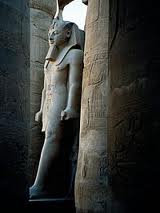
    There were 6 standing statues in front of the Pylon, only one of them, on the western side, is still in place.

    Flanking the gate of the first pylon, which is 24m high, there are two seated colossi representing King Ramses II, seated on his throne, with all the royal features. Both towers of this pylon were once decorated with relief’s depicting the Battle of Kadesh, fought between the armies of Egypt and the Hittites, in present day Syria. The 1st open court has double rows of 32 papyrus bud columns.

    To the right side of the open court there is an old triple shrine made by Queen Hatshepsut and Tuthmosis III, dedicated to the sacred boats of the “Triad of Thebes”. To the left is the Mosque of Abou El-Hagag.

    The open court of Ramses II leads to the Colonnade, which was built by Amenhotep III, and decorated by Tutankhamen and later, Horemheb; Seti I, Ramses II, and Seti II all recorded their names there. It consists of two pairs of large open papyrus columns, which are arranged to make a long processional avenue. The walls of this colonnade are decorated by scenes of the Opt Festival, special ceremonies for the visit of the “Triad of Karnak” to the Temple of Luxor. This feast lasted for about 24 days, including the return to the Karnak Temple.

    The colonnade leads to the Court of Amenhotep III (52m in length and 46m in width). It has a double row of clustered round papyrus bud columns on three sides. The Court of Amenhotep III leads to the Hypostyle Hall, which consists

    of 32 columns arranged in 4 columns and 8 columns each. To the left of the Hypostyle Hall stands a Roman altar, bearing Latin inscriptions, dedicated to Emperor Augustus. On the walls of the Hypostyle Hall, there are some reliefs representing Amenhotep III hunting and killing a gazelle in front of Amon Ra, and other scenes representing the King in front of various deities.

    On the rear of The Hypostyle Hall, and on both sides of the central doorway,

    There are 2 long chapels. The one to the east is dedicated to Mut and the One to the west dedicated to Khonso. The Hypostyle opens south to the 1st Antechamber, which originally had 8 columns, but they were removed when the antechamber was converted into a Christian Church.

    The Birth Room situated to the east, is a side room with 3 columns. Most of the scenes, depicting the divine birth of King Amen-hotep III, are in very poor condition.

    After the Birth Room there is another 3 columned chamber, also with badly damaged relief’s, and then the Sanctuary of Alexander the Great. Alexander the Great, who removed the 4 original columns and built a chapel, open to the north and to the south, rebuilt this sanctuary, which once had a golden plated statue of Amon Ra. Fortunately he did not remove the relief’s on the walls.

    From the shrine of Alexander the Great, we enter a 2nd antechamber, which has 4 papyrus bud columns.

    After passing the 2nd antechamber, there are 2 offering rooms, in poor condition, with their scenes also badly damaged.

    The original sanctuary is a small chamber with 4 clustered papyrus columns. The walls of this room are decorated with scenes depicting Amenhotep III dancing before the God Amon Ra. The outside walls of the Temple, on the west side, are covered with scenes and inscriptions, again representing the battle of Kadesh. This was the work of Ramses II to commemorate his “victory” over the Hittites.

    Temple of Man;

     Your Ad Here

    Temples (Luxor:The Temple in Man)

    The temples of ancient Egypt symbolized the focal point of each Egyptian settlement, the crossroads of the cosmos, where the divine and the earthly inhabitants of the mortal realm met in perpetual harmony. Priests, being an exclusive caste of high officials that often filled other important government posts and jobs, progressively became the “backbone” of Egypt in many ways. Historically, the priests collectively challenged the authority of the Pharaoh, and even invalidated his rule at several instances in ancient Egyptian history.

    Such a secular influence attest to the strong beliefs in the religion that permeated the culture, a system of divine sciences integrated into the very fabric of the whole society through cosmological symbols and magical hieroglyphs the priests alone could transcribe and “cast”.

    The temple represented the apex of all the disciplines, unsurprisingly since the priestsoften functioned simultaneously as artists, literary scribes, architects, doctors, healers, mathematicians, astronomers, and government officials.

    Signs and symbols riddled the temple walls, fusing into one inextricable whole allseparate spheres of study, in contrast to our modern society that divides branches apart with little or no relationship to each other.

    In ancient Egypt, those divisions meant little. As such, there was no art that wasn’t religious, no religion that wasn’t philosophical, no philosophy that wasn’t scientific, no science that was not art.

    The house of the gods reflected, through design and architecture, the principles of all the different studies of the universe, the sacred science, the timeless wisdom of the ancient mystery schools, enshrined behind a veil of harmony and architectural proportion, myth and symbolism. The initiate sought to unlock  the keys to the invisible college wrought in the stones, and by comprehending the powerful magic of symbolism, practiced the necessary rituals within the temple, ensuring that the gods would in fact reside within its walls.

    The Layout of Luxor Temple

    No place is such a conceptual divine plan illustrated better than at Luxor. There, at a city that once was the capital of the Middle Kingdom onwards, Waset (Thebes), the cult of Amun dominated the minds of the ancient Egyptian peoples.

    The Luxor Temple: House of Amun

    Amun meant, the “hidden one”, or the invisible science, the breath or spirit of life across the waters. Over time, as the temple stacked up in sections through 1000 years of slow and careful work done by architects,priests, artists and sculptors, the “body of Amun” (the temple) eventually stretched across the land; the living walls of Amun permanently channeled the magical powers of the “invisible one”, a force felt, absorbed, and finally understood only by specially initiated persons who unveiled the secrets of the cosmos through years of study of symbols and “talismans” in the temple.

    Entrance of the Horizon 

    The twin peaks of the horizon hieroglyph with sun rising between, depicted in the form  of the two architectural pylons guarding the temple entrance, symbolically demonstrates the unity of the universe dividing itself into the duality of the spiritual and manifested realms with each peak. Thus, by entering the temple, coupled with the performing of the rites, the reconciliation between the two worlds could be established through the multiplicity of the temple’s many functions and “magical acts”.

    Luxor Pylons marking the “The Peaks of the horizon”

    Between the two pylons, the third eye of the soul rested, so to speak, also seen in the Pharaoh’s sacred and protective Uraeus cobra snake diadem atop the forehead, the place where the ka of each person’s soul could leave or enter life and the afterlife.

    Cobra Uraeus atop forehead (Note Similar shape of Nemes headdress with above Pylons)

    R.A. Swchaller Lubiz noted that the pylon processional way heading into the complex exactly lined up with the starVega in the year 3500BC. That date is irrational in conjunction with the temple’s known dates of activity, as most of the structure rose up much later in the Middle and New Kingdom eras (2000-1200BC).

    Such an early date may harken back to the oldest foundations of the temple, a simple shrine perhaps, during an older archaic epoch.

    The Power of Amun

    The forecourt beyond the main entry way, contains the relief of two mirrored images of the lord Hapi, god of fertility and the Nile, holding together the river. The unification of the two lands of Egypt on the relief, denoted by the Lotus (Upper Egypt) and Papyrus (Lower Egypt), simultaneously demonstrates the division between the mortal and spiritual worlds.

    Hapi Relief

    At the base of the two gods rests a pair of lungs, where the breath of Amun propels the river up through the two lands, moving that artery throughout Egypt, which the country relied on for communication and thrived upon through trade.


    The Opet Festival Barque of Amun

    The legs of Amun, rest at the forecourt, the force by which Egypt prospered through progress or movement. Here, at the important Opet festival, thousands of lay commoners and workers celebrated the divine birth of the King, a ceremony that established a connection with the current Pharaoh to the Gods.

    When Pharaoh returned with the priests from the inner most sanctum to the forecourt, the people rejoiced. Then the King and priests paraded the barque with the inner sanctum statue of Amun down the Nile to Karnak with the people. Thus, the kingdom remained stable and capable of prospering into the future.

    Interestingly, the temple runs parallel to the Nile river nearby, reemphasizing the visual nature of the Nile as the backbone, or the “skeleton” of Amun, indeed of all Egypt, quite literally the whole universe as far as the ancient Egyptians felt concerned.

    The King is Born

    In the wide hall where the stomach of Amun resided, the announcement of the birth ofthe King was made by the priests, evidenced by hieroglyphic inscriptions. The place of birth in the womb, clearly corresponds to the belly of Amun overlaying the whole temple layout at the court of Amenhotep.

    At the place of the lungs, the hypostyle hall housed fluted columns inlaid on the ground with the phases of the moon, providing a monthly calendar the priestsused to monitor the days of each month. The right and left wing of columns correlate with the two lobes or wings of the lungs. Within the portico just beyond the hall, the heart of Amun lay, marked by 8 columns, divided in half as well, corresponding to the twoseparate ventricles of the heart each.

    Given the elaborate mummification processes the ancient Egyptians developed over the centuries, the familiarity the priests and builders displayed within the architecture of the temple mimicking the visual intricacies of the internal organs, is not a surprising one.

    The Name of the King

    Further up, the offering hall coincides with the vocalchords of the patron god. There the different names ofthe King are written in hieroglyphs lining a carved relief of Amun and wife Mut; a passage literally, “portrays the Annunciation [of a god] and creation through the [spoken] verb.”

    At the mouth of Amun lies the holiest inner sanctum, which enshrined the god’s statue. From here, the earliest phase of the temple remained accessible only to the high priest, and symbolized the very seed or point of origin from which the temple grew forth the body of Amun over the centuries. The original shrine was later replaced with one dedicated to Alexander the Great c.300BC.

    Amun Speaks

    The mouth, obviously, is paramount in the sustaining of life and growth, as it allows one to eat, to breath, to speak, and to drink water. Here, the high priest prayed and “listened”, hoping to hear the words of Amun. The inner sanctum also functioned as the place of “coronation” of the King by the priests.

    Through the Eyes of Amun, the Universe Unfolds

    Above the inner sanctum, lies the hall of hours, which contains 12 columns. The eyes of Amun directly hover over the hall of hours when the skeleton is superimposed over the overall temple layout. Altogether the columns represented the hours of the day, 12 in all.

    A series of bulls carved into the west wall with backs to the observer, sit opposite another set of bulls facing forward the observer on the east wall. Thus, what one actually sees or perceives, back of bulls or front, greatly depends on ones own unique point of view, or  one’s position in space or time.

    Once again, the 12 columns directly align with the 12 optical nerves occurring beyond the eye sockets, 6 on the left which connect to the right brain (the intuitive self), and the 6 on the right to the left brain (the logical/linear brain).

    Through the construction of the hall, the priests believed that the opposing oddities between the linear rational mind of the sciences and the artful endeavors of non-verbal intuition might perhaps be reconciled with the secret magic of Amun.

    The fluted columns contain arched designs on one half of the hall to the east, symbolizing duality and disunity, the separation between spirituality and the manifest, while the smooth ogival fluting on the western columns features completion and fluidity between spirit and man.

    The sun’s journey over the sky, horizon to horizon, in many ways symbolizes the journey of man or humanity, as the individual grows and matures over time, gaining wisdom as the initiate travels further and further into the temple.

    The Highest Wisdom

    At the very end of the temple, where the brain sits, the highest levels of enlightenment and wisdom and learning are sought. The internal organ of the brain wasn’t viewed as important to the ancient Egyptians, as the organ usually was discarded in the mummification process.

    Instead, the invisible “third eye”, the rearing cobra atop the forehead, is seen as the ultimate point of the higher mind, the seat of the intelligence-of-the-heart below, the translator or communicator of the divinity of the heart (soul). The last sanctuary’s unique geometry contains the exact proportions of the ratio 8:9, the designation of an important musical note at the beginning of the Egyptian scale, indicating the inner journey did not end with awakening.

    Initiation into the Mysteries

    Through study and contemplation, the initiate aimed to recognize the seat of the intelligence-of-the-heart, the embodiment of Amun, by understanding the united cosmology of the abstract “temple in man” which the physical temple attempted to reconstruct.

    An initiate tried to fully comprehend the idea until the mind transcended the outer body with a new communion finally established as the true dweller in two worlds that alone held the dual intelligence of Amun, the “hidden one.”

    With the simultaneous wielding of the two types of intelligence, the formerly invisible world of Amun opened up to the initiate.

    Due to the innate mysteriousness of the knowledge the priests held elite access to, the growth of the Amun cult collected greater and greater power over the people and even the Pharaoh into the New and Later Kingdoms, until the caste finally usurped larger control over the southern half of Egypt c.1000BC through vast land grants gifted by pharaoh and officials.

    **All of the following information is based on the brilliant research of one John Anthony West,  and also inspired from the earlier R.A. Swchaller Lubicz. I claim no ownership or credit for the research of these two brilliant researchers. Please check out West’s book called, Serpent in the Sky.

    Stonehenge

    Posted: August 28, 2012 by noxprognatus in Monuments

    Stonehenge Construction Periods, Phases, and History


    Stonehenge is definitely one of England’s greatest icons. Its original purpose is still somewhat unclear, but some have speculated that it was a temple made for worship of ancient earth deities. It has also been called an astronomical observatory for marking significant events on the ancient prehistoric calendar. Others claim that it was a sacred site created by Merlin and King Arthur for the burial of high-ranking citizens from societies of long ago.

    No matter what the claim has been for Stonehenge’s original purpose, the truth is that it has inspired countless generations of people to strive to learn and figure out the history of our past. Stonehenge is somewhat a “gateway to the realms” providing insights into humanities past and showing that maybe we were not as “technically challenged” as some would like us to believe.

    Construction of Stonehenge was broken into three periods:

    Stonehenge Period I (c. 2950-2900 BC)

    The earliest portion of Stonehenge dates to approximately 2950-2900 BC. The dates for each “period” can be fixed to about a 100 years or so with radiocarbon dating, but as to the exact building sequence within each period archaeologist cannot be certain.

    The first period of Stonehenge was basically a circular enclosure outlined by two banks and a ditch with an entrance to the northeast and a standing stone a bit away from the entrance.

    Stonehenge Period I (image from Mohen)

    The outer circle was made from earthand even though it is now mostly destroyed, it was about 380 feet in diameter, 8 feet wide, and 2 or 3 feet high.

    The ditch (more like pits) was not uniform in shape or depth and it varied in width from 10 – 20 feet and a depth of 4.5 – 7 feet. Not much effort was taken in keeping the ditch clean. Archaeologists have been able to use the varied fragments (picks made of red deer antlers, scoops made of oxen shoulder blades, and some pottery fragments) found near the bottom of the ditch to help date its construction.

    Next was the chalkwork inner bank of Stonehenge. It was an impressive sight standing at least 6 feet high, about 20 feet wide and had a diameter of 320 feet. It was composed of the solid chalk that makes up most of the surface region around Stonehenge. An interesting fact to note is that all of the other Stonehenge type monuments have their bigger encircling banks outside of the quarry ditches; yet Stonehenge has its bigger bank within the ditch. No one has been able to figure out why Stonehenge was done like this.

    The Heel Stone.

    From the center of the circle facing northeast is the entrance into Stonehenge. It is about 35 feet wide and is set so that a person standing in the center of Stonehenge can see the sun rise on midsummer morning just to the left of the heel stone.

    The naturally shaped heel stone is about 20 feet long and 8 feet wide by 7 feet thick. Its lower 4 feet is buried in the ground and it weighs an estimated 35 tons. It is made up of natural sandstone called sarsen which are thought to have come from Marlborough Downs, 20 miles to the north of Stonehenge. Currently the heel stone leans inward toward the circle at an angle of about 30 degrees from the perpendicular, but it is believed that the stone was once standing straight. Circling the stone about 12 feet from its base is a covered ditch filled with chalk.

    Aubrey Holes.

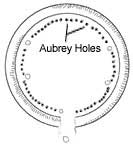
    Inside the circle are 56 Aubrey holes (named after their 17th century discoverer John Aubrey) which vary from 2.5 – 6 feet in width, and 2 – 4 feet in depth. They were spaced quite accurately in a 288 foot diameter circle with an average center point for each hole of 19 inches (+/- an inch or two).

    Probably also dating to this time are the four Station Stones (only two survive) which stand approximately on the circle of Aubrey holes. They formed a rectangle perpendicular to the midsummer sunrise line of the monument. Of the two still standing, one is naturally shaped while the other is slightly tooled. There is some contention among archaeologists as to when the Station Stones were placed at Stonehenge but general consensus is during period I.

    The questions still remain. What purpose did it serve? Who built it? For phase II there will be another blog. After the final phase. We will discuss the possible uses and some of the theories of the Henge.  Nox.