Author Archive

The Little-Known Legend of Jesus in Japan

Posted: December 28, 2012 by phaedrap1 in Spirituality
Tags: ,
A mountain hamlet in northern Japan claims Jesus Christ was buried there

Japan Jesus

The burial ground to what some claim is Jesus’ final resting place. (Jensen Walker / Getty Images)

On the flat top of a steep hill in a distant corner of northern Japan lies the tomb of an itinerant shepherd who, two millennia ago, settled down there to grow garlic. He fell in love with a farmer’s daughter named Miyuko, fathered three kids and died at the ripe old age of 106. In the mountain hamlet of Shingo, he’s remembered by the name Daitenku Taro Jurai. The rest of the world knows him as Jesus Christ.

It turns out that Jesus of Nazareth—the Messiah, worker of miracles and spiritual figurehead for one of the world’s foremost religions—did not die on the cross at Calvary, as widely reported. According to amusing local folklore, that was his kid brother, Isukiri, whose severed ear was interred in an adjacent burial mound in Japan.

A bucolic backwater with only one Christian resident (Toshiko Sato, who was 77 when I visited last spring) and no church within 30 miles, Shingo nevertheless bills itself as Kirisuto no Sato (Christ’s Hometown). Every year 20,000 or so pilgrims and pagans visit the site, which is maintained by a nearby yogurt factory. Some visitors shell out the 100-yen entrance fee at the Legend of Christ Museum, a trove of religious relics that sells everything from Jesus coasters to coffee mugs. Some participate in the springtime Christ Festival, a mashup of multidenominational rites in which kimono-clad women dance around the twin graves and chant a three-line litany in an unknown language. The ceremony, designed to console the spirit of Jesus, has been staged by the local tourism bureau since 1964.

The Japanese are mostly Buddhist or Shintoist, and, in a nation of 127.8 million, about 1 percent identify themselves as Christian. The country harbors a large floating population of folk religionists enchanted by the mysterious, the uncanny and the counterintuitive. “They find spiritual fulfillment in being eclectic,” says Richard Fox Young, a professor of religious history at the Princeton Theological Seminary. “That is, you can have it all: A feeling of closeness—to Jesus and Buddha and many, many other divine figures—without any of the obligations that come from a more singular religious orientation.”

In Shingo, the Greatest Story Ever Told is retold like this: Jesus first came to Japan at the age of 21 to study theology. This was during his so-called “lost years,” a 12-year gap unaccounted for in the New Testament. He landed at the west coast port of Amanohashidate, a spit of land that juts across Miyazu Bay, and became a disciple of a great master near Mount Fuji, learning the Japanese language and Eastern culture. At 33, he returned to Judea—by way of Morocco!—to talk up what a museum brochure calls the “sacred land” he had just visited.

Having run afoul of the Roman authorities, Jesus was arrested and condemned to crucifixion for heresy. But he cheated the executioners by trading places with the unsung, if not unremembered, Isukiri. To escape persecution, Jesus fled back to the promised land of Japan with two keepsakes: one of his sibling’s ears and a lock of the Virgin Mary’s hair. He trekked across the frozen wilderness of Siberia to Alaska, a journey of four years, 6,000 miles and innumerable privations. This alternative Second Coming ended after he sailed to Hachinohe, an ox-cart ride from Shingo.

Upon reaching the village, Jesus retired to a life in exile, adopted a new identity and raised a family. He is said to have lived out his natural life ministering to the needy. He sported a balding gray pate, a coat of many folds and a distinctive nose, which, the museum brochure observes, earned him a reputation as a “long-nosed goblin.”

When Jesus died, his body was left exposed on a hilltop for four years. In keeping with the customs of the time, his bones were then bundled and buried in a grave—the same mound of earth that is now topped by a timber cross and surrounded by a picket fence. Though the Japanese Jesus performed no miracles, one could be forgiven for wondering whether he ever turned water into sake.

***

This all sounds more Life of Brian than Life of Jesus. Still, the case for the Shingo Savior is argued vigorously in the museum and enlivened by folklore. In ancient times, it’s believed, villagers maintained traditions alien to the rest of Japan. Men wore clothes that resembled the toga-like robes of biblical Palestine, women wore veils, and babies were toted around in woven baskets like those in the Holy Land. Not only were newborns swaddled in clothes embroidered with a design that resembled a Star of David, but, as a talisman, their foreheads were marked with charcoal crosses.

The museum contends that the local dialect contains words like aba or gaga (mother) and aya or dada (father) that are closer to Hebrew than Japanese, and that the old village name, Heraimura, can be traced to an early Middle Eastern diaspora. Religious scholar Arimasa Kubo, a retired Tokyo pastor, thinks Shingo may have been settled by “descendants of the ten lost tribes of Israel.”

As if to fuel this unlikely explanation, in 2004, Israeli ambassador Eli Cohen visited the tombs and dedicated a plaque, in Hebrew, to honor the ties between Shingo and the city of Jerusalem. Embassy spokesman Gil Haskel explained that while Hebrew tribes could have migrated to Japan, the marker was merely “a symbol of friendship rather than an endorsement of the Jesus claims.”

Another theory raises the possibility that the tombs hold the bodies of 16th- century missionaries. Christian evangelists first came to Japan in 1549, but bitter infighting for influence and Japanese converts led to a nationwide ban on the religion in 1614.

Believers went underground, and these Hidden Christians, as they are called, encountered ferocious persecution. To root them out, officials administered loyalty tests in which priests and other practitioners were required to trample a cross or an image of the Madonna and the baby Jesus. Those who refused to denounce their beliefs were crucified, beheaded, burned at the stake, tortured to death or hanged upside-down over cesspools to intensify their suffering. For more than 200 years, until an isolated Japan opened its doors to the West in 1868, Christianity survived in scattered communities, which perhaps explains why Shingo’s so-called Christian traditions are not practiced in the rest of the region.

Follow us: @SmithsonianMag on Twitter

2,750-year-old temple discovered in Israel

Posted: December 27, 2012 by phaedrap1 in Monuments, Science
Tags: ,


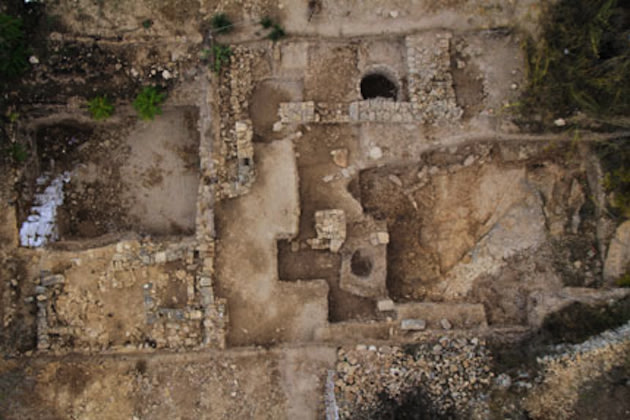
An overhead view of the excavation site (Skyview/Israeli Antiquities Authority)Israeli archeologists have discovered the remains of an ancient temple that is nearly 3,000 years old and was once home to a ritual cult.

“The ritual building at Tel Motza is an unusual and striking find, in light of the fact that there are hardly any remains of ritual buildings of the period in Judaea at the time of the First Temple,” excavation directors Anna Eirikh, Hamoudi Khalaily and Shua Kisilevitz said in a statement released by the Israeli Ministry of Foreign Affairs.

The temple remains were discovered at the Tel Motza site, located to the west of Jerusalem. The Israeli Antiquities Authority has been conducting excavation efforts at the site and says that along with the temple remains itself, the findings include a “cache of sacred vessels” estimated to be 2,750 years old.

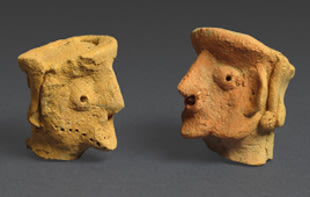
“Among other finds, the site has yielded pottery figurines of men, one of them bearded, whose significance is still unknown,” the statement from Khalaily and Kisilevitz reads.

NBC’s Cosmic Log notes that the discovery was made during preparations for a new section of Israel’s Highway 1. Because of the number of historical sites and artifacts in and near Jerusalem, the Israeli government typically conducts similar archeological excavation efforts before beginning construction on major infrastructure projects.

Two head figurines discovered at the 2,750-year-old site (Clara Amit, courtesy Israel Antiquities Authority)Dating back to the Iron Age, the temple was designed in accordance with similar layouts for other religious buildings from that era, according to the Israeli government. More from its analysis:

“The walls of the structure are massive, and it includes a wide, east-facing entrance, conforming to the tradition of temple construction in the ancient Near East: The rays of the sun rising in the east would have illuminated the object placed inside the temple first, symbolizing the divine presence within. A square structure which was probably an altar was exposed in the temple courtyard, and the cache of sacred vessels was found near the structure.”

The excavation directors said they will continue to examine the findings and conduct further digs while preparations for the highway construction continue.

“The find of the sacred structure, together with the accompanying cache of sacred vessels, and especially the significant coastal influence evident in the anthropomorphic figurines, still require extensive research,” they said.

Eric Pfeiffer  Yahoo News

What is Spiritual Energy?

First of all, we are not talking about “ghosts” here, but the spiritual (not religious) level vibrational radiance from all matter in all dimensions, including non-physical ones. This is the emanation of the clear, clean, loving, primordial energy that allows things to exist. One day soon this energy will be universally recognized as the basic organizational level of all things. It is Creational energy coming through as the signature vibrations of individuated forms. Science does not yet have a way to reliably detect or measure this energy nor do the inane “ghostbusters” on TV shows. Fortunately, we can use our own higher senses to perceive and evaluate these higher vibrational frequencies. We can also tap into and make use of them to expand our consciousness, heal ourselves, help others, communicate with higher dimensions, and move forward on our path.

There are also subtle energies that are not so spiritual in nature. These are the vibrations of unbalanced, unloving, or disorganized thoughts, emotions, actions, and intentions from human Souls here on Earth or on the Other Side. These energies surround us all of the time and can detrimentally affect us along with the subtle frequencies of electromagnetic devices like cellphones, high tension wires, computers, microwaves, etc. You may have sensed that you’ve been affected by some of them without being fully aware of it. Not to worry. As you learn to perceive subtle energies, you can also learn ways remediate the detrimental ones. Read on…


When and how do people notice or feel subtle or spiritual “energy”?

People sense subtle energy in different ways. Not everyone feels it bodily. Some people perceive it as colored light, “hear” it as a rising or falling sound or just “know” it. Some sense it in multiple ways at the same time or in succession. Some people can tell what consciousness, emotional, or situational “labels” are attached to subtle energy since energy can carry all possible outcomes at the same time. This is in fact what physicists have seen on the smallest level of matter, the Quantum level, where a particle can exist at many places at the same time yet still be only one “thing”.

To notice these subtle energies, you have to know that Spiritual energy exists. Understand that these Spiritual forces are not nearly as physically strong or readily noticeable to our five senses as the other kinds of energy (movement or Kinetic energy, heat, light, sound, electricity, gravity, etc.) that people interact with every day. If you’ve ever been “zapped” with electricity, you know what we’re talking about. Those energies we usually register only with our five senses of touch, taste, smell, feel, sight, or hearing. They are usually overtly apparent to us, even in relatively small amounts or strength as we have the ability to see in relatively dim light, sense minute temperature changes, or feel the brush of a hair against our skin. You’ve learned to hold your hand over a stove burner to feel if there is heat energy coming off of it before you touch it and can feel it quite far away if you tune in to the feeling of “heat”. If you pay attention, you may even be able to feel light falling upon your skin. What you notice, you are conscious of and what you are conscious of, you notice. So too with subtle energies:

Mesa Creative Arts Center Director, Brad Silberberg says this about sensing subtle energies: “When doing healing work or work with energy tools, I will often feel with my left hand by placing it on or near the source. I may feel a tingling or pushing sensation or feel a kind of heat coming from them, but not the kind of heat from a flame. This mostly tells me the strength and balance of the energy. I may feel other qualities contained by or attached to the energy somewhere inside of ‘me’ as well and use my practiced discernment to decode it. I sense energy with my whole physical body, my aura, chakras, and my expanded consciousness; what I call my ‘Felt Sense’. I believe I’m processing these sensations, in part, by using some of the 90% of my Human brain that Science says we ‘don’t use’ because they don’t understand subtle energy, how to detect, or measure it because it’s not electrical or chemical. It’s nonsense to me to think that so much of our brain is useless tissue. Nature and Creation would not have wasted that space.

I have always perceived other people’s emotions, state of mind, state of openness or closed-ness, denseness or lightness, high or low vibrational frequency, general health, and other information this way, often feeling it as if I am ‘having’ them myself. Over time I have learned how to interpret a great deal of what I pick up empathically with my Felt Sense and to widen my perception to other energies. I am still learning ways to sense, interpret, and work with inter-dimensional energies and the fundamental structural energies at the Spiritual/Creational level of matter that I ‘know’ are there all around us. Doing hands-on energy healing work with people, animals, and plants (e.g. Reiki, White Light, Sound Healing) interacting with crystals, and building and working with energy/healing tools have helped me to hone my perception and interpretation of subtle energies.”

Can just anyone feel these energies?

We are ALL sensitive to subtle energies, but as a species have largely forgotten how to notice and interpret them. You’ve probably had myriad energy-sensing experiences without recognizing them. One of the easiest energies to notice is “people energy”. (Why do you think shopping malls feel like they do?) Have you ever had the experience of pulling up at a traffic light and looking at the guy in the car next to you, only to have him turn and look back at you? Why did he do that? Because he FELT your attention energy and your consciousness focused at him and turned to see where it was coming from. His animal instincts told him to do so because some part of him was sensing that energy. Have you ever felt someone looking at you or felt someone silently enter a room behind your back?

Whether you realize it or not, you’ve likely already had experiences with feeling the Life Force or thought energies of people or places yourself. You’ve probably walked into a restaurant or motel room and just felt an uncomfortable “something” that made you decide to leave. If you thought about it at the time, you may have been able to describe it as a heaviness, staleness, sadness, or dullness. You may have even felt an uncomfortable humming or buzzing sensation somewhere in your body. You probably took your business to another establishment where you found the place feeling lighter, calmer, or happier somehow.

If you were to sit in a circle with a group of total strangers, besides what you see and hear you’d likely be noticing all kinds of things about them with your higher senses. If you turned your attention to each one in turn, you might find one person to seem happier and one sadder, one angrier or one more withdrawn. One person might feel “brighter” or “shinier” somehow while another might have a “dullness” about them. There might even be one person for whom you get a feeling that “the lights are on, but no one is home”. You may be picking up visual clues to give you this information, but you’d probably still be getting a lot of it even if they were each covered with a blanket. What you are doing is using your higher senses to feel their energy without thinking about it. It is part of the sensing system that our ancient ancestors evolved to survive in a dangerous world, but because our current times are relatively safe compared to dodging saber-toothed tigers, this system has fallen into background of Human awareness in “developed” cultures.

Brad Silberberg relates an experience he had with a woman who wanted to sense energy but wasn’t aware of it:

I met a woman who was working in a small health food store who wanted desperately to “feel” energy. I told her she already was, but that she simply wasn’t noticing it. Things were very quiet in the store, so her manager gave her permission to go into the little office room with me for a few minutes. I sat down next to her and asked her if she could feel her own presence. She looked quite puzzled and replied that she could not.

“Close your eyes,” I said, “Can you feel me sitting next to you without looking?”
“Yes,” she replied.
“OK then,” I said, “I’m going to move over here (crossing the room). Did you feel something change?”
“Why, yes, I did!” she answered excitedly.

I came back and sat next to her. “Can you feel me sitting next to you again?”, I said.
“Yes, I am,” she replied.
“What are you feeling that moved over there and back? You’re feeling my energy, my presence, my I-am-here-ness,” I explained.
“Now,” I said, “can you feel that same thing about yourself?”

A startled look came over her face. “Oh, my God!”, she exclaimed, “what IS that?!!”
“You’re feeling your own presence, your own I-am-sitting-right-here-ness,” I replied.

Her mouth fell open and then she started to cry. “I’ve never felt that before,” she wailed, “I’ve never felt that part of me.”
“That’s where our awareness needs to start,” I told her, “with noticing our own Spiritual nature.”

The thing that we notice most easily is CHANGE (like someone’s presence moving across the room), in part because we would just go nuts if we were constantly noticing every little static situation (like our OWN presence). When you put on a shirt, you feel it against your skin. You don’t spend all day noticing your “I-have-a shirt-on-ness.” We take notice when we feel a room turn from hot to cold when the air conditioning is turned on or feel a hand press on our skin when there was nothing there before. We notice change most easily when we are PAYING ATTENTION to what is changing. That’s the first part of the equation and the key to perception and eventual enlightenment. The second part is just a lot of practice feeling energies and noticing their subtle differences. Think of a professional wine taster; he takes a swig of wine (Blindfolded, of course!) and proceeds to tell you that it was bottled in 1968 in Bordeaux, France at 11am on a Sunday in October and that it had spent 11-1/4 months in an oak barrel. How does he know all that? He’s tasted a whole lot of wine and peeked at all of the labels to get to the point of acquiring great discernment, becoming a connoisseur in the process.

The third and maybe most important component for energy discernment is being mentally OPEN TO IT and allowing yourself to sense it. If we are not open to noticing it or even blocking the sensation by closing the safety shutters on our energy system, it’s like having our Geiger counter turned off when we are trying to measure nuclear radiation. Most people tend to shut down their own personal energy emanations (or aura) rather than allowing in “the other” and facing the emotional risks involved. This is a protective maneuver we do out of limiting beliefs, fear, lack of trust, and because most of those around us are also shut down, so we mirror it unconsciously. It is also a self preserving habit to keep out some of the ever growing energy bombardment from people, places, things, light pollution, cell phones, air and car traffic, microwaves, TV and radio broadcasts, power lines, computer screens, etc., that is stressing people out and making them sick. These energies can also clog up our Human energy system and keep us from perceiving movement and changes that we might otherwise notice.

Lastly, releasing disappointment from past experiences and holding the intention that you will eventually be able to feel these subtle/spiritual energies will magnetize you for actually achieving it. Remember that you cannot fail until you stop making attempts to succeed, so hold a lot of crystals, get involved in energy healing, engage in psychic practice exercises, and handle or work with energy devices like our Mesa Creative Arts Tools for Transformation and Healing. Not only will you hone your sensing abilities, but you will receive healing in the process that will open and enhance them.

Staying open to energy

Besides unbalanced Earth energies (geopathic stress) and electromagnetic smog, the negativity of Humanity’s mass consciousness is one of the greatest sources of unbalanced energy that we are exposed to every day. Other people’s fear, anger, pain, grief, etc, can drain us or induce resonance to those emotions in our own systems. It’s important to be aware of this process and find ways to keep from absorbing these energies. One way is to use our minds to make ourselves less like an absorbing sponge and more like a window screen, allowing things to simply flow through us instead of needing periodic “wringing out” to stay energetically healthy. Along with natural healing modalities that release energy, our Tools for Transformation and Healing may be just what’s needed to help release what might otherwise accumulate. It also helps to RADIATE.

Radiating

There are practical ways to stay open to what comes our way while remaining healthy and radiant. One way is by using our intention to be an receiver-transmitter for higher energies from Creation. We can use our awareness to take in those life-giving subtle energies from Nature, God/Source, and The Universe, and radiate them back out. The more we remember to radiate, the more we can take in and the more we take in, the more we can send out. The more we are able to radiate, the more relaxed we are. The more relaxed we are, the more we can feel and notice. Radiating also protects us through a process of giving away instead of fearful shielding and helps us to clear our own energy systems. Think about trying to push dirt and stones into the end of a garden hose with a forceful stream of water coming out of it. If the water is turned off, it’s far easier to do. The good news is that there is no shortage of “water” (spiritual or life-force energy) for you to draw from and radiate. Holding back (NOT radiating) is a stressed state that most people don’t even know they are in.

You see, each one of us is an antenna for Source/God Energy. We are here (in part) to receive it, slow down its very high frequency with our chakras (subtle energy centers in our bodies), and radiate it back out to the Earth, Nature, and Humanity through our aura. We have demonstrated the difference in how this feels to others by asking people to turn on their energy “radar” while we stand in front of them and consciously pulling in our aura as hard and as tight as we can. They will usually say they feel “quietness”, “coldness”, and/or a pulling or sucking sensation. As we release our aura (It’s very uncomfortable to hold in for long) people often say; “You came back!”

When people shut down and stop radiating their auric light they become like a Black Hole, sucking in energy from all around them and sending it off-planet to who knows where. (You’ve probably met someone who was in such a bad or sad mood that they seemed to suck the very oxygen out of the room.) Each one of us who is radiating counteracts the effects of many Black Holes. It can take some practice to let your Light shine and our Tools for Transformation and Healing can help you by unclogging your energy systems, healing your thoughts and emotions, and increasing your vibrational frequency directly or indirectly. It’s still up to you to choose to be a Shining Star or Black Hole. Remember that radiating your Light keeps the flowers opening, the birds singing, the rivers flowing, and the Earth turning. Do you really want to NOT radiate?

What might subtle and spiritual energies FEEL like?

One of the most common experiences people have had that’s like that of feeling energy move through them is BLUSHING. The sensation starts in your face, but then rapidly spreads through your whole body. That rush of adrenaline that causes the blood vessels in your face to dilate goes through your whole system in seconds and so does the emotional energy that set it off.

“OK,” you might say, “so you’ve told me all about these subtle energies, but how do I deal with or discuss them if I can’t describe them even to myself?” People are still finding language to talk about the complex nature of what they feel. You probably know what Love feels like to you, but can you really describe what it feels like inside of your body when you are feeling Love? Here’s a little meditation/exercise to help you do some sensing and practice discernment:

Close your eyes and just feel what your are feeling right now. (Noticing what you are noticing is called being CONSCIOUS.) Take a little tour of your body and awareness from your feet to your head, pausing first to sense how your feet feel. Are they tired, tingling, relaxed, aching? Next move up to your knees and tune in there. How do they feel? Now move up to your pelvis. Are you relaxed or tense there, hot or cold? Do you feel pressure anywhere? Is your chest tight or expanded and relaxed? Are your shoulders sore? Is your neck stiff? Turn your attention to your jaw. Are you gritting your teeth? Is your tongue pressed against the roof of your mouth? Are your eyes tired, burning, or cool? Can you feel wrinkles in your forehead or is it calm? Is the top of your head itching or tingling? Do you feel dense or loose, warm or cold, calm or nervous? Now you’ve gone completed that tour so you’ll more easily pick up on it if some sensation were to change. Now pick up a crystal, touch a plant, put your hand on someone’s heart, or hold a Tool for Transformation and Healing. Does something change in your awareness? Can you describe it? If you’re not noticing anything different you’re still OK, but you may be resisting the whole idea of this energy or your internal “meter” may be shut down– energetically in protective mode. Try this:

First, take a deep breath and let it out. Think about radiating light, sound, or heat out from your body in all directions. Close your eyes, put your hands on your heart, say “RADIATE” and move your hands out to the sides until your arms are straight out. Can you feel your energy system open up? Now pick up that crystal and see what changes you feel. You may still have to open the protective “doorway” in your wrist that keeps everything you touch from entering your energy system through your hand. Just envision a door (however you see it, as the door to your house, a garden gate, or a big iron prison door) at your wrist and envision that door opening. Can you trust enough to let the energy and consciousness of the crystal enter now? Can you even send your consciousness out to meet it? What do you feel now? Need some words/concepts to fill things out?

Here are some ways we use to describe how these energies feel to us that might help you increase your awareness of them. They may be sensed with the hand or all over the body:

  • Buzzing or tingling, like when your leg is asleep.
  • Prickly, like static electricity.
  • A feeling of heat without a heat source. (Usually denotes a LOT of energy moving.)
  • A feeling of cold without a physical source.
  • A sense of a rising or falling pitch without any audible sound.
  • A feeling of something flowing through you like wind or a stream or current of warm water.
  • A feeling like a wave passing through you.
  • A sense that some other Being, like an angel or ghost has stepped inside of you (“incorporation”)
  • Pressure or a pushing sensation with nothing touching you.
  • A pulsing sensation that is not in time with your heartbeat. (Usually a balancing “Healing Pulse”.)
  • A sensation of bubbles rising like carbonated water or Alka-Seltzer.
  • A “clanging” sensation like striking a piece of metal held in your hand with a hammer.
  • A spinning or spiraling sensation.
  • A fluttering or shimmering sensation.
  • A sensation like a change in altitude or barometric pressure.
  • A sense of lightness that wasn’t present before.
  • A sense of expansion in some way.
  • A shift in consciousness like meditation or falling asleep.
  • A sudden sigh or yawn. (Denotes that you are getting relieved of something by what you came into contact with.)

Many people don’t recognize the signs of their energy system in movement or release. Here are some signs that built up energy is being released from a person’s system on the physical, mental, emotional, and/or spiritual level:

  • Crying
  • Laughing
  • Muscle twitching/releasing
  • Yelling
  • Coughing
  • Vomiting
  • Burping
  • Flatulence
  • Shaking or trembling
  • Sighing
  • Yawning
  • Vibrating or buzzing, especially in the feet, hands, head, or sex organs

Mesa Creative Arts

A zombie invasion is a problem that may seem to belong in a horror film rather than to real life, but, none the less, the British government believes it has worked out the best way to cope with one.

Shaun Of The Dead

The Cabinet Office would lead Britain’s response to a zombie apocalypse, according to an official response to a Freedom of Information request

8:02AM GMT 26 Dec 2012

In the event of an apocalypse brought about by an army of the undead, civil servants would co-ordinate the military’s efforts to “return England to its pre-attack glory”, according to a Freedom of Information request that has revealed the country’s contingency plans.

The MoD would not lead efforts to plan for such a zombie attack or deal with the aftermath because that role rests with the Cabinet Office, which co-ordinates emergency planning for the Government.

Details about the authorities’ surprising level of readiness for a zombie onslaught emerged in a response to an inquiry from a member of the public.

The MoD replied: “In the event of an apocalyptic incident (eg zombies), any plans to rebuild and return England to its pre-attack glory would be led by the Cabinet Office, and thus any pre-planning activity would also taken place there.

“The Ministry of Defence’s role in any such event would be to provide military support to the civil authorities, not take the lead. Consequently, the Ministry of Defence holds no information on this matter.”

The Army is frequently called on to save the day in zombie films. Soldiers arrive in the nick of time, for example, to rescue the hero at the climax of Simon Pegg’s 2004 comedy Shaun of the Dead.

This is not the first time that public authorities have provided tongue-in-cheek responses to Freedom of Information inquiries about zombies.

Last year, Leicester city council was forced to admit that it had no specific preparations for dealing with a zombie invasion, although the local authority stressed that certain aspects of its emergency plan would apply to any disaster. Bristol city council went rather further when asked what it would do in the event of an undead rampage through the West Country.

A senior official replied with a copy of a “top secret” internal strategy document setting out how the council would respond to a “zombie pandemic”.

Staff were told to listen out for code words in radio and television broadcasts to warn them that an attack was under way, and given health and safety advice on the correct way to kill zombies.

Under the heading “procurement implications”, the memo said Bristol city council had ordered suitable equipment for tackling the undead, “where possible, in line with our buy-local policy”. It added: “A catalogue of standard issue equipment – cuffs, stun guns, protection suits, etc – is available on the staff intranet.”

However, critics have accused people who make Freedom of Information requests about subjects such as zombies, wizards and vampires, of being time-wasters who are costing the taxpayer money.

Some fear that trivial uses of the recently won right to ask public bodies to release information they hold will give politicians an excuse to scale back the powers, which were introduced in full only as late as 2005.


The Telegraph

Crossrail dig unearths forgotten London

Posted: December 24, 2012 by phaedrap1 in News
Tags:

BBC News, London

Archaeologist and skeletons
Hundreds of skeletons were found in an excavation at Crossrail’s new ticket hall

As a team of archaeologists digs through layers of history beneath London, the thought of the next find is never far away.

“Just about any new discovery is thoroughly exciting,” says Jay Carver, the lead on what is currently the UK’s largest archaeology project.

His team has been working alongside engineers building stations and digging two giant tunnels under central London as part of Crossrail since 2009.

On the journey so far, finds include rare amber, hundreds of skeletons and a Bronze Age track.

But for Mr Carver, among the most exciting discoveries was the Thames ironworks and ship building company which occupied the entire Limmo Peninsula.

Wild animals

He said: “The site had literally been forgotten in the ground. It was 100 years old but we have pretty much been able to reconstruct it.”

“To have discovered this huge timber shipway was extraordinary.”

“The discovery of ancient animal bones in Paddington takes it to the other extreme to a London with wild animals, an unbelievable concept in today’s world.”

Amber Archaeologists said the largest piece of amber found in the UK was unearthed at Canary Wharf

Crossrail will connect 37 stations from Heathrow Airport and Maidenhead in the west, through central London and out to Abbey Wood and Shenfield in the east.

It is due to be completed in 2018.

Being a part of this giant feat of engineering has allowed the 100-strong team of archaeologists to venture into largely unexplored territory.

Mr Carver said: “The project has allowed us to dig so many holes across so many parts of London.”

“It’s about filling information gaps, finding out about stuff we didn’t know before and making all the details we had in the past, clearer.”

He explained that digging from west to east through the centre of London, which due to city’s built-up nature is usually restricted, gives them a unique opportunity.

Roman city

“It enables us to compare and contrast areas of London by gathering scientific data from different locations, for example excavating several sites across west London and parts of the City.”

“It is exciting as you spend years doing the research then you get to dig and prove your homework” Mike Court Archaeologist

“Looking at how they developed from green fields into the city we know today and how the river system changed and developed over thousands of years.

“It will also reveal thousands of years of history in the Square Mile which covers what was a Roman and medieval city, which are fairly unknown.”

Advances in technology may mean there is less uncertainty about what might lay beneath the surface, but Crossrail has still delivered a few surprises.

At Canary Wharf a 55-million-year-old piece of amber was unearthed from beneath the dock bed in 2009.

The archaeology team said very little amber had been found in London and this piece was larger and clearer than any previously found in the UK.

The next stop for the team is Farringdon where archaeologist Mike Court will be leading a two-week excavation in January.

Crossrail excavation The Thames ship building company was unearthed at Limmo Peninsula

Trial digs have confirmed an old river channel and evidence of leather production under Smithfield Market.

Mr Court said: “It is exciting as you spend years doing the research then you get to dig and prove your homework.”

“It’s close to a big plaque pit from the black death so it gives us a chance to dig down but there’s only a 20% chance we will find it.”

Meanwhile, in a trial excavation pit at Liverpool Street in February 2011, Mr Court said they came across what he considers to be the most exciting find on the project so far – a silver Denarius, a Roman coin from 225AD.

Roman coin The team found a silver Roman Denarius which would have been in use across Europe at the time

“It’s fairly run of the mill for sites but it gives you something in your hand which showed the time Britain was part of the Roman Empire and puts us into the wider context,” he said.

Looking to 2013, Mr Carver said they would be working on the largest single excavation at the site of Crossrail’s ticket hall in Liverpool Street.

It is expected to reveal the less salubrious parts of Roman London outside of the City walls with archaeologists anticipating to encounter Roman timber-framed buildings and a street surface 6m below ground level.

The “lost” Walbrook River – a channel that divided the western and eastern parts of the city – may also be found.

At the eastern end of the Crossrail route, archaeologists will work at four large tunnel entrance sites at Pudding Mill Lane, Victoria Dock, North Woolwich and Plumstead.

Here it is thought the team will come across areas where Bronze Age people lived, farmed and hunted some 3,500 years ago.

Only halfway through its journey, and with a total of 20 archaeology sites to explore, it is hoped there is much more to be uncovered.

Jane Mower

BBC NEWS


 The fate of Ramesses III has long been the subject of debate among Egyptologists.

Recently, a team of researchers, led by Dr Albert Zink from the Institute for Mummies and the Iceman of the European Academy of Bolzano/Bozen in Italy, analyzed the mummies of Ramesses III the second ruler of Egypt’s 20th Dynasty, and the last of great pharaohs on the throne and unknown man E, the suspected son of the king.

Ramesses III’s reign (probably from 1186 to 1155 BC) was a time of considerable turmoil throughout the Mediterranean that saw the Trojan War, the fall of Mycenae and a great surge of displaced people from all over the region that was to wreak havoc; even toppling some empires.


Ancient papyrus trial documents mention an attempt on the pharaoh’s life in 1155 BC.

Apparently, members of his harem and several people in high positions in the pharaoh’s government were involved a palace coup.


The conspiracy was led by Tiye, one of his two known wives, and her son Prince Pentawere, over who would inherit the throne, but it is not clear whether the plot was successful or not.

Recent CT scans of Ramesses III revealed a wide and deep wound in the throat of the king’s mummy.

According to researchers, the deadly wound caused by a sharp blade and hidden by the bandages, probably caused immediate death of the king.

The neck was covered by a collar of thick linen layers.

Analysis of unknown man E revealed an age of 18-20 years, while an inflated thorax and compressed skinfolds around the neck of the mummy suggests violent actions that led to death, such as strangulation.


Additionally, the body was not mummified in the usual way – and was covered with a “ritually impure” goatskin – which the authors say could be interpreted as evidence for a punishment in the form of a non-royal burial procedure.

A Horus eye amulet was also found inside the wound, most probably inserted by the ancient Egyptian embalmers during the mummification process to promote healing.


Another mummy that belongs to unknown man E, has unusual marks around the neck, and could be Prince Pentawere, that may have been forced to kill himself as a punishment for the conspiracy.

The cause of death “has to remain a matter of speculation.”

Finally, DNA analysis revealed that the mummies share the same parental lineage, “strongly suggesting that they were father and son,” researchers say.

“Before now we knew more or less nothing about the destiny of Ramesses III. People had examined his body before and had done radiographs but they didn’t notice any trauma. They did not have access to the CT scans that we do,” Dr Albert Zink, palaeopathologist of the EURAC Institute for Mummies and the Iceman in Italy, said.

“We were very surprised by what we found. We still cannot be sure that the cut killed him, but we think it did.

“It might have been made by the embalmers but this is very unlikely. I’m not aware of any other examples of this.”

The body was not mummified in the usual way – and was covered with a “ritually impure” goatskin – which might have been an ancient punishment in the form of a non-royal burial procedure.

“He was badly treated for a mummy,” said Dr Zink.

© MessageToEagle.com

Found: Whale thought extinct for 2 million years

Posted: December 23, 2012 by phaedrap1 in Uncategorized
 Mysterious, elusive, diminutive creature rarely came to shore
Image: Pygmy whale

Darryl Wilson, University of Otago

The pygmy whale, a mysterious cetacean that looks radically different from all living whales, is actually the last living member of a group thought to have gone extinct 2 million years ago.
By Tia Ghose Staff Writer

The pygmy right whale, a mysterious and elusive creature that rarely comes to shore, is the last living relative of an ancient group of whales long believed to be extinct, a new study suggests.

The findings, published Tuesday in the Proceedings of the Royal Society B, may help to explain why the enigmatic marine mammals look so different from any other living whale.

“The living pygmy right whale is, if you like, a remnant, almost like a living fossil,” said Felix Marx, a paleontologist at the University of Otago in New Zealand. “It’s the last survivor of quite an ancient lineage that until now no one thought was around.”

The relatively diminutive pygmy right whale, which grows to just 21 feet long, lives out in the open ocean. The elusive marine mammals inhabit the Southern Hemisphere and have only been spotted at sea a few dozen times. As a result, scientists know almost nothing about the species’ habits or social structure.

The strange creature’s arched, frownlike snout makes it look oddly different from other living whales. DNA analysis suggested pygmy right whales diverged from modern baleen whales such as the blue whale and the humpback whale between 17 million and 25 million years ago. However, the pygmy whales’ snouts suggested they were more closely related to the family of whales that includes the bowhead whale. Yet there were no studies of fossils showing how the pygmy whale had evolved, Marx said.

To understand how the pygmy whale fit into the lineage of whales, Marx and his colleagues carefully analyzed the skull bones and other fossil fragments from pygmy right whales and several other ancient cetaceans.

The pygmy whale’s skull most closely resembled that of an ancient family of whales called cetotheres that were thought to have gone extinct around 2 million years ago, the researchers found. Cetotheres emerged about 15 million years ago and once occupied oceans across the globe.

The findings help explain how pygmy whales evolved and may also help shed light on how these ancient “lost” whales lived. The new information is also a first step in reconstructing the ancient lineage all the way back to the point when all members of this group first diverged, he said.


The pineal gland (also called the pineal body, epiphysis cerebri, epiphysis or the “third eye”) is a small endocrine gland. It produces melatonin, a hormone that affects the modulation of wake/sleep patterns and photoperiodic (seasonal) functions. It is located near to the center of the brain between the two hemispheres, tucked in a groove where the two rounded thalamic bodies join. Unlike much of the rest of the brain, the pineal gland is not isolated from the body by the blood-brain barrier system. It is reddish-gray and about the size of a pea (8 mm in humans).


The pineal gland is shaped like a tiny pine cone, hence its name.

Pine Cone Pineal Gland


Pseudoscience Theories

While the physiological function of the pineal gland has been unknown until recent times, mystical traditions and esoteric schools have long known this area in the middle of the brain to be the connecting link between the physical and spiritual worlds. Considered the most powerful and highest source of ethereal energy available to humans, the pineal gland has always been important in initiating supernatural powers. Development of psychic talents has been closely associated with this organ of higher vision.

The third eye controls the various bio-rhythms of the body. It works in harmony with the hypothalamus gland which directs the body’s thirst, hunger, sexual desire and the biological clock that determines our aging process. When it “awakens”, one feels a pressure at the base of the brain.

The pineal gland’s location deep in the brain seems to intimate hidden importance. In the days before its function as a physical eye that could see beyond space-time was discovered, it was considered a mystery linked to superstition and mysticism. Today it is associated with the sixth chakra.


Chakras – Spiraling Wheels or Cones of Energy

12 Around Spiraling Cones of Creation


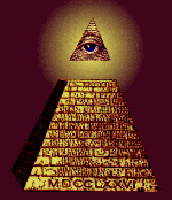
All-Seeing-Eye

It’s about the Eye, Zero Point, focusing your consciousness and trusting what you see. You do it all the time and may not beware of the difference between your thoughts and those from higher frequency. I was told that the third eye has a lens that opens to see behind physical reality, so you might want to relate to that theory. When the third eye opens it can feels like a pressure at the base of the brain. We all want to be more psychic and increase the connection with the other side as our Consciousness Hologram closes and souls return to light. We want to empower and most of all to understand beyond the physical. Meditation, Visualization, Yoga, and all forms of Out of Body Experiences help.

In the early 1900s, an archaeologist, William Mills, dug up a treasure-trove of carved stone pipes that had been buried almost 2,000 years earlier.

Mills was the first to dig the Native American site, called Tremper Mound, in southern Ohio. And when he inspected the pipes, he made a reasonable – but untested – assumption. The pipes looked as if they had been carved from local stone, and so he said they were. That assumption, first published in 1916, has been repeated in scientific publications to this day. But according to a new analysis, Mills was wrong.

In a new study, the first to actually test the stone pipes and pipestone from quarries across the upper Midwest, researchers conclude that those who buried the pipes in Tremper Mound got most of their pipestone – and perhaps even the finished, carved pipes – from Illinois.

The researchers spent nearly a decade on the new research. They first collected the mineralogical signatures of stone found in traditional pipestone quarries in Illinois, Kansas, Michigan, Minnesota, Missouri and Ohio. Then they compared the material found in those quarries to the mineralogical makeup of the artifacts left behind by the people of Tremper Mound.

Less than 20 percent of the 111 Tremper Mound pipes they tested were made from local Ohio stone. About 65 percent were carved from flint clay found only in northern Illinois and 18 percent were made of a stone called catlinite – from Minnesota.

The researchers are still puzzling over how most of these materials made it to Ohio from Illinois, and are baffled by another new discovery.Pipes from a site only about 40 miles north of Tremper Mound, an elaborate cluster of immense mounds known as Mound City, were carved almost entirely from local stone.Mound City was inhabited at about the same time or shortly after Tremper Mound, and the pipes found there are stylistically very similar to the Tremper pipes.

The researchers describe their findings in a paper in American Antiquity.

These results should remind archaeologists that things are not as simple as they sometimes appear, said Thomas Emerson, the principal investigator on the study and the director of the Illinois State Archaeological Survey (ISAS) at the University of Illinois.

“This is how mythology becomes encased in science,” he said.

The study also confirms that the people who produced these pipestone artifacts, known today as members of the Hopewell tradition, were more diverse and varied in their cultural practices than scientists once appreciated, Emerson said.

Photo by L. Brian Stauffer

The Hopewell people, who lived in the region from about 100 B.C. to roughly A.D. 400, have long been the subject of speculation, as the artifacts they left behind and the manner in which these goods were disposed of are not easily understood. Those living in southeastern Ohio, especially, seemed to be “conspicuous consumers and connoisseurs of the exotic,” Emerson said.

Photo by L. Brian Stauffer

The Hopewell people from that area collected “massive assemblages of obsidian from Wyoming, mica from the Appalachians, and caches of elaborately carved pipes, ” Emerson said. They also collected shells from the Gulf Coast, along with the skulls of exotic animals (an alligator, for instance).

Photo by L. Brian Stauffer

“Strange animals, strange minerals, strange things were really a focus,” he said.

Most of the carved stone pipes from that era have been found in Ohio, where very large caches often containing more than 100 pipes were ritually broken, burned and buried, Emerson said. The same style of pipes are found in Illinois, but many fewer have been uncovered in Illinois to date, he said, and they are dispersed, not heaped together in giant hordes as in Ohio.

There is evidence of stone carving at the Illinois sources where the stone was gathered, but none at Tremper Mound, suggesting that the Illinois stone was carved into pipes before it was transported to Ohio.

The team used a variety of techniques to analyze the material in the quarries and the artifacts. One method, called X-ray diffraction (XRD), produces a distinct signal that reflects the proportion of minerals in different types of stone. The stone must be pulverized, however, to subject it to XRD.

Photo by L. Brian Stauffer

Photo by L. Brian Stauffer

Photo by L. Brian Stauffer

Location where the owl pipes were discovered.

To analyze the intact pipes, the researchers used a non-destructive portable technology, called PIMA, which illuminates a specimen with short-wavelength infrared radiation and records the refracted (unabsorbed) wavelengths, allowing investigators to identify the minerals present. They verified the accuracy of the PIMA by comparing its results to those obtained with XRD on quarry specimens and broken pipes.

The new findings should challenge archaeologists to look more carefully at the evidence left behind by the Hopewell people, Emerson said.

“This study really says to the archaeological community, you need to go back to the drawing board,” he said. “You’ve been telling stories for decades that are based on essentially misinformation.”

© MessageToEagle.com

Rudolph WAS lit — and Santa was taking magic mushrooms!

Posted: December 21, 2012 by phaedrap1 in News, Science
Flying reindeer? Theory calls St. Nick modern counterpart of shaman — on hallucinogenics
Image: FINLAND-CHRISTMAS-SANTA CLAUS

Olivier Morin  /  AFP / Getty Images

Santa Claus — hopefully without the assistance of hallucinogens — prepares his reindeer and sled in Rovaniemi, Finland, on Dec. 16, 2008. Rovaniemi’s Christmas theme park gets into full swing during the holidays, teeming mainly with families with children eager to meet Santa and his elves.
By Douglas Main
This Christmas, like many before it and many yet to come, the story of Santa and his flying reindeer will be told, including how the “jolly old elf” flies on his sleigh throughout the entire world in one night, giving gifts to all the good children.

But according to one theory, the story of Santa and his flying reindeer can be traced to an unlikely source: hallucinogenic or “magic” mushrooms.

“Santa is a modern counterpart of a shaman, who consumed mind-altering plants and fungi to commune with the spirit world,” said John Rush, an anthropologist and instructor at Sierra College in Rocklin, Calif.

According to the theory, the legend of Santa derives from shamans in the Siberian and Arctic regions who dropped into locals’ teepeelike homes with a bag full of hallucinatory mushrooms as presents in late December, Rush said.

“As the story goes, up until a few hundred years ago these practicing shamans or priests connected to the older traditions would collect Amanita muscaria (the Holy Mushroom), dry them, and then give them as gifts on the winter solstice,” Rush told LiveScience. “Because snow is usually blocking doors, there was an opening in the roof through which people entered and exited, thus the chimney story.”

But that’s just the beginning of the symbolic connections between the Amanita muscaria mushroom and the iconography of Christmas, according to several historians and ethnomycologists, or people who study the influence fungi has had on human societies. Of course, not all scientists agree that the Santa story is tied to a hallucinogen. [ Tales of Magic Mushrooms & Other Hallucinogens ]

Presents under the tree
In his book “ Mushrooms and Mankind ” (The Book Tree, 2003) the late author James Arthur points out that Amanita muscaria, also known as fly agaric, lives throughout the Northern Hemisphere under conifers and birch trees, with which the fungi —which is deep red with white flecks — has a symbiotic relationship. This partially explains the practice of the Christmas tree, and the placement of bright red-and-white presents underneath, which look like Amanita mushrooms, he wrote.

“Why do people bring pine trees into their houses at the Winter Solstice, placing brightly colored (red and white) packages under their boughs, as gifts to show their love for each other … ?” he wrote. “It is because, underneath the pine bough is the exact location where one would find this ‘Most Sacred’ substance, the Amanita muscaria, in the wild.”

Reindeer are common in Siberia, and seek out these hallucinogenic fungi, as the area’s human inhabitants have been known to do. Donald Pfister, a biologist who studies fungi at Harvard University, suggests that Siberian tribesmen who ingested fly agaric may have hallucinated into thinking that reindeer were flying.

“Flying” reindeer
“At first glance, one thinks it’s ridiculous, but it’s not,” said Carl Ruck, a professor of classics at Boston University. “Whoever heard of reindeer flying? I think it’s becoming general knowledge that Santa is taking a ‘trip’ with his reindeer,” Ruck said. [ 6 Surprising Facts About Reindeer ]

“Amongst the Siberian shamans, you have an animal spirit you can journey with in your vision quest,” Ruck continued. ” And reindeer are common and familiar to people in eastern Siberia. They also have a tradition of dressing up like the (mushroom) … they dress up in red suits with white spots.”

Ornaments shaped like Amanita mushrooms and other depictions of the fungi are also prevalent in Christmas decorations throughout the world, particularly in Scandinavia and northern Europe, Pfister points out. That said, Pfister made it clear that the connection between modern-day Christmas and the ancestral practice of eating mushrooms is a coincidence, and he doesn’t know about any direct link.

Many of these traditions were merged or projected upon Saint Nicholas, a fourth-century saint who was known for his generosity, as the story goes.

The Santa connection
There is little debate about the consumption of mushrooms by Arctic and Siberian tribes’ people and shamans, but the connection to Christmas traditions is more tenuous, or “mysterious,” as Ruck put it.

Many of the modern details of the modern-day American Santa Claus come from “A Visit from St. Nicholas” (which later became famous as “‘Twas the Night Before Christmas”), an 1823 poem credited to Clement Clarke Moore, an aristocratic academic who lived in New York City.

The origins of Moore’s vision are unclear, although Arthur, Rush and Ruck all think he probably drew from northern Europe motifs that derive from Siberian or Arctic shamanic traditions. At the very least, Arthur wrote, Santa’s sleigh and reindeer are references back to various related Northern European mythology. For example, the Norse god Thor (known in German as “Donner”) flew in a chariot drawn by two goats, which have been replaced in the modern retelling by Santa’s reindeer, Arthur wrote.

Ruck points to Rudolf as another example of the mushroom imagery resurfacing: his nose looks exactly like a red mushroom, he said.  “It’s amazing that a reindeer with a red-mushroom nose is at the head, leading the others.”

Some doubt
Other historians were unaware of a connection between Santa and shamans or magic mushrooms, including Stephen Nissenbaum, who wrote a book about the origins of Christmas traditions, and Penne Restad, at the University of Texas.

One historian, Ronald Hutton, told NPR that the theory of a mushroom-Santa connection is off-base. “If you look at the evidence of Siberian shamanism, which I’ve done,” Hutton said, “you find that shamans didn’t travel by sleigh, didn’t usually deal with reindeer spirits, very rarely took the mushrooms to get trances, didn’t have red-and-white clothes.”

But Rush and Ruck say these statements are incorrect; shamans did deal with reindeer spirits, and the depiction of their clothes’ coloring has more to do with the colors of the mushroom than the shamans’ actual garb. As for sleighs, the point isn’t the exact mode of travel, but that the “trip” involves transportation to a different, celestial realm, Rush said.

“People who know about shamanism accept this story,” Ruck said. “Is there any other reason that Santa lives in the North Pole? It is a tradition that can be traced back to Siberia.”