Archive for the ‘Science’ Category

Split-Personality Elliptical Galaxy Holds A Hidden Spiral

Posted: October 22, 2012 by phaedrap1 in Science
Tags:

Most big galaxies fit into one of two camps: pinwheel-shaped spiral galaxies and blobby elliptical galaxies.

Spirals like the Milky Way are hip and happening places, with plenty of gas and dust to birth new stars. Ellipticals are like cosmic retirement villages, full of aging residents in the form of red giant stars.

Now, astronomers have discovered that one well-known elliptical has a split personality. Centaurus A is hiding a gassy spiral in its center.


Click on image to enlarge

M87The giant elliptical galaxy M87 shows a split personality because it hides a gaseous spiral at its core. When M87 collided with a spiral galaxy 300 million years ago, it slurped up the spiral’s gases, which formed a new spiral inside the larger galaxy. Credit: ESO
“No other elliptical galaxy is known to have spiral arms,” said lead author Daniel Espada (National Astronomical Observatory of Japan & Harvard-Smithsonian Center for Astrophysics).

“Centaurus A may be an old galaxy, but it’s still very young at heart.”

 
Centaurus A isn’t your typical elliptical to begin with. Its most striking feature is a dark dust lane across its middle – a sign that it swallowed a spiral galaxy about 300 million years ago.

Centaurus A slurped that galaxy’s gases down, forming a disk that we see nearly edge on. From our point of view, any features in that disk have been hidden by the intervening dust.

This pan video takes a close look at the peculiar galaxy Centaurus A (NGC 5128) in an image taken with by the Wide Field Imager attached to the MPG/ESO 2.2-metre telescope at the La Silla Observatory in Chile. With a total exposure time of more than 50 hours this is one of the most revealing views of this peculiar and spectacular object every created. Credit: ESO


This video zoom sequence starts with a broad view of the Milky Way. We close in on a region not far from the plane of a the galaxy and can soon see a strange fuzz with a dark band across it. This is the famous peculiar radio galaxy Centaurus A. The final view shows a new and very detailed image from the MPG/ESO 2.2-metre telescope at the La Silla Observatory in Chile. Credit: ESO/Nick Risinger (skysurvey.org)
To tease out the disk’s structure, Espada and his colleagues used the sharp vision of the Smithsonian’s Submillimeter Array. This radio telescope can see through dust to pick up signals from naturally occurring carbon monoxide gas.

By mapping the gas, the team unveiled two distinct spiral arms within the galaxy’s core.

These gaseous tendrils have sizes and shapes similar to spiral arms in galaxies like the Milky Way. Also like the Milky Way’s spiral arms, they are forming new generations of stars.

“Centaurus A has been given a new lease on life by that past merger,” said Espada.

Computer simulations suggest that the spiral features might endure for hundreds of millions of years to come.

Although Centaurus A is the first elliptical galaxy found to have spiral arms, it may not be the last. Since it’s only 12 million light-years away, it’s relatively nearby and easy to study. The Atacama Large Millimeter/submillimeter Array (ALMA) potentially can find more split-personality galaxies with its improved radio “vision.”

“We definitely will use ALMA to search for other objects that are similar to Centaurus A,” added Espada.

These findings were published in The Astrophysical Journal Letters and are available online.


MessageToEagle.com

The Watchers Tweet Tweet 41,000 years ago, a complete and rapid reversal of the geomagnetic field occurred. As a consequence, the Earth nearly completely lost its protection shield against hard cosmic rays, leading to a significantly increased radiation exposure, a new study led by Dr. Norbert Nowaczyk and Prof. Helge Arz claims. A geomagnetic reversal is a change in the Earth’s magnetic field such that the positions of magnetic north and magnetic south are interchanged. The Earth’s field has alternated between periods...

    41,000 years ago, a complete and rapid reversal of the geomagnetic field occurred. As a consequence, the Earth nearly completely lost its protection shield against hard cosmic rays, leading to a significantly increased radiation exposure, a new study led by Dr. Norbert Nowaczyk and Prof. Helge Arz claims.

    A geomagnetic reversal is a change in the Earth’s magnetic field such that the positions of magnetic north and magnetic south are interchanged. The Earth’s field has alternated between periods of normal polarity, in which the direction of the field was the same as the present direction, and reverse polarity, in which the field was the opposite. These periods are called chrons.

    Magnetic studies of the GFZ German Research Centre for Geosciences on sediment cores from the Black Sea show that during this period, during the last ice age, a compass at the Black Sea would have pointed to the south instead of north.

    Moreover, data obtained by the research team formed around GFZ researchers Dr. Norbert Nowaczyk and Prof. Helge Arz, together with additional data from other studies in the North Atlantic, the South Pacific and Hawaii, prove that this polarity reversal was a global event. Their results are published in the latest issue of the scientific journal “Earth and Planetary Science Letters”.

    What is remarkable is the speed of the reversal: “The field geometry of reversed polarity, with field lines pointing into the opposite direction when compared to today’s configuration, lasted for only about 440 years, and it was associated with a field strength that was only one quarter of today’s field,” explains Norbert Nowaczyk. “The actual polarity changes lasted only 250 years. In terms of geological time scales, that is very fast.” During this period, the field was even weaker, with only 5% of today’s field strength. As a consequence, the Earth nearly completely lost its protection shield against hard cosmic rays, leading to a significantly increased radiation exposure.

    Abrupt climate changes and a super volcano

    Besides giving evidence for a geomagnetic field reversal 41,000 years ago, the geoscientists from Potsdam discovered numerous abrupt climate changes during the last ice age in the analysed cores from the Black Sea, as it was already known from the Greenland ice cores. This ultimately allowed a high precision synchronisation of the two data records from the Black Sea and Greenland. The largest volcanic eruption on the Northern hemisphere in the past 100 000 years, namely the eruption of the super volcano 39400 years ago in the area of today’s Phlegraean Fields near Naples, Italy, is also documented within the studied sediments from the Black Sea. The ashes of this eruption, during which about 350 cubic kilometers of rock and lava were ejected, were distributed over the entire eastern Mediterranean and up to central Russia.

    These three extreme scenarios, a short and fast reversal of the Earth’s magnetic field, short-term climate variability of the last ice age and the volcanic eruption in Italy, have been investigated for the first time in a single geological archive and placed in precise chronological order.

    (Helmholtz Centre Potsdam – GFZ German Research Centre for Geosciences. “Ice age polarity reversal was global event: Extremely brief reversal of geomagnetic field, climate variability, and super volcano.” ScienceDaily, 16 Oct. 2012. Web. 19 Oct. 2012.)

    NASA claims geomagnetic reversals are the rule, not the exception

    Above: Supercomputer models of Earth’s magnetic field. On the left is a normal dipolar magnetic field, typical of the long years between polarity reversals. On the right is the sort of complicated magnetic field Earth has during the upheaval of a reversal.

    In November 2011, NASA published an interesting article claiming this kind of geomagnetic reversals occur as a rule, not an exception. The N-S markings of a compass would be 180 degrees wrong if the polarity of today’s magnetic field were reversed. Many doomsday theorists have tried to take this natural geological occurrence and suggest it could lead to Earth’s destruction. But would there be any dramatic effects? The answer, from the geologic and fossil records we have from hundreds of past magnetic polarity reversals, seems to be ‘no.’

    The following is a part of above mentioned article with its headline as they wrote it:

    2012: Magnetic pole reversal happens all the (geologic) time

    Earth’s polarity is not a constant. Unlike a classic bar magnet, or the decorative magnets on your refrigerator, the matter governing Earth’s magnetic field moves around. Geophysicists are pretty sure that the reason Earth has a magnetic field is because its solid iron core is surrounded by a fluid ocean of hot, liquid metal. This process can also be modeled with supercomputers. Ours is, without hyperbole, a dynamic planet. The flow of liquid iron in Earth’s core creates electric currents, which in turn create the magnetic field. So while parts of Earth’s outer core are too deep for scientists to measure directly, we can infer movement in the core by observing changes in the magnetic field. The magnetic north pole has been creeping northward – by more than 600 miles (1,100 km) – since the early 19th century, when explorers first located it precisely. It is moving faster now, actually, as scientists estimate the pole is migrating northward about 40 miles per year, as opposed to about 10 miles per year in the early 20th century.

    Another doomsday hypothesis about a geomagnetic flip plays up fears about incoming solar activity. This suggestion mistakenly assumes that a pole reversal would momentarily leave Earth without the magnetic field that protects us from solar flares and coronal mass ejections from the sun. But, while Earth’s magnetic field can indeed weaken and strengthen over time, there is no indication that it has ever disappeared completely. A weaker field would certainly lead to a small increase in solar radiation on Earth – as well as a beautiful display of aurora at lower latitudes — but nothing deadly. Moreover, even with a weakened magnetic field, Earth’s thick atmosphere also offers protection against the sun’s incoming particles.

    The science shows that magnetic pole reversal is – in terms of geologic time scales – a common occurrence that happens gradually over millennia. While the conditions that cause polarity reversals are not entirely predictable – the north pole’s movement could subtly change direction, for instance – there is nothing in the millions of years of geologic record to suggest that any of the 2012 doomsday scenarios connected to a pole reversal should be taken seriously. A reversal might, however, be good business for magnetic compass manufacturers.

    Sources: Helmholtz Centre Potsdam – GFZ German Research Centre for Geosciences, sciencedaily.com, nasa.gov

    About the Helmholtz Centre Potsdam: The Helmholtz Association is dedicated to pursuing the long-term research goals of state and society, and to maintaining and improving the livelihoods of the population. In order to do this, the Helmholtz Association carries out top-level research to identify and explore the major challenges facing society, science and the economy. Its work is divided into six strategic research fields: Energy; Earth and Environment; Health; Key Technologies; Structure of Matter; and Aeronautics, Space and Transport. The Helmholtz Association brings together 18 scientific-technical and biological-medical research centres. With some 32,698 employees and an annual budget of approximately €3.4 billion, the Helmholtz Association is Germany’s largest scientific organisation. Its work follows in the tradition of the great natural scientist Hermann von Helmholtz (1821-1894).

    Featured image: Schematic illustration of Earth’s magnetic field. Credit/Copyright: Peter Reid, The University of Edinburgh

    By Adonai/The Watchers

    Dolmen_at_ ale_stones

    The remains of a 5,500-year-old tomb near Ale’s Stones, a megalithic monument where, according to myth, the legendary King Ale lies buried, has been discovered by Swedish archaeologists. The discovery is the product of a geophysical investigation of the area carried out in 2006.

    Intrigued by a circular structure measuring about 165 feet in diameter with a rectangular feature in its center, archaeologists of the Swedish National Heritage Board decided to dig a trial trench.

    “The outer circle was difficult to prove, but we did find vague traces at the spot, possibly imprints of smaller stones,” archaeologist Bengt Söderberg told Discovery News.

    In the middle, the researchers found “several components” that are evidence of a dolmen, a megalithic portal tomb usually made of two vertical stones supporting a large flat horizontal stone on top.

    “The components consisted of imprints of large stones belonging to a central grave chamber, which was surrounded by large stones and a brim of smaller stones,” Söderberg said.

    Dolmen_stones_ at_ale_stones

    Oriented north-south, the 65- by 26-foot dolmen dated to the Swedish early Neolithic period, about 5,500 years ago.

    “We also found a blade, a scraper and some flakes of flint. This is not unusual when it comes to this type of graves,” Söderberg said.

    According to archaeologist Annika Knarrström of the Swedish National Heritage Board, the dolmen was likely “the grave of some local magnate.”

    “However, we have little data to really tell who was buried there,” Knarrström said.

    The newly discovered dolmen lay just 130 feet from the spectacular Ales Stenar (“Ale’s Stones”), also known as “Sweden’s Stonehenge.”

    Located near the fishing village of Kåseberga, the structure consists of 59 stones, each weighing up to 4,000 pounds, that appear to form a 220-foot-long ship overlooking the Baltic Sea.

    Ales_stenar_kaseberga

    Although some researchers argue that the stone formation was assembled 2,500 years ago, during the Scandinavian Bronze Age, most scholars agree that it dates back some 1,400 years, toward the end of the Nordic Iron Age.

    Like Stonehenge, the enigmatic stone ship has raised many theories about its purpose. According to local folklore, it was the final resting place of a legendary leader known as King Ale. Other theories suggest it was an ancient astronomical calendar, a cemetery, or a monument to the Vikings. The newly discovered dolmen might provide new clues on the pre-history of the monument.

    “Our findings confirm what we have long suspected: Some stone-built monuments might have stood on the ridge long before the Ale’s Stones,” Knarrström said.

    The older stones, as well as those making the dolmen, were most likely reused to build the stone ship.

    “This discovery also confirms our belief that the site must have attracted people in all times,” Knarrström said.

    Photos: Top: Archaeologists clearing part of the trench with Ale’s Stones in the background. Credit: Annika Knarrström, Swedish National Heritage Board.

    Middle: Detail from the west brim of the dolmen. Archaeologist Annika Knarrström puts a mark on one of the many small stones in the brim, after digitally measuring its position. Credit: Bengt Söderberg, Swedish National Heritage Board.

    Bottom: Ale’s Stones, also known as “Sweden’s Stonehenge,” consists of 59 stones that appear to form a 220-foot-long ship overlooking the Baltic Sea near the fishing village of Kåseberga. Credit: Anders LageråsI/ Wikimedia Common


    Discovery News

    • Images are most detailed ever taken of the planet
    • Planet was initially described as ‘notoriously bland’ by researchers
    • Scientists now believe weather patterns are constantly changing on the surface

    In 1986, when Voyager swept past Uranus, the probe’s portraits of the planet were ‘notoriously bland,’ disappointing scientists, yielding few new details of the planet and its atmosphere, and giving it a reputation as a bore of the solar system.

    However, researchers today revealed new images that reveal the planet is actually home to torrid and bizarre weather patterns unseen on any other planet.

    Researchers used a new technique at the Keck Observatory to reveal in incredible detail the bizarre weather of the seventh planet from the sun.

    The sharpest, most detailed picture of Uranus. The north pole of Uranus (to the right in the picture) is characterized by a swarm of storm-like featuresThe sharpest, most detailed picture of Uranus. The north pole of Uranus (to the right in the picture) is characterized by a swarm of storm-like features

    THE ‘NOTORIOUSLY BLAND’ PLANET

    Uranus is the seventh planet from the Sun, and is named after the ancient Greek deity of the sky Uranus (Ancient Greek: Οὐρανός), the father of Cronus (Saturn) and grandfather of Zeus (Jupiter).

    Though it is visible to the naked eye like the five classical planets, it was never recognized as a planet by ancient observers because of its dimness and slow orbit.

    It is similar in composition to Neptune, and both are of different chemical composition than the larger gas giants, Jupiter and Saturn.

    Astronomers sometimes place them in a separate category called ‘ice giants’.

    Like the other giant planets, Uranus has a ring system, a magnetosphere, and numerous moons – but is unique because it is tilted sideways.

    The images reveal the planet’s deep blue-green atmosphere is thick with hydrogen, helium and methane, Uranus’s primary condensable gas.

    Winds blow mainly east to west at speeds up to 560 miles per hour, in spite of the small amounts of energy available to drive them.

    Researchers say the atmosphere is almost equal to Neptune’s as the coldest in our solar system with cloud-top temperatures in the minus 360-degree Fahrenheit range, cold enough to freeze methane.

    ‘My first reaction to these images was ‘wow’ and then my second reaction was WOW,’ says AURA’s Heidi Hammel, a co-investigator on the new observations and an expert on the atmospheres of the solar system’s outer planets.

    ‘These images reveal an astonishing amount of complexity in Uranus’s atmosphere.

    ‘We knew the planet was active, but until now much of the activity was masked by noise in our data.’

    Large weather systems, which are probably much less violent than the storms we know on Earth, behave in bizarre ways on Uranus, said Larry Sromovsky, a University of Wisconsin-Madison planetary scientist who led the new study using the Keck II telescope.

    The scalloped band of clouds near the planet’s equator may indicate atmospheric instability or wind shear: ‘This is new and we don’t fully understand what it means.

    ‘We haven’t seen it anywhere else on Uranus,’ said Sromovsky.

    ‘Some of these weather systems stay at fixed latitudes and undergo large variations in activity.

    ‘Others are seen to drift toward the planet’s equator while undergoing great changes in size and shape.

    ‘Better measures of the wind fields that surround these massive weather systems are the key to unraveling their mysteries.’

    The team believe the primary driving mechanism for the strange weather must be solar energy because there is no detectable internal energy source.

    ‘But the sun is 900 times weaker there than on Earth because it is 30 times further from the sun, so you don’t have the same intensity of solar energy driving the system,’ said Sromovsky.

    ‘Thus the atmosphere of Uranus must operate as a very efficient machine with very little dissipation.

    Previous images of Uranus, such as this one taken in January 2004, failed to spot the weather conditions.Previous images of Uranus, such as this one taken in January 2004, failed to spot the weather conditions.

    ‘Yet the weather variations we see seem to defy that requirement.’

    The new Keck II pictures of the planet, according to Sromovsky, are the ‘most richly detailed views of Uranus yet obtained by any instrument on any observatory.

    ‘No other telescope could come close to producing this result.’

    The images were released in Renoat a meeting of the American Astronomical Society’s Division of Planetary Sciences.

    The team used used Keck II, located on the summit of Hawaii’s 14,000-foot extinct volcano Mauna Kea, to capture a series of images that, when combined, help increase the signal to noise ratio and thus tease out weather features that are otherwise obscured.

    In two nights of observing under superb conditions, Sromovsky’s group was able to obtain exposures of the planet that provide a clear view of the planet’s cloudy features, including several new to science.

    The group used two different filters in an effort to characterize cloud features at different altitudes.

    Two telescopes at the W.M. Keck Observatory on Mauna Kea on the Big Island of Hawaii which were used to capture the new imagesTwo telescopes at the W.M. Keck Observatory on Mauna Kea on the Big Island of Hawaii which were used to capture the new images

    ‘The main objective was to find a larger number of cloud features by detecting those that were previously too subtle to be seen, so we could better define atmospheric motions,’

    New features found by the Wisconsin group include a scalloped band of clouds just south of Uranus’s equator and a swarm of small convective features in the north polar regions of the planet, features that have never been seen in the southern polar regions.

    ‘This is a very asymmetric situation: There is certainly something different going on in those two polar regions.’

    One possible explanation, is that methane is pushed north by an atmospheric conveyor belt toward the pole where it wells up to form the convective features observed by Sromovsky’s group.

    ‘Perhaps we will also see a vortex at Uranus’s pole when it comes into view,’ the researchers said.

    The phenomena may be seasonal, Sromovsky notes, but the group has so far been unable to establish a clear seasonal trend in the winds of Uranus.

    ‘Uranus is changing,’ he says. ‘We don’t expect things at the north pole to stay the way they are now.

    By Mark Prigg

    Spectacular Meteor Sparks Fireball Over California

    Posted: October 18, 2012 by phaedrap1 in News, Science
    Tags: ,
    Fireball Over Belmont, CA
    Wes Jones caught the fireball over Belmont, CA, at 7:44 PM PDT, Oct. 17, 2012, using the camera at http://astrobytes.net/AllSky3.html.
    CREDIT: Wes Jones

    A spectacular meteor lit up the sky over California Wednesday night (Oct. 17) just days before a highly anticipated meteor shower hits its peak this weekend.

    The meteor put on a dazzling display over Northern California when it streaked across the sky at 7:44 p.m. PDT (0244 GMT), according to scientists at NASA’s Ames Research Center in Moffett Field. The subsequent fireball and sonic boom triggered a flood of reports by witnesses to local news stations and authorities, with accounts coming in from across San Francisco and the Bay Area, according to ABC’s KGO-TV news station.

    “At 7:44:44 pm PDT this evening, a bright fireball was seen  in the San Francisco Bay Area,” scientists with Ames’ Cameras for Allsky Meteor Surveillance (CAMS) wrote in an update. The project is led by meteor expert Peter Jenniskens of the SETI (Search for Extraterrestrial Intelligence) Institute. “We are checking our CAMS camera results to see if we have a track. Biggest question at the moment is whether this ended over land or ocean.”


    The celestial fireworks came just days ahead of this weekend’s Orionid meteor shower peak, which occurs overnight on Oct. 20 and 21. The meteor shower is created by bits of the famed Halley’s Comet as they hit Earth’s atmosphere and flare up in fiery display.

    October 2012 Orionid Meteor Shower
    The Orionids are remnants of Halley’s Comet scattered along its orbit, one of the finest meteor showers in the year. The meteors appear to radiate from a point just between Orion’s club and the Gemini twins’ feet, but may be seen anywhere in the sky.
    CREDIT: Starry Night Software

    NASA meteor expert Bill Cooke at the agency’s Marshall Space Flight Center in Huntsville, Ala., has said the 2012 Orionid meteor shower should create dozens of meteors an hour, weather permitting. Because the moon is just a few days past its dark, “new” phase, it won’t interfere with the weekend “shooting stars” show.

    The Orionid meteor shower is one of two meteor displays created by Halley’s Comet, which makes one orbit around the sun every 76 years. The other is the Eta Aquarid meteor shower, which occurs in May. The two meteor showers are created when the Earth passes through streams of dust cast off from Halley’s Comet.

    Editor’s Note: If you snapped a photo of Wednesday night’s dazzling meteor and would like to share it with SPACE.com, please send images, comments and your location info to managing Editor Tariq Malik at: tmalik@space.com.

    You can follow SPACE.com Managing Editor Tariq Malik on Twitter @tariqjmalik and SPACE.com on Twitter @Spacedotcom. We’re also on Facebook & Google+


    Huge Moon-Forming Collision Theory Gets New Spin

    Posted: October 18, 2012 by phaedrap1 in News, Science
    Tags: ,
    Moon Born in Violence
    This artist’s conception of a planetary smashup whose debris was spotted by NASA’s Spitzer Space Telescope three years ago gives an impression of the carnage that would have been wrecked when a similar impact created Earth’s Moon. A team at Washington University in St. Louis has uncovered evidence of this impact that scientists have been trying to find for more than 30 years. Image released Oct. 17, 2012.
    CREDIT: NASA/JPL-Caltech

    The moon did indeed coalesce out of tiny bits of pulverized planet blasted into space by a catastrophic collision 4.5 billion years ago, two new studies suggest.

    The new research potentially plugs a big hole in the giant impact theory, long the leading explanation for the moon’s formation. Previous versions of the theory held that the moon formed primarily from pieces of a mysterious Mars-size body that slammed into a proto-Earth — but that presented a problem, because scientists know that the moon and Earth are made of the same stuff.

    The two studies both explain how Earth and the moon came to be geochemical twins. However, they offer differing versions of the enormous smashup that apparently created Earth’s natural satellite, giving scientists plenty to chew on going forward.

    A fast-spinning Earth

    One of the studies — by Matija Cuk of the SETI (Search for Extraterrestrial Intelligence) Institute in Mountain View, Calif., and Sarah Stewart of Harvard — suggests the answer lies in Earth’s rotation rate.

    If Earth’s day had been just two to three hours long at the time of the impact, Cuk and Stewart calculate, the planet could well have thrown off enough material to form the moon (which is 1.2 percent as massive as Earth).

    This rotational speed might sound incredible, and indeed it’s close to the threshold beyond which the planet would begin to fly apart. But researchers say the early solar system was a “shooting gallery” marked by many large impacts, which could have spun planets up to enormous speeds.

    Cuk and Stewart’s study, which appears online today (Oct. 17) in the journal Science, also provides a mechanism by which Earth’s rotation rate could have slowed over time.

    After the collision, a gravitational interaction between Earth’s orbit around the sun and the moon’s orbit around Earth could have put the brakes on the planet’s super-spin, eventually producing a 24-hour day, the scientists determined.

    A Massive Collision Creates the Moon
    Simulation of an off-center, low-velocity collision between two protoplanets containing 45 percent and 55 percent of Earth’s mass. Color scales with particle temperature in kelvin, with blue-to-red indicating temperatures from 2,000 K to in excess of 6,440 K. After the initial impact, the protoplanets re-collide, merge and form a rapidly spinning Earth-mass planet surrounded by an iron-poor protolunar disk containing about 3 lunar masses. The composition of the disk and the final planet’s mantle differ by less than 1 percent.
    CREDIT: Southwest Research Institute

    A bigger impactor

    Cuk and Stewart’s version of the cosmic smashup posits a roughly Mars-size impactor — a body with 5 percent to 10 percent the mass of Earth. However, the other new study — being published in the same issue of Science today — envisions a collision between two planets in the same weight class.

    “In this impact, the impactor and the target each contain about 50 percent of the [present] Earth’s mass,” Robin Canup, of the Southwest Research Institute in Boulder, Colo., told SPACE.com via email.

    “This type of impact has not been advocated for the Earth-moon before (although a similar type of collision has been invoked for the origin of the Pluto-Charon pair),” Canup added, referring to the largest moon of Pluto.

    In her computer models, the symmetry of this collision caused the resulting moon-forming debris disk to be nearly identical in composition to the mantle of the newly enlarged Earth.

    Canup’s models further predict that such an impact would significantly increase Earth’s rotational speed. But that may not be a big issue, since Cuk and Stewart’s work explains how Earth’s spin could have slowed over time.

    A third study, published today in the journal Nature, determined that huge amounts of water boiled away during the moon’s birth. The finding, made by examining moon rocks brought back to Earth by Apollo astronauts, further bolsters the broad outlines of the giant impact theory.

    Though the gigantic smashup occurred 4.5 billion years ago, scientists may one day be able to piece together in detail how it all went down, Canup said.

    “Models of terrestrial planet assembly should be able to evaluate the relative probability of, e.g., the collision I advocate vs. the one proposed by Cuk and Stewart,” she said.


    by Mike Wall, SPACE.com Senior Writer

    Date: 17 October 2012

    Earth sized Planet Around Alpha Centauri

    Posted: October 16, 2012 by noxprognatus in News, Science

    COSMIC NEIGHBORHOOD

    The nearest star detected orbiting Earth twin

    Foto: ESO/

    Date of publication: 
    16.10.2012 19:25


    European astronomers have discovered that around the nearest star Alpha Centauri orbits the planet whose mass is nearly equal to the Earth


    It is also the lightest planet ever discovered. Investigations were carried out with the help of the instrument HARPS mounted on the 3.6 m telescope of the La Silla Observatory in Chile. 

    Alpha Centauri is one of the brightest stars in the southern sky and the closest solar system – is only 4.3 light years away.This system is actually composed of three stars – Alpha Centauri A and B, which are similar to the Sun and move in orbits close to each other and one distant, pale, red Proxima Centauri. The possibility that in this system there are planets and possibly life scientists speculate since the 19th century, however, even a very precise studies have failed to reveal anything.Until today. 

    ‘Our observations HARPS instrument that lasted for more than four years have revealed a small, but real signal coming from the planets turned around Alpha Centauri B every 3.2 days, “said lead researcher Xavier Dumusque from the Geneva Observatory and the Centro de Astrofisica da Universidade do Porto in Portugal. “This is an extraordinary discovery, in which we use our technique to the limit. ‘ 

    The existence of a small planet was determined from the wobble of the star images influenced by its gravity. The effect is truly portable – runs the star forward or backward at a speed of 1.8 kilometers per hour, which is about the speed of crawling children. The planet is around Alpha Centauri B at a distance of about six million miles, much closer than Mercury is to the Sun. From another star Alpha Centauri A is a hundred times further, however, and it is in his heaven, probably a very shiny object. 

    The first exoplanet in the sun-like star was discovered early as 1995. Since then, it has found more than 800, however, generally are all much larger than Earth. The biggest challenge for scientists is to search for small planets the size of Earth that are in the habitable zones of their parent stars. 

    “This result represents a major step in the discovery of Earth’s twins in the immediate vicinity of our Sun.We live in an exciting time, “said Xavier Dumusque. 

    WISE fills in Gaps on Jupiter’s Asteroids.

    Posted: October 15, 2012 by noxprognatus in News, Science

    NASA’s WISE Colors in Unknowns on Jupiter Asteroids

    Trojan Colors Revealed (Artist's Concept)New results from NASA’s Wide-field Infrared Explorer, or WISE, reveal that the Jovian Trojans — asteroids that lap the sun in the same orbit as Jupiter — are uniformly dark with a hint of burgundy color, and have matte surfaces that reflect little sunlight. Imagecredit: NASA/JPL-Caltech
    › Full image and caption

    •  
     

    October 15, 2012

    Scientists using data from NASA’s Wide-field Infrared Survey Explorer, or WISE, have uncovered new clues in the ongoing mystery of the Jovian Trojans — asteroids that orbit the sun on the same path as Jupiter. Like racehorses, the asteroids travel in packs, with one group leading the way in front of the gas giant, and a second group trailing behind. 

    The observations are the first to get a detailed look at the Trojans’ colors: both the leading and trailing packs are made up of predominantly dark, reddish rocks with a matte, non-reflecting surface. What’s more, the data verify the previous suspicion that the leading pack of Trojans outnumbers the trailing bunch. 

    The new results offer clues in the puzzle of the asteroids’ origins. Where did the Trojans come from? What are they made of? WISE has shown that the two packs of rocks are strikingly similar and do not harbor any “out-of-towners,” or interlopers, from other parts of the solar system. The Trojans do not resemble the asteroids from the main belt between Mars and Jupiter, nor the Kuiper belt family of objects from the icier, outer regionsnear Pluto. 

    “Jupiter and Saturn are in calm, stable orbits today, but in their past, they rumbled around and disrupted any asteroids that were in orbit with these planets,” said Tommy Grav, a WISE scientist from the PlanetaryScience Institute in Tucson, Ariz. “Later, Jupiter re-captured the Trojan asteroids, but we don’t know where they came from. Our results suggest they may have been captured locally. If so, that’s exciting because it means these asteroids could be made of primordial material from this particular part of the solar system, something we don’t know much about.” Grav is a member of the NEOWISE team, the asteroid-hunting portion of the WISE mission. 

    The first Trojan was discovered on Feb. 22, 1906, by German astronomer Max Wolf, who found the celestial object leading ahead of Jupiter. Christened “Achilles” by the astronomer, the roughly 220-mile-wide (350-kilometer-wide) chunk of space rock was the first of many asteroids detected to be traveling in front of the gas giant. Later, asteroids were also found trailing behind Jupiter. The asteroids were collectively named Trojans after a legend, in which Greek soldiers hid inside in a giant horse statue to launch a surprise attack on the Trojan people of the city of Troy. 

    “The two asteroid camps even have their own ‘spy,'” said Grav. “After having discovered a handful of Trojans, astronomers decided to name the asteroid in the leading camp after the Greek heroes and the ones in the trailing after the heroes of Troy. But each of the camps already had an ‘enemy’ in their midst, with asteroid ‘Hector’ in the Greek camp and ‘Patroclus’ in the Trojan camp.” 

    Other planets were later found to have Trojan asteroids riding along with them too, such as Mars, Neptune and even Earth, where WISE recently found the first known Earth Trojan: http://www.jpl.nasa.gov/news/news.php?release=2011-230 . 

    Before WISE, the main uncertainty defining the population of Jupiter Trojans was just how many individual chunks were in these clouds of space rock and ice leading Jupiter, and how many were trailing. It is believed that there are as many objects in these two swarms leading and trailing Jupiter as there are in the entirety of the main asteroid belt between Mars and Jupiter. 

    To put this and other theories to bed requires a well-coordinated, well-executed observational campaign. But there were many things in the way of accurate observations — chiefly, Jupiter itself. The orientation of these Jovian asteroid clouds in the sky in the last few decades has been an impediment to observations. One cloud is predominantly in Earth’s northern sky, while the other is in the southern, forcing ground-based optical surveys to use at least two different telescopes. The surveys generated results, but it was unclear whether a particular result was caused by the problems of having to observe the two clouds with different instruments, and at different times of the year. 

    Enter WISE, which roared into orbit on Dec. 14, 2009. The spacecraft’s 16-inch (40-centimeter) telescope and infrared cameras scoured the entire sky looking for the glow of celestial heat sources. From January 2010 to February 2011, about 7,500 images were taken every day. The NEOWISE project used the data to catalogue more than 158,000 asteroids and comets throughout the solar system. 

    “By obtaining accurate diameter and surface reflectivity measurements on 1,750 Jupiter Trojans, we increased by an order of magnitude what we knew about these two gatherings of asteroids,” said Grav. “With this information, we were able to more accurately than ever confirm there are indeed almost 40 percent more objects in the leading cloud.” 

    Trying to understand the surface or interior of a Jovian Trojan is also difficult. The WISE suite of infrared detectors was sensitive to the thermal glow of the objects, unlike visible-light telescopes. This means WISE can provide better estimates of their surface reflectivity, or albedo, in addition to more details about their visible and infrared colors (in astronomy “colors” can refer to types of light beyond the visible spectrum). 

    “Seeing asteroids with WISE’s many wavelengths is like the scene in ‘The Wizard of Oz,’ where Dorothy goes from her black-and-white world into the Technicolor land of Oz,” said Amy Mainzer, the principal investigator of the NEOWISE project at NASA’s Jet Propulsion Laboratory in Pasadena, Calif. “Because we can see farther into the infrared portion of the light spectrum, we can see more details of the asteroids’ colors, or, in essence, more shades or hues.” 

    The NEOWISE team has analyzed the colors of 400 Trojan asteroids so far, allowing many of these asteroids to be properly sorted according to asteroid classification schemes for the first time. 

    “We didn’t see any ultra-red asteroids, typical of the main belt and Kuiper belt populations,” said Grav. “Instead, we find a largely uniform population of what we call D-type asteroids, which are dark burgundy in color, with the rest being C- and P-type, which are more grey-bluish in color. More research is needed, but it’s possible we are looking at the some of the oldest material known in the solar system.” 

    Scientists have proposed a future space mission to the Jupiter Trojans that will gather the data needed to determine their age and origins. 

    The results were presented today at the 44th annual meeting of the Division for Planetary Sciences of the American Astronomical Society in Reno, Nev. Two studies detailing this research are accepted for publication in the Astrophysical Journal. 

    JPL manages, and operated, WISE for NASA’s Science Mission Directorate. The spacecraft was put into hibernation mode in 2011, after it scanned the entire sky twice, completing its main objectives. Edward Wright is the principal investigator and is at UCLA. The mission was selected competitively under NASA’s Explorers Program managed by the agency’s Goddard Space Flight Center in Greenbelt, Md. The science instrument was built by the Space Dynamics Laboratory in Logan, Utah. The spacecraft was built by Ball Aerospace & Technologies Corp. in Boulder, Colo. Science operations and data processing take place at the Infrared Processing and Analysis Center at the California Institute of Technology in Pasadena. Caltech manages JPL for NASA. More information is online at http://www.nasa.gov/wise , http://wise.astro.ucla.edu andhttp://jpl.nasa.gov/wise .

    Orion Nebula

    Posted: October 6, 2012 by noxprognatus in Science

    See Explanation.  Clicking on the picture will download
 the highest resolution version available.

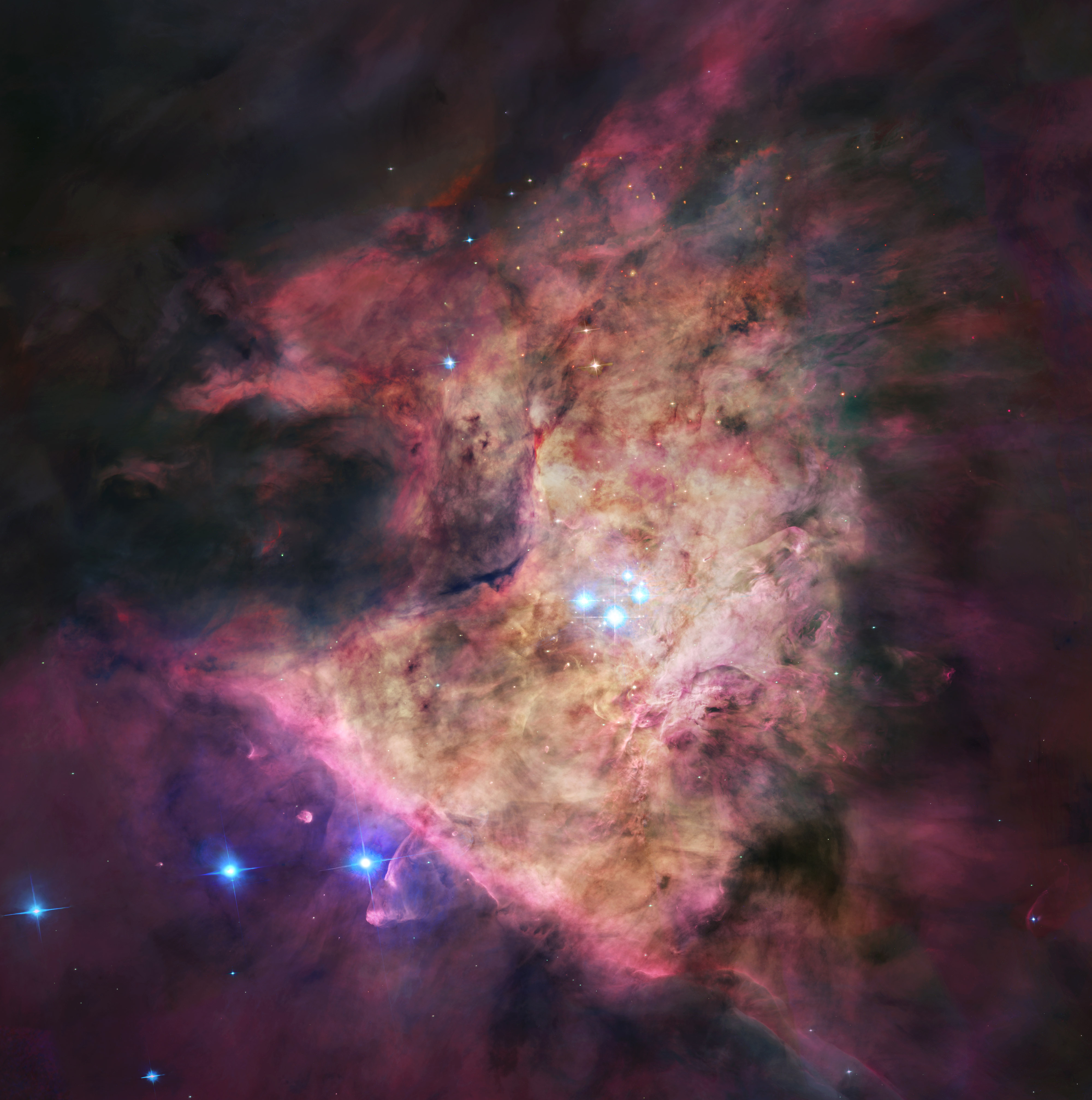
    At the Heart of Orion 
    CreditImage Data – Hubble Legacy ArchiveProcessing – Robert Gendler

    Explanation: Near the center of this sharp cosmic portrait, at the heart of the Orion Nebula, are four hot, massive stars known as the Trapezium. Gathered within a region about 1.5 light-years in radius, they dominate the core of the dense Orion Nebula Star Cluster. Ultraviolet ionizing radiation from the Trapezium stars, mostly from the brightest star Theta 1 Orionis C powers the complex star forming region’s entire visible glow. About three million years old, the Orion Nebula Cluster was even more compact in its younger years and a recent dynamical study indicates that runaway stellar collisions at an earlier age may have formed a black hole with more than 100 times the mass of the Sun. The presence of a black hole within the cluster could explain the observed high velocities of the Trapezium stars, The Orion Nebula’s distance of some 1500 light-years would make it the closest known black hole to planet Earth.

    Earth is undergoing true polar wander, scientists say

    Posted: October 2, 2012 by phaedrap1 in Science
    Tags: ,
    earth_nasa_300
    Scientists developed a computer model to identify four possible instances of true polar wander in the past. And, they say, true polar wander is happening now.

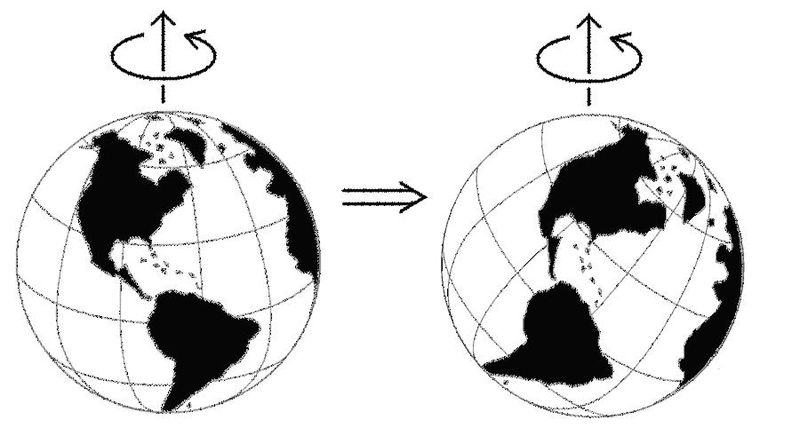
    Scientists based in Germany and Norway today published new results about a geophysical theory known as true polar wander. That is a drifting of Earth’s solid exterior – an actual change in latitude for some land masses – relative to our planet’s rotation axis. These scientists used hotspots in Earth’s mantle as part of a computer model, which they say is accurate for the past 120 million years, to identify four possible instances of true polar wander in the past. And, they say, true polar wander is happening now. These scientists published their results in the Journal for Geophysical Research today (October 1, 2012).

    The scientists – including Pavel V. Doubrovine and Trond H. Torsvik of the University of Oslo, and Bernhard Steinberger of the Helmholtz Center in Potsdam, Germany – established what they believe is a stable reference frame for tracking true polar wander. Based on this reference frame, they say that twice – from 90 to 40 million years ago – the solid Earth traveled back and forth by nearly 9 degrees with respect to our planet’s axis of rotation. What’s more, for the past 40 million years, the Earth’s solid outer layers have been slowly rotating at a rate of 0.2 degrees every million years, according to these scientists.

    Diagram showing solid-body rotation of the Earth with respect to a stationary spin axis due to true polar wander. This diagram is greatly exaggerated. According to Doubrovine and his team, Earth’s solid outer layers have been slowly rotating at a rate of 0.2 degrees every million years. Diagram via Wikimedia Commons.

    True polar wander is not:

    • A geomagnetic reversal, or reversal of Earth’s magnetic field, known to have happened before in Earth history.
    • Plate tectonics, which describes the large-scale motions of great land plates on Earth and is thought to be driven by the circulation of Earth’s mantle.
    • Precession of the Earth, whereby our world’s axis of rotation slowly moves, tracing out a circle among the stars, causing the identity of our North Star changes over time.

    True polar wander is a geophysical theory, a way of thinking about Earth processes that might happen and that these scientists believe do happen. The theory suggests that if an object of sufficient weight on Earth – for example, a supersized volcano or other weighty land mass – formed far from Earth’s equator, the force of Earth’s rotation would gradually pull the object away from the axis around which Earth spins. A supersized volcano far from Earth’s equator would create an imbalance, in other words. As explained at Princeton.edu:

    If the volcanoes, land and other masses that exist within the spinning Earth ever became sufficiently imbalanced, the planet would tilt and rotate itself until this extra weight was relocated to a point along the equator.

    That’s the theory of true polar wander. It would cause a movement of Earth’s land masses, but for a different reason than the reason the continents drift in the theory of plate tectonics (formerly called “continental drift”). In the theory of plate tectonics, the continents drift because Earth’s the layer of Earth underlying our planet’s crust, called the mantle, is convective. That is, it circulates, slowly – like water about to boil. In true polar wander, on the other hand, a similar-seeming movement of land masses on Earth’s crust happens in order to correct an imbalance of weight with respect to Earth’s spin.

    Scientists’ understanding of true polar wander overlaps with their understanding of plate tectonics in various ways. That’s understandable, since it’s all the same Earth.

    Scientists delving into true polar wander want to know when, in which direction, and at what rate the Earth’s solid exterior might be rotating due to true polar wander. To sort it out, they say, you would need a stable frame of reference to which observations of relative motion might be compared. Doubrovine and his team say they found one: volcanic hotspots.

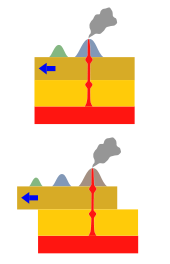
    Hotspot forming an island chain. As land plates drift, a successive of volcanoes form over the hotspot. Image via Wikimedia Commons.

    In geology, hotspots are volcanic regions fed by Earth’s underlying mantle. For example, the Hawaiian islands are believed to have formed over a hotspot in the mantle. The hotspot created a volcano, but then – as that land plate drifted over time, as described by the theory of plate tectonics – the volcano drifted, too, and was eventually cut off from the hotspot. Gradually, another volcano begins to form over the hotspot, right next to the first one. And then it moves on … and another one forms … and so on … and so on. Earth’s crust produces first one, then another volcano over the hotspot until a long chain of volcanoes forms, such as in Hawaii. Hotspots have long been used to understand the motion of tectonic plates.

    Doubrovine and colleagues went a step further in order to understand true polar wander. Instead of treating the hot spots as static – frozen in place at one spot above Earth’s mantle – their computer model let the hotspots’ positions drift slowly. According to these scientists, this drifting is what produced a model of a stable reference frame, which in turn let them draw conclusions about true polar wander.

    They say their model does a good job of matching observations of real hotspot tracks on Earth – the path drawn by each hotspot’s island chain – which gives them confidence their results about true polar wander are accurate.

    The Hawaiian islands are believed to have formed over a hotspot – a particularly hot place in Earth’s underlying mantle. Scientists expanded on previous thinking about hotspots to suggest that Earth’s solid surface is drifting, minutely, with respect to our planet’s rotation axis.

    Bottom line: German and Norwegian scientists have incorporated hotspots in Earth’s mantle into a computer model being used to study true polar wander. They say their work established a stable reference frame for this study that lets them conclude Earth is undergoing true polar wander today.

    Read the original paper: Absolute plate motions in a reference frame defined by moving hot spots in the Pacific, Atlantic and Indian oceans

    Deborah Byrd/EarthSky