Archive for the ‘Science’ Category

The point of no return: In astronomy, it’s known as a black hole—a region in space where the pull of gravity is so strong that nothing, not even light, can escape. Black holes that can be billions of times more massive than our sun may reside at the heart of most galaxies. Such supermassive black holes are so powerful that activity at their boundaries can ripple throughout their host galaxies. Now, an international team, led by researchers at MIT’s Haystack Observatory, has for the first time measured the radius of a black hole at the center of a distant galaxy—the closest distance at which matter can approach before being irretrievably pulled into the black hole. The scientists linked together radio dishes in Hawaii, Arizona and California to create a telescope array called the “Event Horizon Telescope” (EHT) that can see details 2,000 times finer than what’s visible to the Hubble Space Telescope. These radio dishes were trained on M87, a galaxy some 50 million light years from the Milky Way. M87 harbors a black hole 6 billion times more massive than our sun; using this array, the team observed the glow of matter near the edge of this black hole—a region known as the “event horizon.” “Once objects fall through the event horizon, they’re lost forever,” says Shep Doeleman, assistant director at the MIT Haystack Observatory and research associate at the Smithsonian Astrophysical Observatory. “It’s an exit door from our universe. You walk through that door, you’re not coming back.” Doeleman and his colleagues have published the results of their study this week in the journal Science.
Jets at the edge of a black hole
Supermassive black holes are the most extreme objects predicted by Albert Einstein’s theory of gravity—where, according to Doeleman, “gravity completely goes haywire and crushes an enormous mass into an incredibly close space.” At the edge of a black hole, the gravitational force is so strong that it pulls in everything from its surroundings. However, not everything can cross the event horizon to squeeze into a black hole. The result is a “cosmic traffic jam” in which gas and dust build up, creating a flat pancake of matter known as an accretion disk. This disk of matter orbits the black hole at nearly the speed of light, feeding the black hole a steady diet of superheated material. Over time, this disk can cause the black hole to spin in the same direction as the orbiting material.  Caught up in this spiraling flow are magnetic fields, which accelerate hot material along powerful beams above the accretion disk The resulting high-speed jet, launched by the black hole and the disk, shoots out across the galaxy, extending for hundreds of thousands of light-years. These jets can influence many galactic processes, including how fast stars form.
‘Is Einstein right?’
A jet’s trajectory may help scientists understand the dynamics of black holes in the region where their gravity is the dominant force. Doeleman says such an extreme environment is perfect for confirming Einstein’s theory of general relativity—today’s definitive description of gravitation. “Einstein’s theories have been verified in low-gravitational field cases, like on Earth or in the solar system,” Doeleman says. “But they have not been verified precisely in the only place in the universe where Einstein’s theories might break down—which is right at the edge of a black hole.” According to Einstein’s theory, a black hole’s mass and its spin determine how closely material can orbit before becoming unstable and falling in toward the event horizon. Because M87’s jet is magnetically launched from this smallest orbit, astronomers can estimate the black hole’s spin through careful measurement of the jet’s size as it leaves the black hole. Until now, no telescope has had the magnifying power required for this kind of observation. “We are now in a position to ask the question, ‘Is Einstein right?'” Doeleman says. “We can identify features and signatures predicted by his theories, in this very strong gravitational field.” The team used a technique called Very Long Baseline Interferometry, or VLBI, which links data from radio dishes located thousands of miles apart. Signals from the various dishes, taken together, create a “virtual telescope” with the resolving power of a single telescope as big as the space between the disparate dishes. The technique enables scientists to view extremely precise details in faraway galaxies. Using the technique, Doeleman and his team measured the innermost orbit of the accretion disk to be only 5.5 times the size of the black hole event horizon. According to the laws of physics, this size suggests that the accretion disk is spinning in the same direction as the black hole—the first direct observation to confirm theories of how black holes power jets from the centers of galaxies. The team plans to expand its telescope array, adding radio dishes in Chile, Europe, Mexico, Greenland and Antarctica, in order to obtain even more detailed pictures of black holes in the future.
By Jennifer Chu / Physorg.com
September 27, 2012
Ref. “Jet Launching Structure Resolved Near the Supermassive Black Hole in M87,” by S.S. Doeleman et al., Science, 2012.
Journal reference: Science
search and more info website Provided by Massachusetts Institute of Technology
Deepest Ever View into Universe

Posted: September 25, 2012 by noxprognatus in News, Science

Universe just before “The Big Bang”


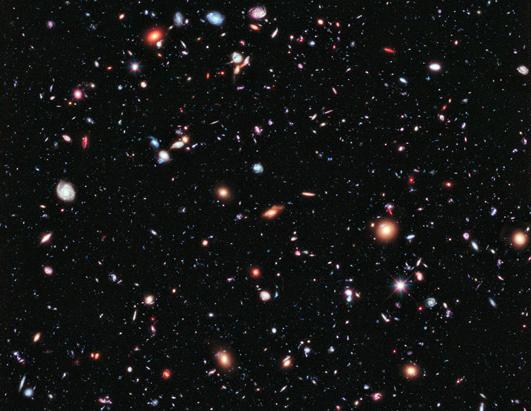
    Astronomers have assembled a new, improved portrait of our deepest-ever view of the universe. Called the eXtreme Deep Field, or XDF, the photo was assembled by combining ten years of Hubble Space Telescope observations. Some of the galaxies in it are 13.2 billion years old. The universe itself formed 13.7 billion years ago. (NASA/ESA/G. Illingworth/D. Magee/P. Oesch/R. Bouwens/HUDF09 Team)

    Scientists say before the “Big Bang”  happened. My theory is that the big bang did not happen as we understand it. And another theory of beginning is required. Watch out for a post on White Holes in the near future. Nox

Disc With A Skull

Posted: September 8, 2012 by noxprognatus in Science

Pinned Image

Disc with a skull in the middle Teotihuacan, Early Classic (300-550 A.D.) Teotihuacan, State of Mexico

Lucid Dreaming

Posted: August 29, 2012 by phaedrap1 in Science

Dreaming is a regular part of our nightly existence.  We enter the dream world each night whether we remember or not.  Frequently, our dreams are surreal mixtures of the fantastic and the ordinary. There is, however, another kind of dream which transcends the everyday, that is lucid dreaming.

Lucid dreams happens when the dreamer  “wakes up” in the dream.  Usually there is something   that triggers the awakening.  It could be anything, the realization that cats don’t fly or  that you’ve never learned to tap dance.  Whatever the occurrence, the dreamer realizes that he or she is not awake physically.  Usually, this state lasts for only a short time and then lucidity fades and the dream continues without awareness.  However, with practice, the length of time the dreamer can remain lucid increases.

There are several techniques that help the beginner become more proficient.  Some of these are:

1)  Dream recall – this can be done by keeping a dream journal.  The first thing upon waking in the morning, write down everything remembered.  It doesn’t have to be much, a word, color or feeling, anything you remember.  With continued journaling the amount of dream recall with increase.

2) Reality checks – this could be anything, a word or gesture that you constantly repeat throughout the day, such as looking at your hands when going in or out of a doorway.  When you see your hands, ask yourself “am I dreaming”.  Done often enough the gesture becomes second nature and will be repeated in a dreamstate.  It is a cue that can trigger the realization that you are not physically awake.

3)  Another is Mnemonic-Induction of Lucid Dreaming (MILD).  This technique was created by Dr. Stephen LaBarge of Stanford University, who is a pioneer in lucid dream research and consists of setting the intention to lucid dream by saying a mantra over and over while visualizing yourself awake in a dream.  Make the mantra short, such as “I am aware that I am dreaming”. Do not use the word “want” in your mantra, say that it is going to happen.  A command statement convinces the mind that this is what is happening.

4) There are also certain drugs or supplements that can help to achieve the lucid dream state.  One of these is Melatonin (3mg), this helps to set the circadian rhythm and its release is controlled by the pineal gland.   Another drug is nicotine, which is not recommended due to its highly addictive nature.

The first few times you achieve lucidity, you will likely be so excited that you will wake yourself up. Two effective techniques for extending lucidity are spinning  and rubbing your hands. Both techniques, originated with Carlos Castaneda, but LaBerge was the first to test techniques.   Of the two, hand rubbing seems to be the most effective.

People new to lucid dreaming spent much of their time indulging in various recreational activities such as flying to new places, this is to be expected, we all want to try things we aren’t able to do in the “real” world, but after you have enjoyed the extracurricular activities, its time to expand in new directions.  Lucid dreaming can help you find creative solutions to everyday situations or give you ideas on how to deal with past issues which are still causing stress in the present.  You will never know what knowledge can be gleaned during lucid dreaming.

Pulsar Puzzles Scientists

Posted: August 27, 2012 by noxprognatus in Science

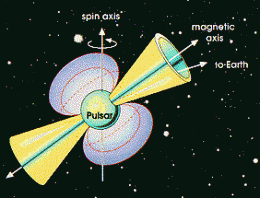
Researchers find absorption features in spectrum of ordinary pulsar August 27, 2012 by Bob Yirka   Enlarge A diagram of a pulsar, showing its rotation axis and its magnetic axis. Image: NASA (Phys.org)—An international team of astronomers and astrophysicists has found some unusual spectral activity involving an otherwise “normal” pulsar; it displayed some absorption lines, which generally only occurs with bodies that have some degree of an atmosphere. In studying stars that lay outside the normal galactic plane, the team found, as they describe in their paper published in the journal Science, spectra that was not as smooth as expected, along with absorption lines.

Pulsars are the remnants of stars that have exploded, leaving behind their inner core; neutron stars with a very dense mass that spins causing the electromagnetic radiation emitted to appear to flash or pulse to observers here on Earth. Researchers studying neutron stars over the years have come to define most such pulsars as “normal”, i.e. they exhibit a smooth spectra. A few anomalous neutron stars been found however, that exhibit odd spectra. They exhibit weak pulsar effects and in some cases a less than strong magnetic field. In this new find, the researchers have found a pulsar, PSR J1740+1000, that appears to exhibit behavior found in both normal and non-normal neutron starts, opening up the possibility of a third class. In every other respect, the pulsar looks like most other pulsars, the only exception being the absorption lines. And now that they’ve seen it, the researchers aren’t sure what exactly to make of it. One possibility is that most pulsars have absorption lines and we just can’t seem them. That would be because most pulsars we can see exist in the flat, pancake like part of the galaxy known as the galactic plane. PSR J1740+1000 exists just above that plane, meaning there is less gas and dust between us and it, giving us a clearer view. Another possibility is that the absorption occurs due to some unknown particles that might exist high up in the pulsar’s magnetosphere, akin to Earth’s van Allen radiation belt. Whatever the cause, the finding has sparked some excitement in the astronomy world as it appears that there is more to pulsars than has been thought, and in further exploring pulsars and absorption properties, it’s likely researchers will come to better understand anomalous features found in other stars and systems as well. More information: Absorption Features in the X-ray Spectrum of an Ordinary Radio Pulsar, Science 24 August 2012: Vol. 337 no. 6097 pp. 946-949. DOI: 10.1126/science.1221378 ABSTRACT The vast majority of known nonaccreting neutron stars (NSs) are rotation-powered radio and/or γ-ray pulsars. So far, their multiwavelength spectra have all been described satisfactorily by thermal and nonthermal continuum models, with no spectral lines. Spectral features have, however, been found in a handful of exotic NSs and were thought to be a manifestation of their unique traits. Here, we report the detection of absorption features in the x-ray spectrum of an ordinary rotation-powered radio pulsar, J1740+1000. Our findings bridge the gap between the spectra of pulsars and other, more exotic, NSs, suggesting that the features are more common in the NS spectra than they have been thought so far.


A pulsar exhibiting unusual activity near the galactic plane. That is, its electromagnetic field is altered. Is this what is happening to our Solar System as we get closer to the Plane itself. Time will tell. Nox

Learning While Asleep

Posted: August 27, 2012 by noxprognatus in Science

A study, published in the journal Nature Neuroscience, found that volunteers were able to recall something they had heard while slumbering when they awoke the next day, even though they had no memory of being taught.

The experiment focused on teaching the brain to associate particular sounds and smells – as people can be exposed to these stimuli without waking up. Researchers monitored the sleeping volunteers’ nostril movements and found that the pleasant scent of shampoo, for instance, led to deep intakes of air, while the unpleasant odour of rotting fish caused the volunteers to briefly stop inhaling.

As the night progressed, the sleeping individuals learnt to associate the sound of particular tones with certain smells. For instance, they breathed more deeply when played the positive tone even when no smell was present.

“The next day, the now awake subjects again heard the tones alone – with no accompanying odour. Although they had no conscious recollection of listening to them during the night, their breathing patterns told a different story,” said a spokesman for the Weizmann Institute of Science in Israel. “When exposed to tones that had been paired with pleasant odours, they sniffed deeply, while the second tones – those associated with bad smells – provoked short, shallow sniffs,” he added.

Anat Arzi, a research student at Weizmann who carried out the study, said: “The common knowledge is that although the sleeping brain can process, consolidate and strengthen information, it cannot learn new information. We showed that it could.” He added: “There will be clear limits on what we can learn in sleep, but I speculate that they will be beyond what we have demonstrated.”

The researchers intend to continue investigating other types of brain processing in various altered states of consciousness such as sleep and coma.

This research is interesting in terms of Meditation. If we can learn while asleep, it points to the possibility of learning via meditation. As we can see we are only one step from learning from the source.  An article on Meditation is to follow. Nox.

Lunar Eclipse

Posted: August 26, 2012 by noxprognatus in Occult, Science

(more…)

Antarctic Ice Sheet Quakes Shed Light On Ice Movement and Earthquakes

ScienceDaily (Aug. 23, 2012) — Analysis of small, repeating earthquakes in an Antarctic ice sheet may not only lead to an understanding of glacial movement, but may also shed light on stick slip earthquakes like those on the San Andreas fault or in Haiti, according to Penn State geoscientists.

“No one has ever seen anything with such regularity,” said Lucas K. Zoet, recent Penn State Ph. D. recipient, now a postdoctoral fellow at Iowa State University. “An earthquake every 25 minutes for a year.”

The researchers looked at seismic activity recorded during the Transantarctic Mountains Seismic Experiment from 2002 to 2003 on the David Glacier in Antarctica, coupled with data from the Global Seismic Network station Vanda. They found that the local earthquakes on the David Glacier, about 20,000 identified, were predominantly the same and occurred every 25 minutes give or take five minutes.

The researchers note in the current Nature Geoscience that, “The remarkable similarity of the waveforms … indicates that they share the same source location and source mechanisms.” They suggest that “the same subglacial asperity repeatedly ruptures in response to steady loading from the overlying ice, which is modulated by stress from the tide at the glacier front.”

“Our leading idea is that part of the bedrock is poking through the ductile till layer beneath the glacier,” said Zoet.

The researchers have determined that the asperity — or hill — is about a half mile in diameter.

The glacier, passing over the hill, creates a stick slip situation much like that on the San Andreas fault. The ice sticks on the hill and stress gradually builds until the energy behind the obstruction is high enough to move the ice forward. The ice moves in a step-by-step manner rather than smoothly.

But motion toward the sea is not the only thing acting on the ice streaming from David glacier. Like most glaciers near oceans, the edge of the ice floats out over the water and the floating ice is subject to the action of tides.

“When the tide comes in it pushes back on the ice, making the time between slips slightly longer,” said Sridhar Anandakrishnan, professor of geoscience. “When the tide goes out, the time between slips decreases.”

However, the researchers note that the tides are acting at the ground line, a long way from the location of the asperity and therefore the effects that shorten or lengthen the stick slip cycle are delayed.

“This was something we didn’t expect to see,” said Richard B. Alley, Evan Pugh Professor of Geosciences. “Seeing it is making us reevaluate the basics.”

He also noted that these glacial earthquakes, besides helping glaciologists understand the way ice moves, can provide a simple model for the stick slip earthquakes that occur between landmasses.

“We have not completely explained how ice sheets flow unless we can reproduce this effect,” said Alley. “We can use this as a probe and look into the physics so we better understand how glaciers move.”

Before 2002, this area of the David glacier flowed smoothly, but then for nearly a year the 20-minute earthquake intervals occurred and then stopped. Something occurred at the base of the ice to start and then stop these earthquakes.

“The best idea we have is that during those 300 days, a dirty patch of ice was in contact with the mount, changing the way stress was transferred,” said Zoet. “The glacier is experiencing earthquakes again, although at a different rate. It would be nice to study that.”

Unfortunately, the seismographic instruments that were on the glacier in 2002 no longer exist, and information is coming from only one source at the moment.

Language family may have Turkish origins

Indo-European tongues traced back more than 8,000 years to Anatolia

Indo-European languages range throughout Europe and South Asia and even into Iran, yet the roots of this widespread family of tongues have long been controversial. A new study adds support to the proposal that the language family expanded out of Anatolia — what’s now Turkey — between 8,000 and 9,500 years ago, as early farmers sought new land to cultivate.

A team led by psychologist Quentin Atkinson of the University of Auckland in New Zealand came to that conclusion by using a mathematical method to calculate the most likely starting point and pattern of geographic spread for a large set of Indo-European languages. The new investigation, published in the Aug. 24 Science, rejects a decades-old idea that Kurgan warriors riding horses and driving chariots out of West Asia’s steppes 5,000 to 6,000 years ago triggered the rise of Indo-European speakers.

“Our analysis finds decisive support for an Anatolian origin over a steppe origin of Indo-European languages,” Atkinson says.

He and his colleagues generated likely family trees for Indo-European languages, much as geneticists use DNA from different individuals to reconstruct humankind’s genetic evolution. Many linguists, who compare various features of languages to establish their historical connections, consider Atkinson’s statistical approach unreliable (SN: 11/19/11, p. 22).

Atkinson’s group analyzed 207 commonly used words, including terms for relatives and numbers, in 103 ancient and modern Indo-European languages. The researchers produced possible language trees based on estimated rates at which languages gained and lost cognates, words with similar meanings and shared sounds, such as five in English and fem in Swedish.

The studied cognates are basic vocabulary terms that rarely get borrowed when speakers of different languages encounter one another, Atkinson contends. Thus, in his view, these words provide a valuable window into the evolution of separate branches on the Indo-European family tree.

The researchers combined their language trees with present geographic ranges of individual languages to identify the most likely location and age of the Indo-European family’s origins. An ancient Anatolian root emerged whether the researchers combined linguistic data or separately considered the 20 ancient languages and 83 modern ones.

As a further check, statistical simulations that assumed slow rates of language migration if people traveled along land routes or faster migration rates spurred by water crossings converged on a scenario in which Indo-European tongues originated among Anatolian farmers sometime between 8,000 and 9,500 years ago.

Farmers alone didn’t propel the evolution of different Indo-European tongues, Atkinson says. His team’s proposed trees suggest that new languages began to sprout within the five major Indo-European subfamilies from 4,500 to 2,000 years ago, after agriculture had spread across Europe. Kurgans or other expansionist Indo-European cultures could have instigated those later linguistic developments, Atkinson says.

Atkinson’s statistical reconstruction is unpersuasive, comments linguist H. Craig Melchert of the University of California, Los Angeles. Researchers can confidently rebuild trees of Indo-European languages extending back no more than about 7,000 years, he says.

Many linguists and archaeologists suspect that Indo-European languages originated in what’s now the southern Russian steppes, and that’s unlikely to change as a result of the new study, says linguist Joe Eska of Virginia Tech in Blacksburg. Cognate swapping across languages could have occurred more often than assumed by Atkinson, undermining his conclusions, Eska contends.

          Registered readers are invited to post a comment. To encourage fruitful discussion,          please keep your comments relevant, brief and courteous. Offensive, irrelevant, nonsensical          and commercial posts will not be published. (All links will be removed from comments.)
ScienceNews
    Suggested Reading    :
seperator
  •       B. Bower. Darwin’s tongues. Science News, Vol. 180, Nov. 19, 2011, p. 22. Available online: [Go to]
  • Quentin Atkinson’s web site: [Go to]
    Citations & References    :

seperator

  •       R. Bouckaert et al. Mapping the origins and expansion of the Indo-European language family. Science, Vol. 337, Aug. 24, 2012, p. 957. doi:10.1126/science.1219669.