Archive for the ‘News’ Category

For all the popularity Tutankhamun enjoys today, key details about the ancient Egyptian pharaoh’s life, such as his parentage, have remained somewhat mysterious. While Akhenaten was known to be Tut’s dad, the identity of the boy king’s mother has remained elusive. But at least one archaeologist believes she was Nefertiti.

Recent DNA analyses from the mummies of Tut and his kin revealed that the boy king’s parents were siblings. Those results, published in the Journal of the American Medical Association (JAMA) in February 2010, pointed to the “heretic” king Akhenaten and one of his sisters as the mom and dad of Tut.

But researcher Marc Gabolde said in a talk at Harvard University last week that he believes King Tut’s mom was Akhenaten’s cousin Nefertiti, who was Akhenaten’s chief wife and the mother of six of his daughters.

Gabolde said the genetic closeness of Tut’s parents does not necessarily point to a brother-sister pairing. Rather, it could be due to three successive generations of marriage between first cousins, he said.

“The consequence of that is that the DNA of the third generation between cousins looks like the DNA between a brother and sister,” Gabolde said, according to the Harvard Gazette. “I believe that Tutankhamun is the son of Akhenaten and Nefertiti, but that Akhenaten and Nefertiti were cousins.”

Zahi Hawass, head of Egypt’s Supreme Council of Antiquities, disputed Gabolde’s claim. Hawass, who led the 2010 JAMA study, told LiveScience in an email Friday (Feb. 15) that his team’s research showed that Tut’s mother was, like Akhenaten, the daughter of Amenhotep III and Queen Tiye. Hawass added that there is “no evidence” in archaeology or philology to indicate that Nefertiti was the daughter of Amenhotep III.

Gabolde is the director of the archaeological expedition of Université Paul Valery-Montpellier III in the Royal Necropolis at el-Amarna, a city built on the banks of the Nile by Akhenaten, the son of Amenhotep III and Queen Tiye who ushered in a brief period of monotheism in Egypt through worship of the sun disk, Aten.

King Tut was part of the 18th dynasty of the Egyptian New Kingdom, which lasted from about 1550 B.C. to 1295 B.C. He died in the ninth year of his reign, circa 1324 B.C., at the age of 19, leaving no heirs. Several ideas have popped up about possible diseases that may have wreaked havoc on his family as well as the cause of Tut’s early demise, with some evidence suggesting he died in part from malaria and bone abnormalities.

Megan Gannon, News Editor

Follow LiveScience on Twitter @livescience. We’re also on Facebook & Google+.

Beothuk_drawing_contrast


Archeologists have shed stunning new light on the extinct Beothuk nation of Newfoundland, revealing through a study of carved pendants unearthed from coastal burial sites that the ill-fated people — who had inhabited the region for at least 1,000 years before the devastating arrival of Europeans in the 15th century — placed birds at the centre of their complex religious cosmology, believing the winged creatures were “spiritual messengers” that carried the souls of the dead to an “island afterlife.”

The remarkable revelations about the vanished culture, the 19th-century eclipse of which remains one of the central tragedies of Canadian history, are detailed in a paper published this week in the Cambridge Archaeological Journal by University of Alberta researcher Todd Kristensen and his U.S. co-author Donald Holly.

Kristensen told Postmedia News on Thursday that the project is particularly significant because it “gives us a glimpse into Beothuk minds. We can begin to see how the Beothuk viewed the world around them — their beliefs about death, the afterlife and the role of animals and spiritual helpers.”

He added that the study’s findings are important because “there aren’t any modern Beothuk people to say, ‘This is what we believed in, and this is the story that we should share.’ Archeologists are one of the few people who can tell the Beothuk story.”

After Anglo-Italian explorer John Cabot’s landmark voyage to Newfoundland in 1497, the indigenous Beothuk clashed with a succession of colonizers from Portugal, France and Britain in the centuries that followed.

The Beothuk may also have been the so-called “skraelings” who had violent encounters with Viking voyagers from Iceland and Greenland who briefly settled in northern Newfoundland — and then quickly retreated — around 1000 A.D.

Once numbering as many as 5,000 people, the Beothuk population was ravaged by diseases introduced to the future Canada by European settlers. An artistically gifted Beothuk woman named Shanawdithit, the last known survivor of her nation, died in St. John’s in 1829.

Notably, the new study points out, historical records show that Shanawdithit once referred to a “happy island” afterworld that figured prominently in the Beothuk’s little-understood belief system.

“We scoured historical documents and found a handful of sentences about Beothuk religion,” said Kristensen. “No one really knows what the Beothuk believed in.

“But we found out, surprisingly, that they ate a lot of birds, which was odd because we had thought that they lived mostly on caribou and seal. From there, we began to wonder that if birds were an important food, what other dimensions of Beothuk life might they show up in?”

Suddenly, fresh analyses of objects from Beothuk burials showed that most of the patterns etched in caribou-bone pendants had an unlikely source of inspiration: the webbed feet and feathers of seabirds.

“Sure enough, when we looked at those burials, we started to see bird shapes in their funeral goods,” said Kristensen. “Why depict seabirds when you’ve got bears and wolves and seals and whales? While a waddling sea duck might not appear to be a glorious animal, these birds were powerful to the Beothuk because they moved easily from one world to the next — water to air.”

Seabirds such as the arctic tern, black guillemot and the penguin-like great auk — once a plentiful source eggs and meat on Newfoundland, but which, like the Beothuk, was extinct by the mid-19th century — provided both “food and food for thought” for ancient island inhabitants, the authors state in the published study.

“Given the sheer presence of birds in the environment, their importance in Beothuk diet, and the unique role of birds in Beothuk activities — such as dangerous voyages to rookeries — we suggest that birds provided a plethora of source material for Beothuk belief systems,” argue Kristensen and Holly, a professor at Eastern Illinois University who spent four months at the U of A working on the study. “Notwithstanding the probable significance of other animals to the Beothuk, we suggest that seabirds commanded a prominent place in Beothuk ideology.”

They conclude that the Beothuk believed their souls required “help from animals that can move through those worlds” of water and air to reach their culture’s idea of heaven.

“We thought it was such a unique system,” added Kristensen. “But when you think about it, just about every culture in the world thinks about the afterlife place that’s either above or below us — heaven or hell — so we do compartmentalize our worlds in this kind of ladder of movement. The Beothuk did that the same way.”

rboswell@postmedia.com

© Copyright (c) Postmedia News

Ancient languages reconstructed by computer program

Posted: February 14, 2013 by phaedrap1 in News, Science
Tags:
Assyrian script
Unlike this Assyrian script, few ancient languages have a written record, which makes reconstructing them extremely difficult

A new tool has been developed that can reconstruct long-dead languages.

Researchers have created software that can rebuild protolanguages – the ancient tongues from which our modern languages evolved.

To test the system, the team took 637 languages currently spoken in Asia and the Pacific and recreated the early language from which they descended.

The work is published in the Proceedings of the National Academy of Science.

Currently language reconstructions are carried out by linguists – but the process is slow and labour-intensive.

Dan Klein, an associate professor at the University of California, Berkeley, said: “It’s very time consuming for humans to look at all the data. There are thousands of languages in the world, with thousands of words each, not to mention all of those languages’ ancestors.

“It would take hundreds of lifetimes to pore over all those languages, cross-referencing all the different changes that happened across such an expanse of space – and of time. But this is where computers shine.”

Rosetta stone

Languages change gradually over time.

Over thousands of years, tiny variations in the way that we produce sounds have meant that early languages have morphed into many different descendents.

Dr Klein explains: “These sound changes are almost always regular, with similar words changing in similar ways, so patterns are left that a human or a computer can find.

“The trick is to identify these patterns of change and then to ‘reverse’ them, basically evolving words backwards in time.”

The scientists demonstrated their system by looking at a group of Austronesian languages that are currently spoken in southeast Asia, parts of continental Asia and the Pacific.

From a database of 142,000 words, the system was able to recreate the early language from which these modern tongues derived. The scientists believe it would have been spoken about 7,000 years ago.

They then compared the computer’s findings to those of linguists, finding that 85% of the early words that the software presented were within one “character” – or sound – of the words that the language experts had identified.

 But while the computerised method was much faster, the scientists said it would not put the experts out of a job.

The software can churn through large amounts of data quickly, but it does not bring the same degree of accuracy as a linguist’s expertise.

Dr Klein said: “Our system still has shortcomings. For example, it can’t handle morphological changes or re-duplications – how a word like ‘cat’ becomes ‘kitty-cat’.

“At a much deeper level, our system doesn’t explain why or how certain changes happened, only that they probably did happen.”

While researchers are able to reconstruct languages that date back thousands of years, there is still a question mark over whether it would ever be possible to go even further back to recreate the very first protolanguage from which all others evolved.

By Rebecca Morelle

Science reporter, BBC World Service

Pentillie Castle: Body found in knight’s grave hunt

Posted: February 12, 2013 by phaedrap1 in Monuments, News

Human remains, found at a stately home in Cornwall, are thought to be those of the man who built it.

Sir James Tillie, who built Pentillie Castle in 1698, instructed his staff to place him in a chair with his pipe when he died.

The instructions were followed before he was removed, but no burial information has ever been found.

Archaeologists who examined a mausoleum built in 1713, upon his death, said a body had been found in a vault.

In his will, Sir James demanded that he should not be buried, but dressed in his best clothes, bound to a stout chair and placed with his books, wine and pipe on Mount Ararat on the estate.

‘Resurrection’ plan

Archaeologist Oliver Jessop said: “It would appear that potentially we do have real evidence that the story or the myth actually was true.

“In the early 19th Century it has been suggested that the bones were removed to the local churchyard.

“I can confirm that that’s not the case and there is a body actually still inside the vault.”

Mr Jessop said the vault was found after archaeologists dug an exploratory hole in the internal floor of the mausoleum and discovered a brick-built roof.

Inside it a structure with leather studs and woodwork with handles on it was found, which are thought to be either a chair or coffin.

Ted Coryton, the owner of Pentillie Castle, said: “It’s an extraordinary legacy really, 300 years after his death and we’re all talking about it, it doesn’t happen to many people so maybe he decided to be resurrected, then maybe this is his resurrection.”

The team had also hoped to find out if Sir James’ wife, Elizabeth, was buried with him, but this is yet to be discovered.

35 Ancient Pyramids Discovered in Sudan Necropolis

Posted: February 6, 2013 by phaedrap1 in Monuments, News
Tags:
pyramids discovered at Sedeinga in Sudan
Among the discoveries are pyramids with a circle built inside them, cross-braces connecting the circle to the corners of the pyramid. Outside of Sedeinga only one pyramid is known to have been built in this way.
CREDIT: Photo copyright Vincent Francigny/SEDAU

At least 35 small pyramids, along with graves, have been discovered clustered closely together at a site called Sedeinga in Sudan.

Discovered between 2009 and 2012, researchers are surprised at how densely the pyramids are concentrated. In one field season alone, in 2011, the research team discovered 13 pyramids packed into  roughly 5,381 square feet (500 square meters), or  slightly larger than an NBA basketball court.

They date back around 2,000 years to a time when a kingdom named Kush flourished in Sudan. Kush shared a border with Egypt and, later on, the Roman Empire. The desire of the kingdom’s people to build pyramids was apparently influenced by Egyptian funerary architecture.

At Sedeinga, researchers say, pyramid building continued for centuries. “The density of the pyramids is huge,” said researcher Vincent Francigny, a research associate with the American Museum of Natural History in New York, in an interview with LiveScience. “Because it lasted for hundreds of years they built more, more, more pyramids and after centuries they started to fill all the spaces that were still available in the necropolis.” [See Photos of the Newly Discovered Pyramids]

pyramids discovered at Sedeinga in Sudan
This aerial photo shows a series of pyramids and graves that a team of archaeologists has been exploring at Sedeinga in Sudan. Since 2009 they have discovered at least 35 small pyramids at the site, the largest being 22 feet (7 meters) in width.
CREDIT: Photo copyright B-N Chagny, SEDAU/SFDAS

The biggest pyramids they discovered are about 22 feet (7 meters) wide at their base with the smallest example, likely constructed for the burial of a child, being only 30 inches (750 millimeters) long. The tops of the pyramids are not attached, as the passage of time and the presence of a camel caravan route resulted in damage to the monuments. Francigny said that the tops would have been decorated with a capstone depicting either a bird or a lotus flower on top of a solar orb.

The building continued until, eventually, they ran out of room to build pyramids. “They reached a point where it was so filled with people and graves that they had to reuse the oldest one,” Francigny said.

Francigny is excavation director of the French Archaeological Mission to Sedeinga, the team that made the discoveries. He and team leader Claude Rilly published an article detailing the results of their 2011 field season in the most recent edition of the journal Sudan and Nubia.

The inner circle

Among the discoveries were several pyramids designed with an inner cupola (circular structure) connected to the pyramid corners through cross-braces. Rilly and Francigny noted in their paper that the pyramid design resembles a “French Formal Garden.”

Only one pyramid, outside of Sedeinga, is known to have been constructed this way, and it’s a mystery why the people of Sedeinga were fond of the design. It “did not add either to the solidity or to the external aspect [appearance] of the monument,” Rilly and Francigny write.

A discovery made in 2012 may provide a clue, Francigny said in the interview. “What we found this year is very intriguing,” he said. “A grave of a child and it was covered by only a kind of circle, almost complete, of brick.” It’s possible, he said, that when pyramid building came into fashion at Sedeinga it was combined with a local circle-building tradition called tumulus construction, resulting in pyramids with circles within them.

skeletal remains of a child found at pyramids in sudan
People were buried beside the pyramids in tomb chambers that often held more than one individual. This image shows a child who was buried with necklaces.
CREDIT: Photo copyright Vincent Francigny/SEDAU

An offering for grandma?

The graves beside the pyramids had largely been plundered, possibly in antiquity, by the time archaeologists excavated them. Researchers did find skeletal remains and, in some cases, artifacts.

One of the most interesting new finds was an offering table found by the remains of a pyramid. . It appears to depict the goddess Isis and the jackal-headed god Anubis and includes an inscription, written in Meroitic language, dedicated to a woman named “Aba-la,” which may be a nickname for “grandmother,” Rilly writes.

It reads in translation:

Oh Isis! Oh Osiris!

It is Aba-la.

Make her drink plentiful water;

Make her eat plentiful bread;

Make her be served a good meal.

The offering table with inscription was a final send-off for a woman, possibly a grandmother, given a pyramid burial nearly 2,000 years ago.

By Owen Jarus

Follow LiveScience on Twitter @livescience. We’re also on Facebook & Google+.

Experts say DNA analysis supports their claim that the bones dug up last year under a parking lot in the English city of Leicester are the last mortal remains of England’s King Richard III.

“It’s the academic conclusion of the University of Leicester that beyond reasonable doubt the individual exhumed at Greyfriars in September 2012 is indeed Richard III, the last Plantagenet king of England,” Richard Buckley, the project’s lead archaeologist, said during a Monday news briefing in Leicester.

The project used 21st-century forensic science to solve a 500-year-old mystery surrounding one of William Shakespeare’s best-known villains. Shakespeare’s play, “Richard III,” made the king out to be a scheming monster who killed children to get to the English throne. The bard gave Richard III dramatic lines that are still evoked today, ranging from “the winter of our discontent” to “A horse! A horse! My kingdom for a horse!”

In real life, Richard III’s battlefield death in 1485 marked the end of England’s Wars of the Roses, a decades-long conflict between the houses of York and Lancaster. Tradition held that he was buried in the choir of Leicester’s Greyfriars Church, but the precise location of his remains was lost in the mists of time. Some even speculated that Richard’s bones were thrown into the River Soar during Henry VIII’s reign.

It was only in the past few years that archaeologists have been able to zero in on the location of the Greyfriars site again. Last year, a team led by the University of Leicester excavated a city parking lot and found a wealth of intriguing evidence — including a skeleton with a battle-scarred skull and a spine that was curved due to scoliosis. There was no evidence of a coffin, a shroud or clothing that was buried with the body.

All those clues suggested that the skeleton could have been that of the historical Richard III, but to firm up the connection, scientists put the bones through genetic tests, radiocarbon dating and more detailed osteological analysis.

“The skull was in good condition, although fragile, and was able to give us detailed information about this individual,” University of Leicester archaeologist Jo Appleby reported Sunday in a news release. During Monday’s news briefing, Appleby said experts identified 10 injuries to the bones, including eight wounds to the skull and “postmortem humiliation injuries.” Such wounds are “highly consistent” with the accounts of Richard III’s death, she said.

“Historical sources tell us that Richard’s body was stripped,” hacked and put on public display after the battle, Appleby noted.

The skeleton’s relatively delicate structure was consistent with descriptions of Richard III’s physical appearance, University of Leicester historian Lin Foxhall said.

University of Leicester

A photo shows the Greyfriars skeleton lying in the site where it was found.

University of Leicester

The Greyfriars skeleton is laid out for forensic analysis. Experts believe the foot bones were separated from the rest of the body after burial.

University of Leicester

The Greyfriars skull was found by researchers during a search for the remains of King Richard III.

Buckley told journalists that the position of the hands suggested that they might have been bound together. Initially, the team reported that an arrowhead was found among the bones, but Buckley said a closer look determined that the object was a nail that was apparently mixed in with the remains.

Radiocarbon dating showed that “the individual could have died in 1485,” Buckley said. Two tests yielded dates possibly ranging from 1455 to 1540.

The team’s genetic analysis reinforced the link to Richard III: DNA was extracted from bone samples and compared with modern-day mitochondrial DNA from two direct descendants of Richard III’s family, including an anonymous donor as well as Michael Ibsen, a Canadian-born cabinetmaker who is a 17th-generation descendant of Richard III’s eldest sister, Anne of York.

“The DNA evidence points to these being the remains of Richard III,” said Turi King, a geneticist at the University of Leicester. She said additional DNA tests were still in progress.

Genetic matches based on mitochondrial DNA aren’t as clear-cut as, say, a paternity test — but a mismatch would have ruled out any family connection. Similar techniques were used to identify the remains of Czar Nicholas II and other members of Russia’s royal family, who were killed in 1918 during the Russian Revolution.

A documentary about the Leicester project, “Richard III: The King in the Car Park,” is to be aired by Britain’s Channel 4 on Monday night. But this isn’t the end of the story. For one thing, the results announced on Monday will have to go through review and publication in scientific journals. The announcement also could lead to a reassessment of Richard III’s reign, which some historians say wasn’t nearly as terrible as Shakespeare made it out to be.

“It will be a whole new era for Richard III,” Lynda Pidgeon of the Richard III Society told The Associated Press. “It’s certainly going to spark a lot more interest. Hopefully people will have a more open mind toward Richard.”

And then there’s the matter of reburying the remains: Authorities said the skeleton would get a proper interment in Leicester Cathedral, not far from the parking lot where it was found. The cathedral’s canon chancellor, David Monteith, said planning for an interment ceremony in 2014 has already begun, and he expressed the hope that after more than 500 years, Richard III “may come to rest in peace, and rise in glory.”

By Alan Boyle, Science Editor, NBC News

  • Glass necklace discovered inside 2,400-year-old burial mound
  • Jewellery thought to have belonged to a 25-year-old virgin priestess
  • Experts want to pinpoint precise origin of priceless beads

Extraordinary brightly-coloured glass jewellery believed to be from Ancient Egypt has been found in a 2,400-year-old burial mound in Siberia.

Nicknamed ‘Cleopatra’s Necklace’ by the Russians who found it, the jewellery was discovered on the skeleton of a 25-year-old woman, believed to have been a virgin priestess.

Although it was discovered during a dig nine years ago, this is the first time a picture of the priceless 17-bead necklace has been shown since it was found in the Altai Mountains by archaeologist Yelena Borodovskya.

Rare find: The necklace was discovered around the neck of a skeleton in a 24,000-year-old burial moundRare find: The necklace was discovered around the neck of a skeleton in a 24,000-year-old burial mound


Valued: The intricate beads are believed to have belonged to a 25-year-old virgin priestessValued: The intricate beads are believed to have belonged to a 25-year-old virgin priestess


Intricate: The beads were created using the 'Millefiori technique' where glass canes or rods are combined to produce multicoloured patternsIntricate: The beads were created using the ‘Millefiori technique’ where glass canes or rods are combined to produce multicoloured patterns

Siberian academics have released the images in the hope of finding experts from across the world who may be able to pinpoint the necklace’s exact origin.

 ‘It has a striking variety of colours, beautiful shades of deep and light yellow and blue, said Professor Andrey Borodovsky, 53, of the Institute of Archeology and Ethnography, Novosibirsk.

‘I have worked with Altai antiquities for more than 30 years, and this necklace is probably the most beautiful find I’ve ever seen.’

Discovery: The precious necklace was found by archeologist Yelena Borodovskaya in the Altai mountains of SiberiaDiscovery: The precious necklace was found by archeologist Yelena Borodovskaya in the Altai mountains


Investigating: Professor Andrey Borodovsky is keen to discover how the necklace came to SiberiaInvestigating: Professor Andrey Borodovsky is keen to discover how the necklace came to Siberia

Professor Borodovsky said that the intricate beads were made using the ‘Millefiori technique’, which involves production of glass canes or rods with multicoloured patterns that can only be seen from the cut ends.

It is believed that the jewellery pre-dates Egyptian queen Cleopatra, who died in 30BC, but Professor Borodovsky wants to find experts to help him date the piece, according to the Siberian Times.

The owner of the necklace was believed to have been 25-years-old when she was buried with the beads around her neck.

Unusual: Professor Borodovsky, pictured left, said the skeleton was also found with a bronze mirrorUnusual: Professor Borodovsky, pictured left, said the skeleton was also found with a bronze mirror

She was believed to have been a ‘blue-blooded’ woman, who was likely to have come from a highly regarded tribe or clan.

‘It is quite likely she was a priestess,’ said Professor Borodovsky.

‘What points to this status is a bronze mirror which was packed into her “burial bag”.

‘The mirror had a chain of bronze pendants attached to it, also there was a set of sacrificial bones with a little butcher knife.

‘It shows that the mirror was treated as a living creature, which points to its magical function.

‘If she performed some priestly functions, she could have been a virgin, not having a family and belonging to a completely different social sphere.’

Academics also suspect the mystery necklace owner was a kinswoman of the famous tattooed ‘Princess Ukok’, whose body artwork was preserved in ice following her death.

An artifact such as the necklace has never been found in Russia before, although Professor Borodovsky said that he was not surprised that the jewellery reached remote Siberia from Egypt more than two millennia ago during the Scythian period.

‘Siberia has always been a kind of ‘stream of civilization’ – a transit territory, rich with resources and attractive for migration,’ he said.

He added that the necklace, and its owner had probably come to Siberia via present-day Kazakhstan, along an old silk road.

‘It is most likely by this route that those beads got to Altai,’ he said.

‘Obviously, this area was a very busy place.’

Intrigue: Professor Borodovsky suspects that the necklace arrived in Siberia via silk road through modern-day KazakhstanIntrigue: Professor Borodovsky suspects that the necklace arrived in Siberia via silk road through modern-day Kazakhstan

Ancient: The necklace and skeleton were discovered at this Siberian burial ground, believed to be around 2,400-years-oldAncient: The necklace and skeleton were discovered at this Siberian burial ground, believed to be around 2,400-years-old

What do plants and humans have in common? Actually, more than most people realize.

Plants possess a number of amazing properties and they can “behave” similar to us.

Plants are very much alive. Not only do they dislike human noise but they also posses the capacity to learn and communicate. Perhaps even more astonishing is that plants can also make music and they can sing.

Plants can also sense danger and know exactly how to avoid predators.

In recent years, scientists have uncovered surprising biological connections between humans and other forms of life.Researchers have revealed that plant and human biology is much closer than has ever been understood and the study of these similarities could uncover the biological basis of diseases like cancer as well as other “animal” behaviors.

Not long ago, a group of researchers discovered that although plants are deaf they can feel, see, smell and remember

Now, according to a recent study plants can also be altruistic!

The researchers looked at corn, in which each fertilized seed contained two “siblings” — an embryo and a corresponding bit of tissue known as endosperm that feeds the embryo as the seed grows, said CU-Boulder Professor Pamela Diggle. They compared the growth and behavior of the embryos and endosperm in seeds sharing the same mother and father with the growth and behavior of embryos and endosperm that had genetically different parents.

Plants and humans can behave in a similar way!
“The results indicated embryos with the same mother and father as the endosperm in their seed weighed significantly more than embryos with the same mother but a different father,” said Diggle, a faculty member in CU-Boulder’s ecology and evolutionary biology department. “We found that endosperm that does not share the same father as the embryo does not hand over as much food — it appears to be acting less cooperatively.”

“One of the most fundamental laws of nature is that if you are going to be an altruist, give it up to your closest relatives,” said Friedman.

“Altruism only evolves if the benefactor is a close relative of the beneficiary. When the endosperm gives all of its food to the embryo and then dies, it doesn’t get more altruistic than that.”

In corn reproduction, male flowers at the top of the plants distribute pollen grains two at a time through individual tubes to tiny cobs on the stalks covered by strands known as silks in a process known as double fertilization. When the two pollen grains come in contact with an individual silk, they produce a seed containing an embryo and endosperm. Each embryo results in just a single kernel of corn, said Diggle.

Studies show plants can be altruisti.
The team took advantage of an extremely rare phenomenon in plants called “hetero-fertilization,” in which two different fathers sire individual corn kernels, said Diggle, currently a visiting professor at Harvard. The manipulation of corn plant genes that has been going on for millennia — resulting in the production of multicolored “Indian corn” cobs of various colors like red, purple, blue and yellow — helped the researchers in assessing the parentage of the kernels, she said.

Wu, who cultivated the corn and harvested more than 100 ears over a three-year period, removed, mapped and weighed every individual kernel out of each cob from the harvests. While the majority of kernels had an endosperm and embryo of the same color — an indication they shared the same mother and father — some had different colors for each, such as a purple outer kernel with yellow embryo.

Wu was searching for such rare kernels — far less than one in 100 — that had two different fathers as a way to assess cooperation between the embryo and endosperm.

“It was very challenging and time-consuming research,” said Friedman. “It was like looking for a needle in a haystack, or in this case, a kernel in a silo.”

Endosperm — in the form of corn, rice, wheat and other crops — is critical to humans, providing about 70 percent of calories we consume annually worldwide.

“The tissue in the seeds of flowering plants is what feeds the world,” said Friedman, who also directs the Arnold Arboretum at Harvard.

“If flowering plants weren’t here, humans wouldn’t be here.”

© MessageToEagle.com

Saturnian Ouroboros

Posted: January 31, 2013 by noxprognatus in News

NASA’s Cassini Watches Saturn Storm Choke On Its Own Tail

130131145455-large

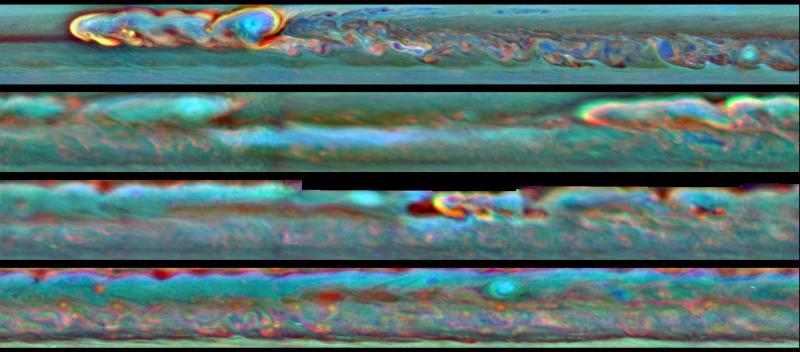
Jan. 31, 2013 — Call it a Saturnian version of the Ouroboros, the mythical serpent that bites its own tail. In a new paper that provides the most detail yet about the life and death of a monstrous thunder-and-lightning storm on Saturn, scientists from NASA’s Cassini mission describe how the massive storm churned around the planet until it encountered its own tail and sputtered out. It is the first time scientists have observed a storm consume itself in this way anywhere in the solar system.

——————————————————————————–

“This Saturn storm behaved like a terrestrial hurricane — but with a twist unique to Saturn,” said Andrew Ingersoll, a Cassini imaging team member based at the California Institute of Technology, Pasadena, who is a co-author on the new paper in the journal Icarus. “Even the giant storms at Jupiter don’t consume themselves like this, which goes to show that nature can play many awe-inspiring variations on a theme and surprise us again and again.”

Earth’s hurricanes feed off the energy of warm water and leave a cold-water wake. This storm in Saturn’s northern hemisphere also feasted off warm “air” in the gas giant’s atmosphere. The storm, first detected on Dec. 5, 2010, and tracked by Cassini’s radio and plasma wave subsystem and imaging cameras, erupted around 33 degrees north latitude. Shortly after the bright, turbulent head of the storm emerged and started moving west, it spawned a clockwise-spinning vortex that drifted much more slowly. Within months, the storm wrapped around the planet at that latitude, stretching about 190,000 miles (300,000 kilometers) in circumference, thundering and throwing lightning along the way.

Terrestrial storms have never run into their own wakes — they encounter topographic features like mountains first and expend themselves. But Saturn has no land to stop its hurricanes. The bright, turbulent storm head was able to chomp all the way around the planet. It was only when the head of the storm ran into the vortex in June 2011 that the massive, convective storm faded away. Why the encounter would shut down the storm is still a mystery.

By Aug. 28, after 267 days, the Saturn storm stopped thundering for good. While Cassini’s infrared detectors continue to track some lingering effects in higher layers of Saturn’s atmosphere, the troposphere — which is the weather-producing layer, lower in the atmosphere — has been quiet at that latitude.

“This thunder-and-lightning storm on Saturn was a beast,” said Kunio Sayanagi, the paper’s lead author and a Cassini imaging team associate at Hampton University in Virginia. “The storm maintained its intensity for an unusually long time. The storm head itself thrashed for 201 days, and its updraft erupted with an intensity that would have sucked out the entire volume of Earth’s atmosphere in 150 days. And it also created the largest vortex ever observed in the troposphere of Saturn, expanding up to 7,500 miles [12,000 kilometers] across.”

The vortex grew to be as large as the giant storm known as Oval BA on Jupiter. But Oval BA and Jupiter’s more famous storm — the Great Red Spot — are not thunder-and-lightning storms. Jupiter’s storms also have a quiet center, unlike the violence at the center of Saturn’s storms.

“Cassini’s stay in the Saturn system has enabled us to marvel at the power of this storm,” said Scott Edgington, Cassini’s deputy project scientist at NASA’s Jet Propulsion Laboratory in Pasadena, Calif. “We had front-row seats to a wonderful adventure movie and got to watch the whole plot from start to finish. These kinds of data help scientists compare weather patterns around our solar system and learn what sustains and extinguishes them.”

This storm was the longest running of the massive storms that appear to break out in Saturn’s northern hemisphere once every Saturn year (30 Earth years). The longest storm of any size ever detected on Saturn actually unfolded over 334 days in 2009 in an area known as “Storm Alley” in the southern hemisphere, but it was about 100 times smaller in area than the latest northern storm.

The Cassini-Huygens mission is a cooperative project of NASA, the European Space Agency and the Italian Space Agency. JPL manages the mission for NASA’s Science Mission Directorate, Washington. The Cassini orbiter and its two onboard cameras were designed, developed and assembled at JPL. The imaging team consists of scientists from the U.S., England, France and Germany. The imaging operations center is based at the Space Science Institute in Boulder, Colo.

For more information, visit: http://www.nasa.gov/cassini and http://saturn.jpl.nasa.gov .

For more than fifteen years, Thierry Jamin, French Archaeologist and adventurer, explores the jungles of South Peru in every possible direction, searching for clues of the permanent presence of the Incas in the Amazonian forest, and the legendary lost city of Paititi.
After the discovery of about thirty incredible archeological sites, located in the North of the department of Cuzco, between 2009 and 2011, which include several fortresses, burial and ceremonial, centers, and small Inca cities composed by hundreds of buildings, and many streets, passages, squares…, Thierry Jamin embarks on an incredible journey in Machu Picchu.

A few months ago, Thierry Jamin and his team think they have realized an extraordinary archaeological discovery in the Inca city discovered by Hiram Bingham in 1911. This discovery was made possible thanks to the testimony of a French engineer who lives in Barcelona-Spain, David Crespy. In 2010, while he was visiting the lost city, David Crespy noticed the presence of a strange “shelter” located in the heart of the city, at the bottom of one of the main buildings.

For him, there was no doubt about it, he was looking at a “door”, an entrance sealed by the Incas. In August, 2011, David Crespy, found by chance an article about Thierry Jamin and his work in the French newspaper the Figaro magazine. Immediately he decided to contact the French researcher.

Thierry Jamin, who has investigated several burial sites in the North of Cusco, listened carefully the story of David Crespy. Quickly he wants to confirm the facts behind the story. Accompanied by archaeologists of the Regional Office of the Culture in Cusco, he was able to visit the site several times. His preliminary findings are unequivocal: it is indeed an entrance, blocked by the Incas at an undetermined moment of History. This one is strangely similar to a burial site, such as the ones Thierry Jamin and his companions often find in the valleys of Lacco and Chunchusmayo.

In order to confirm the existence of cavities in the basement of the building, in December 2011 Thierry and his team submit and official request to the Ministry of Culture in Lima, to perform a geophysical survey with the help of electromagnetic (EM) conductivity instruments. This license was granted a few months later.

Realized between April 9th and April 12th 2012, the electromagnetic survey not only confirmed the presence of an underground room but several! Just Behind the famous entrance, a staircase was also discovered. The two main paths seem to lead to specific chambers, including to the main squared one. The different techniques used by the French researcher(s), (Molecular Frequencies Discriminator) allowed them to highlight the presence of important archaeological material, including deposits of metal and a large quantity of gold and silver!

Thierry Jamin is now preparing the next step: the opening of the entrance sealed by the Incas more than five centuries ago. On May 22nd 2012, he officially submitted a request for authorization to the Peruvian authorities which would allow his team to proceed with the opening of the burial chambers.

This project, “Machu Picchu 2012″, is now extended to a period of six months. At stake, an extraordinary archaeological treasure and some new revelations about the forgotten History of the Inca Empire. Soon you will see Machu Picchu from a brand new perspective…

By HeritageDaily