Archive for the ‘News’ Category

Europe’s oldest urban settlement is near Provadia, a town of about 13 000 people about 40km inland from Bulgaria’s Black Sea city of Varna, according to archaeology Professor Vassil Nikolov, citing evidence from work done at the Provadia – Solnitsata archaeological site in summer 2012.
The team of archaeologists headed by Nikolov excavated stone walls estimated to date from 4700 to 4200 BCE. The walls are two metres thick and three metres high, and according to Nikolov are the earliest and most massive fortifications from Europe’s pre-history.
There were about 300 to 350 people living at the site in those times, living in two-storey houses and earning their living by salt mining.
To this day, Provadia is an important salt centre, with a large-scale foreign investor represented in the area. Estimates are that salt has been extracted in the area for about 7500.
Nikolov said that salt was the currency of ancient times, both in terms of value and prestige.
As the only place in the Balkans used to produce salt at the time, Provadia –Solnitsatsa of the fifth century BCE was the “mint” of the region, Nikolov said.
He said that finds of gravesites at a necropolis showed that people in the town were wealthy.
Ritual burial practices also were strange and complex, he said. Copper needles and pottery found in graves at the site showed that people had been wealthy, but in some cases the corpses had been cut in half and buried from the pelvis up.
The study in summer 2012, lasting two months, focused mainly on the necropolis and the village.
Oct 8 2012 by The Sofia Globe staff in Bulgaria, News

Humans were hunting mastodons in Mexico 250,000 years ago.  This archaeological heresy is supported by finding at Hueyatlaco.

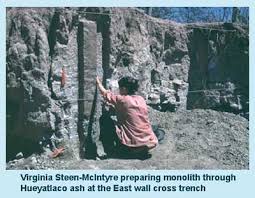
Hueyatlaco is an archeological site in Valsequillo, Mexico. Several potential pre-Clovis localities were found in the 1960s around the edge of the Valsequillo Reservoir, Mexico.  One of these localities is the site of Hueyatlaco.  This site was excavated by Cynthia Irwin-Williams in 1962, 1964, and 1966.

One of its early excavators Virginia Steen-McIntyre writes “Hueyátlaco is a dangerous site. To even publicly mention the geological evidence for its great age is to jeopardize one’s professional career. Three of us geologists can testify to that. It’s very existence is blasphemous because it questions a basic dogma of Darwinism, the ruling philosophy (or religion, if you will) of the western scientific world for the past 150 years. That dogma states that, over a long period of time, members of the human family have generally become more and more intelligent. The Hueyátlaco site is thus ‘impossible’ because Mid-Pleistocene humans weren’t smart enough to do all that the evidence implies. Besides, there is no New World anthropoid stock from which they could have evolved.:

File:High res mastodon rendering.jpg


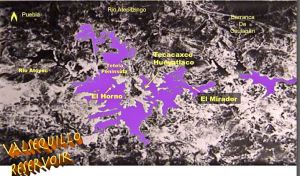
The Hueyatlaco Archeological Site is situated on the Tetela Peninsula, along the north shore of the Valsequillo reservoir in the State of Puebla, Mexico, approximately 100 km southeast of Mexico City and 10 km south of the City of Puebla.

In the 1960s, highly sophisticated stone tools rivaling the best work of Cro-magnon man in Europe were unearthed by Professor Juan Armenta Camacho and Dr. Cynthia Irwin-Williams at Hueyatlaco, near Valsequillo.

Dr. Cynthia Irwin-Williams

Credit: Smithsonian National Archives

After excavations in the 1960s, the site became notorious due to geochronologists’ analyses that indicated human habitation at Hueyatlaco was dated to ca. 250,000 years before the present.

Professor Juan Armenta Camacho

Professor Juan Armenta Camacho

Beds containing human artifacts at Valsequillo, Mexico, have been dated at approximately 250,000 years before the present by fission-track dating of volcanic material and uranium dating of a camel pelvis. The dilemma posed by such dates is clearly stated in the following quotation from the conclusions of the subject article.


“The evidence outlined here consistently indicates that the Hueyatlaco site is about 250,000 yr old. We who have worked on geological aspects of the Valsequillo area are painfully aware that so great an age poses an archeological dilemma. If the geological dating is correct, sophisticated stone tools were used at Valsequillo long before analogous tools are though to have been developed in Europe and Asia. Thus, our colleague, Cynthia Irwin-Williams, has criticized the dating methods we have used, and she wishes us to emphasize that an age of 250,000 yr is essentially impossible.”
(Steen-McIntyre, Virginia, et al; “Geologic Evidence for Age of Deposits at Hueyatlaco Archeological Site, Valsequillo, Mexico,” Quaternary Research, 16:1, 1981.)
Credit: mcremo.com

These controversial findings are orders of magnitude older than the scientific consensus for habitation of the New World (which generally traces widespread human migration to the New World to 13,000 to 16,000 ybp). The findings at Hueyatlaco have mostly been repudiated by the larger scientific community, and have seen only occasional discussion in the literature

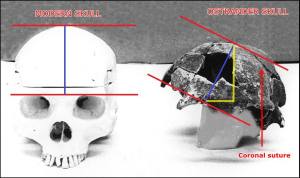
According to  Steen-McIntyre “we have evidence for two primitive human skulls. The Dorenberg skull was collected in the area over 100 years ago (Reichelt,1899 (1900)) . The interior cavities were filled with a diatomite that contains the same Sangamon-age suite of taxa that occurs associated with the artifacts at Hueyátlaco (VanLandingham 2000, 2002b,c, 2003). It was on display in a museum in Leipzig for many years, and was destroyed during the bombings of WW II. We are looking for a photo or drawing of it.

The second skull, the Ostrander skull, is rumored to have been collected illegally at Hueyátlaco sometime in the late 60’s or early 70’s and recently to have been turned over to a Native American tribe for reburial. No attempt was made to date it.”

Ostrander skull to the right, allegedly from the Hueyatlaco Site. On the left a modern skull
Credit:  Austin Whittall patagoniamonsters.blogspot.com

Cynthia Irwin-Williams led the team that first excavated the site in 1962 The dig is often associated with Virginia Steen-McIntyre because of her continuing efforts to publicize her findings and opinions. However, the site was actually discovered by Juan Armenta Camacho and Irwin-Williams. Steen-McIntyre joined the team in 1966 as a graduate student, at the request of project geologist Hal Malde. The excavation was associated with the U.S. Geological Survey.

The region, about 75 miles SE of Mexico City, was known for its abundance of animal fossils, and Irwin-Williams described Hueyatlaco as a “kill site” where animals were hunted and butchered.

These tools are believed to be 250,000 years old from the Hueyatlaco site.

Credit: Dr. Cynthia Irwin-Williams/H.S. Rice

Excavations were conducted via standard protocols, including securing the sites to prevent trespass or accidental disturbances. During excavation, investigators discovered numerous stone tools. The tools ranged from relatively primitive implements at a smaller associated site, to more sophisticated items such as scrapers and double-edged blades uncovered at the main excavation site. The diversity of tools made from non-local materials suggested that the region had been used by multiple groups over a considerable period.

Credit: Chris Hardaker

In 1967, Jose L. Lorenzo of the Instituto Nacional de Antropología e Historia claimed that implements had been planted at the site by local laborers in such a way as to make it difficult or impossible to determine which artifacts were discovered in situ and which were planted. Irwin-Williams counter-argued that Lorenzo’s claims were malicious and without merit. Furthermore, in 1969 Irwin-Williams cited statements of support from three prominent archeologists and anthropologists (Richard MacNeish, Hannah Marie Wormington and Frederick A. Peterson) who had each visited the site independently and attested to the integrity of the excavations and the professionalism of the group’s methodology
Credit: Chris Hardaker

In mid-1969, Szabo, Malde and Irwin-Williams published their first paper about dating the excavation site. The stone tools were discovered in situ in a stratum that also contained animal remains. Radiocarbon dating of the animal remains produced an age of over 35,000 ybp. Uranium dating produced an age of 260,000 ybp, ± 60,000 years.

The site had been buried by the ash of La Malinche. The reservoir, which lies 100 km southeast of Mexico City and south of the city of Puebla is surrounded by four of Mexico’s famous volcanoes: Tláloc, Iztaccíhuatl, Popocatepetl, and La Malinche, which is shown below.

File:Matlalcueitl.jpg

Credit: Wikipedia

The authors admitted that they had no definitive explanation for the anomalous results. However, Malde suggested the tool-bearing strata had possibly been eroded by an ancient streambed, thus combining older and newer strata and complicating dating.

Credit: Chris Hardaker

In 1973, Steen-MacIntyre, Malde and Roald Fryxell returned to Hueyatalco to re-examine the geographic strata and more accurately determine an age for the tool-bearing strata. They were able to rule out Malde’s streambed hypothesis. Moreover, the team undertook an exhaustive analysis of volcanic ash and pumice from the original excavation site and the surrounding region. Using the zircon fission-track dating method, geochemist C.W. Naeser dated samples of ash from Hueyatlaco’s tool-bearing strata to 370,000 ybp +/- 240,000 years.

The confirmation of an anomalously distant age for human habitation at the Hueyatlaco site led to tension between Irwin-Williams and the other team members. Malde and Fryxell announced the findings at a Geological Society of America meeting, admitting that they could not account for the anomalous results. Irwin-Williams responded by describing their announcement as “irresponsible”.  Given the substantial margin of error for the fission-track findings, and the then-new method of uranium dating, Irwin-Williams asserted that Hueyatlaco had not been accurately dated to her satisfaction.

Credit: Chris Hardaker

Excerpt of letter to Marie Wormington from Dr. Cynthia Irwin-Williams [circa 1969]:

“…Meanwhile, I recently got a letter from Hal, with some (completely wild) uranium dates on Valsequillo material. I don’t see how he can take them seriously since they conflict with the archaeology, with his own geologic correlations, and with a couple C14 dates. However, God help us, he wants to publish right away! I am enclosing a copy of Hal’s letter and my reply. Needless to say any restraint you can exercise on him would be greatly appreciated. All we need to do at this point is to put that stuff in print and every reputable prehistorian in the country will be rolling in the aisles.”


On March 30, 1981, Steen-McIntyre wrote to Estella Leopold, the associate editor of Quaternary Research: “The problem as I see it is much bigger than Hueyatlaco. It concerns the manipulation of scientific thought through the suppression of ‘Enigmatic Data,’ data that challenges the prevailing mode of thinking. Hueyatlaco certainly does that! Not being an anthropologist, I didn’t realize the full significance of our dates back in 1973, nor how deeply woven into our thought the current theory of human evolution had become. Our work at Hueyatlaco has been rejected by most archaeologists because it contradicts that theory, period.”

Eventually, Quaternary Research (1981) published an article by Virginia Steen-McIntyre, Roald Fryxell, and Harold E. Malde. It upheld an age of 250,000 years for the Hueyatlaco site. Cynthia Irwin-Williams (1981) objected to these findings in a letter responding to these authors. Her objections were answered point-for-point in a counter letter from Malde and Steen-McIntyre (1981).

Credit: Chris Hardaker

The case of Virginia Steen-McIntyre opens a rare window into the actual social processes of data suppression in paleoanthropology, processes that involve a great deal of hurt and conflict. In general, however, this goes on behind the scenes, and the public sees only the end result—the carefully edited journals and books that have passed the censors.

The Sangamonian Stage, also known as the Sangamon interglacial, is the name used by Quaternary geologists to designate the last interglacial period in North America from 125,000—75,000 years ago, a period of 0.05 million years. The Sangamonian Stage precedes the Wisconsinan (Wisconsin) Stage and follows the Illinoian Stage in North America

In recent times the Hueyatlaco Site has been reinvestigated by Dr. Sam VanLandingham using diatom dating methodology to confirm the anomalously old dates assigned by Malde, Steen-McIntyre and Fryxell:
Important artifacts have been found in situ (i.e., not redeposited) within lacustrine deposits in the Valsequillo region. These deposits contain many diatoms which indicate an age corresponding to the Sangamonian Interglacial sensu lato (80,000 to ca. 220,000yr BP). Two of the four samples in this study are associated with the Dorenberg skull or with stratigraphic units which contain bifacial tools. The remaining two samples are from diatomaceous deposits which are also Sangamonian and stratigraphically above the artifact units. These four diatomaceous samples yielded 30 extinct and 143 extant diatom taxa.

The ages of the four samples correspond to other diatomaceous samples (some of which are associated with artifacts) from nearby Valsequillo localities. A post-Sangamonian age for these four diatom-bearing samples is discounted by the presence of Navicula bronislaae and N. dorenbergi, both of which have short stratigraphic ranges and are known only from the Sangamonian (or its equivalents), and by 13 diatoms which evidently have known long stratigraphic ranges and extinctions before the end of the Sangamonian.

An age no older than Sangamonian for the artifacts and their enclosing diatomaceous deposits is indicated by the presence of two diatoms (Epithemia zebra var. undulata and Navicula creguti) known only from Sangamonian (or = age) or younger and by an extant diatom, Cymbella cistula var. gibbosa (C. gibbosa), which has its first occurrence in the Sangamonian.
The diatom biostratigraphy presented herein establishes a minimum (Sangamonian) and a maximum (Illinoian) age for the younger (bifacial) artifacts at the Hueyatlacoarchaeological site in units B,C, and E, Puebla, Mexico.

VanLandingham  used  diatom biostratigraphy in determining a minimum (Sangamonian = 80,000–ca.220,000 yr. BP) and a maximum (Illinoian = 220,000–430,00 yr. BP) age for the Hueyatlaco artifacts, Puebla, Mexico. Nova Hedwigia (February, 2009), Beiheft 135, p. 15-36.

Quoting the Abstract: The diatom biostratigraphy presented herein establishes a minimum (Sangamonian) and a maximum (Illinoian) age for the younger (bifacial) artifacts at the Hueyatlaco archaeological site in units B,C, and E, Puebla, Mexico. One of the 13 samples in this study is from a position of Sangamonian age which is stratigraphically higher than the artifacts. The minimum age of this sample (from unit B) is demonstrated by 6 taxa which became extinct at the end of the Sangamonian , and its maximum age (also Sangamonian) is denoted by 3 taxa with earliest known first occurrences in the Sangamonian. The diatoms of the remaining 12 samples have a minimum age of Sangamonian. Three of the 13 samples are in unit I and no Hueyatlaco artifacts are known below this unit.
____________________________

Sources:

http://gordonwagner.wordpress.com/2010/10/23/250000-year-old-mastodon-hunter-from-puebla/

http://www.bibliotecapleyades.net/ciencia/esp_ciencia_life18.htm

http://csfa.tamu.edu/research.php

http://valsequillo.earthmeasure.com/

^ Irwin-Williams, C., et al., Comments on the Associations of Archaeological Materials and Extinct Fauna in the Valsequillo Region Puebla Mexico, American Antiquity, Volume 34, Number 1, Pages 82-83, Jan 1969

^ Szabo, B.J., Malde, H.E., and Irwin-Williams, C., Dilemma Posed By Uranium-Series Dates On Archaeologically Significant Bones From Valsequillo Puebla Mexico, Earth and Planetary Science Letters, Volume 6, Pages 237-244, Jul 1969

^ Gonzalez, Silvia; Huddart, David; and Bennett Matthew. (2006) Valsequillo Pleistocene archaeology and dating : ongoing controversy in Central Mexico . World Archaeology, 2006, vol. 38, no4, pp. 611-627.

a b Irwin-Williams, C., et al., Comments on the Associations of Archaeological Materials and Extinct Fauna in the Valsequillo Region Puebla Mexico, American Antiquity, Volume 34, Number 1, Pages 82-83, Jan 1969

^ Irwin-Williams, Cynthia. (1978) Summary of Archeological Evidence from the Valsequillo Region, Puebla, Mexico. In Cultural Continuity in Mesoamerica, David L. Browman, ed. The Hague: Mouton Publishers.

a b c d e f g h Webb, Mark Owen and Suzanne Clark. (1999). “Anatomy of an Anomaly .” Disputatio, 6.

^ Szabo, B.J., Malde, H.E., and Irwin-Williams, C., Dilemma Posed By Uranium-Series Dates On Archaeologically Significant Bones From Valsequillo Puebla Mexico, Earth and Planetary Science Letters, Volume 6, Pages 237-244, Jul 1969

^ Steen-McIntyre, V., R. Fyxell and H. Malde. (1981) Geologic Evidence for Age Deposits at Hueyatlaco Archaeological Site Valsequillo Mexico, Quaternary Research, Number 16, Pages 1-17, 1981

^ http://www.xmission.com/~tlacy/mom.txt

^ VanLandingham, S.L., Corroboration of Sangamonian Age of Artifacts From the Valsequillo Region Puebla Mexico By Means of Diatom Biostratigraphy, Micropaleontology, Volume 50, Number 4, Pages 313-342, 2004

^ VanLandingham, S.L., Diatom Evidence For Autocthonous Artifact Deposition In the Valsequillo Region Puebla Mexico During Sangamonian (sensu lato = 80,0000 to ca. 220,000 yr BP and Illinoian (220,000 to 430,000 yr BP)), Journal of Paleolimnology, Volume 36, Number 1, Pages 101-116, Jul 2006

http://ancientstuff.maxforum.org/2012/09/09/evidence-for-modern-humans-in-americas-250000-year/

http://valsequillo.earthmeasure.com/Val3/content/Slide07_large.html

http://patagoniamonsters.blogspot.com/2011/01/ostrander-skull-supposedly-erectus.htm

Tomb of Mayan Queen Found

Posted: October 7, 2012 by phaedrap1 in News
Tags: , ,

K'abel_burial

Archaeologists in Guatemala say they have discovered the 7th-century tomb of Lady K’abel, one of the greatest queens of classic Maya civilization.

Unearthed during excavations of the royal Maya city of El Perú-Waka’ in northwestern Petén, Guatemala, the grave contained the skeletal remains of a mature individual buried with rich offerings such as dozens of ceramic vessels, numerous carved jade, shell artifacts and a small, carved alabaster jar.

According to the archaeologists, the white vessel strongly suggest the tomb belonged to the warrior Queen Lady K’abel.

Carved as a conch shell, with a head and arm of an aged woman emerging from the opening, the alabaster jar portrayed a woman, mature with a lined face and a strand of hair in front of her ear, while on the other side it featured a brief glyphic text consisting of four hieroglyphs.

The final two glyphs named the owner as “Lady Waterlily-Hand, Princess of Calakmul.”

“This is almost certainly an alternative spelling of the name of Lady K’abel, as both names consist of hands holding waterlilies and both are titled as princesses of Calakmul,” David Freidel, professor of archaeology at Washington University in St. Louis and co-director of the expedition, said.

The most powerful person in Waka’ during her lifetime, Lady K’abel is known in Maya archaeology because of a beautiful and detailed portrait of her in a stela dated to 692 A.D. The carved stone slab was looted from Waka’ in the 1960s and is now in the Cleveland Art Museum.

Lady K’abel ruled with her husband, K’inich Bahlam, for at least 20 years (672-692 A.D.). She was the military governor of the Wak kingdom for her family, the imperial house of the Snake King, and carried the title Kaloomte’, which translates to “Supreme Warrior.”

“The significance of this woman’s powerful role as a ‘Kaloomte,’ a title rarely associated with Maya women, provides tremendous insight on the nexus of gender and power in Classic Maya politics,” Olivia Navarro-Farr, assistant professor of sociology and anthropology at The College of Wooster and co-director of the expedition, said.

The discovery of the tomb of the seventh-century Maya queen occurred while Navarro-Farr investigated “ritually potent” features at El Perú-Waka’, such as shrines, altars, and dedicatory offerings.

Conch effigy

The tomb was found underneath various phases of a masonry shrine that had been placed on a staircase.

The shrine contained a monumental fire altar which had been dedicated by the sacrifice of a mature woman buried underneath it.

“Below that last shrine was a buried earlier version and it was below this earlier shrine that the royal tomb was found,” Freidel and Navarro-Farr said.

It soon became clear to the archaeologists why the structure received so much ritual attention throughout its final occupation.

“The golden age of the city, and the great queen and her husband who presided over it, were remembered and celebrated by ordinary people with their humble offerings,” the researchers said.

Inside the tomb the team led by Freidel and Navarro-Farr found the skeletal remains of an individual, whose skull was almost covered by ceramic vessels.

Deterioration of the bones did not permit a clear identification of the subject as male or female.

“If female, the interred individual had more robust than gracile features,” the researchers said. The traits would match the queen’s portrait on the stela on display at the Cleveland Art Museum.

One further clue favoring the identification of the skeleton as a queen was the presence of a large red spiny oyster shell on the lower torso.

“Late Classic queens at Waka’, including K’abel, regularly wore such a shell as a girdle ornament in their stela portraits while kings did not,” the researchers said.

According to Freidel, the newly uncovered tomb is a rare situation in which Maya archaeological and historical records meet.

“To put the discovery into perspective, there are five maya tombs in Classic Maya history that are indentifiable as to the person inside them — this is one of those five,” Freidel said.

Photos: Top: The burial chamber. Queen K’abel’s skull is above the plate fragments. Credit: El Peru Waka Regional Archaeological Project. Bottom: The carved alabaster vessel (shown from two sides). Credit: El Peru Waka Regional Archaeological Project.

Earthquake overview, latest areas of risk!!

Posted: October 2, 2012 by noxprognatus in News, videos

Latest update of earthquakes, after the success of Colombia 7.3, now Japan 6.2. Where will be next? Areas of risk Turkey, Indonesia, China, Japan, California, British Virgin Islands, Mid-Atlanti Ridge, Carlsberg Ridge.

Earthquake 7.3 Colombia Predicted cycle of 188

Posted: October 1, 2012 by noxprognatus in News, Occult, videos

This earthquake was predicted. The location was only slightly out…I said Peru. Time was two hours out! Date correct! Large Earthquake correct…cycle of 188 in effect…read more on face book group. Watch this space for more updates …Nox 😉

6.3 Mag EQ California..25/9/12 23:45 UTC

Posted: September 26, 2012 by noxprognatus in News, videos

The uptick may have started. A big earthquake is due according to the cycle of 188. See other posts on website for more information. I hope we are wrong, but the figures have previously spoken for themselves! Stay safe everyone!! Nox.

Deepest Ever View into Universe

Posted: September 25, 2012 by noxprognatus in News, Science

Universe just before “The Big Bang”


    Astronomers have assembled a new, improved portrait of our deepest-ever view of the universe. Called the eXtreme Deep Field, or XDF, the photo was assembled by combining ten years of Hubble Space Telescope observations. Some of the galaxies in it are 13.2 billion years old. The universe itself formed 13.7 billion years ago. (NASA/ESA/G. Illingworth/D. Magee/P. Oesch/R. Bouwens/HUDF09 Team)

    Scientists say before the “Big Bang”  happened. My theory is that the big bang did not happen as we understand it. And another theory of beginning is required. Watch out for a post on White Holes in the near future. Nox

Earthquake update 25/9/12

Posted: September 25, 2012 by noxprognatus in News, videos

First update in a pre large quake lull.

The Watchers Tweet Tweet Herbs played a huge role in Egyptian medicine. Proof comes from burial sites, tombs and underground temples where archeologists have found extensive sets of medical documents and scrolls, including the Ebers Papyrus, the Edwin Smith Papyrus, the Hearst Papyrus, and the London Medical Papyrus, which contained the earliest documented awareness of tumors. The most famous plant – medicine “encyclopedia” is the Ebers Papyrus, a 110 page scroll which rolls out to be about 20 meters...

Herbs played a huge role in Egyptian medicine. Proof comes from burial sites, tombs and underground temples where archeologists have found extensive sets of medical documents and scrolls, including the Ebers Papyrus, the Edwin Smith Papyrus, the Hearst Papyrus, and the London Medical Papyrus, which contained the earliest documented awareness of tumors. The most famous plant – medicine “encyclopedia” is the Ebers Papyrus, a 110 page scroll which rolls out to be about 20 meters long.

Egyptians consumed raw garlic and onions for endurance and to heal asthma and bronchial-pulmonary issues. Many of their herbs were steeped in wine and used as oral medicine. These were natural herbs, untainted by pesticides, herbicides, insecticides, or fluoridated water. The Egyptians documented use of myrrh, frankincense, fennel, cassia, thyme, juniper, and even aloe. Fresh garlic cloves were peeled, mashed and macerated in a mixture of vinegar and water and used as a rinse for sore throats and toothaches.

The God of Sweetness

Egyptians knew about the healing powers of honey. In fact, the first official recognition of the importance of honey dates back to the first Egyptian Dynasty and the “Sealer of the Honey.” In Niuserre’s Sun temple, bee-keepers are shown in hieroglyphics blowing smoke into hives as they are removing honey-combs. The honey was immediately jarred and sealed and could therefore be kept for years, and it was used for the production of medicines and ointments. They even used it as a natural antibiotic.

The main land for bee-keeping was in Lower Egypt where there was extensive irrigation feeding thousands of flowering plants. The Bee was chosen as a symbol for the country and the gods were associated with the bee. One pharaoh’s title was Bee King and his Royal archers protected the bees like they were his holy temple. The temples were actually homes for the bees, in order to satisfy the desire of the gods. Canaan was called the “Land of Milk and Honey” in the Hebrew tradition.

Egyptian medicine is some of the oldest ever documented. From the 33rd century BC until the Persian invasion in 525 BC, Egyptian medical practice remained consistent in its highly advanced methods for the time. Homer even wrote in the Odyssey: “In Egypt, the men are more skilled in medicine than any of human kind,” and “The Egyptians were skilled in medicine more than any other art.”

The Edwin Smith papyrus is still benefiting modern medicine, and is viewed as a learning manual. Treatments consisted of ailments made from animal, vegetable, fruits and minerals. But the Ebers Papyrus is the most voluminous record of ancient Egyptian medicine known. The scroll contains some 700 remedies including empirical practice and observation. The papyrus actually contains a “treatise on the heart,” which recognizes the heart as the center of the blood supply, with vessels attached.

Even mental disorders, depression and dementia were detailed in one of the chapters. The Egyptians were treating intestinal disease and parasites, eye and skin problems, and even abscesses and tumors.

Remedies from the Ancient Ebers Papyrus Scrolls:

• Aloe vera was used to alleviate burns, ulcers, skin diseases and allergies

• Basil was written up as heart medicine

• Balsam Apple (Apple of Jerusalem) was used as a laxative and as a liver stimulant

• Bayberry was prescribed for diarrhea, ulcers and hemorrhoids

• Caraway soothed digestion and was a breath freshener

• Colchicum (citrullus colocynthus or meadow saffron) soothed rheumatism and reduced swelling

• Dill was recognized for laxative and diuretic properties

• Fenugreek was prescribed for respiratory disorders and to cleanse the stomach and calm the liver and pancreas

• Frankincense was used for throat and larynx infections, and to stop bleeding and vomiting

• Garlic was given to the Hebrew slaves daily to give them vitality and strength for building the pyramids

• Licorice was utilized as a mild laxative, to expel phlegm, and to alleviate chest and respiratory problems

• Onion was taken to prevent colds and to address cardiovascular problems (How did they know?)

• Parsley was prescribed as a diuretic

• Thyme was given as a pain reliever and Tumeric for open wounds

• Poppy was used to relieve insomnia, as an anesthetic, and to deaden pain

• Coriander was taken as a tea for urinary complaints, including cystitis

• Pomegranate root was strained with water and drunk to address “snakes of the belly” (tapeworms). The alkaloids contained in pomegranate paralyzed the worms’ nervous system and they relinquished their hold.

• Persian henna was used against hair loss

Disease and Natural Cures in Ancient Egypt

Disease was not uncommon in Ancient Egypt. There were many skin afflictions and parasites from the Nile river waters. Worms and tuberculosis were common, sometimes transmitted from cattle. Pneumonia struck people who breathed in too much sand into the lungs during sand storms. But the Egyptian physicians took full advantage of the natural resources all around them in order to treat common ailments. Many of their methods are still very viable today and are considered part of the homeopathic world of medicine.

Thanks to diligent record keeping, scholars have been able to translate the scrolls and appreciate what the Egyptians knew back then about anatomy, hygiene, and healing. Those scrolls, without question, paved the way for modern medicine.

NaturalNews
By S. D. Wells

Arctic sea ice melt ‘may bring harsh winter to Europe’

Posted: September 16, 2012 by phaedrap1 in News

The unprecedented loss of polar sea ice may lead to ‘wild extremes’ in the UK and northern Europe, say researchers

Arctic sea ice : Winter weather : Roads around Newcastle were blocked by deep snow

Unprecedented sea ice loss may bring a cold winter to the UK, say researchers. Photograph: John Giles/PA

The record loss of Arctic sea ice this summer may mean a cold winter for the UK and northern Europe. The region has been prone to bad wintersafter summers with very low sea ice, such as 2011 and 2007, said Jennifer Francis, a researcher at Rutgers University.


“We can’t make predictions yet … [but] I wouldn’t be surprised to see wild extremes this winter,” Francis told the Guardian.


This year’s ice melt has broken the 2007 record by an an area larger than the state of Texas.


Polar ice experts “thought that it would be many years until we again saw anything like we saw in 2007″, said Mark Serreze, director of the National Snow and Ice Data Centre in Colorado.


The unprecedented expanse of ice-free Arctic Ocean has been absorbing the 24-hour sun over the short polar summer. The heat in the water must be released into the atmosphere if the ice is to re-form this autumn. “This is like a new energy source for the atmosphere,” said Francis.


This heat and water vapour will affect the all-important jet stream – the west-to-east winds that are the boundary between cold Arctic and the warm mid-latitudes. Others researchers have already shown that the jet stream has been shifting northwards in recent years. Francis and colleagues have recently documented that the jet stream is also slowing down.


“The jet stream is clearly weaker,” said Francis. That means weather systems, be it rain or dry conditions, are slow to move on and last longer. Ultimately this can result in “blocking” events, such as the conditions that produced the terrible heatwave in western Russia during the summer of 2010, she said.


This summer, Greenland experienced a similar blocking anti-cyclone, resulting in a record surface melting of its ice sheet. It is not possible to directly connect that block to the prolonged US heatwave and drought this summer, Francis said. However “blocks act like a traffic jam, slowing down weather patterns elsewhere”.


These changes are happening much earlier than scientists thought, said James Overland, an oceanographer and researcher at the University of Washington.


“We’ve only had a little bit of global warming so far,” Overland said.


As the sea ice continues to decline, the jet stream will likely continue to slow more, and shift further north “bringing wild temperature swings and greater numbers of extreme events” in the future he said. “We’re in uncharted territory.”