Archive for the ‘News’ Category

The Watchers Tweet Tweet An investigative historian has recently discovered information which may prove that the ancient Philosopher Plato was telling the truth about the assignment of ancient territories to the “Gods” in the Golden age of civilization. This is not the first time that one of the ancient philosophers writings have been found to be true. Statements, previously considered myths by Homer were found to be true when, in 1871, the amateur German Archaeologist...

    An investigative historian has recently discovered information which may prove that the ancient Philosopher Plato was telling the truth about the assignment of ancient territories to the “Gods” in the Golden age of civilization. This is not the first time that one of the ancient philosophers writings have been found to be true. Statements, previously considered myths by Homer were found to be true when, in 1871, the amateur German Archaeologist Heinrich Schlieman uncovered the mythical city of Troy.

    In Plato’s work titled “Cretias” he wrote about the Golden Age of Civilization when the children of god were assigned territories to manage, populate and live in peace with their neighbors. A portion of Plato’s text follows:

    …”In the days of old the gods had the whole earth distributed among them by allotment. There was no quarreling; for you cannot rightly suppose that the gods did not know what was proper for each of them to have, or, knowing this, that they would seek to procure for themselves by contention that which more properly belonged to others. They, all of them by just apportionment, obtained what they wanted and peopled their own districts; and when they had peopled them they tended us, their nurslings and possessions, as shepherds tend their flocks, excepting only that they did not use blows or bodily force, as shepherds do, but governed us like pilots from the stern of the vessel, which is an easy way of guiding animals, holding our souls by the rudder of persuasion according to their own pleasure; thus did they guide all mortal creatures. Now different gods had their allotments in different places which they set in order. Hephaestus and Athene, who were brother and sister, and sprang from the same father, having a common nature, and being united also in the love of philosophy and art, both obtained as their common portion this land, which was naturally adapted for wisdom and virtue; and there they implanted brave children of the soil, and put into their minds the order of government; their names are preserved, but their actions have disappeared by reason of the destruction of those who received the tradition, and the lapse of ages”…

    These ancient territories were discovered by Arthur Faram after re-discovering the ancient science of Geoglyphology. For the past several years Arthur has been using this ancient science to track the movements and territories of ancient civilizations as far back as 10,000 BC, which according to ancient Greek philosophers was around the time of the Golden Age of Civilization.

    Connections between the territories have been found in past research; however, it wasn’t until recently that non adjacent territories had been tied to one another. This connection was made when the newly discovered, and previously un-researched, pyramids of East Java, Indonesia were geometrically tied to the previously studied territories that make up North, Central and South America.

    The Lalakon and Sudahurip Pyramids of East Java lie within the previously discovered Japanese territory. That territory appears to have been assigned to Japan, and is delineated by the Japanese Yonaguni Pyramid. What ties these territories together is the fact that the Indonesian Pyramids lie within the Japanese territory but their alignment obviously ties all the territories together, over thousands of miles of ocean.

    Current research is revealing that these territories exist over the entire face of the earth and do not overlap. This fact alone shows a worldwide coordination, thousands of years ago, to divide the earth into geographic regions.

    This discovery comes on the heels of many other recent discoveries which are telling the world that our past history is much different than we had previously imagined.

    By Adonai

    By Arthur Faram
    The Faram Foundation

    References:

    Plato’s Critias – Google
    The Indonesian Pyramids – http://thefaramfoundation.com/javapyramids.htm
    The Faram Foundation –  http://thefaramfoundation.com/
    Google Earth (Using the ruler function.)

    Both practical and beautiful, the 400-foot lighthouse at the mouth of Alexandria harbor started guiding sailors home around 250 BC. A fire made the lighthouse glow at night and a mirror reflected sun rays during the day, some say up to 35 miles away.
    CREDIT: Photo Credit: The Pharos of Alexandria, an ancient lighthouse, is depicted in this hand-colored engraving by Martin Heemskerck.

    The Egyptian city of Alexandria, home to one of the seven wonders of the ancient world, may have been built to align with the rising sun on the day of Alexander the Great’s birth, a new study finds.

    The Macedonian king, who commanded an empire that stretched from Greece to Egypt to the Indus River in what is now India, founded the city of Alexandria in 331 B.C. The town would later become hugely prosperous, home to Cleopatra, the magnificent Royal Library of Alexandria and the 450-foot-tall (140 meters) Lighthouse of Alexandria, one of the wonders of the ancient world. Today, more than 4 million people live in modern Alexandria.

    Ancient Alexandria was planned around a main east-west thoroughfare called Canopic Road, said Giulio Magli, an archaeoastronomer at the Politecnico of Milan. A study of the ancient route reveals it is not laid out according to topography; for example, it doesn’t run quite parallel to the coastline. But on the birthday of Alexander the Great, the rising sun of the fourth century rose “in almost perfect alignment with the road,” Magli said.


    The results, he added, could help researchers in the hunt for the elusive tomb of Alexander. Ancient texts hold that the king’s body was placed in a gold casket in a gold sarcophagus, later replaced with glass. The tomb, located somewhere in Alexandria, has been lost for nearly 2,000 years. [8 Grisly Archaeological Discoveries]

    Building by the stars

    Magli and his colleague Luisa Ferro used computer software to simulate the sun’s position in the fourth century B.C. (Because Earth’s orbit isn’t perfect, there is some variation in the sun’s path through the sky over centuries.) Alexander the Great was born on July 20, 356 B.C. by the Julian calendar, which is slightly different than the modern, Gregorian calendar, because it does not have leap years to account for partial days in the Earth’s orbit around the sun. On that day in the fourth century B.C., the researchers found, the sun rose at a spot less than half a degree off of the road’s route.

    “With a slight displacement of the day, the phenomenon is still enjoyable in our times,” Magli told LiveScience.

    A second star would have added to the effect, Magli said. The “King’s Star” Regulus, which is found on the head of the lion in the constellation Leo, also rose in near-perfect alignment with Canopic Road and became visible after a period of conjunction with the sun near July 20. Earth’s orbit has changed enough that this Regulus phenomenon no longer happens, Magli said.

    Sun as a symbol

    Architecture-by-astronomy was common in the ancient world, Magli said. The Great Pyramid of Giza, for example, is aligned with amazing precision along the compass points, which would have required the use of the stars as reference points. The Egyptians, whom Alexander conquered, had long associated the sun god Ra with their pharaohs.

    “Aligning the city [of Alexandria] to the sun in the day of birth of Alexander was a way to embody in the architectural project an explicit reference to his power,” Magli said. The King’s Star would have only added to the mystique, he said.

    The researchers reported their work online Oct. 9 in the Oxford Journal of Archaeology. They are now examining other cities founded by Alexander and later rulers to see if the solar pattern holds. The hope, Magli said, is that an understanding of Alexandria’s astronomical layout will give researchers a better idea of where Alexander’s tomb might be.

    Stephanie Pappas, LiveScience Senior Writer


    Earth sized Planet Around Alpha Centauri

    Posted: October 16, 2012 by noxprognatus in News, Science

    COSMIC NEIGHBORHOOD

    The nearest star detected orbiting Earth twin

    Foto: ESO/

    Date of publication: 
    16.10.2012 19:25


    European astronomers have discovered that around the nearest star Alpha Centauri orbits the planet whose mass is nearly equal to the Earth


    It is also the lightest planet ever discovered. Investigations were carried out with the help of the instrument HARPS mounted on the 3.6 m telescope of the La Silla Observatory in Chile. 

    Alpha Centauri is one of the brightest stars in the southern sky and the closest solar system – is only 4.3 light years away.This system is actually composed of three stars – Alpha Centauri A and B, which are similar to the Sun and move in orbits close to each other and one distant, pale, red Proxima Centauri. The possibility that in this system there are planets and possibly life scientists speculate since the 19th century, however, even a very precise studies have failed to reveal anything.Until today. 

    ‘Our observations HARPS instrument that lasted for more than four years have revealed a small, but real signal coming from the planets turned around Alpha Centauri B every 3.2 days, “said lead researcher Xavier Dumusque from the Geneva Observatory and the Centro de Astrofisica da Universidade do Porto in Portugal. “This is an extraordinary discovery, in which we use our technique to the limit. ‘ 

    The existence of a small planet was determined from the wobble of the star images influenced by its gravity. The effect is truly portable – runs the star forward or backward at a speed of 1.8 kilometers per hour, which is about the speed of crawling children. The planet is around Alpha Centauri B at a distance of about six million miles, much closer than Mercury is to the Sun. From another star Alpha Centauri A is a hundred times further, however, and it is in his heaven, probably a very shiny object. 

    The first exoplanet in the sun-like star was discovered early as 1995. Since then, it has found more than 800, however, generally are all much larger than Earth. The biggest challenge for scientists is to search for small planets the size of Earth that are in the habitable zones of their parent stars. 

    “This result represents a major step in the discovery of Earth’s twins in the immediate vicinity of our Sun.We live in an exciting time, “said Xavier Dumusque. 

    Russia’s space agency wants to send a mission to Apophis, the notorious asteroid which may change its course and eventually collide with Earth. It will plant a radio beacon, which will help track the celestial body and assess the risks it poses.

    ­The 300-meter-wide asteroid first made headlines in 2004, when NASA reported that it has 1 chance in 223 of impacting on our planet in 2029. It was even named after the Ancient Egyptian evil god, archenemy of the sun god Ra.

    But additional observations proved that it will pass by at the small, but safe, distance of some 36,000 kilometers from Earth. The close approach however may result in an unpredictable gravitational pull on Apophis, which would change its course and pose a danger in 2036, when it comes back.

    To better assess the risks it poses to the civilization the Roscosmos plans a robotic mission to the asteroid, chief Vladimir Popovkin announced on Monday.

    The plan is “to land a module on the surface of Apophis and set up a radio beacon there, which will work after the spaceship’s lifetime expires,” he said at the Space Research Institute in Moscow.

    The beacon signal will allow astronomers to better calculate Apophis’ movement and the effect of the 2029 Earth flyby. The mission would not be launched before 2020.

    Popovkin, who was speaking at a solar system exploration conference, outlined other mid-term plans Roscosmos has. These include a Venus orbiter between 2020 and 2025, which will study the planet’s hot and dense atmosphere. The mission may include a descending probe, although due to the harsh environment it would only work for about one day on the surface.

    Another target is Jupiter’s moon Ganymede. Roscosmos plans to send a spacecraft there in 2022 and is currently negotiating with its European counterpart ESA, which has a similar project, over a possible closer collaboration.

    Russia also plans a new Mars mission. Popovkin said launching such a spacecraft is no less important after the embarrassing failure of Fobos-Grunt in November 2011. Now engineers will be able to learn from the mistakes of the original attempt to reach the Martian moon.

    A more immediate plan is the Luna Glob mission to the Moon scheduled for late 2015. It would include returning a soil sample to Earth and studying it from an orbiter, which would change its altitude from the initial 100 kilometers down to 50 kilometers and later to 500 kilometers. The soil would later be studied for possible extraction of water from it.

    “We will allocate our main effort and majority of resources to the moon,”
    Popovkin said.

    RT Published: 08 October, 2012, 16:46


    WISE fills in Gaps on Jupiter’s Asteroids.

    Posted: October 15, 2012 by noxprognatus in News, Science

    NASA’s WISE Colors in Unknowns on Jupiter Asteroids

    Trojan Colors Revealed (Artist's Concept)New results from NASA’s Wide-field Infrared Explorer, or WISE, reveal that the Jovian Trojans — asteroids that lap the sun in the same orbit as Jupiter — are uniformly dark with a hint of burgundy color, and have matte surfaces that reflect little sunlight. Imagecredit: NASA/JPL-Caltech
    › Full image and caption

    •  
     

    October 15, 2012

    Scientists using data from NASA’s Wide-field Infrared Survey Explorer, or WISE, have uncovered new clues in the ongoing mystery of the Jovian Trojans — asteroids that orbit the sun on the same path as Jupiter. Like racehorses, the asteroids travel in packs, with one group leading the way in front of the gas giant, and a second group trailing behind. 

    The observations are the first to get a detailed look at the Trojans’ colors: both the leading and trailing packs are made up of predominantly dark, reddish rocks with a matte, non-reflecting surface. What’s more, the data verify the previous suspicion that the leading pack of Trojans outnumbers the trailing bunch. 

    The new results offer clues in the puzzle of the asteroids’ origins. Where did the Trojans come from? What are they made of? WISE has shown that the two packs of rocks are strikingly similar and do not harbor any “out-of-towners,” or interlopers, from other parts of the solar system. The Trojans do not resemble the asteroids from the main belt between Mars and Jupiter, nor the Kuiper belt family of objects from the icier, outer regionsnear Pluto. 

    “Jupiter and Saturn are in calm, stable orbits today, but in their past, they rumbled around and disrupted any asteroids that were in orbit with these planets,” said Tommy Grav, a WISE scientist from the PlanetaryScience Institute in Tucson, Ariz. “Later, Jupiter re-captured the Trojan asteroids, but we don’t know where they came from. Our results suggest they may have been captured locally. If so, that’s exciting because it means these asteroids could be made of primordial material from this particular part of the solar system, something we don’t know much about.” Grav is a member of the NEOWISE team, the asteroid-hunting portion of the WISE mission. 

    The first Trojan was discovered on Feb. 22, 1906, by German astronomer Max Wolf, who found the celestial object leading ahead of Jupiter. Christened “Achilles” by the astronomer, the roughly 220-mile-wide (350-kilometer-wide) chunk of space rock was the first of many asteroids detected to be traveling in front of the gas giant. Later, asteroids were also found trailing behind Jupiter. The asteroids were collectively named Trojans after a legend, in which Greek soldiers hid inside in a giant horse statue to launch a surprise attack on the Trojan people of the city of Troy. 

    “The two asteroid camps even have their own ‘spy,'” said Grav. “After having discovered a handful of Trojans, astronomers decided to name the asteroid in the leading camp after the Greek heroes and the ones in the trailing after the heroes of Troy. But each of the camps already had an ‘enemy’ in their midst, with asteroid ‘Hector’ in the Greek camp and ‘Patroclus’ in the Trojan camp.” 

    Other planets were later found to have Trojan asteroids riding along with them too, such as Mars, Neptune and even Earth, where WISE recently found the first known Earth Trojan: http://www.jpl.nasa.gov/news/news.php?release=2011-230 . 

    Before WISE, the main uncertainty defining the population of Jupiter Trojans was just how many individual chunks were in these clouds of space rock and ice leading Jupiter, and how many were trailing. It is believed that there are as many objects in these two swarms leading and trailing Jupiter as there are in the entirety of the main asteroid belt between Mars and Jupiter. 

    To put this and other theories to bed requires a well-coordinated, well-executed observational campaign. But there were many things in the way of accurate observations — chiefly, Jupiter itself. The orientation of these Jovian asteroid clouds in the sky in the last few decades has been an impediment to observations. One cloud is predominantly in Earth’s northern sky, while the other is in the southern, forcing ground-based optical surveys to use at least two different telescopes. The surveys generated results, but it was unclear whether a particular result was caused by the problems of having to observe the two clouds with different instruments, and at different times of the year. 

    Enter WISE, which roared into orbit on Dec. 14, 2009. The spacecraft’s 16-inch (40-centimeter) telescope and infrared cameras scoured the entire sky looking for the glow of celestial heat sources. From January 2010 to February 2011, about 7,500 images were taken every day. The NEOWISE project used the data to catalogue more than 158,000 asteroids and comets throughout the solar system. 

    “By obtaining accurate diameter and surface reflectivity measurements on 1,750 Jupiter Trojans, we increased by an order of magnitude what we knew about these two gatherings of asteroids,” said Grav. “With this information, we were able to more accurately than ever confirm there are indeed almost 40 percent more objects in the leading cloud.” 

    Trying to understand the surface or interior of a Jovian Trojan is also difficult. The WISE suite of infrared detectors was sensitive to the thermal glow of the objects, unlike visible-light telescopes. This means WISE can provide better estimates of their surface reflectivity, or albedo, in addition to more details about their visible and infrared colors (in astronomy “colors” can refer to types of light beyond the visible spectrum). 

    “Seeing asteroids with WISE’s many wavelengths is like the scene in ‘The Wizard of Oz,’ where Dorothy goes from her black-and-white world into the Technicolor land of Oz,” said Amy Mainzer, the principal investigator of the NEOWISE project at NASA’s Jet Propulsion Laboratory in Pasadena, Calif. “Because we can see farther into the infrared portion of the light spectrum, we can see more details of the asteroids’ colors, or, in essence, more shades or hues.” 

    The NEOWISE team has analyzed the colors of 400 Trojan asteroids so far, allowing many of these asteroids to be properly sorted according to asteroid classification schemes for the first time. 

    “We didn’t see any ultra-red asteroids, typical of the main belt and Kuiper belt populations,” said Grav. “Instead, we find a largely uniform population of what we call D-type asteroids, which are dark burgundy in color, with the rest being C- and P-type, which are more grey-bluish in color. More research is needed, but it’s possible we are looking at the some of the oldest material known in the solar system.” 

    Scientists have proposed a future space mission to the Jupiter Trojans that will gather the data needed to determine their age and origins. 

    The results were presented today at the 44th annual meeting of the Division for Planetary Sciences of the American Astronomical Society in Reno, Nev. Two studies detailing this research are accepted for publication in the Astrophysical Journal. 

    JPL manages, and operated, WISE for NASA’s Science Mission Directorate. The spacecraft was put into hibernation mode in 2011, after it scanned the entire sky twice, completing its main objectives. Edward Wright is the principal investigator and is at UCLA. The mission was selected competitively under NASA’s Explorers Program managed by the agency’s Goddard Space Flight Center in Greenbelt, Md. The science instrument was built by the Space Dynamics Laboratory in Logan, Utah. The spacecraft was built by Ball Aerospace & Technologies Corp. in Boulder, Colo. Science operations and data processing take place at the Infrared Processing and Analysis Center at the California Institute of Technology in Pasadena. Caltech manages JPL for NASA. More information is online at http://www.nasa.gov/wise , http://wise.astro.ucla.edu andhttp://jpl.nasa.gov/wise .

    Planet with Four suns!

    Posted: October 15, 2012 by noxprognatus in News

    By Paul Rincon
    Science editor, BBC News website

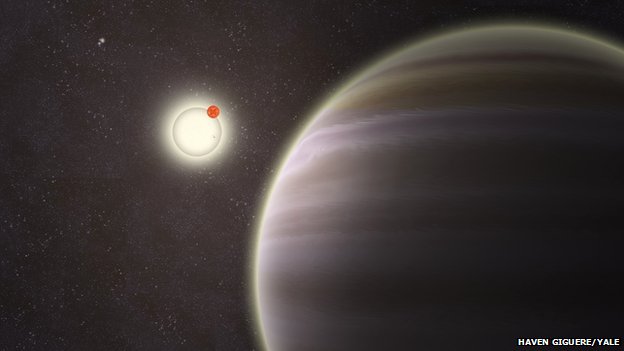
    The new planet – a gas giant – is about six times the size of Earth
    Continue reading the main story
    Related Stories

    Double-star system hosts planets
    A home from home: Five planets that could host life
    Study says most stars have planet
    Astronomers have found a planet whose skies are illuminated by four different suns – the first known of its type.

    The distant world orbits one pair of stars and has a second stellar pair revolving around it.

    The discovery was made by volunteers using the Planethunters.org website along with a team from UK and US institutes; follow-up observations were made with the Keck Observatory.

    Continue reading the main story

    Start Quote

    Computerised attempts to find things [in the data] missed this system entirely. That tells you there are probably more of these that are slipping through our fingers”

    Dr Chris Lintott
    Oxford University
    A scientific paper has been posted on the Arxiv pre-print server.

    The planet, located just under 5,000 light-years away, has been named PH1 after the Planet Hunters site.

    It is thought to be a “gas giant” slightly larger than Neptune but more than six times the size of the Earth.

    “You don’t have to go back too far before you would have got really good odds against one of these systems existing,” Dr Chris Lintott, from the University of Oxford, told BBC News.

    “All four stars pulling on it creates a very complicated environment. Yet there it sits in an apparently stable orbit.

    “That’s really confusing, which is one of the things which makes this discovery so fun. It’s absolutely not what we would have expected.”

    Binary stars – systems with pairs of stars – are not uncommon. But only a handful of known exoplanets (planets that circle other stars) have been found to orbit such binaries. And none of these are known to have another pair of stars circling them.

    Follow-up observations were made with the Keck facility on Mauna Kea
    Dr Lintott said: “There are six other well-established planets around double stars, and they’re all pretty close to those stars. So I think what this is telling us is planets can form in the inner parts of protoplanetary discs (the torus of dense gas that gives rise to planetary systems).

    “The planets are forming close in and are able to cling to a stable orbit there. That probably has implications for how planets form elsewhere.”

    Continue reading the main story
    Kepler Space Telescope

    Stares fixedly at a patch corresponding to 1/400th of the sky
    Looks at more than 155,000 stars
    Has so far found 2,321 candidate planets
    Among them are 207 Earth-sized planets, 10 of which are in the “habitable zone” where liquid water can exist
    Kepler candidate list
    William Borucki talks about Kepler
    PH1 was discovered by two US volunteers using the Planethunters.org website: Kian Jek of San Francisco and Robert Gagliano from Cottonwood, Arizona.

    They spotted faint dips in light caused by the planet passing in front of its parent stars. The team of professional astronomers then confirmed the discovery using the Keck telescopes on Mauna Kea, Hawaii.

    Founded in 2010, Planethunters.org aims to harness human pattern recognition to identify transits in publicly available data gathered by Nasa’s Kepler Space Telescope.

    Kepler was launched in March 2009 to search for Earth-like planets orbiting other stars.

    Visitors to the Planet Hunters website have access to randomly selected data from one of Kepler’s target stars.

    Volunteers are asked to draw boxes to mark the locations of visible transits – when a planet passes in front of its parent star.

    Dr Lintott points out: “Computerised attempts to find things [in the data] missed this system entirely. That tells you there are probably more of these that are slipping through our fingers. We’ve just stuck a load of new data up on Planethunters.org to help people find the next one.”

    Searching for such systems, he said, was “a complicated test to hand a computer”, adding: “We’re using human pattern recognition, which can disentangle that reasonably well to see the important stuff.”

    Since December 2010, more than 170,000 members of the public have participated in the project.

    Polar Ice Cap Imbalance=Pole Shift??

    Posted: October 14, 2012 by noxprognatus in News, videos

    Look at the evidence, and decide for yourself!

    Two possible ‘Great Comets’ coming in 2013

    Posted: October 14, 2012 by phaedrap1 in News
    Tags: ,

    Few sights in our sky are more impressive than that of a “Great Comet.” Often appearing as bright (or brighter) than the brightest stars, and with bright tails that may span a considerable distance across the nighttime sky, such objects can be truly spectacular and awe-inspiring.

    It is easy to see how ancient peoples, who didn’t understand their physical nature, often considered them as being supernatural phenomena, usually signs of divine displeasure.

    Comets are relatively common phenomena, with several usually being accessible to larger backyard telescopes at any given time. Perhaps once a year or so, on the average, a comet will come along that is bright enough to view with the unaided eye, if a sky-watcher is located at a dark site and knows where to look. A “Great Comet,” however, is fairly rare, with such objects appearing perhaps only once a decade on the average.

    For those of us in the northern hemisphere, it’s been a while. Our most recent “Great Comets” were the pair that appeared in the mid-1990s — Hyakutake in 1996 and Hale-Bopp a year later. While there have been several comets that have reached naked-eye visibility since then, none of these could really be considered to have reached “Great Comet” status.

    Our friends south of the equator, however, have been more fortunate. Comet McNaught put on a spectacular show in early 2007 after briefly being bright enough to be visible during broad daylight. Late last year, Comet Lovejoy put on another great

    show.

    As fate would have it, neither of these two comets were visible from the northern hemisphere when they were anywhere near the best, which has been rather frustrating for those of us skywatchers who live north of the equator. That frustration may be coming to an end, however, as not one, but two, inbound comets have the potential to become “Great Comets” as seen from the northern hemisphere in 2013.

    The first of these two comets was discovered in June 2011 by the Panoramic Survey Telescope And Rapid Response System project, a comprehensive survey program based at Mount Haleakala, Hawaii, that became operational a little over two years ago. While Comet PANSTARRS was a very dim and distant object at the time of its discovery, it has brightened steadily since then. For the past several months it has been detectable with larger backyard telescopes as it slowly tracks across the constellations of Scorpius and Libra.

    Comet PANSTARRS will be visible only from the southern hemisphere for the first two months of 2013, but by the beginning of March it begins to swing northward. At around the middle of that month it becomes visible from the northern hemisphere, quite possibly as a very bright object low in the west during evening twilight.

    At that time it is also near its closest approaches to the sun (28 million miles) and Earth (102 million miles). Over subsequent weeks it continues tracking northward and becomes more easily visible, although it should also fade as it moves away from the sun and Earth.

    By the latter part of May it will be high in the northern sky near Polaris, although by that time it will probably no longer be detectable with the unaided eye.

    Meanwhile, just within the past week has come the discovery of another comet that has the potential to become even brighter. It was discovered Sept. 21 by two amateur astronomers, Vitali Nevski of Belarus and Artyom Novichonok of Russia, using a telescope owned by the International Scientific Optical Network based in Russia. The comet, currently quite dim and distant, and located near the bright star Pollux in the constellation Gemini, has been given the name “ISON.”

    Comet ISON will be closest to the sun, less than 750,000 miles above the sun’s “surface,” near the end of November 2013, and will be closest to Earth (40 million miles) a month later. Potentially, it could be bright enough to be visible in broad daylight around the time it is nearest the sun.

    Since it is very well placed for viewing from the northern hemisphere during the weeks afterward, it could become one of the best and brightest comets of the past several centuries.

    In early 2014 it, like its predecessor was a few months earlier, will be located in far northern skies near Polaris and may still be visible to the unaided eye at that time.

    There is a distinct similarity between the orbit of Comet ISON and that of the Great Comet of 1680, a very brilliant object that was undoubtedly one of the brightest comets of the past millennium. While Comet ISON is not identical to that earlier comet, it is conceivable that the two are related. Perhaps they were once part of the same comet sometime during the distant past. We may be able to tell for sure one way or the other over the next few months as we gather more data about Comet ISON’s orbit.

    Of course, comets are notoriously unpredictable when it comes to their brightnesses, and it is distinctly possible that Comet PANSTARRS and/or Comet ISON could “fizzle” and fade away as they approach the sun. But it is also distinctly possible that either, or both, of them could become “Great Comets” that will rank among the brightest comets that will appear during our lifetimes.

    We will just have to wait and see.
    Alan Hale is a professional astronomer who resides in Cloudcroft. He is involved in various space-related research and educational activities throughout New Mexico and elsewhere. His website is http://www.earthriseinstitute.org.

    Stonehenge Yields New Secrets in 3-D Scan

    Posted: October 14, 2012 by phaedrap1 in News


    ht stonehenge laser scan jef 121009 wblog Stonehenge Yields New Secrets in 3 D Scan                                                                                              Image credit: English Heritage

    Stonehenge, one of world’s the most famous ancient landmarks, has been studied for centuries. Now, new evidence provides insight into the construction of the famous stone circle.

    Using 3-D laser scanning technology, the British company English Heritage conducted an extensive analysis of Stonehenge, revealing that more effort was put into certain parts of the circle than others.

    “They were looking at each stone and discovered layers of tool marks found in specific areas,” said Marcus Abbott, head of Geomatics and Visualization at ArcHeritage.

    As the researchers examined them, they found they were looking at ancient, faded art.

    “They began to discover prehistoric carvings, previously unknown carvings from the Bronze Age, mostly on four stones within the actual monument. These panels of artwork on the stones were deliberately placed,” Abbott said. “It shows particular significance that they appear facing east towards an area of burial mounds and then also appear to be facing the center of Stonehenge.”

    The new evidence suggests that more effort was put into creating this part of Stonehenge because most ancient people would have approached the landmark from that side.

    “The significance of the working reveals that Stonehenge was much better finished on one side than the other. They were both completed but they chose better materials, which suggests the majority of people would have seen it from one side.”

    Researchers have long suspected this, but the new research has finally confirmed the idea.

    “This is very significant because previously there was no physical evidence for this,” Abbott said. “Now we actually have scientific data to back up those theories.”

    The shape and workings of the stones give insight into the intent of the landmark’s creators.

    “The study also shows that the techniques and amounts of labour used vary from stone to stone. These variations provide almost definite proof that it was the intent of Stonehenge’s builders to align the monument with the two solstices along the NE/SW [Northeast/Southwest] axis,” English Heritage said in a statement. “The sides of the stones that flanked the solstice axis were found to have been most carefully worked to form very straight and narrow rectangular slots.”

    In contrast, the other stones have visibly more natural outlines.

    “This strongly suggests that special effort was made to dress those that flank the NE/SW axis to allow more dramatic and obvious passage of sunlight through the stone circle on midsummer and midwinter solstices.”


    By Alexandra Ludka

    Oct 9, 2012 3:45pm

    Spot where Julius Caesar was stabbed discovered

    Posted: October 13, 2012 by phaedrap1 in News

    Archaeologists believe they have found the first physical evidence of the spot where Julius Caesar died, according to a new Spanish National Research Council report.

    Caesar, the head of the Roman Republic, was stabbed to death by a group of rival Roman senators on March 15, 44 B.C., the Ides of March. The assassination is well-covered in classical texts, but until now, researchers had no archaeological evidence of the place where it happened.

    Now, archaeologists have unearthed a concrete structure nearly 10 feet wide and 6.5 feet tall that may have been erected by Augustus, Julius Caesar’s successor, to condemn the assassination. The structure is at the base of the Curia, or Theater, of Pompey, the spot where classical writers reported the stabbing took place

    “We always knew that Julius Caesar was killed in the Curia of Pompey on March 15th 44 B.C. because the classical texts pass on so, but so far no material evidence of this fact, so often depicted in historicist painting and cinema, had been recovered,” Antonio Monterroso, a researcher at the Spanish National Research Council, said in a statement.

    Classical texts also say that years after the assassination, the Curia was closed and turned into a memorial chapel for Caesar. The researchers are studying this building along with another monument in the same complex, the Portico of the Hundred Columns, or Hecatostylon; they are looking for links between the archaeology of the assassination and what has been portrayed in art.

    “It is very attractive, in a civic and citizen sense, that thousands of people today take the bus and the tram right next to the place where Julius Caesar was stabbed 2,056 years ago,” Monterroso said.

    By Stephanie Pappas Senior writer