Author Archive

Angkor Wat

Angkor Wat’s heavy stones were likely transported along a complex canal network, according to a new study.

By Traci Watson

Scientists have long known that the sandstone blocks used to build the famous Angkor Wat temple and other monuments in the ancient Cambodian city of Angkor came from quarries at the foot of a sacred mountain nearby. But how did the 5 million to 10 million blocks, some weighing more than 1500 kilograms, reach Angkor? Researchers report in a paper in press at the Journal of Archaeological Science that when they examined Google Earth maps of the area, they saw lines that looked like a transportation network. Field surveys revealed that the lines are a series of canals, connected by short stretches of road and river, that lead from the quarries straight to Angkor. The roads and canals—some of which still hold water—would’ve carried blocks from the 9th century to the 13th century on a total journey of 37 kilometers or so. The researchers don’t know whether the blocks would’ve floated down the canals on rafts or via some other method. Scholars had previously assumed that the blocks were floated down a canal to the Tonle Sap Lake and then upstream on the Siem Reap River, a route of 90 kilometers. The newly reported canal network would’ve taken many months and thousands of laborers to construct, but it would have been all in a day’s work for Khmer engineers, whose elaborate reservoirs and other hydraulic works at Angkor still inspire awe.


Science Now

The Watchers Tweet Tweet An investigative historian has recently discovered information which may prove that the ancient Philosopher Plato was telling the truth about the assignment of ancient territories to the “Gods” in the Golden age of civilization. This is not the first time that one of the ancient philosophers writings have been found to be true. Statements, previously considered myths by Homer were found to be true when, in 1871, the amateur German Archaeologist...

    An investigative historian has recently discovered information which may prove that the ancient Philosopher Plato was telling the truth about the assignment of ancient territories to the “Gods” in the Golden age of civilization. This is not the first time that one of the ancient philosophers writings have been found to be true. Statements, previously considered myths by Homer were found to be true when, in 1871, the amateur German Archaeologist Heinrich Schlieman uncovered the mythical city of Troy.

    In Plato’s work titled “Cretias” he wrote about the Golden Age of Civilization when the children of god were assigned territories to manage, populate and live in peace with their neighbors. A portion of Plato’s text follows:

    …”In the days of old the gods had the whole earth distributed among them by allotment. There was no quarreling; for you cannot rightly suppose that the gods did not know what was proper for each of them to have, or, knowing this, that they would seek to procure for themselves by contention that which more properly belonged to others. They, all of them by just apportionment, obtained what they wanted and peopled their own districts; and when they had peopled them they tended us, their nurslings and possessions, as shepherds tend their flocks, excepting only that they did not use blows or bodily force, as shepherds do, but governed us like pilots from the stern of the vessel, which is an easy way of guiding animals, holding our souls by the rudder of persuasion according to their own pleasure; thus did they guide all mortal creatures. Now different gods had their allotments in different places which they set in order. Hephaestus and Athene, who were brother and sister, and sprang from the same father, having a common nature, and being united also in the love of philosophy and art, both obtained as their common portion this land, which was naturally adapted for wisdom and virtue; and there they implanted brave children of the soil, and put into their minds the order of government; their names are preserved, but their actions have disappeared by reason of the destruction of those who received the tradition, and the lapse of ages”…

    These ancient territories were discovered by Arthur Faram after re-discovering the ancient science of Geoglyphology. For the past several years Arthur has been using this ancient science to track the movements and territories of ancient civilizations as far back as 10,000 BC, which according to ancient Greek philosophers was around the time of the Golden Age of Civilization.

    Connections between the territories have been found in past research; however, it wasn’t until recently that non adjacent territories had been tied to one another. This connection was made when the newly discovered, and previously un-researched, pyramids of East Java, Indonesia were geometrically tied to the previously studied territories that make up North, Central and South America.

    The Lalakon and Sudahurip Pyramids of East Java lie within the previously discovered Japanese territory. That territory appears to have been assigned to Japan, and is delineated by the Japanese Yonaguni Pyramid. What ties these territories together is the fact that the Indonesian Pyramids lie within the Japanese territory but their alignment obviously ties all the territories together, over thousands of miles of ocean.

    Current research is revealing that these territories exist over the entire face of the earth and do not overlap. This fact alone shows a worldwide coordination, thousands of years ago, to divide the earth into geographic regions.

    This discovery comes on the heels of many other recent discoveries which are telling the world that our past history is much different than we had previously imagined.

    By Adonai

    By Arthur Faram
    The Faram Foundation

    References:

    Plato’s Critias – Google
    The Indonesian Pyramids – http://thefaramfoundation.com/javapyramids.htm
    The Faram Foundation –  http://thefaramfoundation.com/
    Google Earth (Using the ruler function.)

    The following is an excerpt from LAST CRY  Native American Prophecies & Tales of the End Times, by Dr. Robert Ghost Wolf © 1994-2004 It has appeared in numerous articles over the web, and in magazines all over the world.

    The story of the Blue Kachina is a very old story, very old.  I have been aware of the story of the Blue Kachina since I was very young.  I was told this story by grandfathers who are now between 80 and 108 years of age. Frank Waters also wrote about Saquasohuh, the Blue Star  Kachina in The Book of the Hopi, The story came from Grandfather Dan, Oldest Hopi

    “It was told to me that first the Blue Kachina would start to be seen at the dances, and would make his appearance known to the children in the plaza during the night dance. This event would tell us that the end times are very near.  Then the Blue Star Kachina would physically appear in our heavens which would mean that we were in the end times.

    In the Final days we will look up in our heavens and we will witness the return of the two brothers who helped create this world in the birthing time. Poganghoya is the guardian of our North Pole and his Brother Palongawhoya is the guardian of the South pole. In the final days the Blue Star Katchina will come to be with his nephews and they will return the Earth to its natural rotation which is counter clock wise.

    This fact is evidenced in many petraglyphs that speak of the Zodiac, and within the Mayan and Egyptian pyramids. The rotation of the Earth has been manipulated by not so benevolent Star beings . The twins will be seen in our North Western skies.  They will come and visit  to see who still remembered the original teachings  flying in their Patuwvotas, or flying shields.  They will bring many of their star family with them in the final days.

    The return of the Blue Star Katchina who is also known as Nan ga sohu  will be the alarm clock that tells us of the new day and new way of life, a new world that is coming.  This is where the changes will begin.  They will start as fires  that burn within us, and we will burn up with desires and conflict if we do not remember the original teachings, and return to the peaceful way of life.

    Not far behind the twins will come the Purifier  The Red Katchina, who will bring the Day of Purification. On this day the Earth, her creatures and all life as we know it will change forever.  There will be messengers that will precede this coming of the Purifier.  They will leave messages to those on Earth who remember the old ways.

    The messages will be found written in the living stone, through the sacred grains, and even the waters. ( Crop Circles have been found in ice) From the Purifier will issue forth a great Red Light.  All things will change in their manner of being.  Every living thing will be offered the opportunity to change from the largest to the smallest thing.

    Those who return to the ways given to us in the original teachings, and live a natural way of life will not be touched by the coming of the Purifier.  They will survive and build the new world. Only in the ancient teachings will the ability to understand the messages be found.

    It is important to understand that these messages will be found upon every living thing, even within our bodies, even within a drop of our blood.  All life forms will receive the messages from the twins.. those that fly, the plants, even the rabbit.  The appearance of the twins begins a period of seven years  will be our final opportunity to change our ways.  Everything we experience is all a mater of choice.

    Many will appear to have lost their souls in these final days.  So intense will the nature of the changes be that those who are weak in spiritual awareness will go insane, for we are nothing without spirit. They will disappear, for they are just hollow vessels for any thing to use.  Life will be so bad in the cities that many will choose to leave this plane.  Some in whole groups.

    Only those who return to the values of the old ways will be able to find peace of mind.  For in the Earth we shall find relief from the madness that will be all around us.  It will be a very hard time for women with children for they will be shunned, and many of the children in these times will be unnatural.  Some being from the Stars some from  past worlds, some will even be created by man in an unnatural manner and will be souless.  Many of people in this time will be empty in Spirit they will have Sampacu.  No life force in their eyes.

    As we get close to the time of arrival the Purifier there will be those who walk as ghosts through the cities, through canyons they will have constructed in their man made mountains.  Those that walk through these places will be very heavy in their walk, it will appear almost painful as they take each step  for they will be disconnected from their spirit and the Earth.

    After the arrival of the twins, they will begin to vanish before your eyes like so muck smoke.  Others will have great deformities, both in the mind and upon their bodies.  There will be those who  would walk in the body that are not from this reality, for many of the gateways that once protected us will be opened, there will be much confusion.  Confusion between sexes, and children and their elders.

    Life will get very perverted, and there will be little social order, in these times  Many will ask for the mountains themselves to fall upon them just to end their misery.  Still others will appear as if untouched by what is occurring.  The ones who remember the original teachings and have reconnected their hearts and spirit. Those who remember who their mother and father is. The Pahana who have left to live in the Mountains and forest.

    When the Purifier comes we will see him first as a small Red Star which will come very close and sit in our heavens watching us.  Watching us to see how well we have remembered the sacred teachings.

    This Purifier will show us many miraculous signs in our heavens  In this way we will know Creator is not a dream.  Even those who do not feel their connection to spirit will see the face of creator across the sky.  Things unseen will be felt very strongly.

    Many things will begin to occur that will not make sense, for reality will be shifting back in and out of the dream state.  There will be many doorways to the lower world that will open at this time. Things long forgotten will come back to remind us of our past creations.  All living things will want to be present for this day when time ends, and we enter the forever cycle of the Fifth World.

    We will receive many warnings allowing us to change our ways from below the Earth as well as above.  Then one morning  in a moment.  We will awaken to the Red Dawn. The sky will be the color of blood, many things will then begin to happen that right now we are nor sure of their exact nature. For much of reality will not be as it is now.

    There will be many strange beasts upon the Earth in those days, some from the past and some that we have never seen. . The nature of mankind will appear strange in these times we walk between worlds and we will house many spirits even within our bodies  After a time we will again walk with our brothers from the Stars, and rebuild this Earth But not until the Purifier has left his mark upon the universe.

    No thing living will go untouched, here or in the heavens. The way through this time it is said is to be found in our hearts, and reuniting with our spiritual self. Getting simple and returning to living with and upon the Earth and in harmony with her creatures.  Remembering that we are the caretakers, the fire keepers of the Spirit. Our relatives from the Stars are coming home to see how well we have faired in our journey.

    Both practical and beautiful, the 400-foot lighthouse at the mouth of Alexandria harbor started guiding sailors home around 250 BC. A fire made the lighthouse glow at night and a mirror reflected sun rays during the day, some say up to 35 miles away.
    CREDIT: Photo Credit: The Pharos of Alexandria, an ancient lighthouse, is depicted in this hand-colored engraving by Martin Heemskerck.

    The Egyptian city of Alexandria, home to one of the seven wonders of the ancient world, may have been built to align with the rising sun on the day of Alexander the Great’s birth, a new study finds.

    The Macedonian king, who commanded an empire that stretched from Greece to Egypt to the Indus River in what is now India, founded the city of Alexandria in 331 B.C. The town would later become hugely prosperous, home to Cleopatra, the magnificent Royal Library of Alexandria and the 450-foot-tall (140 meters) Lighthouse of Alexandria, one of the wonders of the ancient world. Today, more than 4 million people live in modern Alexandria.

    Ancient Alexandria was planned around a main east-west thoroughfare called Canopic Road, said Giulio Magli, an archaeoastronomer at the Politecnico of Milan. A study of the ancient route reveals it is not laid out according to topography; for example, it doesn’t run quite parallel to the coastline. But on the birthday of Alexander the Great, the rising sun of the fourth century rose “in almost perfect alignment with the road,” Magli said.


    The results, he added, could help researchers in the hunt for the elusive tomb of Alexander. Ancient texts hold that the king’s body was placed in a gold casket in a gold sarcophagus, later replaced with glass. The tomb, located somewhere in Alexandria, has been lost for nearly 2,000 years. [8 Grisly Archaeological Discoveries]

    Building by the stars

    Magli and his colleague Luisa Ferro used computer software to simulate the sun’s position in the fourth century B.C. (Because Earth’s orbit isn’t perfect, there is some variation in the sun’s path through the sky over centuries.) Alexander the Great was born on July 20, 356 B.C. by the Julian calendar, which is slightly different than the modern, Gregorian calendar, because it does not have leap years to account for partial days in the Earth’s orbit around the sun. On that day in the fourth century B.C., the researchers found, the sun rose at a spot less than half a degree off of the road’s route.

    “With a slight displacement of the day, the phenomenon is still enjoyable in our times,” Magli told LiveScience.

    A second star would have added to the effect, Magli said. The “King’s Star” Regulus, which is found on the head of the lion in the constellation Leo, also rose in near-perfect alignment with Canopic Road and became visible after a period of conjunction with the sun near July 20. Earth’s orbit has changed enough that this Regulus phenomenon no longer happens, Magli said.

    Sun as a symbol

    Architecture-by-astronomy was common in the ancient world, Magli said. The Great Pyramid of Giza, for example, is aligned with amazing precision along the compass points, which would have required the use of the stars as reference points. The Egyptians, whom Alexander conquered, had long associated the sun god Ra with their pharaohs.

    “Aligning the city [of Alexandria] to the sun in the day of birth of Alexander was a way to embody in the architectural project an explicit reference to his power,” Magli said. The King’s Star would have only added to the mystique, he said.

    The researchers reported their work online Oct. 9 in the Oxford Journal of Archaeology. They are now examining other cities founded by Alexander and later rulers to see if the solar pattern holds. The hope, Magli said, is that an understanding of Alexandria’s astronomical layout will give researchers a better idea of where Alexander’s tomb might be.

    Stephanie Pappas, LiveScience Senior Writer


    Russia’s space agency wants to send a mission to Apophis, the notorious asteroid which may change its course and eventually collide with Earth. It will plant a radio beacon, which will help track the celestial body and assess the risks it poses.

    ­The 300-meter-wide asteroid first made headlines in 2004, when NASA reported that it has 1 chance in 223 of impacting on our planet in 2029. It was even named after the Ancient Egyptian evil god, archenemy of the sun god Ra.

    But additional observations proved that it will pass by at the small, but safe, distance of some 36,000 kilometers from Earth. The close approach however may result in an unpredictable gravitational pull on Apophis, which would change its course and pose a danger in 2036, when it comes back.

    To better assess the risks it poses to the civilization the Roscosmos plans a robotic mission to the asteroid, chief Vladimir Popovkin announced on Monday.

    The plan is “to land a module on the surface of Apophis and set up a radio beacon there, which will work after the spaceship’s lifetime expires,” he said at the Space Research Institute in Moscow.

    The beacon signal will allow astronomers to better calculate Apophis’ movement and the effect of the 2029 Earth flyby. The mission would not be launched before 2020.

    Popovkin, who was speaking at a solar system exploration conference, outlined other mid-term plans Roscosmos has. These include a Venus orbiter between 2020 and 2025, which will study the planet’s hot and dense atmosphere. The mission may include a descending probe, although due to the harsh environment it would only work for about one day on the surface.

    Another target is Jupiter’s moon Ganymede. Roscosmos plans to send a spacecraft there in 2022 and is currently negotiating with its European counterpart ESA, which has a similar project, over a possible closer collaboration.

    Russia also plans a new Mars mission. Popovkin said launching such a spacecraft is no less important after the embarrassing failure of Fobos-Grunt in November 2011. Now engineers will be able to learn from the mistakes of the original attempt to reach the Martian moon.

    A more immediate plan is the Luna Glob mission to the Moon scheduled for late 2015. It would include returning a soil sample to Earth and studying it from an orbiter, which would change its altitude from the initial 100 kilometers down to 50 kilometers and later to 500 kilometers. The soil would later be studied for possible extraction of water from it.

    “We will allocate our main effort and majority of resources to the moon,”
    Popovkin said.

    RT Published: 08 October, 2012, 16:46


    Two possible ‘Great Comets’ coming in 2013

    Posted: October 14, 2012 by phaedrap1 in News
    Tags: ,

    Few sights in our sky are more impressive than that of a “Great Comet.” Often appearing as bright (or brighter) than the brightest stars, and with bright tails that may span a considerable distance across the nighttime sky, such objects can be truly spectacular and awe-inspiring.

    It is easy to see how ancient peoples, who didn’t understand their physical nature, often considered them as being supernatural phenomena, usually signs of divine displeasure.

    Comets are relatively common phenomena, with several usually being accessible to larger backyard telescopes at any given time. Perhaps once a year or so, on the average, a comet will come along that is bright enough to view with the unaided eye, if a sky-watcher is located at a dark site and knows where to look. A “Great Comet,” however, is fairly rare, with such objects appearing perhaps only once a decade on the average.

    For those of us in the northern hemisphere, it’s been a while. Our most recent “Great Comets” were the pair that appeared in the mid-1990s — Hyakutake in 1996 and Hale-Bopp a year later. While there have been several comets that have reached naked-eye visibility since then, none of these could really be considered to have reached “Great Comet” status.

    Our friends south of the equator, however, have been more fortunate. Comet McNaught put on a spectacular show in early 2007 after briefly being bright enough to be visible during broad daylight. Late last year, Comet Lovejoy put on another great

    show.

    As fate would have it, neither of these two comets were visible from the northern hemisphere when they were anywhere near the best, which has been rather frustrating for those of us skywatchers who live north of the equator. That frustration may be coming to an end, however, as not one, but two, inbound comets have the potential to become “Great Comets” as seen from the northern hemisphere in 2013.

    The first of these two comets was discovered in June 2011 by the Panoramic Survey Telescope And Rapid Response System project, a comprehensive survey program based at Mount Haleakala, Hawaii, that became operational a little over two years ago. While Comet PANSTARRS was a very dim and distant object at the time of its discovery, it has brightened steadily since then. For the past several months it has been detectable with larger backyard telescopes as it slowly tracks across the constellations of Scorpius and Libra.

    Comet PANSTARRS will be visible only from the southern hemisphere for the first two months of 2013, but by the beginning of March it begins to swing northward. At around the middle of that month it becomes visible from the northern hemisphere, quite possibly as a very bright object low in the west during evening twilight.

    At that time it is also near its closest approaches to the sun (28 million miles) and Earth (102 million miles). Over subsequent weeks it continues tracking northward and becomes more easily visible, although it should also fade as it moves away from the sun and Earth.

    By the latter part of May it will be high in the northern sky near Polaris, although by that time it will probably no longer be detectable with the unaided eye.

    Meanwhile, just within the past week has come the discovery of another comet that has the potential to become even brighter. It was discovered Sept. 21 by two amateur astronomers, Vitali Nevski of Belarus and Artyom Novichonok of Russia, using a telescope owned by the International Scientific Optical Network based in Russia. The comet, currently quite dim and distant, and located near the bright star Pollux in the constellation Gemini, has been given the name “ISON.”

    Comet ISON will be closest to the sun, less than 750,000 miles above the sun’s “surface,” near the end of November 2013, and will be closest to Earth (40 million miles) a month later. Potentially, it could be bright enough to be visible in broad daylight around the time it is nearest the sun.

    Since it is very well placed for viewing from the northern hemisphere during the weeks afterward, it could become one of the best and brightest comets of the past several centuries.

    In early 2014 it, like its predecessor was a few months earlier, will be located in far northern skies near Polaris and may still be visible to the unaided eye at that time.

    There is a distinct similarity between the orbit of Comet ISON and that of the Great Comet of 1680, a very brilliant object that was undoubtedly one of the brightest comets of the past millennium. While Comet ISON is not identical to that earlier comet, it is conceivable that the two are related. Perhaps they were once part of the same comet sometime during the distant past. We may be able to tell for sure one way or the other over the next few months as we gather more data about Comet ISON’s orbit.

    Of course, comets are notoriously unpredictable when it comes to their brightnesses, and it is distinctly possible that Comet PANSTARRS and/or Comet ISON could “fizzle” and fade away as they approach the sun. But it is also distinctly possible that either, or both, of them could become “Great Comets” that will rank among the brightest comets that will appear during our lifetimes.

    We will just have to wait and see.
    Alan Hale is a professional astronomer who resides in Cloudcroft. He is involved in various space-related research and educational activities throughout New Mexico and elsewhere. His website is http://www.earthriseinstitute.org.

    Stonehenge Yields New Secrets in 3-D Scan

    Posted: October 14, 2012 by phaedrap1 in News


    ht stonehenge laser scan jef 121009 wblog Stonehenge Yields New Secrets in 3 D Scan                                                                                              Image credit: English Heritage

    Stonehenge, one of world’s the most famous ancient landmarks, has been studied for centuries. Now, new evidence provides insight into the construction of the famous stone circle.

    Using 3-D laser scanning technology, the British company English Heritage conducted an extensive analysis of Stonehenge, revealing that more effort was put into certain parts of the circle than others.

    “They were looking at each stone and discovered layers of tool marks found in specific areas,” said Marcus Abbott, head of Geomatics and Visualization at ArcHeritage.

    As the researchers examined them, they found they were looking at ancient, faded art.

    “They began to discover prehistoric carvings, previously unknown carvings from the Bronze Age, mostly on four stones within the actual monument. These panels of artwork on the stones were deliberately placed,” Abbott said. “It shows particular significance that they appear facing east towards an area of burial mounds and then also appear to be facing the center of Stonehenge.”

    The new evidence suggests that more effort was put into creating this part of Stonehenge because most ancient people would have approached the landmark from that side.

    “The significance of the working reveals that Stonehenge was much better finished on one side than the other. They were both completed but they chose better materials, which suggests the majority of people would have seen it from one side.”

    Researchers have long suspected this, but the new research has finally confirmed the idea.

    “This is very significant because previously there was no physical evidence for this,” Abbott said. “Now we actually have scientific data to back up those theories.”

    The shape and workings of the stones give insight into the intent of the landmark’s creators.

    “The study also shows that the techniques and amounts of labour used vary from stone to stone. These variations provide almost definite proof that it was the intent of Stonehenge’s builders to align the monument with the two solstices along the NE/SW [Northeast/Southwest] axis,” English Heritage said in a statement. “The sides of the stones that flanked the solstice axis were found to have been most carefully worked to form very straight and narrow rectangular slots.”

    In contrast, the other stones have visibly more natural outlines.

    “This strongly suggests that special effort was made to dress those that flank the NE/SW axis to allow more dramatic and obvious passage of sunlight through the stone circle on midsummer and midwinter solstices.”


    By Alexandra Ludka

    Oct 9, 2012 3:45pm

    Spot where Julius Caesar was stabbed discovered

    Posted: October 13, 2012 by phaedrap1 in News

    Archaeologists believe they have found the first physical evidence of the spot where Julius Caesar died, according to a new Spanish National Research Council report.

    Caesar, the head of the Roman Republic, was stabbed to death by a group of rival Roman senators on March 15, 44 B.C., the Ides of March. The assassination is well-covered in classical texts, but until now, researchers had no archaeological evidence of the place where it happened.

    Now, archaeologists have unearthed a concrete structure nearly 10 feet wide and 6.5 feet tall that may have been erected by Augustus, Julius Caesar’s successor, to condemn the assassination. The structure is at the base of the Curia, or Theater, of Pompey, the spot where classical writers reported the stabbing took place

    “We always knew that Julius Caesar was killed in the Curia of Pompey on March 15th 44 B.C. because the classical texts pass on so, but so far no material evidence of this fact, so often depicted in historicist painting and cinema, had been recovered,” Antonio Monterroso, a researcher at the Spanish National Research Council, said in a statement.

    Classical texts also say that years after the assassination, the Curia was closed and turned into a memorial chapel for Caesar. The researchers are studying this building along with another monument in the same complex, the Portico of the Hundred Columns, or Hecatostylon; they are looking for links between the archaeology of the assassination and what has been portrayed in art.

    “It is very attractive, in a civic and citizen sense, that thousands of people today take the bus and the tram right next to the place where Julius Caesar was stabbed 2,056 years ago,” Monterroso said.

    By Stephanie Pappas Senior writer

    Europe’s oldest urban settlement is near Provadia, a town of about 13 000 people about 40km inland from Bulgaria’s Black Sea city of Varna, according to archaeology Professor Vassil Nikolov, citing evidence from work done at the Provadia – Solnitsata archaeological site in summer 2012.
    The team of archaeologists headed by Nikolov excavated stone walls estimated to date from 4700 to 4200 BCE. The walls are two metres thick and three metres high, and according to Nikolov are the earliest and most massive fortifications from Europe’s pre-history.
    There were about 300 to 350 people living at the site in those times, living in two-storey houses and earning their living by salt mining.
    To this day, Provadia is an important salt centre, with a large-scale foreign investor represented in the area. Estimates are that salt has been extracted in the area for about 7500.
    Nikolov said that salt was the currency of ancient times, both in terms of value and prestige.
    As the only place in the Balkans used to produce salt at the time, Provadia –Solnitsatsa of the fifth century BCE was the “mint” of the region, Nikolov said.
    He said that finds of gravesites at a necropolis showed that people in the town were wealthy.
    Ritual burial practices also were strange and complex, he said. Copper needles and pottery found in graves at the site showed that people had been wealthy, but in some cases the corpses had been cut in half and buried from the pelvis up.
    The study in summer 2012, lasting two months, focused mainly on the necropolis and the village.
    Oct 8 2012 by The Sofia Globe staff in Bulgaria, News

    Humans were hunting mastodons in Mexico 250,000 years ago.  This archaeological heresy is supported by finding at Hueyatlaco.

    Hueyatlaco is an archeological site in Valsequillo, Mexico. Several potential pre-Clovis localities were found in the 1960s around the edge of the Valsequillo Reservoir, Mexico.  One of these localities is the site of Hueyatlaco.  This site was excavated by Cynthia Irwin-Williams in 1962, 1964, and 1966.

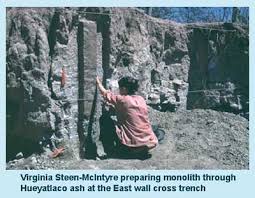
    One of its early excavators Virginia Steen-McIntyre writes “Hueyátlaco is a dangerous site. To even publicly mention the geological evidence for its great age is to jeopardize one’s professional career. Three of us geologists can testify to that. It’s very existence is blasphemous because it questions a basic dogma of Darwinism, the ruling philosophy (or religion, if you will) of the western scientific world for the past 150 years. That dogma states that, over a long period of time, members of the human family have generally become more and more intelligent. The Hueyátlaco site is thus ‘impossible’ because Mid-Pleistocene humans weren’t smart enough to do all that the evidence implies. Besides, there is no New World anthropoid stock from which they could have evolved.:

    File:High res mastodon rendering.jpg


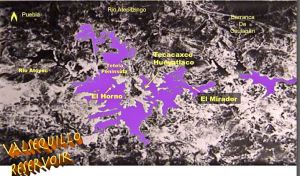
    The Hueyatlaco Archeological Site is situated on the Tetela Peninsula, along the north shore of the Valsequillo reservoir in the State of Puebla, Mexico, approximately 100 km southeast of Mexico City and 10 km south of the City of Puebla.

    In the 1960s, highly sophisticated stone tools rivaling the best work of Cro-magnon man in Europe were unearthed by Professor Juan Armenta Camacho and Dr. Cynthia Irwin-Williams at Hueyatlaco, near Valsequillo.

    Dr. Cynthia Irwin-Williams

    Credit: Smithsonian National Archives

    After excavations in the 1960s, the site became notorious due to geochronologists’ analyses that indicated human habitation at Hueyatlaco was dated to ca. 250,000 years before the present.

    Professor Juan Armenta Camacho

    Professor Juan Armenta Camacho

    Beds containing human artifacts at Valsequillo, Mexico, have been dated at approximately 250,000 years before the present by fission-track dating of volcanic material and uranium dating of a camel pelvis. The dilemma posed by such dates is clearly stated in the following quotation from the conclusions of the subject article.


    “The evidence outlined here consistently indicates that the Hueyatlaco site is about 250,000 yr old. We who have worked on geological aspects of the Valsequillo area are painfully aware that so great an age poses an archeological dilemma. If the geological dating is correct, sophisticated stone tools were used at Valsequillo long before analogous tools are though to have been developed in Europe and Asia. Thus, our colleague, Cynthia Irwin-Williams, has criticized the dating methods we have used, and she wishes us to emphasize that an age of 250,000 yr is essentially impossible.”
    (Steen-McIntyre, Virginia, et al; “Geologic Evidence for Age of Deposits at Hueyatlaco Archeological Site, Valsequillo, Mexico,” Quaternary Research, 16:1, 1981.)
    Credit: mcremo.com

    These controversial findings are orders of magnitude older than the scientific consensus for habitation of the New World (which generally traces widespread human migration to the New World to 13,000 to 16,000 ybp). The findings at Hueyatlaco have mostly been repudiated by the larger scientific community, and have seen only occasional discussion in the literature

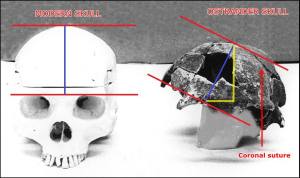
    According to  Steen-McIntyre “we have evidence for two primitive human skulls. The Dorenberg skull was collected in the area over 100 years ago (Reichelt,1899 (1900)) . The interior cavities were filled with a diatomite that contains the same Sangamon-age suite of taxa that occurs associated with the artifacts at Hueyátlaco (VanLandingham 2000, 2002b,c, 2003). It was on display in a museum in Leipzig for many years, and was destroyed during the bombings of WW II. We are looking for a photo or drawing of it.

    The second skull, the Ostrander skull, is rumored to have been collected illegally at Hueyátlaco sometime in the late 60’s or early 70’s and recently to have been turned over to a Native American tribe for reburial. No attempt was made to date it.”

    Ostrander skull to the right, allegedly from the Hueyatlaco Site. On the left a modern skull
    Credit:  Austin Whittall patagoniamonsters.blogspot.com

    Cynthia Irwin-Williams led the team that first excavated the site in 1962 The dig is often associated with Virginia Steen-McIntyre because of her continuing efforts to publicize her findings and opinions. However, the site was actually discovered by Juan Armenta Camacho and Irwin-Williams. Steen-McIntyre joined the team in 1966 as a graduate student, at the request of project geologist Hal Malde. The excavation was associated with the U.S. Geological Survey.

    The region, about 75 miles SE of Mexico City, was known for its abundance of animal fossils, and Irwin-Williams described Hueyatlaco as a “kill site” where animals were hunted and butchered.

    These tools are believed to be 250,000 years old from the Hueyatlaco site.

    Credit: Dr. Cynthia Irwin-Williams/H.S. Rice

    Excavations were conducted via standard protocols, including securing the sites to prevent trespass or accidental disturbances. During excavation, investigators discovered numerous stone tools. The tools ranged from relatively primitive implements at a smaller associated site, to more sophisticated items such as scrapers and double-edged blades uncovered at the main excavation site. The diversity of tools made from non-local materials suggested that the region had been used by multiple groups over a considerable period.

    Credit: Chris Hardaker

    In 1967, Jose L. Lorenzo of the Instituto Nacional de Antropología e Historia claimed that implements had been planted at the site by local laborers in such a way as to make it difficult or impossible to determine which artifacts were discovered in situ and which were planted. Irwin-Williams counter-argued that Lorenzo’s claims were malicious and without merit. Furthermore, in 1969 Irwin-Williams cited statements of support from three prominent archeologists and anthropologists (Richard MacNeish, Hannah Marie Wormington and Frederick A. Peterson) who had each visited the site independently and attested to the integrity of the excavations and the professionalism of the group’s methodology
    Credit: Chris Hardaker

    In mid-1969, Szabo, Malde and Irwin-Williams published their first paper about dating the excavation site. The stone tools were discovered in situ in a stratum that also contained animal remains. Radiocarbon dating of the animal remains produced an age of over 35,000 ybp. Uranium dating produced an age of 260,000 ybp, ± 60,000 years.

    The site had been buried by the ash of La Malinche. The reservoir, which lies 100 km southeast of Mexico City and south of the city of Puebla is surrounded by four of Mexico’s famous volcanoes: Tláloc, Iztaccíhuatl, Popocatepetl, and La Malinche, which is shown below.

    File:Matlalcueitl.jpg

    Credit: Wikipedia

    The authors admitted that they had no definitive explanation for the anomalous results. However, Malde suggested the tool-bearing strata had possibly been eroded by an ancient streambed, thus combining older and newer strata and complicating dating.

    Credit: Chris Hardaker

    In 1973, Steen-MacIntyre, Malde and Roald Fryxell returned to Hueyatalco to re-examine the geographic strata and more accurately determine an age for the tool-bearing strata. They were able to rule out Malde’s streambed hypothesis. Moreover, the team undertook an exhaustive analysis of volcanic ash and pumice from the original excavation site and the surrounding region. Using the zircon fission-track dating method, geochemist C.W. Naeser dated samples of ash from Hueyatlaco’s tool-bearing strata to 370,000 ybp +/- 240,000 years.

    The confirmation of an anomalously distant age for human habitation at the Hueyatlaco site led to tension between Irwin-Williams and the other team members. Malde and Fryxell announced the findings at a Geological Society of America meeting, admitting that they could not account for the anomalous results. Irwin-Williams responded by describing their announcement as “irresponsible”.  Given the substantial margin of error for the fission-track findings, and the then-new method of uranium dating, Irwin-Williams asserted that Hueyatlaco had not been accurately dated to her satisfaction.

    Credit: Chris Hardaker

    Excerpt of letter to Marie Wormington from Dr. Cynthia Irwin-Williams [circa 1969]:

    “…Meanwhile, I recently got a letter from Hal, with some (completely wild) uranium dates on Valsequillo material. I don’t see how he can take them seriously since they conflict with the archaeology, with his own geologic correlations, and with a couple C14 dates. However, God help us, he wants to publish right away! I am enclosing a copy of Hal’s letter and my reply. Needless to say any restraint you can exercise on him would be greatly appreciated. All we need to do at this point is to put that stuff in print and every reputable prehistorian in the country will be rolling in the aisles.”


    On March 30, 1981, Steen-McIntyre wrote to Estella Leopold, the associate editor of Quaternary Research: “The problem as I see it is much bigger than Hueyatlaco. It concerns the manipulation of scientific thought through the suppression of ‘Enigmatic Data,’ data that challenges the prevailing mode of thinking. Hueyatlaco certainly does that! Not being an anthropologist, I didn’t realize the full significance of our dates back in 1973, nor how deeply woven into our thought the current theory of human evolution had become. Our work at Hueyatlaco has been rejected by most archaeologists because it contradicts that theory, period.”

    Eventually, Quaternary Research (1981) published an article by Virginia Steen-McIntyre, Roald Fryxell, and Harold E. Malde. It upheld an age of 250,000 years for the Hueyatlaco site. Cynthia Irwin-Williams (1981) objected to these findings in a letter responding to these authors. Her objections were answered point-for-point in a counter letter from Malde and Steen-McIntyre (1981).

    Credit: Chris Hardaker

    The case of Virginia Steen-McIntyre opens a rare window into the actual social processes of data suppression in paleoanthropology, processes that involve a great deal of hurt and conflict. In general, however, this goes on behind the scenes, and the public sees only the end result—the carefully edited journals and books that have passed the censors.

    The Sangamonian Stage, also known as the Sangamon interglacial, is the name used by Quaternary geologists to designate the last interglacial period in North America from 125,000—75,000 years ago, a period of 0.05 million years. The Sangamonian Stage precedes the Wisconsinan (Wisconsin) Stage and follows the Illinoian Stage in North America

    In recent times the Hueyatlaco Site has been reinvestigated by Dr. Sam VanLandingham using diatom dating methodology to confirm the anomalously old dates assigned by Malde, Steen-McIntyre and Fryxell:
    Important artifacts have been found in situ (i.e., not redeposited) within lacustrine deposits in the Valsequillo region. These deposits contain many diatoms which indicate an age corresponding to the Sangamonian Interglacial sensu lato (80,000 to ca. 220,000yr BP). Two of the four samples in this study are associated with the Dorenberg skull or with stratigraphic units which contain bifacial tools. The remaining two samples are from diatomaceous deposits which are also Sangamonian and stratigraphically above the artifact units. These four diatomaceous samples yielded 30 extinct and 143 extant diatom taxa.

    The ages of the four samples correspond to other diatomaceous samples (some of which are associated with artifacts) from nearby Valsequillo localities. A post-Sangamonian age for these four diatom-bearing samples is discounted by the presence of Navicula bronislaae and N. dorenbergi, both of which have short stratigraphic ranges and are known only from the Sangamonian (or its equivalents), and by 13 diatoms which evidently have known long stratigraphic ranges and extinctions before the end of the Sangamonian.

    An age no older than Sangamonian for the artifacts and their enclosing diatomaceous deposits is indicated by the presence of two diatoms (Epithemia zebra var. undulata and Navicula creguti) known only from Sangamonian (or = age) or younger and by an extant diatom, Cymbella cistula var. gibbosa (C. gibbosa), which has its first occurrence in the Sangamonian.
    The diatom biostratigraphy presented herein establishes a minimum (Sangamonian) and a maximum (Illinoian) age for the younger (bifacial) artifacts at the Hueyatlacoarchaeological site in units B,C, and E, Puebla, Mexico.

    VanLandingham  used  diatom biostratigraphy in determining a minimum (Sangamonian = 80,000–ca.220,000 yr. BP) and a maximum (Illinoian = 220,000–430,00 yr. BP) age for the Hueyatlaco artifacts, Puebla, Mexico. Nova Hedwigia (February, 2009), Beiheft 135, p. 15-36.

    Quoting the Abstract: The diatom biostratigraphy presented herein establishes a minimum (Sangamonian) and a maximum (Illinoian) age for the younger (bifacial) artifacts at the Hueyatlaco archaeological site in units B,C, and E, Puebla, Mexico. One of the 13 samples in this study is from a position of Sangamonian age which is stratigraphically higher than the artifacts. The minimum age of this sample (from unit B) is demonstrated by 6 taxa which became extinct at the end of the Sangamonian , and its maximum age (also Sangamonian) is denoted by 3 taxa with earliest known first occurrences in the Sangamonian. The diatoms of the remaining 12 samples have a minimum age of Sangamonian. Three of the 13 samples are in unit I and no Hueyatlaco artifacts are known below this unit.
    ____________________________

    Sources:

    http://gordonwagner.wordpress.com/2010/10/23/250000-year-old-mastodon-hunter-from-puebla/

    http://www.bibliotecapleyades.net/ciencia/esp_ciencia_life18.htm

    http://csfa.tamu.edu/research.php

    http://valsequillo.earthmeasure.com/

    ^ Irwin-Williams, C., et al., Comments on the Associations of Archaeological Materials and Extinct Fauna in the Valsequillo Region Puebla Mexico, American Antiquity, Volume 34, Number 1, Pages 82-83, Jan 1969

    ^ Szabo, B.J., Malde, H.E., and Irwin-Williams, C., Dilemma Posed By Uranium-Series Dates On Archaeologically Significant Bones From Valsequillo Puebla Mexico, Earth and Planetary Science Letters, Volume 6, Pages 237-244, Jul 1969

    ^ Gonzalez, Silvia; Huddart, David; and Bennett Matthew. (2006) Valsequillo Pleistocene archaeology and dating : ongoing controversy in Central Mexico . World Archaeology, 2006, vol. 38, no4, pp. 611-627.

    a b Irwin-Williams, C., et al., Comments on the Associations of Archaeological Materials and Extinct Fauna in the Valsequillo Region Puebla Mexico, American Antiquity, Volume 34, Number 1, Pages 82-83, Jan 1969

    ^ Irwin-Williams, Cynthia. (1978) Summary of Archeological Evidence from the Valsequillo Region, Puebla, Mexico. In Cultural Continuity in Mesoamerica, David L. Browman, ed. The Hague: Mouton Publishers.

    a b c d e f g h Webb, Mark Owen and Suzanne Clark. (1999). “Anatomy of an Anomaly .” Disputatio, 6.

    ^ Szabo, B.J., Malde, H.E., and Irwin-Williams, C., Dilemma Posed By Uranium-Series Dates On Archaeologically Significant Bones From Valsequillo Puebla Mexico, Earth and Planetary Science Letters, Volume 6, Pages 237-244, Jul 1969

    ^ Steen-McIntyre, V., R. Fyxell and H. Malde. (1981) Geologic Evidence for Age Deposits at Hueyatlaco Archaeological Site Valsequillo Mexico, Quaternary Research, Number 16, Pages 1-17, 1981

    ^ http://www.xmission.com/~tlacy/mom.txt

    ^ VanLandingham, S.L., Corroboration of Sangamonian Age of Artifacts From the Valsequillo Region Puebla Mexico By Means of Diatom Biostratigraphy, Micropaleontology, Volume 50, Number 4, Pages 313-342, 2004

    ^ VanLandingham, S.L., Diatom Evidence For Autocthonous Artifact Deposition In the Valsequillo Region Puebla Mexico During Sangamonian (sensu lato = 80,0000 to ca. 220,000 yr BP and Illinoian (220,000 to 430,000 yr BP)), Journal of Paleolimnology, Volume 36, Number 1, Pages 101-116, Jul 2006

    http://ancientstuff.maxforum.org/2012/09/09/evidence-for-modern-humans-in-americas-250000-year/

    http://valsequillo.earthmeasure.com/Val3/content/Slide07_large.html

    http://patagoniamonsters.blogspot.com/2011/01/ostrander-skull-supposedly-erectus.htm